• Our Blogger

    Fr. Joseph Jenkins

  • The blog header depicts an important and yet mis-understood New Testament scene, Jesus flogging the money-changers out of the temple. I selected it because the faith that gives us consolation can also make us very uncomfortable. Both Divine Mercy and Divine Justice meet in Jesus. Priests are ministers of reconciliation, but never at the cost of truth. In or out of season, we must be courageous in preaching and living out the Gospel of Life. The title of my blog is a play on words, not Flogger Priest but Blogger Priest.

  • Archives

  • Categories

  • Recent Posts

  • Recent Comments

    Anonymous's avatarAnonymous on Ask a Priest
    Michael J's avatarMichael J on Ask a Priest
    Jeremy Kok's avatarJeremy Kok on Ask a Priest
    Mike Zias's avatarMike Zias on Ask a Priest
    Jeremy Kok's avatarJeremy Kok on Ask a Priest

The Greatest Food of All

John 6:26-32: Jesus answered them, “Truly, truly, I say to you, you seek me, not because you saw signs, but because you ate your fill of the loaves. Do not labor for the food [meat] which perishes, but for the food [meat] which endures to eternal life, which the Son of man will give to you; for on him has God the Father set his seal.” Then they said to him, “What must we do, to be doing the works of God?” Jesus answered them, “This is the work of God, that you believe in him whom he has sent.” So they said to him, “Then what sign do you do, that we may see, and believe you? What work do you perform? Our fathers ate the manna in the wilderness; as it is written, ‘He gave them bread from heaven to eat.'” Jesus then said to them, “Truly, truly, I say to you, it was not Moses who gave you the bread from heaven; my Father gives you the true bread from heaven.”

More important than any miraculous food (John 6:11 to 13) or the manna in the desert (Exodus 16:31), the Eucharist is highlighted as our saving food. If there were no change in the elements of bread and wine into the real body and blood of Christ, then our Lord has played us for fools. Such is not the case. There is no deception on Christ’s part. A rejection of the Eucharist, by both liberal modernists and by fundamentalist Christians signifies a lack of faith; indeed, it is the intrusion of a sometimes-subtle atheism.

For more such reading, contact me about getting my book, DEFENDING THE CATHOLIC FAITH.

The Real Presence in the Eucharist: Our Inheritance

Mark 14:22-24: And as they were eating, he took bread and blessed, and broke it, and gave it to them, and said, “Take; this is my body.” And he took a cup, and when he had given thanks he gave it to them, and they all drank of it. And he said to them, “This is my blood of the covenant, which is poured out for many.”

The Eucharist was Christ’s parting gift to us. It is literally the New Testament itself— making it present and ratifying it again and again. Jesus gives us his body and blood as the bread of life and our spiritual drink. There is nothing of figurative language about this. If Christ is God and speaks the truth, who are we to call him a liar? Catholics take Jesus at his word.

Women Priests & Our Girl Jesus

1194984585936802019female_rollandin_frances__svg_medMary gave birth to a baby boy and named him Jesus. Jesus grew up and he picked more boys to be his apostles. They in turn ordained still more boys to be bishops, priests and deacons. The priesthood is the ultimate boy’s club. But radical feminists act as if it is a woman-hater’s club… it is not. We all benefit from the ministry of priests. Not all men are worthy of this vocation. Women are called to other vocations, like religious life and motherhood. Except for a misguided sense of egalitarian equality, a disproportionate focus upon one element of social jusitice and feminists hungry for power, there is little that commends a move to ordain women. These dissenters would not only refashion the ministries but also Jesus would be remolded to their liking. He would become an abstraction, a model for their agenda but not the historical Savior. If God is not neutered, then he is likely made feminine. Jesus becomes Jessica or the Kristi who hangs upon the cross, raped and defiled by male machismo. They talk about equality; but this is a lie. They seek dominance and payback for what they regard as past subjugation and oppression.

I just read an article by Greg Archer over at THE HUFFINGTON POST entitled, “Roman Catholic Female Priests Growing in Numbers: An Insider’s Perspective.” I feel compelled to make a few comments. It is important that good Catholics not be confused by dissent on women priests or priestesses. There simply is no such creature within the Christian context. Christ has never given the Church the authority to ordain women. While our Lord counted women among his disciples, only men were selected to be his apostles. Jesus proved time and time again that he was willing to break the stereotypes of his day; however, upon this matter he retained a male leadership or hierarchy.

Many are surprised to find out that Catholicism only has one High Priest— Jesus Christ. Every man ordained to service is configured to Christ and participates in his one priesthood. The ordained priest is a living and breathing icon for Christ. His very flesh and his manhood resonate with that of Christ— making our Lord and his saving work present for the community. Historically, the Gnostic heretics had priestesses because they rejected matter as evil and denied the full incarnation of Christ as the God-Man. Catholics and/or orthodox Christianity take the incarnation seriously. Matter is not evil. Indeed, human nature is elevated and divinized by the coming of God among us as our brother. While the soteriological implications transcend gender, in baptism and faith all can know the gift of redemption; the parameters of sacerdotal ministry were clearly laid out. Only men could be bishops and priests. This did not deride the role of women. Holiness is available for all. It is just that God has intended that we fulfill differing roles.

Some have argued that the male-only priesthood gives balance to God’s life-giving love. Just as only women can physically conceive and give birth to a child; only a man (who is a priest) can spiritually confect the Eucharist and give us the bread of life. The Church also offers us the marriage analogy that passes down from Scripture. The priest signifies Christ who is the divine bridegroom; the congregation at Mass signifies the Church, his bride. Many of the centrist advocates for priestesses hate this analogy because it makes the notion of a woman priest into a kind of sacramental lesbianism. Of course, the more liberal critics might like this analogy in that they also support the gay and lesbian lifestyle.

The article started off by mentioning Victoria Rue, a lady who “attempted” ordination back in July 2005. Although the author claims to be “an insider” he refers to the precious blood as a wine chalice. This might be Episcopalian terminology; but, it is not how informed Catholics would speak about the cup. In any case, his point is that she is only one of a quickly growing number of women who are becoming “priests”. I have to stop at that point and insist that he is wrong to assume that these women are truly priests. They can play dress up, but as far as the true Catholic Church is concerned, they are only posturing.

He pokes fun that the Vatican would solely acknowledge “those sporting an XY chromosome” and yet he fails to realize that gender is more than an accidental. Too many people have bought the lie that the sexes are interchangeable or essentially the same. Gender is more than facial hair and muscles; it is a core element of human identity. The saints in heaven will still be both men and women, not neutered monstrosities. The resurrected and glorified Christ was still a man. Mary, our Blessed Mother, is still a woman. Gender has more purpose and meaning than genital expression. It is who we are.

Seven women tried to become priests three years earlier on the Danube River, seeking to avoid canonical sanction from the immediate archdiocese. However, by January 2003, they were all rightfully judged excommunicated. He also mentions Christine Mayr-Lumetzberger and Gisela Foster of a group called Womenpriests. They make a claim to ordination because their renegade bishop had apostolic succession. However, a woman constitutes “invalid matter” and cannot be ordained, even if the form is correct. They also like to confuse the issue of a celibate clergy (a discipline in the Church) with that of proposed women priests (which is doctrinally impossible).

Other women are also slowly joining the ranks of excommunicated wannabe priestesses. Rue claims that the Vatican has become quiet because they do not want an escalation. I suspect the real reason is because the Church has already made its position clear. There might also be an element of pity for these poor women who want something so desperately that they cannot have. The article gives the impression that this is all a game of strategy. But this is only the opinion of the dissenters. The Church is not playing. There is no game. It is a done deal. There can be no change… not today, not tomorrow, not ever.

These so-called women priests are really just creating their own church. They are Protestants with a few Catholic trappings. Some have gravitated toward the Episcopal communities that allow priestesses. As far as many of us are concerned, this movement is rather mute. Anglican orders, even for men, are probably largely invalid. Women priests merely represent the last nail in the coffin for a church that is no longer even Christian in its values. Adultery is routinely accepted. Fornication is excused. They welcome openly gay men and lesbians! What is left? When mortal sin is regarded as a virtue, Satan has won the day!

The author cited a 2006 NATIONAL CATHOLIC REPORTER survey of U.S. Catholics that said 62% of those responding favored women priests. An AP poll in 2005 found about 65% supported the change. But the AP is hardly sympathetic to Catholicism and such numbers make good news. As for the NCR, it is a liberal rag that gets the answers it wants. Traditional Catholics would likely not even respond to such garbage surveys. Further, who are these Catholics? Are we talking about NCR readership? Just because someone was baptized or went to Catholic school does not make a person a “real” or “practicing” Catholic. Only a quarter of our people still go to Mass. The rest are victims of modernity with its secular humanism, materialism, hedonism, and ignorance of faith. In any case, the truth and Church teachings are not open to polls. The Church is not a democracy. Christ is king and still in his heaven. The Pope is his vicar on earth.

While the 1975 report of the Pontifical Biblical Commission noted “no scriptural objections to ordaining women,” this summation is somewhat misleading. All it means is there is no direct statement from Christ about it. However, we do have the Scriptural teachings about Christ’s relationship to the Church (see St. Paul) and his example in appointing only men as his apostle-bishop-priests. Further, Catholicism is NOT a “sola scriptura” religion. We also have Sacred Tradition. There we do find explicit statements against women’s ordination. The early council of Nicea forbade the laying on of hands upon women (ordination).

Rue asserts in the article that there is archeological and Scriptural evidence for priestesses, but this is not true. She and her organization Womenpriests put a spin on dubious materials that cannot be substantiated. Conveniently for her, too much so, she complains that there was more evidence the Church destroyed and that the canonist Gracian wrote them out of the Church’s legal books and history. Her organization also sometimes fails to distinguish early heretical groups from the orthodox. They try to argue that boyish icons of priests are really females. They grab for straws and the author of the article swallows it uncritically.

And who is this know-it-all Victoria Rue who functions as his chief source? She is an ex-nun, seduced by militant feminism and angry with the Church. She left the Catholic Church. Her theological training was at a Reformed Protestant school in New York. She studied Liberation Theology, inherently Marxist in regards to its dialectic analysis of poverty, but she pursued it under the umbrella of radical feminism and lesbianism. She also studied at the GTU in Berkeley, California, a so-called ecumenical school known for its adherence to religious indifferentism and relativism, even in regard to blatantly and/or pagan non-Christian religions. She, along with other Womenpriests, are deceitful to gullible Catholics about their standing. As a teacher of propaganda in “women studies” and “comparative religious studies” she feigned being a real priest and offered a “weekly Catholic Mass” at San Jose State University. We are told that the diocese in 2006 rendered this statement:

Rue is not a validly ordained priest of the Roman Catholic Church. Members of the Roman Catholic Church should not participate in celebrations of the sacraments that are conducted by Victoria Rue, as those celebrations are not in union with the local or universal Church.

The fact that she regularly celebrates so-called Masses at an Episcopal church in San Francisco says it all. They might be in communion with her but she is not in communion with the bishops of the Catholic Church. She is a Protestant. All priestesses are either Protestant or pagan (understood as a reference to the old religions prior to Christ). Some of them even say that they worship the goddess. There is a popular crucifix with a naked woman upon it. However, Kristi is a model of the divine that has no place in genuine Christianity. It is Jesus Christ who offers the saving sacrifice and who forgives sins, not Kristi suffering with a bad hair day.

At the end of the article we are told that Rue is a lesbian who has lived with her partner for many years— big surprise— NOT!

Scriptural prohibitions against homosexuality and lesbianism mean nothing to her. She cites psychological views to the contrary. Of course, the American Psychiatric Association once referred to perversion as a disease. It was only when gays poured into the field that this verdict changed. Divine positive law and natural law take precedence over human whim. Rue says that her sexuality is important to her identity as a priest. This is an interesting statement, given that she renounced the Church’s prohibition of women priests based upon the importance of male gender as an element of identity in the priest.

The article concludes by telling us that there are now five RC bishop gals and almost 100 priestesses in the U.S. This is hardly a number about which the Church needs to be worried. Few practicing Catholics take these ladies seriously. Many of them are also quite advanced in years. They will not be around for long. Meanwhile, the numbers of young men entering legitimate seminaries are on the rise. Nice Catholic girls and women are entering religious orders with traditional charisms and structure. Rue traded in her habit for a collar. But the former she prized too lightly and the latter does not belong to her.

The article ends with the acclamation, “Hail, Mary!” But Mary would not be pleased. She is about bringing us to her Son. These women are preoccupied about themselves and power. In reality, the priesthood must always be about humility and obedience— servanthood. However, Mary must indeed be brought into the equation. All these wannabe priests should repent and come home to the true Church.

“Holy Mary, Mother of God, Pray for Us Sinners!”

The Church is CATHOLIC

Matthew 28:18-20: And Jesus came and said to them, “All authority in heaven and on earth has been given to me. Go therefore and make disciples of all nations, baptizing them in the name of the Father and of the Son and of the Holy Spirit, teaching them to observe all that I have commanded you; and lo, I am with you always, to the close of the age.”

Mark 16:15: And he said to them, “Go into all the world and preach the gospel to the whole creation.”

Acts 1:8: “But you shall receive power when the Holy Spirit has come upon you; and you shall be my witnesses in Jerusalem and in all Judea and Samaria and to the end of the earth.”

Romans 10:18: But I ask, have they not heard? Indeed they have; for “Their voice has gone out to all the earth, and their words to the ends of the world.”

The Church has always had a universal mission. In every time and place, she is the established means of salvation, the faith community instituted by Christ. The word “catholic” itself means universal or worldwide. While biblical interpretations and belief divide Protestant churches and Orthodox churches are distinguished by national affiliation and origin— the Catholic Church is given to all men and women as the most legitimate and unified voice of Christ in our world.

For more such reading, contact me about getting my book, DEFENDING THE CATHOLIC FAITH.

Christianity is a New People of God, A Visible Community

Romans 12:5: . . . so we, though many, are one body in Christ, and individually members one of another.

Ephesians 4:3-5: . . . eager to maintain the unity of the Spirit in the bond of peace. There is one body and one Spirit, just as you were called to the one hope that belongs to your call, one Lord, one faith, one baptism . . .

John 10:16: “And I have other sheep, that are not of this fold; I must bring them also, and they will heed my voice. So there shall be one flock, one shepherd.”

Romans 12:4-5: For as in one body we have many members, and all the members do not have the same function, so we, though many, are one body in Christ, and individually members one of another.

John 17:21: “. . . that they may all be one; even as thou, Father, art in me, and I in thee, that they also be in us, so, that the world may believe that thou hast sent me.”

The Christian faith was never intended to be a strictly personal and individualistic affair. Christ establishes a new People of God, a new Israel— the Church. This community of the faithful is a visible organization with certain marks or traits from God. Sometimes the Bible compares the Church to a house, a body, a city built on a hill, a flock, etc. These are all visible images. The unity of this one body compares favorably against all the various argumentative sects and Protestant organizations. The Catholic Church puts them to shame.

For more such reading, contact me about getting my book, DEFENDING THE CATHOLIC FAITH.

Church Authority

Hebrews 13:17: Obey your leaders and submit to them; for they are keeping watch over your souls, as men who will have to give account. Let them do this joyfully, and not sadly, for that would be of no advantage to you.

Matthew 18:17: “If he refuses to listen to them, tell it to the church; and if he refuses to listen even to the church, let him be to you as a Gentile and a tax collector.”

Luke 10:16: “He who hears you hears me, and he who rejects you rejects me, and he who rejects me rejects him who sent me.”

Matthew 16:19: “I will give you (Peter) the keys of the kingdom of heaven, and whatever you bind on earth shall be bound in heaven, and whatever you loose on earth shall be loosed in heaven.”

Galatians 1:8-9: But even if we, or an angel from heaven, should preach to you a gospel contrary to that which we preached to you, let him be accursed. As we have said before, so now I say again, if anyone is preaching to you a gospel contrary to that which you received, let him be accursed.

The claims of authority for the leadership of the Catholic Church find verification in the Scriptures. It is given by Christ and affirmed by the apostles. Since the Church acts in the name of our Lord, we even back up the Decalogue with the precepts of the Catholic Church. Chapter 15 of Acts gives a wonderful instance of leadership among “the apostles and the elders” over the community against those who “troubled [them] with words.” This troubling continues today in the voices of secularism and anti-Catholic fundamentalism.

For more such reading, contact me about getting my book, DEFENDING THE CATHOLIC FAITH.

Institution of the Catholic Church by Christ

Matthew 28:18-20: And Jesus came and said to them, “All authority in heaven and on earth has been given to me. Go therefore and make disciples of all nations, baptizing them in the name of the Father and of the Son and of the Holy Spirit, teaching them to observe all that I have commanded you; and lo, I am with you always, to the close of the age.”

Unlike the Protestant churches, the Catholic Church traces its history all the way back to Christ, himself. Martin Luther, an excommunicated Catholic priest, established his breakaway church in 1517. Thousands of Protestant sects have formed subsequently from his move of rebellion.

For more such reading, contact me about getting my book, DEFENDING THE CATHOLIC FAITH.

Commanded to Keep Traditions

2 Thessalonians 2:15: So then, brethren, stand firm and hold fast to the traditions which you were taught by us, either by word of mouth or by letter.

2 Timothy 2:2: . . . and what you have heard from me before many witnesses entrust to faithful men who will be able to teach others also.

If these statements did not appear in the Bible, I would suspect that “bible alone” believers would immediately pounce upon them as distortions of the truth by Catholics. Most ministers actually avoid such passages, perhaps with the hope that if ignored, they might go away? The Catholic Church is the most literal bible Church of all in that she makes the entirety of Scripture her own. We keep alive the faith and traditions which come down to us from the Apostolic Church.

A number of years passed before the final composition of the New Testament. Some say the Book of Revelation may have been finished as late as 100 AD. And yet, there is a letter from Clement, the bishop of Rome, in other words, a Catholic Pope, written to the Corinthians in 93 AD. The Catholic Church was teaching and preaching even before the Bible was completed. This is a historical fact! The first complete compilation of the New Testament was not officially completed until the Third Council of Carthage in 397 AD. This runs smack in the face of those who claim only private interpretation of the Scriptures. The Bible, from beginning to end, is the Catholic Church’s BOOK. It was only after the persecution of Christians and the peace given by Constantine in 313 AD that the Church could share the inspired documents preserved by various congregations. The bishops would then have to authenticate the writings, deeming which ones were doctrinally sound and also inspired. If this decision were deemed infallible and such is implicit by our acceptance of the New Testament books, then this Church is still infallible. If not, then the New Testament can be disregarded as inconclusive. Non-Catholics are unable to go back to review the work of Catholic scholars and bishops since the source documents have long returned to dust. Catholic monks throughout the centuries copied the original papyruses. Protestants must, on this account, TRUST that the Catholic Church worked under divine inspiration. Given that this is the past case— then why not now? This also casts dispersion on any theory of private bible-alone interpretation.

Before the invention of the printing press (1440 AD), bibles were scarce and the cost was prohibitive. Most people were not literate. The Church made recourse to ritual and art to get across the Scriptural message. Any bible alone notion would have excluded the majority from any real comprehension of the truths of Christ and our stories of faith. This would have been ludicrous! To insure that the Bible was not lost, they were often secured in churches so that the unscrupulous would not steal or destroy them. Faith-filled religious spent their whole lives copying the Scriptures by hand. Such care and self-sacrificing devotion is a sure rebuttal against those bigots who insist that Catholics tried to destroy the Bible.

For more such reading, contact me about getting my book, DEFENDING THE CATHOLIC FAITH.

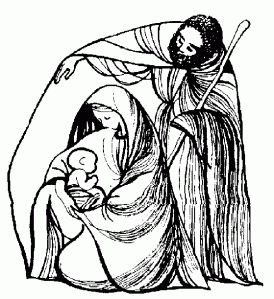
Reflection Upon the Holy Family

Although I offered a reflection upon the Holy Family at the beginning of my book on prayer, I would like to return to this subject in this post. Reflecting upon the Holy Family, we are not only guided as to what a Christian family should be, but stand convicted in our lives over what it is not. While the modern concept of liberty is often moral license, theirs was responsibility and fidelity. We cater to individualism and a preoccupation with self that runs counter to the claims of familial bonds. The immediate family in the time of Christ was expanded to include aunts, uncles, cousins and others. (Indeed, the brethren of Christ were precisely these other relations.) Catholics realize, or at least should, that our relationship to God and to one another is in the context of family. We are not alone.

While these brief words can only offer a quick brush-stroke on the subject of “family,” a few thoughts might be beneficial. Something is wrong. No amount of beating around the bush or a pretense at greater enlightenment can take away this nagging perception in all segments of society. Determining what is wrong, and for that matter right, is where public debate becomes quickly frozen and polarized.

Politicians clamor about “family values” and then argue about what this means in a pluralistic society. Advocates of alternative lifestyles seek through the media and legislatures to socially engineer the family into something past generations would think unimaginable. It is in the midst of this confusion that we come to terms with that most central of human relationships. If it were not hard enough, even our traditional family units are plagued by communication that is absent or dysfunctional.

God sends his Son that repentant children might be added to his family and given eternal life. And yet, in our sinfulness, we can and often do offer a counter-witness to this truth. I know a couple whose girl ran away at seventeen. She eventually realized her foolishness and sought to return home. However, she discovered the locks changed. Her father had told her that if she went out the door she would not be welcome back. He gave away her clothes and personal things to charity. He would not allow his wife to display her picture. It was as if she had never been born. This couple, with their older daughter, were active in the parish and regularly at Sunday Mass. When their youngest returned to Mass, they refused to sit beside her. They even maligned her to neighbors. I overheard one of her father’s parish friends tell her, “You did it to yourself. You made your own mess, now you have to live with it! This is what tough love means!” Well, yes and no. Tough love means discouraging selfishness and nurturing self-reliance. This was not that at all; it was cruelty. The girl, as it turned out, was not only a foolish teenager, she suffered from bipolar disorder. When I first met her, she was just out of a mental institution and living with her boyfriend and his grandmother. It was either this or the streets. She had nowhere else to go. She had no job because employers did not want a “crazy” girl working for them. When informed of an upcoming family reunion, she decided to attend. Her mother dismissed her at the back door: “You will just embarrass us. I planned long and hard for this party and I will not have you ruin it. Go away.” When her boyfriend smacked her around, she again tried to go home. But they were gone to Europe. The wife confided that with the younger daughter gone, they had regained their freedom, and could finally live for themselves.

As a pastor of souls I have heard many variations of this story. The happy ending of the prodigal son parable is not always revisited in the lives of those who claim to be Christian, and yet, it is precisely the witness that our Lord gave us from the Cross. We read in Colossians, “Because you are God’s chosen ones, holy and beloved, clothe yourselves with heartfelt mercy, with kindness, humility, meekness, and patience . . . Forgive as the Lord has forgiven you” (Colossians 3:12-13). This is the challenge and the transformation for those who would truly be Christian. Neglectful parents today might have astonished the worst sinners and unbelievers of yesterday. Our Lord says, “What father among you, if his son asks for a fish, will instead of a fish give him a serpent; or if he asks for an egg, will give him a scorpion? If you then, who are evil, know how to give good gifts to your children, how much more will the heavenly Father give the Holy Spirit to those who ask him!” (Luke 11:11-13; see also Matthew 7:9-11). A rhetorical question is now a frighteningly real one.

Among those who call upon the saving name of Jesus are those who engage in unlawful sexual activity and infidelity, destroy children in the womb, and discard those labeled defective. Instead of a forgiving love, they harden their hearts against those who share their blood and their name. This is the way it is, not the way it should be, and definitely not the way true believers should want it to remain.

Sirach 3:2-6,12-14 points, not to the parents’ obligations, but to those of children, particularly regarding the 4th commandment stipulation of honoring (obeying) one’s father and mother. But increasingly preachers are forced to confront parents. How can a child honor parents if they are dishonorable? When Jesus demanded, “Call no man your father,” (Matthew 23:9), he precisely meant that true fathers, indeed parents of either gender, are only worthy of the title when their role is reflective of the loving and merciful fatherhood of God. Parents have responsibilities toward those whom they give life. Many churches have to offer remedial instructions for uncatechized but baptized Catholics. Their parents failed to take them to Sunday Mass, to teach them their prayers, and to transmit to them our holy faith. This implies that parents themselves do not believe; nevertheless, they are still culpable for the damage to their children’s immortal souls. Such neglect is a form of child abuse and ranks with murder in the hierarchy of sins.

In return, just as we read in Sirach, children have a lasting obligation toward their parents. When parents grow older and need the support of grown children, it is not merely a matter of charity but of duty. However, such a turn-of-events is increasingly considered an unwarranted burden. I know of cases where the children fight each other, no one wanting to take the personal and immediate responsibility for an elderly parent. The children, in some cases, have learned from the example of their parents all too well. I also know good parents who did little or nothing wrong in raising their children; and yet their brood contains both the holy and the wicked.

Familial roles are not limited to a few years but have lasting consequences and obligations. Mary followed her Son and quietly emerges at various stages of the Gospel and in the public life of Jesus. She was his mother at the Annunciation, at the Nativity, indeed, all the way to the Cross. Love brings with it responsibility and often much worry. Jesus was disowned by many of those who knew him; Mary’s testimony of love and loyalty is one that needs to be ours. She always claimed him. Jesus claims her and gives her to us, his new family, on Calvary. As for good St. Joseph, tradition has it that he died in the loving arms of Jesus and Mary. Perhaps this was God’s greatest gift to this noble man? After all, as our Gospel relates, when an angel told him that Herod was seeking Jesus “to destroy him,” Joseph sought refuge for them in Egypt until it was safe to return. The aged guardian of Mary and Jesus might have found it impossible to remain passive when his adult Son underwent his betrayal and passion. When his earthly role was finished, the foster father to Christ was taken from this world to await his Son and Savior in the abode of the righteous dead.

We need to put on the mind of Christ regarding family life. Can we conceive of God being well pleased with parents who killed their children through abortion? Along with contraception that breeds distrust between spouses, the abortion holocaust has attacked the very nucleus of family life. Pregnancy, once called the “blessed state” is now considered a disease to be medicated away. There is no reconciling such a mentality with that in Psalm 128:1-5 where the psalmist praises the wife as “a fruitful vine.” The child, instead of being prized as a precious gift from God, is considered a tragic accident, a problem to be disposed of as quickly as possible. Freedom, or rather license, as well as economic and upward mobility, is all hindered by the presence of a child. We are forced to think of another’s needs and wants before our own. Some just do not want to do this. Sex is recreation, nothing more. Such a mentality is inherently opposed to the Gospel. When such is the point of view of believers in Jesus, one has to wonder if even their concept of God is counterfeit?

Can we suppose that God cares little about marriage vows made in his name “to death do us part?” No, and yet divorce is at an epidemic high. Alternative living arrangements, including polygamy and homosexual liaisons would dismiss it entirely. Some critics argue that the dilemma is not the loss of the traditional family but rather because we are trying to force old codes of behavior (like the commandments) and expectations upon new forms of familial relationships. This post-Christian group insists that transitory unions are ideal and most reflective of modern experience. Some actually say that people live too long for lasting relationships. Prenuptial agreements posit a theoretical doubt in the permanence of a marriage bond, already. Certain states are considering marriages with easy escape clauses and some have even suggested built-in term limits. Logically, if spouses can separate at will, it would seem that offspring might have similar rights? Several years ago a child attempted to divorce his parents.

For more such reflections, contact me about getting my book, CHRISTIAN REFLECTIONS.

The Message of Life

Although the prophet Micah spoke about the future coming of the Messiah as a prince of peace, the remnant from Israel and Judah would come to largely anticipate a warrior savior (see Micah 5:1-4). They had been conquered and downtrodden. They had paid a heavy price for their infidelity but God had not utterly turned his face from them. Interestingly, they saw themselves punished for compromising their faith and trust in God while throughout the centuries they were mocked by the conquering peoples for their fidelity to the ancient faith and the God of Abraham.

“He himself will be peace” (Micah 5:4). It is true, but the peace of God in Jesus Christ is a gift with which we still struggle and misunderstand. Certainly, one dynamic of it is peace between peoples. But, this is not simply a lack of belligerence. The peace of the Good News is radical and all-embracive. We turn on our televisions and open our newspapers and there are almost daily reports of dead soldiers overseas. Everyone is on guard against terrorists and now it looks like North Korea has a nuke that can reach the West Coast. The new millennium is starting to look an awful lot like the old one. The problem remains the same; there can be no true and lasting peace until there is a change in our minds and hearts. Early Christians prided themselves on not resisting aggression. They turned the other cheek and they announced forgiveness to their murderers in imitation of Christ. They also suffered and died in droves. After about three centuries of facing the sword, fiery stake, cross, and wild beasts, believers took up armaments in the service of a would-be emperor, Constantine. Their bets proved fortuitous and Christianity would emerge as the privileged religion of the empire. However, as history shows us, such a victory would not guarantee perpetual peace and harmony.

What do we mean by “peace?” Despite the collapse of European Stalinism, the Asian communists understand it in two ways. First, it is a ploy used with enemies to insure time and resources in building up an arsenal to wage war. Second, it is the integration of each person as an instrument of the state and such an amalgamation is not complete until the whole world is part of the Marxist mechanism. While there is diversity in Islam, the business about the very word for their religion meaning “peace” is somewhat inexact. Before entering Afghanistan and Iraq, Western leaders almost fell over each other in explaining that our actions were against a few terrorists and dictators, not against Islam. There was no new crusade. Such clarifications were appropriate, even if they did over stress a point. Interviews with Islamic moderates in the U.S. do not reflect the positions of many fundamentalists worldwide. Islam is not all the same. Would we ask an average member of a Baptist congregation about Roman Catholicism? No. A cursory reading of the Koran makes it evident that peace is understood as the submission of all to Islam, if need be with force. Unless it is rejected or mitigated, such a mindset will never acknowledge religious freedom and always stand in opposition to the West. After all, how can one have true peace with the “Great Satan,” a widespread label for the United States? As for ourselves, how do we understand peace? Lack of aggression is certainly part of it, as in our desire for security; and justice is a theme we hear much about as well, but how far do we go to achieve the peace we crave? Pearl Harbor and 9-11 have fueled our mistrust of much of the world. Apart from the politics of late, there is the danger of creating a mentality that perverts a command of Christ, “Do unto others as you would have them do unto you” (see Luke 6:31 and Matthew 7:12). It becomes, rather, “Do unto others before they can do unto you.” This is not purely a global strategy, but how many people live their lives.

The Jewish understanding of SHALOM or peace is a salutation and benediction of friendship and cooperation. It is an invocation of divine blessing, for health, prosperity, and good standing with God. At Mass, Catholics extend the sign of peace to one another. We are one in the Lord. We are all brothers and sisters who should love and care about one another. Peace is the realization of divine love in our lives. At least these understandings are what should be present; however, enmity, a lust for revenge, and various forms of racism can get in the way. Here is the tragedy. Peace is not simply an enemy staying on his side of the fence. It is about the removal of walls and fences. It is about mutual good will and cooperation.

The peace among nations must also reflect a peace among fellow citizens, in the Church, in our neighborhoods, in our families, and in us as individuals. Should it surprise us that when the world is at war that our small part of it should also suffer unrest? Are there people with whom we refuse to associate? Are there family members who have not spoken for years? Did we get mad at someone and deliberately hurt them? Did someone do this to us? Do we pray for our enemies and try to forgive? Do we look for forgiveness from God so as to live in peace with him?

The martyrs of the Church knew the peace of God even when there was nothing left for them to do in defense of their lives. They knew that no matter what the world should strip away from them, they had an imperishable treasure in heaven. They knew that God loved them and that they were friends of Jesus. May we learn this lesson too and know the peace that the world cannot give.

Hebrews 10:5-10 stresses that had there been no Christmas there would have been no Good Friday and Easter. God, himself, took on our humanity that we might share in his divinity (see the prayer for mixing water into the wine at Mass). Jesus enters the human family so that he could offer up his life as an oblation for all the sins of the world. Jesus is the faithful servant who makes his flesh the sign of the new covenant with God. The New Law builds upon and replaces the Old.

It begins very simply. There is a message from an angel. Then there is the visitation. Mary greets Elizabeth and the unborn John the Baptist leaps in the womb (see Luke 1:39-45). Elizabeth is filled with the Holy Spirit and echoes the Hail Mary prayer, “blessed is the fruit of your womb.” Next she says, “Why should I be honored with a visit from the mother of my Lord?” Elizabeth’s words are very telling and they are affirmed as from the Spirit of God. John’s actions here parallel his activity thirty some years later in the Jordan River when he baptizes Christ. The unborn prophet cannot speak but he moves his mother to speak for him. She affirms that the unborn Christ is already her Lord. Jesus is Lord from the womb. Since he is the Prince of Peace, this gives credence to the late Mother Teresa’s contention that there can be no peace in the world while we are at war with the child in the womb. Every child is a reflection of the Christ-child.

There is a temptation for homilists or preachers during Advent and Christmas to sidestep the pro-life message. Such Scripture readings as this make it hard to do so. Advent speaks against abortion as Christmas is a condemnation of infanticide and partial-birth abortion. Why are priests and deacons silent? Let me relate a personal experience from a few years ago. I mentioned the seasonal pro-life themes at a Christmas Mass. A couple of people stood up during the homily and remained standing throughout the liturgy. Several days later the bishop called in response to a letter. A woman wrote, “My daughter only comes to Mass a couple times a year and this priest ruined it for us! He had no business talking about abortion or saying how anyone guilty of it should go to Confession before receiving communion. My daughter cried all night. She swears that she will never go to Mass again and I will find another church! By the way, this will cost you all our very generous donations!” I think the money element is why I got in trouble. But my conscience was bothered because the purpose of every homily is to promote continued conversion and not the alienation of God’s people. I think I was right, and there was no particular condemnation of anyone, just a proclamation of the Gospel of Life; but, while my head understood, my heart has never stopped grieving for the strayed lost lamb. No names were given and I could not follow up the message, except in prayer.

For more such reflections, contact me about getting my book, CHRISTIAN REFLECTIONS.