Recently I entered into a heated discussion with Dennis on an assortment of topics. He is very negative to the Catholic faith. PLEASE NOTE that it is an apologetical dialogue that might make some readers uncomfortable.
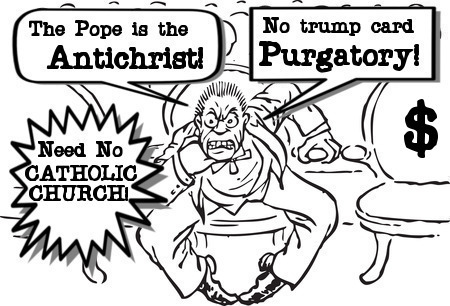
DENNIS:
Purgatory is a myth. Peter was Jewish so how could he be the first pope? I am no longer going to the catholic church because it is all symbolism over substance. It will be a pope (HOLY FATHER, WHAT A JOKE!) who will be the antichrist or at least be very supportive. I joined the catholic church before getting married 29 years ago and I told my wife (who is catholic) that many things the church did were wrong. After many years she agrees and my daughter has taken religious courses that prove the evils that exist.
FATHER JOE:
In the course of God’s progressive revelation to his people, the Jews had come to believe in both an afterlife and that atonement could be made for the dead. Jesus speaks about the afterlife drawing from the analogy of a debtor’s prison where none could be released until the last penny was paid. While the passion and death of Christ makes possible our redemption, he desires that we have both a saving personal faith in him and a corporate faith as members of his new People of God, the Church. Purgation is a sign of God’s gracious mercy. We must be transformed by grace and made perfect for heaven. If we belong to God, then he will finish what is started in this world. The saints of purgatory are all destined for heaven. As they approach the fire of God’s love, that eternal flame burns away the last vestiges of sin and vice. Temporal punishment is appeased and we are made truly holy. Such is no more a myth than our abiding faith that our Lord has gone ahead of us and that he prepares a place in heaven for his children.
The first called by Jesus were the Hebrew people. Salvation comes from the Jews. The apostles were all Jewish and yet at the Last Supper our Lord instituted both the priesthood and the Eucharist. Just as there are Semitic Catholics today, Peter was both Jewish and visible head of Christ’s Church, the Catholic Church. The Jews became the first Catholics.
You probably never really understood your Catholic faith to really know what you were rejecting. Did you ever sit down with a priest and ask your questions? Did you take advantage of adult faith formation in your parish? The odds are that you did not. There is no conflict between sacred signs and a faith of real substance. The problem is that you may never have known where to look for that substance or the meat of faith.
The Pope or Holy Father has even written a personal reflection on the life of Christ, now in two volumes. He preaches and witnesses to our Lord. Be careful of blasphemy against the Holy Spirit. If God does protect Pope Benedict XVI and the faith and morals he teaches, then you slander not men but God. Only ignorant men filled with hatred would call the Pope by the demonic name of “antichrist.” Be careful that the joke is not on you.
You did not have to join the Catholic Church to get married in the Church. The fact that you entered a Church in which you placed no faith is tragic. It says nothing against the Church but volumes about your own lack of integrity and discretion. Why would you lie and say you believed when you did not? You should have shared your reservations then and withheld your prejudiced venom now.
I suspect that you undermined your wife’s weak faith and now delight that your child has also been stolen from the Church. Am I supposed to take these remarks seriously? I challenge you to bring your family to a strong parish-run Catholic instruction program. Bring your questions to the priest. You assume many things and there are plenty of misguided ministers ready to steer you away from Catholicism… not with a positive message of their own, but with a negative message against the Roman Catholic Church. They build themselves up by tearing others down. My Church preaches love, not hate.
DENNIS:
You tell me I assume many things. What about you? You assume I undermined my wife’s faith. You assume that her faith is weak when she has more faith than anyone. You assume that I am delighted that my daughter has been stolen from the church. WRONG! …AND BESIDES SHE IS HERE TO FOLLOW CHRIST not the church. I will never believe in purgatory no matter how persuasive your arguments. If Peter was pope, which I do not believe, then his successors should have been married like him. Perhaps then all this sick disgusting behavior would never have occurred? I will say no more, but I never personally attacked you like you have me. Some of your responses to others seem almost hateful. Trust me; I have done plenty of researching to draw the conclusions that I have. Stop thinking you are the only one with truths. Thanks for your time.
FATHER JOE:
Your assumptions about Catholicism are not coherently argued. You are working from a prejudiced view of the faith, not as one who is truly informed.
As for myself, mine is a faith seeking understanding. Catholics do not accept a blind faith that is at war with reason. We seek to know the truth from all the pertinent sources: the authority of the Church, the Sacred Scriptures, Sacred Tradition, philosophical and theological inquiry, dialoguing with other disciplines of learning, etc.
If your wife abandoned her religion in light of your postured conversion, it is only reasonable to assume that you undermined her Catholic faith. Indeed, you take delight that you have had a part in your family’s defection. I am sorry if you think I am rude but I find what you did to be reprehensible and dishonest.
Catholics regard our relationship with Jesus Christ to be intimately bound to our union with the Church. Our Lord makes himself and his saving activity present through the sacraments of the Church. Defection from the faith means a certain level of estrangement from our Lord, although as in your wife’s case, it might not be absolute. Only God is the ultimate judge as to whether such actions will cost people their salvation.
Peter was the first Pope, although the title was only used later. Being married or not married is beside the point. You would condemn celibate priests as well as chaste single people. Not everyone gets married. Some choose not to do so, like Catholic clergy, and others never meet the person with whom they want to settle down. Our Lord Jesus never married. The beloved apostle John never married. St. Paul never married. The Pope’s line of apostolic succession runs from both St. Peter and St. Paul, although the universal primacy passes down from St. Peter. You equate not being married with perversion and the child predator. You are a very sick and bigoted man. Why are you so angry? Why would you condemn the virginity of the Pope and so many priests? Yes, there have been a few criminals, but there are many of these among married men, too— even Protestant ministers.
I have not sought to be hateful, only truthful. Your allegations are in themselves of the most vulgar sort. It is hard to make proper responses to such bigoted allegations and ignorance. I suppose you would judge any response, as hateful. Part of the problem may be that you have neither the intellectual nor the spiritual tools to discuss such matters calmly and reasonably. That is one of the reasons why I suggested that you contact your local priest and maybe enter the continuing religious formation program. You should at least understand what you are rejecting.
Research has to go further than Chick comics and the ravings of anti-Catholic apologists who hate the Church. If you have nothing to fear, then go to the source… and speak and act with humility.
DENNIS:
I would love to talk to you personally and see if you would call me such things to my face. God have mercy on you for being so judgmental and hateful.
FATHER JOE:
You are upset with me? Listen, you come to “my” blog and assert the following:
- You bluntly stated that Purgatory is a myth.
- You illogically argued that Peter was Jewish and thus could not be Pope.
- You ridiculed the Catholic Church as placing symbolism over substance.
- You mocked the Pope, saying his title “HOLY Father” is a joke.
- You fall for the fundamentalist lie that the Pope is the antichrist.
- You joined the Catholic Church to marry your wife but never believed in what it taught (where is integrity?).
- You taught your wife and daughter that the Church was evil and so they defected with you.
- You will never believe in Purgatory no matter what sensible arguments I and others might make.
Either on the Internet or at my door I would tell you the same. I am not being mean to you, only truthful. Sorry if the truth hurts.
DENNIS:
It is not the truth that hurts. What hurts are the many lies the catholic church has told. I am glad I found out in time. Find out about things that go on inside the vatican: statue of Buddha placed on an alter; giving those of the wiccan faith a room to worship; the upside down cross that is satanic. I only want to leave a church. I am not leaving CHRIST. It is only HIS grace that can save us. The church was not built on peter but Christ. “The Rock the builders rejected became the cornerstone.”
Jesus told the criminal on the cross, “Amen I say to you, today you will be with me in Paradise.” Jesus did not say anything about purgatory. I asked a priest about this and basically he said he defied the odds. I only laughed at this.
Only Jesus is HOLY not the pope.
Praying with people who practice witchcraft, worship Buddha, making the Nazi sign with Hitler, kissing the Quran… are these not signs of antichrist?
I married my wife because of love. Since then we have learned that many things the church teaches are lies. Have you never believed something at one time and then found out it was not what you thought?
You state I taught my wife and daughter these things. My daughter learned many of these things at university here in Canada. We still believe STRONGLY in JESUS CHRIST.
My non-belief in purgatory has nothing to do with salvation. It is only by GOD’S GRACE that we are saved. Acceptance of CHRIST as your savior is the only way to eternal life.
The catholic church has collected plenty of money over the years for saying masses for “SOULS IN PURGATORY.” If there is no purgatory then this money will be a testimony against it at the time of judgment. Great pastors and preachers like BILLY GRAHAM, DAVID JEREMIAH, CHARLES STANLEY, I could name many more, (hardly a list of wackos), do not preach about or believe in purgatory.
So the truth does not hurt at all, it sets one free.
FATHER JOE:
Say what you like, you are still running away from the truth (about yourself). I am a Catholic priest, but while convinced of the Church’s claims, I have studied the writings of the Reformers directly and as objectively as possible. I disagree with many of the views of the Protestant churches, but I have never pretended to be a Protestant. I would also not want to build my Church up by tearing down the religious beliefs of others. Christians of various denominations can find points of concurrence and work together for a more loving and just society. Not all non-Catholics are anti-Catholics. But you would fit the profile of a bigot against the Catholic Church. You classify Church teachings as lies. You even gloat about your prejudice. And, like so many of your ilk, you get basic facts wrong.
Someone wrongly placed a small Buddha statue on an altar during the Assisi Ecumenical Conference (not Vatican) back in 1986. Cardinal Ratzinger (now Pope Benedict XVI) was furious about the mistake.
I have no idea what the Wiccan reference is about. Such paganism is in direct conflict with Catholic teaching and worship. Indeed, several years ago there was an incident where Wiccans insisted on using a military chapel for their services. The U.S. Government cannot play favorites regarding the faith practices of uniformed men and women. The military code of conduct required that the Wiccans keep their clothes on. Afterwards, the Catholic priest and several Protestant ministers offered prayers and ritual to spiritually exorcise or cleanse the room and altar-table.
The so-called upside down cross is not satanic. It is the ancient symbol for the first Pope, Peter. Tradition has it that he was crucified upon an inverted cross. He requested it, not feeling worthy to die like his Lord.
I cannot know your conscience, and only God can judge you, but in my estimation, defection from the Church is a departure from Christ.
Christ is indeed the cornerstone of the Church, but Peter remains KEPHAS or ROCK. He says he will build his Church upon him and after his resurrection, he heals him with the threefold admonition to his question, “Do you love me?” Jesus says: FEED MY LAMBS; TAKE CARE OF MY SHEEP; and FEED MY SHEEP.
As for purgatory and the good thief, you are being silly. Temporal punishment can be remitted by earthly penance and endurance of suffering. Given that he had faith in our Lord and was repentant, dying on a cross next to Jesus must assuredly count for something. Our Lord promises a place with him in paradise. As for ourselves, even if we must pass through purgation, we are also promised a place in his mansion of joy.
All holiness belongs properly to God. But God can extend his presence and make us saints. We can be transformed by the mysterious holiness of God. We can apply the word HOLY to the Pope and to all who have a share in the eternal life of Christ.
You fault the Church for an errant ecumenism which the universal Church and Pope Benedict would not condone. Each can worship as his conscience dictates, but we would not blend the Christian dispensation into a mix with those outside the Judeo-Christian tradition. There can be separate acts of prayer, communal dialogue and debate, a cooperative exploration of the truth and a partnership in making a better world. But Catholics do not practice witchcraft, worship Buddha or any of the Hindu deities. National Socialism, along with Communism, was condemned by the popes, even prior to World War II. You hate the late Pope for kissing a Koran as a sign of human respect to the one billion plus Moslems in the world, well, then so be it. But you are chasing ghosts because everyone knows that the Pope places his faith in Jesus and not in Islam or Mohammad. Indeed, when Pope Benedict XVI urged Moslems to disavow violence as a means to bring about conversion, millions chanted, “Kill the Pope!” It seems that you might have more in common with these fanatics than the Holy Father. If the Pope is truly the Vicar of Christ and you oppose and ridicule him, would this not make you an antichrist?
I am glad you married your wife because of love. I became a priest because of love. However, I always tried to act honestly and from conviction. My entire life is dedicated to God’s service, loving God by ministering to his people. While a teacher, I am also a perpetual student. We can disagree about various points, but I do not see lies when I examine Catholicism. As a matter of fact, I would not accuse Protestant churches of lies, either. There are many good Protestant churchmen who study and teach and work with honesty and professionalism. You would not extend such words of courtesy to the Pope or to a lowly priest and pastor like me.
I am glad you still believe strongly in Jesus Christ. That may be the one element we share. The doctrine of purgatory is a facet of soteriology. We must be made perfect. The elect want to be made perfect. Everything is grace. We are redeemed, given faith and perfected by grace. We cannot save ourselves. Prayers for the dead are literally our way of adding our breath to that divine fire which purifies us like the gold in the furnace. In the end there will only be two realities, heaven and hell. Jesus is the way and the truth and the life. There is no other way to the Father. This is basic Catholic teaching 101.
The stipends for Masses are gifts to the priest. At one time they were the only resources he had to live upon. But the priest will apply the fruits of his Mass even without remuneration for the effort. Ultimately, the sacraments are free. The priest is duty-bound to pray for his people, living and dead. It will be upon that, that he will be judged.
I can give you a long list of popes, bishops, priests, deacons and laity who accept and teach about purgatory. Looking at your list, did you know that Billy Graham has said that the Catholic Gospel is the same as his? Did you know that he contacts the local Catholic churches when he does revivals and sends Catholics who answer the altar call to Catholic churches? Did you know that he has shared his pulpit with Catholic clergy? Evidently he does not see the doctrine of purgatory as an impediment in witnessing the faith alongside Catholics. Do you really think that your venom would please him? I would not be surprised that you turn on him now, like so many other Fundamentalist bigots have chosen to do.
Sometimes the truth does hurt. You say it does not. But that is the problem, it is supposed to hurt. The freedom that we know demanded the great “hurt” of the cross. Our Lord invites us to take up our crosses and follow him.
DENNIS:
I can no longer see any point in discussing things with someone who continues to assume so much about me.
FATHER JOE:
I assume nothing; you come out and reveal what you are about to us all.
DENNIS:
As for BILLY GRAHAM, sharing the pulpit with catholics does not mean he believes in purgatory.
FATHER JOE:
But it does mean that he sees no problem with such a belief and views Catholicism as a saving Christian faith.
DENNIS:
By accepting JESUS as our savior he enters us and lives HIS life through us.
FATHER JOE:
Actually, by accepting Jesus, we enter into his life and are transformed. There is a two-fold movement. We accept the redemptive intervention of Christ. We believe in the infusion of divine grace. We believe that Jesus enters us through the gift of Holy Communion. Jesus became a man (coming to us) that we might have a share in his divine and eternal life (entering into the divine mystery). You do not believe in such a transformation or becoming a new creation in Christ. Those who reject purgatory tend to subscribe to the Lutheran view of juridical imputation. This has been labeled by one critic as salvation by disguise. We must enter into and make our own the mystery of Christ. Christianity is an incarnational religion. Christ lives in us. We must give birth to Christ’s presence, proclamation and activity through our lives.
DENNIS:
We are cleansed by the blood he shed for us.
FATHER JOE:
His blood makes possible the remission of sins.
DENNIS:
But basically you are saying that is not enough and that we need purgatory.
FATHER JOE:
No, you are saying that, Catholic teaching sees no conflict in the redemptive work of Jesus with purgatory. Our Lord makes possible our approach to God and our entry into heaven. We must still participate and accept his gift. Souls that belong to God but are not yet perfected, endure purgation as they approach heaven. Not all souls pass through purgatory.
DENNIS:
Purgatory therefore is a higher trump card than CHRIST.
FATHER JOE:
Purgatory is no trump card at all. Souls that pass through purgation are all headed toward heaven.
DENNIS:
As for the pope, he is the head of the catholic church, not all Christianity.
FATHER JOE:
The Catholic Church is the one, holy, catholic and apostolic Church. All true Christians are in some fashion, even if tenuously, attached to this Church. In that sense, Catholicism is the purest form and the true Christianity.
DENNIS:
As for calling me silly about the criminal, fine if you want to resort to name calling, but this is an issue I prayed about and this is where God directed me, but as you have little respect for me you probably won’t believe me.
FATHER JOE:
I did not call you a “criminal.” Using the word, I was referring to the few misbehaving priests. What you said (about the good thief) was silly. And please be honest, you never had any respect for me from the very beginning. How could you, since you regard the pope as the antichrist and me as one of his minions. What do I think about you personally? I do not think I actually shared much of anything about that, except for a deep disappointment. You pray, and that is good. Prayer is certainly positive, but remember the posture of humility and the need to feed your faith with truth.
DENNIS:
Also I will repeat, just because I don’t want to attend the catholic church anymore does not mean a defection from Christ.
FATHER JOE:
Only you can know this in your own conscience. As for me, any departure from the Church would constitute turning my back on Jesus.
DENNIS:
Also I will credit you with teaching what you believe, it is just that I do not believe some of the catholic teachings and have moved on.
FATHER JOE:
That is fine, but remember this is my blog, and I have a right to express my faith here. I also get the last word.
DENNIS:
You say yourself there are only two realities, heaven and hell. I guess with purgatory no one will see hell.
FATHER JOE:
Why would you say this? The existence of hell is also Catholic doctrine. Once again, here is a statement that proves to me that you really do not understand Catholic teaching. Traditional Catholic eschatology is very clear. Some souls go straight to heaven (forever). Some souls go straight to hell (forever). Some souls go to heaven but pass through purgation (so that they can be perfect in heaven). Souls in purgatory have been forgiven. Like those in heaven, they have been washed in the blood of the Lamb. All souls in purgatory will go to heaven. When the end comes and the final consummation, there will be two realities, heaven and hell. Purgatory will cease to exist.
DENNIS:
Again, thanks for your time. The many things that you have assumed about me certainly do not demonstrate love. To call someone a bigot is HORRIBLE. I would never refer to someone this way even if I thought that way about them.
FATHER JOE:
You cannot have it both ways. You insult the Pope as the antichrist and imply that Catholicism is involved with witchcraft and false religion. I am a priest; mock and malign the Pope and the Church and you impugn me as well. I call it as I see it. I speak the hard truth in love. Yes, Dennis you are an anti-Catholic bigot. You might love Jesus but you have amply shown that you hate his Church. I am spiritually married to that Church and have given up wife and family to serve God with a single-hearted love. You probably feel that I have wasted my life. You have no love and no desire for priests or the sacrifice of the Mass in your life. I became a priest to offer the Mass for the living and the dead. I became a priest, so that like St. Paul, who was an ambassador for Christ and a minister of reconciliation, that I might bring our Lord’s forgiveness of sins to the lives of God’s people. This is not my job. This is my identity and vocation. But I guess I am talking to the wind. You are too far gone to understand. As you said, you have moved on. I will pray for you. Maybe one day you will wake up, and even if you do not come home to the Church, maybe you will again see that good Catholics are your Christian brothers and sisters? Enough said!
Filed under: Catholic, Church, Eschatology, God, Jesus, Pope | 35 Comments »























 The Spirit of God descends upon Moses, and then as if contagious, upon the elders gathered in the tent, and even upon two who were not assembled with them (see Numbers 11:25-29). When some want to stop the two from prophesying, Moses cries that he would have them be a nation of prophets. This is precisely what Jesus seeks to make a reality. We are anointed in baptism as prophets of the Good News. The essential mission of the Church, in all her members, is to be a prophetic voice of Christ’s kingdom.
 We do not want to die. Okay, I know that some would object to this statement, but opposing sentiments are usually the exception. These exceptions are generally aberrations due to some form of suffering. We have all heard of suicide victims due to mental illness and depression, emotional trauma, excessive physical pain and handicap, and delusion (as in certain cults). In all these cases there is a running away from something (pain or anxiety) or a fleeing toward something (a higher plain of existence or some other such alternative). The latter comes close to the Christian hope, although with one essential difference, true faith defends the dignity and sacredness of all life, here and now.
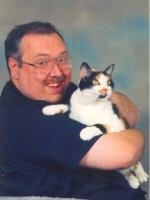 I suppose most Thomists would say that animals do not go to heaven, given that they do not possess immortal souls. This somewhat harsh response is often softened with the assertion that they are not entirely gone in that other animals (like dogs) share their substantial form. Others would say that an animal, like your favorite dog, continues to exist as an idea in the mind of God.
 Isaiah 66:10-14 gives us the image of Jerusalem as a loving and nurturing mother. Similarly, the Church would be viewed as the New Jerusalem, the first glimmerings of Christ’s kingdom breaking into our world. While we find security and comfort in the maternal analogy, verses 15 to 17 speak of the Lord coming in fire to judge all mankind. He shall wave a sword “and many shall be slain by the Lord” (verse 16). It was this messianic vision that many sought in Jesus but he surrendered his life on the Cross and told us to forgive one another. However, the Second Coming of Christ retains the full force of this passage. If we are members of Mother Zion, we can be saved; if we reject her, and here we really mean Mother Church, then we will be subject to fire and the sword. Here we find a serious imperative for the mission activity of the Church. Similarly, the great apostle tells us, “Peace and mercy on all who follow this rule of life (never boasting of anything but the Cross), and on the Israel of God” (Galatians 6:16). Luke 10:1-12,17-20 has Jesus sending out the seventy-two to proclaim the Good News. The urgency of the proclamation is illustrated by Christ’s instruction against a walking staff and traveling bag and against wearing sandals or greeting people along the way. He gives them something of his power but warns them not to be proud, just content that their names “are inscribed in heaven.”



















 Blogger Priest