






















 The message which emerges from our Gospel is sometimes quite unsettling. Take for instance Mark 7:1-8;14-15;21-23. Preachers might even be afraid to bring further attention to it because of the possible angry reactions it might evoke. None of us, myself included, like to be reminded of how imperfect, weak, and sinful we are. We create all kinds of barriers in our lives to protect ourselves from this realization. We try earnestly to project images of wholesomeness and sanctity, even when we realize that we have a long way to go.
We need to be careful not to become a people of pretense, but rather a people of true purity and holiness. This is not some goal reserved to those of past history or to those outside our materialism in poorer nations as in Eastern Europe or Latin America. We here in the capitol of one of the richest, most technological, and powerful nations in the world, we too need to place our trust completely in God, despite the distractions. Christ condemns the Pharisees by using the words of the prophet Isaiah against them, “This people pays me lip service, but their heart is far from me.” Our hearts need to belong to God. It is the only response from us that makes sense. After all, Christ in the Mass comes to live in our hearts by way of the sacrament of his very self, the Eucharist. How contradictory is this miraculous gift to the kind of sad things by which many people are enslaved.
The Lord gives us a long grocery list of the type of wicked designs which emerge from the core of the heart, things which would never allow room for Christ’s presence to reside there. In our prayer and in the sacraments, especially reconciliation, we need to root out these foreign loyalties so that there will be room for Christ to live in us. But to do this, we must also be sensitive to that which does not belong to God.
We need to be on the alert lest we deaden ourselves to the tragic infestation of sin. Throughout this great land, people of all ages flaunt a lifestyle of fornication that Christ noted as the first wicked design to condemn on his list. Perhaps this shows us how serious it is? Elsewhere in Scripture, it is said that no fornicator can have any part of the Kingdom of God. The Church could no more retract this teaching than it could reject Christ’s divinity or his resurrection. People, especially the young, give away their very persons before they even know what they are relinquishing. Our identity is a precious gift. Christ would have any who would share it in the most intimate way, to do so within the secure confines of a holy marriage — a life open to fidelity and receptive to new life.
Also on the list is adultery. If marriage is that special covenant by which the deep relationship of Christ is revealed in regard to his bride the Church, then this is a most serious transgression indeed. It is idolatry. Instead of loving Christ in your spouse, you have turned elsewhere. It undoes everything the Christian is about.
The other sins Christ mentions are also things which should send off warning lights in our lives.
Theft — how many ways, both petty and major, have we stolen during our lives? How often have we taken more than what was our due? How often have we even robbed others of their good name and dignity?
Murder — how many have never lifted a hand to prevent a young woman from destroying her unborn child? How many of us in our words and actions have killed the spirit of such women by not forgiving them afterwards? How many times have we killed others by taking away their hopes and dreams, making them a walking dead?
Greed and Envy — why must we always keep up with the Joneses and decide to insure our lifestyle even at the cost of having children? How often have we made material things into our goal instead of Christ and salvation?
Maliciousness — why is it that sometimes we look back on our behavior and try to justify our meanness?
Deceit — from the white lie and minor alteration to the black and complete dishonesty, how can we justify this as a people who follow a Savior called, “the Way, the Truth, and the Life?”
Sensuality — while not denying our sexuality, why is it so often used as bait for sinful pleasure instead of as an integral part of us? Why do we allow the passions such a free reign in our life, forgetting to mortify ourselves?
Blasphemy — how can it be that our faith and God can be insulted and so many of us fail to be agitated? Why is it that blasphemous movies can be made which distort the image of Christ as a wimpish fool and mock the priesthood and so few seem concerned?
Arrogance and Obtuse/Insensitive Spirit — why is it today that the Word of God and Tradition as interpreted by the teachers in the Church can all be ridiculed with impunity?
How is it that we can show disrespect to sacred images, articles, places, and persons? Why is it that so many of our brothers and sisters can make time for television, movies, dances, sports and other such things, and find no time for God or the Mass? Why is it that we can become callous and cold, even to the needs of others?
If these things convict us of sin, then we must be willing to recognize it and to ask for God’s pardon. He loves us all more than we will ever know. With the gift of his pardon, we will also receive his grace to avoid sin and to become more like that figure in the psalm “Who walks blamelessly and does justice; who thinks the truth in his heart and slanders not with his tongue. Who harms not his fellow man, nor takes up a reproach against his neighbor; . . .” (see Psalm 15:2-3; 3-4; 4-5).
I know a young girl who has just returned to college. To use an old term, she really is a “nice girl.” Some of her friends, especially a few boys she really likes have mocked her values and have alienated themselves from her because of what she believes. She went to church Sunday and they made fun of her. She is decent and they harass her. She called home to her folks and asked, “Mom, why are they doing this to me?” She asked this in tears because she had thought these people were her friends.
We need to pray for such young people who struggle courageously to maintain their faith and values. We know how deeply it can sometimes hurt. It would be good for us in word and example to continue our prophetic witness of Christ’s kingdom breaking into the world; and to pray for ourselves and such young people who need our love and encouragement.
For more such reflections, contact me about getting my book, CHRISTIAN REFLECTIONS.
Filed under: Adultery, Bible, Catholic, Confession, Discipleship, Faith, Forgiveness, God, Jesus, Morality, Redemption, Reflection, Repentance, Sacraments, Sexuality, Sin, Uncategorized | 2 Comments »
 Many parishes celebrate “Come Home for Christmas” and “Come Home for Easter” reconciliation services. Of course, Confession is available all year long. Priests delight in being ministers of reconciliation. The Christian regularly needs to examine his conscience and behavior.
 Just as Jeremiah images the blind and lame as among the throng returning from exile, Jesus pays particular attention to the crippled and blind. The Gospel scene in Mk 10:46-52 is very touching and telling. Bartimaeus is a blind beggar who has heard about the miraculous deeds of Jesus. Now that Jesus is nearby, he calls out to him. People literally scold him to keep quiet. He shouts all the louder. The crowd did not want to hear him. Maybe they were even ashamed of his presence? Nevertheless, while their ears and probably their hearts are closed to the beggar, Jesus hears his cry. Note what Bartimaeus says, “Son of David, have pity on me!” He is acknowledging that Jesus is a descendant of David and from his royal line is to come the Messiah and Savior of Israel. The beggar cries for mercy, but attached to his plea is a profession of faith in our Lord. When Jesus calls him over, the sentiment of the throng seems to change. There is a total about-face. “You have nothing whatever to fear from him! Get up! He is calling you!” There is a two-fold action. This remains an element of discipleship. We cry out for mercy and God hears our prayer. We seek God and he seeks us out. Note what Bartimaeus does. He throws aside his cloak, jumps up, and comes to Jesus. As a blind beggar he probably had little else besides his one cloak. No doubt he slept and sat upon it, lest it be blown away or stolen. Instead of grasping it tightly around him while walking to Jesus, he throws it aside. He no longer needs what is literally his security blanket. He will be able to find it afterwards because he believes that he shall soon see. He wastes no time and jumps up. Such should be our disposition when God calls us. When he reaches Jesus, our Lord does something a bit peculiar, no doubt for the crowd. He asks, “What do you want me to do for you?” We might ask, is it not obvious? The beggar responds, “I want to see.” What else might he ask? Was Jesus hoping for another answer? In any case, the gift of sight is given him. No more mention is made of the cloak. The beggar’s old life has been swept away. He sees, not only with physical eyes, but with eyes of faith. Jesus tells him, “Be on your way! Your faith has healed you.” Here is where we get a hint as to what Jesus wanted to hear from the beggar. His eyes open, Bartimaeus follows him up the road. He becomes one of the many followers or disciples of Jesus. Can you imagine what laughter would have resulted had he answered Jesus’ question, “I want to be your disciple.” Nevertheless, the result here is the same. Tradition suggests that many of those given restored sight and made able to walk would later be blinded and crippled again in the persecution of the Christian saints. Their little faith that brought healing would blossom into a great faith meriting a share in Christ’s eternal life.

 Isaiah 66:10-14 gives us the image of Jerusalem as a loving and nurturing mother. Similarly, the Church would be viewed as the New Jerusalem, the first glimmerings of Christ’s kingdom breaking into our world. While we find security and comfort in the maternal analogy, verses 15 to 17 speak of the Lord coming in fire to judge all mankind. He shall wave a sword “and many shall be slain by the Lord” (verse 16). It was this messianic vision that many sought in Jesus but he surrendered his life on the Cross and told us to forgive one another. However, the Second Coming of Christ retains the full force of this passage. If we are members of Mother Zion, we can be saved; if we reject her, and here we really mean Mother Church, then we will be subject to fire and the sword. Here we find a serious imperative for the mission activity of the Church. Similarly, the great apostle tells us, “Peace and mercy on all who follow this rule of life (never boasting of anything but the Cross), and on the Israel of God” (Galatians 6:16). Luke 10:1-12,17-20 has Jesus sending out the seventy-two to proclaim the Good News. The urgency of the proclamation is illustrated by Christ’s instruction against a walking staff and traveling bag and against wearing sandals or greeting people along the way. He gives them something of his power but warns them not to be proud, just content that their names “are inscribed in heaven.”
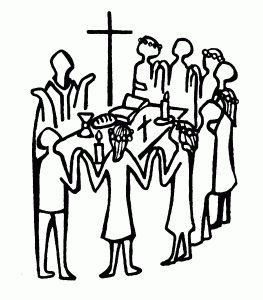 The message about the Church as a New Jerusalem and the analogy of a wedding banquet has serious doctrinal implications that are not always considered by believers in Jesus outside of Catholicism. While there is certainly an individual component to our ultimate salvation, the institution of the Church reminds us that there are vital corporate components as well. Jesus calls to himself disciples and appoints Apostles who will pass their authority down to the bishops who themselves will ordain priests and deacons. Jesus institutes a new covenant in his blood and commands it be repeated “in memory” of him, not in an empty nostalgic way but in a manner that makes present and available that which is recalled. He gives his message and divine mysteries, not to individuals, but to the Church, and appoints Peter and his successors as the visible head. It is the Church that assembles and declares inspired the Bible. Jesus sends his Spirit upon the Church at Pentecost to empower its leadership and to give efficacy to the sacraments. More wondrous than Isaiah could have ever imagined are the splendors given to the People of God.
 Acts 2:1-11 gives us the scene of that first Pentecost. There are some interesting elements. First, the day “found the brethren gathered in one place.” There is an unexpectancy to the movement of the Spirit who FINDS them and acts SUDDENLY. On what would be the birthday of the Church, the Spirit finds the brethren watchful and awake. The believers are gathered, no doubt for fellowship and prayer. Since Christ had already instituted the priesthood and Eucharist, they might have been celebrating the “breaking of the bread.” Second, we read that “Suddenly from up in the sky there came a noise like a strong driving wind . . . .” All hear it in the house. Behind the symbolism of the wind, the Holy Spirit literally breaks from the celestial house of heaven and reverberates in the house of the Church. Third, the Holy Spirit is imaged as “tongues of fire” over the assembled. Fire gives off light. The Holy Spirit would illumine their minds and make them sharers in the Light of the World, Jesus Christ. Fire warms the flesh, and again like Jesus, the Church would bring the healing and forgiveness of the Lord to a cold world. Fire also burns and so does the Holy Spirit in that it destroys the old way of sin and builds new with the firm foundation of Christ Jesus. Fourth, the assembled speak in many tongues, a recognition that the Gospel proclamation is meant for all peoples and nations.
 The story of Jesus appearing to two men on the road to Emmaus is one of the most famous of our resurrection accounts (see Luke 24:13-35). The last phrase, “. . . they had come to know him in the breaking of the bread,” speaks to us about how we encounter the risen Lord in our Eucharist. The Eucharist is Christ’s living legacy to us. No matter what age it might be, he does not abandon us. After his ascension, the Lord continues to abide in his early disciples as well. He sends them his Spirit and works his ministry through them.




















 Blogger Priest