 QUESTION:
You claim that Peter was the first Pope, and yet Scripture attests that he was married. Since this great apostle could be married, why not all bishops and priests?
RESPONSE:
Restricting ourselves to the Gospels, no doubt you are referring to Peter’s mother-in-law. We read in Luke 4:38-39: “After he left the synagogue, he entered the house of Simon. Simon’s mother-in-law was afflicted with a severe fever, and they interceded with him about her. He stood over her, rebuked the fever, and it left her. She got up immediately and waited on them.” See the story again in Mark 1:30.
The Catholic Church does not deny that Peter was married. However, note her general absence in the New Testament texts. We do not even know her name. We only encounter the mother-in-law, never his wife or any children. Indeed, throughout the Gospels and the Acts of the Apostles, references are made to Peter’s activities and travels; but, only a vague intimation by Paul in 1 Cor. 9:5 that he had a right to travel with his “believing wife.” If it were not for this mention in the epistle, one might suppose that Peter was a widower. Tradition suggests that his wife was martyred. It is peculiar that although the wife would ordinarily have cared for the needs of guests, Peter had to rely upon his wife’s mother.
However, granting that she was still around (somewhere); she evidently assumed a secondary role in his life behind his leadership of the infant Church. Indeed, her insignificance in the biblical witness would seem to provide weight to the supporters of priestly celibacy. Like Peter, bishops and priests might do better to serve God’s people without the distraction of wives and children. Jesus gives his sheep to Peter. Pastors similarly love Christ and care for their flocks. This is the emphasis of Catholic ministry, our family in faith.
This post was never meant to be a defamation against Peter’s wife. I have also edited it to avoid any peripheral discussion about whether or not the tradition can be trusted regarding her martyrdom; given that some authorities speculated that she might have died earlier and/or that there might have been a second bond. It is probably best that we accept the tradition at face value.
Here are early testimonies for the martyrdom of Peter’s wife:
CLEMENT OF ALEXANDRIA (died around 215 AD)
(THE STROMATA, 7:11)
So then he undergoes toils, and trials, and afflictions, not as those among the philosophers who are endowed with manliness, in the hope of present troubles ceasing, and of sharing again in what is pleasant; but knowledge has inspired him with the firmest persuasion of receiving the hopes of the future.
Wherefore he contemns not alone the pains of this world, but all its pleasures.
They say, accordingly, that the blessed Peter, on seeing his wife led to death, rejoiced on account of her call and conveyance home, and called very encouragingly and comfortingly, addressing her by name, Remember the Lord. Such was the marriage of the blessed and their perfect disposition towards those dearest to them.
Thus also the apostle says, that he who marries should be as though he married not, and deem his marriage free of inordinate affection, and inseparable from love to the Lord; to which the true husband exhorted his wife to cling on her departure out of this life to the Lord.
Was not then faith in the hope after death conspicuous in the case of those who gave thanks to God even in the very extremities of their punishments? For firm, in my opinion, was the faith they possessed, which was followed by works of faith.
EUSEBIUS (around 265 AD to 340 AD)
(ECCLESIAL HISTORY, 3:30)
1. Clement, indeed, whose words we have just quoted, after the above-mentioned facts gives a statement, on account of those who rejected marriage, of the apostles that had wives. Or will they, says he, reject even the apostles? For Peter and Philip begot children; and Philip also gave his daughters in marriage. And Paul does not hesitate, in one of his epistles, to greet his wife, whom he did not take about with him, that he might not be inconvenienced in his ministry.
2. And since we have mentioned this subject it is not improper to subjoin another account which is given by the same author and which is worth reading. In the seventh book of his Stromata he writes as follows: They say, accordingly, that when the blessed Peter saw his own wife led out to die, he rejoiced because of her summons and her return home, and called to her very encouragingly and comfortingly, addressing her by name, and saying, ‘Remember the Lord.’ Such was the marriage of the blessed, and their perfect disposition toward those dearest to them. This account being in keeping with the subject in hand, I have related here in its proper place.
DISCUSSION
GERRY:
Thanks for all your insights, Fr. Joe. They are priceless! I’d like to let you know that I look forward to reading the “feeds” from your blog site. God Bless!
KARL:
Who would sit in judgment for all the annulments? Certainly the Pope does not have the time and men who cannot keep their houses in order (like those divorced and seeking annulments) certainly should not sit in judgment of each other and their wives.
What would happen to a bishop who abandoned his wife? Should he continue to serve as a bishop? Who would pay for the divorce, alimony and child support settlements? Who would get the Cathedral, the wife?
Anyone who thinks it is wise to have a married clergy is likely naive, foolish or has difficulty keeping their mind off their private parts. Oops, or Orthodox or one of the Uniate Rites.
ALEXANDER ROMAN: As a Ukrainian Catholic, I wanted to take great exception to a comment on that refers to Eastern Catholics as “uniates.” That term is pejorative and offensive – that it is used by a Latin Rite Catholic is not helpful.
FATHER JOE:
Churches of the East do not permit dating priests. They have to be married before ordination. Only single men become bishops. There is a different sense of priesthood between those who are celibate and the ones who are married. The first married Episcopalian priest in the U.S. who became a Catholic priest is now divorced. His wife left him, saying that nothing in the Episcopal church prepared them for what his life would be like. She gave him an ultimatum, leave the Catholic priesthood or she would leave him. He is now a divorced and celibate priest.
CATHOLIC GIRL:
Catholics and Protestants arguing for a married Priesthood (or worse those who propose that Mary was not a perpetual Virgin) miss the point with their literal interpretations.
Catholics are not literalists (although most Protestants are). We hold the Bible as no more or less important as Church tradition and teaching. Remember who put the Bible together – the Catholic Church. Who better to understand and interpret the meaning?
The important part of the message about St. Peter is that he – Peter – represents the Church. Christ was returning to the Father and so he gave Peter a duty as the first Pope and left us with the Church as the visible symbol of his love. He specifically said that he would be with the Church until the end of time and gave it the “keys to heaven,” what they bind on Earth is bound in Heaven.
He knew Peter was not perfect – after all, he denied he knew Christ three times. He did expect and continues to expect that we follow him and that means that unmarried persons should remain celibate – as he did.
Only the Catholic Church has the keys to the kingdom. Pope Benedict says that the tradition will not be changed. The Church isn’t a democracy and those that don’t agree are simply not Catholic. So he’s the boss and that discussion is closed!
MARK:
The Church has never taught the two sacraments are incompatible; neither did Our Lord. That the Church has chosen to promote celibacy in the model of Christ should be sufficient for the discussion.
“In essentials, unity. In non-essentials, liberty. In all things, charity.”—St Augustine
FATHER JOE:
It is probable that his wife later suffered martyrdom but her absence from the Scripture texts is still a significant fact. Except for the fact that Peter had the right to bring her along, there is little or nothing that can be cited to show that his wife actually did participate in his most important missionary journeys.
You are right that the sacrament of marriage and that of holy orders are not intrinsically incompatible with each other; although, there is early evidence of tension. Many of the Popes and saints over the centuries have written about celibacy in the priesthood and religious life as if it were the best course to pursue. Could it be said that just as there was an organic development of doctrine, that celibacy for priests reflects a positive evolution in discipline as well, also under the guidance of the Holy Spirit? I think so. Indeed, there is growing evidence that priests who were married during the apostolic and patristic age were expected to practice perpetual continence after ordination.
ANGELA:
I personally believe that leaders of the church should be able to get married if they want; but I think it is great when they are capable of remaining celibate. I guess I feel if God has called you to become a priest, then he has also called you to become celibate since that is in accordance to what priesthood is.
I no longer attend a Catholic church, although I grew up in one. I have met some great priests and some not so great. I have also met some great married pastors and some not so great. It does talk about how it is better for a man to remain celibate unless you are incapable. I believe if a man can do this successfully he will be greatly rewarded.
Unfortunately, if a man is choosing to go into the priesthood and have lust issues, they may want to consider what going into the priesthood really means. He should either first address such issues or consider the possibility that maybe God wants him to be a leader of men in a different way that allows marriage. He should not necessarily change denominations if he feels his faith corresponds more greatly with Catholic belief systems; but there are so many ways to be a shepherd among men and yet be married.
That being said, I still admire the man and woman who can devote their hearts, minds, and souls solely to God and remain pure in heart, mind, body and soul.
JAKE:
Peter was a [expletive deleted] and his wife was well to be rid of him. Peter is well said to be the founder of the ‘mother of [expletive deleted] church’. Women were nothing more than cattle in the [expletive deleted] bible and the men, including jayzus were perverted [expletive deleted] [expletive deleted]. The catholic church is indeed the true church of jayzus. If priests aren’t [expletive deleted] each other, they are [expletive deleted] innocent children and being paid by stupid people to do so.
FATHER JOE:
I must report your IP number (Atlanta) to the authorities for misuse of this forum. Sorry, but you forced my hand.
JAKE:
Peter=child molester
jayzus=[deleted pejorative word for homosexuals]
catholic church=mother of [plural expletive deleted]
FATHER JOE:
Jake=Bigot
LUCIA:
It is an interesting topic and one I am not sure I yet fully understand. It is my understanding that the vows of celibacy from the priesthood all the way to the pontiff are a matter of the disciplines of the Church. Its necessity is established by the Authority of the Church based on the inspired judgments of the Church.
Thus it is possible that the Church can change its mind on this point for its own reasons, or make exceptions to the rule. For example I know that in cases of Eastern Catholics, those from the predominantly Orthodox regions which are now in full communion with Rome, there are exceptions allowing married priests. None of this creates a problem.
So to my thinking, if as Clement of Alexandria and Eusebius relate, Peter was in fact married as an apostle/bishop it doesn’t matter. If the Church then later decided that it would require celibacy of priests and all the clergy in the higher ranks as well then that is the rule. The rule established by the authority of the Church. If Peter was not married as a bishop likewise it remains a discipline the Church has established and maintained for good reason. And one which, in limited cases to which it makes exception.
Do I understand correctly? Thanks.
FATHER JOE:
Sounds like you do. Priests promise celibacy when they are ordained transitional deacons.
MD:
Lucia has the simplest answer but the most profound.
CO:
First of all, the Bible refers to Peter’s mother-in-law. My assumption is that there is a wife and the Scriptures do not tell me different…meaning, he was married. My concern, however, is the belief that he was the first Pope. If you are basing it on the fact that Jesus said that on this Rock I will build my church, and he was speaking to Peter, Christ is the Rock, not Peter. Peter in the original Greek is petros, which in interpreted… “pebble.”
FATHER JOE:
Actually, in common usage the word PETROS could mean more than pebble. The reason why that word is used instead of the more common Greek word for ROCK is because Greek words have gender. Peter is given the male version of the word. In itself it is a transliteration of the Aramaic which makes no distinctions about ROCK. Peter is literally a chip off the old block, Jesus Christ, who is the foundation stone of the Catholic Church. Peter is Rock because Jesus is ROCK.
Filed under: Anti-Catholicism, Apologetics, Bishops, Catholic, Celibacy, Faith, Marriage, Priests, Religion, Sexuality, Uncategorized | 11 Comments »









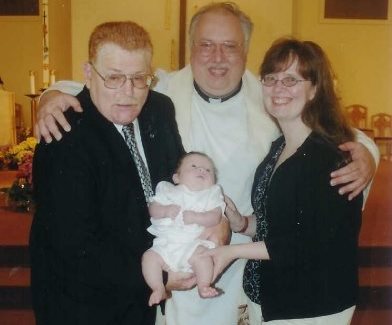
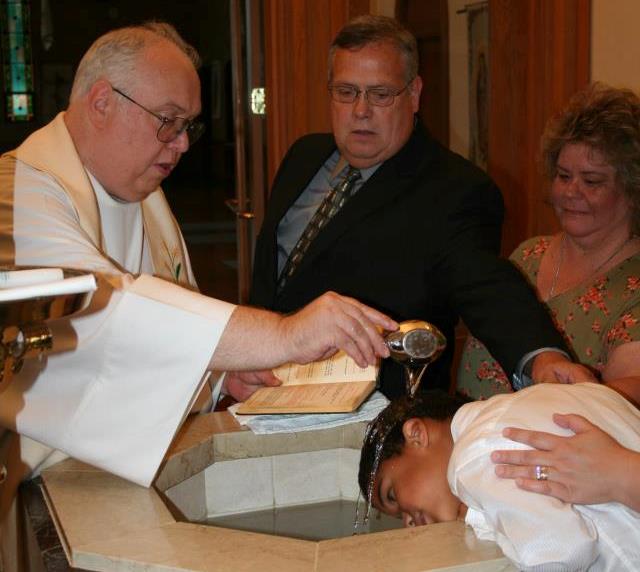





 Another important Catholic sacramental is oil. Either in the back or in an upper corner of the church sanctuary there is a small cabinet (modern ones often have glass doors or windows, but they can also be solid wood or metal) called an ambry. This cabinet contains the holy oils used in the administration of the sacraments. These oils are blessed during Holy Week by the archbishop (or bishop) and distributed to parish priests to be kept in a special place until needed for the sacraments. The oils are used in Baptism, Confirmation, Holy Orders and the Anointing of the Sick. The first three are one-time sacraments; the fourth can be administered repeatedly as long as the infirmed person is alive. One is called the Oil of Catechumens or the Oil of Baptism. Small infants and converts receive this oil before being washed in the waters of Baptism. As of old, athletes would receive oil on their bodies to keep opponents from securing a grip on them in a contest. Our struggle as Christians is not merely against enemies of flesh-and-blood, but Satan. This anointing with the Oil of Catechumens is to prevent Satan from getting a grip on us. The Oil of Chrism in its spelling looks like the Oil of Christ. It is used in Baptism after the pouring of the water and it expresses that we are bonded to Christ and must act like Christians. It also reminds us that we are by our Baptism made members of God’s family and we should act accordingly. Children are anointed as priest, prophet and king. Following Baptism or Reception, adults are usually Confirmed with the Chrism and given a more full share of the Holy Spirit. Chrism is also used in ordinations. The Oil of the Sick or Infirmed is used in grave illness or accident to bring healing and to join our crosses to that of Christ. We are reminded that we do not suffer alone. Rather, we make up in ourselves that suffering wanting in Christ’s suffering. It is not that he did not suffer enough; rather, we suffer some things that Christ did not suffer and join those pains to the sufferings of Christ. The ambry containing these oils may be near the baptismal font although it is traditionally close to the altar where the re-presentation of the death and resurrection of Christ takes place at Mass.












 Blogger Priest