• Our Blogger

    Fr. Joseph Jenkins

  • The blog header depicts an important and yet mis-understood New Testament scene, Jesus flogging the money-changers out of the temple. I selected it because the faith that gives us consolation can also make us very uncomfortable. Both Divine Mercy and Divine Justice meet in Jesus. Priests are ministers of reconciliation, but never at the cost of truth. In or out of season, we must be courageous in preaching and living out the Gospel of Life. The title of my blog is a play on words, not Flogger Priest but Blogger Priest.

  • Archives

  • Categories

  • Recent Posts

  • Recent Comments

    Anonymous's avatarAnonymous on Ask a Priest
    Michael J's avatarMichael J on Ask a Priest
    Jeremy Kok's avatarJeremy Kok on Ask a Priest
    Mike Zias's avatarMike Zias on Ask a Priest
    Jeremy Kok's avatarJeremy Kok on Ask a Priest

Satan Club at Anne Arundel Community College

Anne Arundel Community College is literally in our backyard. Montgomery County is also considering adding a Satan Club to their approved campus organizations. Disguised behind a false rationalism and a host of liberal causes, it is a hate group and exists only to mock both faith and believers.

When people claim Satan but then argue that it is all a ploy, don’t believe it. They are fooling themselves. I have no doubt that the devil has his hand in this!

The Satanic Circle asserts that it does not believe in a literal Satan. Members claim a degree of enlightenment they do not possess. Dismissive of the many great scientists and thinkers who posited faith in a higher power, they grant to science a form of natural faith even though it asks different questions than philosophy and theology. Deductive science might tell us how a watch runs but not who made the watch. The theoretical sciences and mathematics deal with abstraction over the real. While many aggressive atheistic thinkers attack religion as espousing a “God of the Gaps,” they are blind to their own gaps in understanding both the macro- and micro universe. Many of the so-called rational satanists are those with weak minds who parrot the arguments of influential atheists in the scientific community. They are particularly influenced by those in the media. Kids in high school and rebellious youths in college are quick to distance themselves from the beliefs and values of parents and others. They image religious believers as ignorant fools while in fact they are the ones who have little knowledge of anything and know next to nothing about the ultimate questions. They live lives devoid of any appreciation of metaphysics and genuine intellectual reflection. Adherents rattle on against theistic faith even as they make a religion or cult of their atheism and proposed satanism.

Their reasoning signifies dislocated or illogical atheistic rationalism. They make many claims but do not know how to think for themselves.  Question them about the definition of a syllogism and they would only give a blank stare. Those with recourse to a dictionary or the internet might answer with words they do not understand. Unable to truly debate, they turn to so-called proof-statements from leaders in the movement.  But those answers fail to satisfy so they turn to mockery and ridicule.  These new militants who promulgate an evangelistic or missionary atheism, have fooled themselves. We must not allow the wool to be pulled over our own eyes.  This is a real concern at a time when many youths are only superficially Christian. They do not understand their faith as they should, and they cannot defend it.

The devil is powerful, and he strategically exploits doubts and denials about his existence. Those who caricature him as a joke do not know that the joke is on them. This new breed of satanist might welcome occult witches or Wiccans or even new age religionists to their gatherings for “fun,” but in debates they are also criticized as closet theists. They purloin their symbols and nomenclature as their own. They deny that the supernatural is real even as they come under a hidden spiritual oppression. Signs of such manipulation are realized in the dark fruits of their coalition. They go out of their way to mock Christian believers while demanding respect for themselves. They hate the Jews as the progenitors of the Judeo-Christian faith. Indeed, they would side with terrorists against the state of Israel. They are inherently Marxist, contending for “mischief” or revolution to overthrow genuine faith and the Mosaic commandments.  They create a false dichotomy between reason and faith, elevating a science that does not have all the answers, especially about the ultimate meaning for humanity.

They are political activists. Instead of arguing for Christian stewardship over creation, they raise up nature and ecology as in rivalry or war with humanity. They would save whales but exterminate unwanted human babies. The new Gnostics, while they claim an allegiance to science and nature, wholeheartedly endorse same-sex disorientation and gender dysphoria. They not only support the LGBTQ+ agenda, but they also embrace a no holds barred sexual expression between consenting adults. Despite the clear mention of the Almighty in our founding documents as a nation, their interpretation of separation of church and state would go far beyond the intent of our founding fathers. Instead of a mere prohibition of a national denomination or confession, they propose the disavowal of any belief in God and the accompanying religious values. Under the heading of “bodily autonomy,” they would deny the right to life of the unborn. Against the Gospel of Life, they are activists for abortion on demand “whenever women want it.” This false secular humanism allows hidden demons to savor their favorite food, the sacrifice of children to the lust and selfishness of their sycophants.

The satanists are of two types, exhibitionists on one side and cowards on the other.  The first group believes in shock value.  They are often heavily tattooed and have disturbing body piercings.  They wear clothes that immediately offend with crude or derogatory messages. The second group are outright cowards.  They love to wear masks and hoods to disguise their identities.  Both feel that they can use Satan as a weapon and not get hurt, themselves. But they are slaves of the devil even if they are unaware. They are wounded by sin and sentinels for hell.

If Jesus were Tempted, Could He Sin?

The question invariably arises, “If Jesus could be tempted then could he sin?”

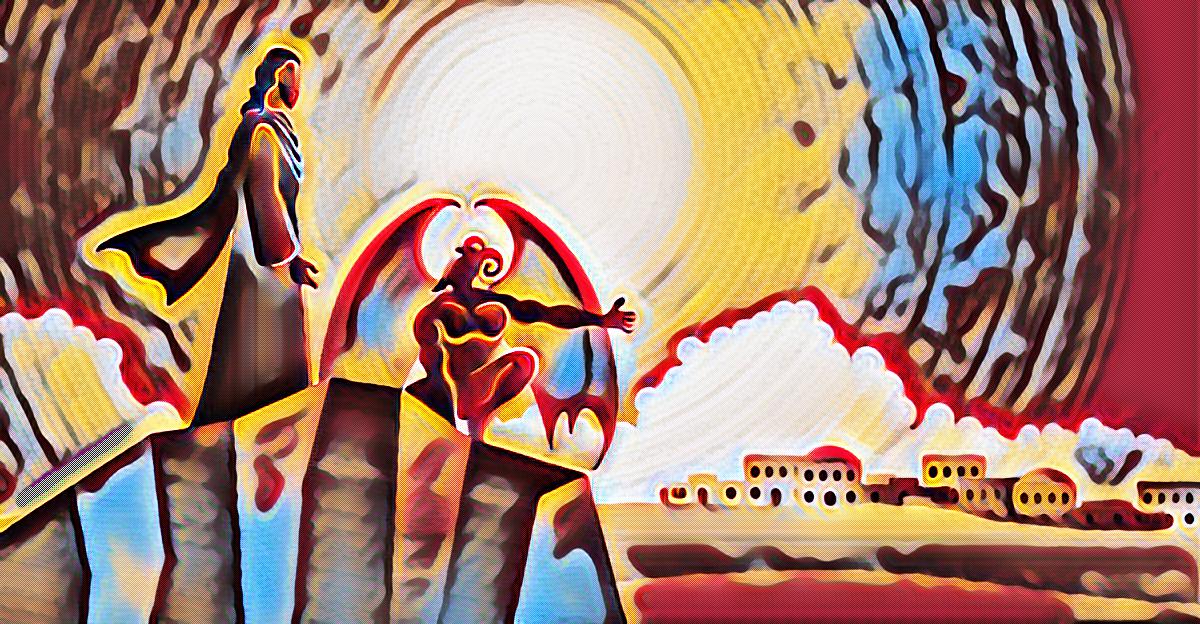
Filled with the holy Spirit, Jesus returned from the Jordan and was led by the Spirit into the desert for forty days, to be tempted by the devil. He ate nothing during those days, and when they were over he was hungry. The devil said to him, “If you are the Son of God, command this stone to become bread.” Jesus answered him, “It is written, ‘One does not live by bread alone.’” Then he took him up and showed him all the kingdoms of the world in a single instant. The devil said to him, “I shall give to you all this power and their glory; for it has been handed over to me, and I may give it to whomever I wish. All this will be yours, if you worship me.” Jesus said to him in reply, “It is written: ‘You shall worship the Lord, your God, and him alone shall you serve.’” Then he led him to Jerusalem, made him stand on the parapet of the temple, and said to him, “If you are the Son of God, throw yourself down from here, for it is written: ‘He will command his angels concerning you, to guard you,’ and: ‘With their hands they will support you, lest you dash your foot against a stone.’” Jesus said to him in reply, “It also says, ‘You shall not put the Lord, your God, to the test.’” When the devil had finished every temptation, he departed from him for a time. (Luke 4:1-13)

There are some critics so desperate to humanize Christ that they will deny the definition of Chalcedon about Jesus as a divine Person with both a human and divine nature. They contend that in his humanity our Lord could sin.  Nuts! Let’s be blunt— if Jesus could sin then he is not God. If Jesus is not God, then he cannot save us, and we are still in our sins.

At work here is nonsensical reasoning. It is like the false logic behind the old question, “Given that God is all powerful, can he make a rock too heavy for him to pick up?” There is an inner contradiction. If God can fashion such a rock, then he is not omnipotent in failing to lift it. If God cannot make this rock, then again, he cannot be all-powerful either.  But it is a silly and flawed syllogism. Similarly, critics will argue, “If Jesus were truly tempted by the devil, then he must be liable to falling into temptation and sinning. But they are wrong. While one might be tempted by hunger and thirst, power, or worldly acceptance and glory; we do not necessarily have to succumb to such allurements.  Indeed, for Jesus while the temptations are real, he is incapable of sin.  How is this? Sin is a violation against God. There is no way that God can wrong himself.  The humanity of Jesus can never be severed through sin from his divinity. Such would be a twisted version of the heresy of Nestorianism. There can be no fracturing of the holy Trinity. There is one deity, not two or three. God is perfect holiness. There is no defect in God that would permit a wrongful act. He is all good and there is no space in him for evil.  He is the LIGHT that cannot be dimmed by the darkness.   

Hebrews 4:15 leaves no room for doubt.  “For we do not have a high priest who is unable to sympathize with our weaknesses, but one who has similarly been tested in every way, yet without sin.” The moral test was real, but the test was fixed.  The new Adam was not liable to fall as was the old Adam.  

While not God, the angels of heaven can no longer sin either as they share the beatific vision. This is another reason why sin for Jesus is impossible.  We must accept that while our Lord entered the human family, he is not entirely like us. After the incarnation of the eternal Word, his hypostatic union ensures the unity of his two natures. Jesus has a complete human nature (body and soul) and a divine nature.  But he is not a human person but the divine Second Person of the Blessed Trinity. Our Lord’s human soul, including its mind and will, were sanctified by the divine presence and heavenly vision. The beatific vision means that he both saw the Father and also all those joined with him in his mystical body. That is why he conquers our sin on the Cross and does not falter as we often do. He lovingly sacrifices himself, intimately knowing by name all those for whom he surrenders his mortal life.    

Our Adversary the Devil

I recall from my days as a seminarian, working in the campus library to make money to pay for my books, there was one student at the tables about whom there were nervous whispers.  He stayed to himself and had piles of books at his workstation about devils and demonic possession. At one time such works were cordoned off in the Forbidden Books section. Maybe it was a good idea because this young man was obsessed about the subject. His proper studies suffered due to the long hours he spent researching this dark topic. I am not even sure he ever graduated. It took over his life.

That is the danger in discussing fallen angels and the devil.  There is a peculiar attraction about the matter. I suspect that is why it is so frequently the theme of fanciful books and movies.  It gives a terrifying thrill. As with an amusement ride, it feels dangerous but there is the presumption of safety— why? I suspect it is because many do not have any credible faith and so the subject is treated as fiction.  The devil is reduced to a caricature.  Many of the emerging satanist clubs are populated not by religious devil worshipers but by atheists who campaign against theism with parodies and mockery. But if the devil and hell are real, then they are in for the shock of their lives— and it will be no joke. 

The issue here is not purely psychological. As a Christian I believe that we battle not only evil men but invisible powers and principalities. The devil and his minions are real and while they are diminutive and weak compared to the power of Christ, they can still exert a dreadful influence upon souls. More than the comical devil on one shoulder and an angel on the other, Satan can corrupt a person through the openings made by malice and human weakness.  More prevalent than outright possession are the phenomena of obsession and oppression.  Indeed, they are arguably more insidious as they seduce the human will and lead victims into mortal sin. The devil can also numb the conscience to moral truths, as with matters of bigotry or threats to the sanctity of life. 

The Lord’s Prayer is evidence of how serious this matter is. The oration literally asserts “deliver us from the evil one.”  The serpent or devil that tempted Adam and Eve also tempted Christ in the desert. Of course, our new Adam prevailed.  Unfortunately, we often play the part of Judas. We are easily swayed by the world, the flesh and the devil. 

The name given to the devil is Lucifer which means “light bearer.” Compared to Jesus as the Light of the World, the devil is a false light. He initiates the angelic rebellion, and he is the chief of the demons that plot the damnation of souls. Given the mystery of Christ’s redemptive work on the Cross, the devil has lost the spiritual war. Nevertheless, Satan fights skirmishes over individual souls.  The fallen angels were created as good by God, but their fall recast them as demons.  Their decisive choice allows for no repentance or reconciliation.  They are cast into hell.  Indeed, one might say that they are hell or carry hell with them wherever they go.  Hell is more than fire. The greatest pain of perdition is the alienation from God and from saving grace. The devil was ranked among the highest angels, a Cherubim or maybe even a Seraphim.  We read in Isaiah 14:12: “How you have fallen from the heavens, O Morning Star, son of the dawn! How you have been cut down to the earth, you who conquered nations!”

Demons may cause grave spiritual harm, or if permitted by God, even hurt to the bodies of men and women. The story of Job cannot be written off as merely literary fiction. It speaks to both the wounded human condition and to our chief adversary that propelled humanity on this dreadful trajectory. Jesus performed several exorcisms and gave the ministers of his Church authority over unclean spirits. Today we often recite after Mass, the Prayer to St. Michael against the devil.  We are also urged to recite deliverance prayers and to avoid those things that can lead to demonic infestation such as vengeance, the occult and lewdness. Pornography is often employed by traditional devil worship. The devil delights in anything that impugns the dignity of God or our own persons. Demons exert various levels of bondage: obsession, oppression, and possession.  The greatest tool we have against demonic influence are the sacraments, particularly the Eucharist and the sacrament of penance.             

Demonic “oppression” is what it says, literally a pressing down or weighing upon a person.  Such an attack from the outside can target anyone, even the most fervent Christian. Often the situation we face is used against us— moral persecution, natural calamity, indebtedness and poverty, hunger, sickness, etc. We are tempted to despair or to do something rash. A person may be in a dark mood that evades shaking off. Another may experience an inexplicable fearfulness— uncomfortable around a person, place, or thing. Some even suffer physical ailments for which no one can find a natural cause.   

Demonic “obsession” is a form of subtle mind control wherein one becomes mentally drawn or addicted to evil.  There is an attraction to the things of sin and an aversion to elements of faith or holiness.  Just the mention of Jesus’ name can sometimes send such victims into a rage. I have often wondered if this might be a reason why vulgar songs, slasher films and other questionable media become so popular, especially with the youth. There is a level of deception in this, with sufferers thinking such preoccupations are neutral or not offensive.  Indeed, some will wrongly equate evil with the will of God. This trespasses into blasphemy against the Spirit of God.  Sexual sins are readily excused or even justified. Christians with traditional values or beliefs are mocked. Compromises are made about prayer and worship that do not serve the purpose of growing in holiness. Bible reading and prayer is neglected.  Anxiety replaces trusting the Lord. Instead of centering one’s life upon Christ, the obsession is about the devil and the many supernatural ways he interacts in people’s lives.  Even the rash of exorcism books by Christian authors might be dangerous to such people as they are overly enamored by the topic. The kids into goth styles and vampire fantasies might be another manifestation of obsession. The darkness saturates where there should be light.  New Age religion and occult practices often reflect the intervention of the demonic into people’s minds and hearts.       

Demonic “possession” is the most feared, although it can signify the least human volition or control of the three afflictions.  While something of the occult like a Ouija board, a séance or tarot cards might initiate a series of events leading to possession; once it begins, the person becomes like a puppet on a string.  Habitual sin, particularly deadly sin, can be a window to the demonic, as well.  Possession is only a hop and a skip away from allowing oneself to be a slave to sin.  The devil moves in and takes control of the will.  It is a dangerous situation.

A priest must be given episcopal approval to perform an exorcism. Often such efforts take place in hospitals because the demon will fight to remain and may hurt or even try to kill the possessed person. The exorcist must be in a state of grace, himself.  The devil will lie and try to frighten those who oppose its presence.  Sometimes the exorcist gets hurt.  There are various signs to be observed in the discerning of spirits.  The exorcist can ask questions but should avoid general conversation with the spiritual invader.  The devil will lie.  The demon will sometimes show a knowledge of languages, like Latin, Greek, Hebrew, and Aramaic. Often demons speak in a shrill sing-song voice, accenting the wrong words. This is often a give-away that the demon and not the human demoniac is talking. Just like artificial intelligence engines on the phone or internet, you can often tell that the speaker is not human. It does not sound right. The devil cannot tell the future, but he is a good guesser and can read into situations and fool his listeners. He can learn a great deal by watching. He cannot read one’s mind unless one invites him to do so.  There may be supernatural manifestations like objects apparently moving of their own accord.  Demons in possessions often seem bestial (a sign of their degradation). The exorcist can ask the name and number of the demons but always remembering that demons are deceptive.  No bargains can be made.  The Church’s prayers deliberately insult the devil. He is commanded to leave.  Once liberated, the possessed person should embrace faith, to help forestall the possibility of a relapse.  The devil loves a spiritual vacuum.  By contrast, if one is filled with the presence and grace of God, the demon will shy away from setting up a nest in that person.  The exorcist invokes the saving name of Jesus and the communion of the saints in administering an exorcism. 

Despite the naysayers, the devil is real and so is hell.  But the devil is a creature, a fallen angel.  The true power remains with God.  If we walk with Christ, the devil will fear both the Lord and us.