• Our Blogger

    Fr. Joseph Jenkins

  • The blog header depicts an important and yet mis-understood New Testament scene, Jesus flogging the money-changers out of the temple. I selected it because the faith that gives us consolation can also make us very uncomfortable. Both Divine Mercy and Divine Justice meet in Jesus. Priests are ministers of reconciliation, but never at the cost of truth. In or out of season, we must be courageous in preaching and living out the Gospel of Life. The title of my blog is a play on words, not Flogger Priest but Blogger Priest.

  • Archives

  • Categories

  • Recent Posts

  • Recent Comments

    Barbara King's avatarBarbara King on Ask a Priest
    Ben Kirk's avatarBen Kirk on Ask a Priest
    Jeremy Kok's avatarJeremy Kok on Ask a Priest
    Barbara's avatarBarbara on Ask a Priest
    forsamuraimarket's avatarforsamuraimarket on Ask a Priest

The Taint of Sin is a Taste of Hell

When we compromise with sin or fail to acknowledge its damaging gravity over us, we are not simply tempting fate but attempting to spurn the providence of God. We are literally daring God to save us despite ourselves. This makes us kindred spirits with Judas who likely thought that a forced confrontation would speed the messianic confrontation with the Romans and a corrupt Jewish leadership. Given his close association with Jesus, it is unlikely that he acted purely from greed. He despairs when he realizes that he has been an agent for Satan in getting his master tortured and murdered. Lacking supernatural faith, he finds himself alienated from the other apostles and stripped of hope. The throngs he expected to rise as an army of the righteous proclaiming their hosannas, shouted “crucify him” instead. If the devil could not claim Jesus, and even has Peter stolen from his grasp, then he will at least claim this one traitor as his own. Indeed, all who sin and fail to repent before death overtakes them, share in the stamp of traitor that is pressed upon their souls. While those who have never known baptism and faith might know hell because of ignorance; Judas was probably the first but not the last to betray our Lord as one who had belonged to his grouping of friends. Indeed, while there is arguably a most terrible circle of hell for renegade Christians, Judas stands as a warning to the Church that even bishops and priests can suffer damnation. 

Why would we play games and take chances? Too many are among the walking dead, perpetually working and playing in mortal sin. Failing to go to confession and to receive absolution, they have allowed the spirit of Satan to enter them. Indeed, akin to Judas at the Last Supper, they attend Mass and receive the Eucharist— blasphemies on top of blasphemies. Their priests like Christ could immediately steal them from Satan and return them to the good graces of God if only they would go to confession. But too many will not submit to God’s ministers of mercy or admit to one another or even to themselves, the terrible truth. They have broken their friendship with God. They already have one foot in hell. The longer this situation lasts, the more comfortable they become with sin. They can still be saved but it is increasingly unlikely. Indeed, many will no longer change their hellish trajectory even if they could.  

Proof of this is evidenced when trying to turn someone around. They get angry when anyone challenges their hypocrisy. “Leave me alone! Who are you to tell me about my business! I haven’t hurt anyone! You talk like I’ve killed someone! I know people a lot worse than me!”

Sexual Sins as the Path to Hell

Our Lord employs Hebraic hyperbole in Matthew 5:27-30. Jesus would not have us literally cut off a hand or pluck out an eye. But he wants to emphasize the gravity of sin. The subject is adultery or more to the point, sexual sin. He says, “It is better for you to lose one of your members than to have your whole body go into Gehenna.” I must admit that as a confessor I have weighed more heavily the sins of malice than those of human weakness. But we must be careful of common rationalizations. Many even make comedy about the easy availability of pornography, infidelity and hormonal boys who cannot control themselves. Christ warns us that a human weakness due to concupiscence can quickly become something deadly.  This warning goes against the current of a society that either excuses sexual sin or normalizes it.  Indeed, ours is an erotic age where much of the moral dissent against the Church has to do with human sexuality. Those in same-sex intimate relationships want their bonds publicly recognized. Those in irregular unions (divorced and remarried) want their adultery dismissed for the good of their children and to preserve fellowship with other churchgoers. This is not new but is a return to the Mosaic decree that was permitted because of the hardness of hearts. Jesus dismissed it as illegitimate and pronounced it as the sin of adultery.  It was not what God intended in Genesis.  Just as in the primordial garden, do we listen to God or to the serpent? Many today would share sexual congress without the benefit of marriage. They give away what belongs to a covenant of grace.  Sexual sins are mortal sins. If we die with such sins on the soul, then we go to hell. No amount of ministerial accompaniment will change this trajectory unless we preach the truth, counsel repentance, and finally urge amendment of life. The message of the Gospel is not that we accept others no matter what. No, the message is changeless, “Repent and believe!” 

God would not have us maim or castrate ourselves; rather, he would have us cut out sinful desires and behavior. Sin begins in the heart. We all need spiritual heart surgery. We need to learn how to properly love. Does an addict to pornography care one bit about the girls he sees in images and videos? He fails to appreciate that this is virtual prostitution and that he has reduced people to commodities or meat.  He has devalued them.  A man who takes a woman to his bed without marrying her, both corrupts himself and steals the precious gift of purity from the one he takes to himself. Neither of them will be able to give to a spouse the chaste gift of self. We are our bodies, and they will crave a nuptial unity that is missing. The promiscuous are robbers to the ones they will one day call “spouse.” The divorced and remarried, lacking an annulment, can only feign their union. They give to one what is pledged to another. They too are thieves, even when it seems benevolent. They stand as a contradiction to the Gospel. Jesus is the groom, and the Church is his bride. Every couple in the sacrament of marriage is called to witness something of this fidelity, until death do they part. The matter of same-sex unions is even more problematical. The Church is not opposed to brotherly and sisterly love; but human sexual expression is reserved to men and women in marriage. Anything else is a disorientation.  All these relationships might be defended as LOVE but in truth they signify a failure to love. True love would not risk one’s salvation and eternal life. True love would never chance damning the beloved.  Such sins are false love, literally loving each other into hell.       

Hell-Spirits are Known by Their Wrath

Rage and anger against a brother are judged by Christ as damnable (see Matthew 5:22). Such hardness of the heart focuses not on justice or mercy, but on revenge and is frequently accompanied by a curse. I suspect that those in hell are locked into that posture and cannot escape. They can never say they are sorry. There is no healing. Their own self-hatred is projected upon God and everyone else.  

Given that the sin of wrath or out-of-control anger is a damning sin, it must assuredly have a role to play in hell, no doubt polluting the atmosphere more than the smoke of any ordinary fire.  While it might be directed toward God, it is a type of anger that is always diffusive, violently assaulting everyone and anything around the enraged person.  The loss of control makes any type of meditative composure or resignation utterly impossible. The hearts of hell are forever restless or agitated. The irony is that the damned can never be whole or truly free. Their anger betrays a self-hatred that evades any semblance of supernatural love. The subject experiencing wrath always believes that he has been wronged and that his anger is justified. However, it allows for no levelheaded analysis. There can be no dialogue or reasoned accommodation. Note that stories of possessions often portray the demoniac as similarly explosive toward any efforts at exorcism. They act like cornered wild animals. Hell would constitute their ultimate cage. Unable to get their way, many souls might resemble wild beasts more than rational men and women. Wrath in hell is a demonic occupation, wrestling against a darkness that has nested in the human soul.  There can be no exorcism for those in hell so infested.  The soul strikes out and seeks to expel an invader and yet it no longer has any strength to do so. It is property. One cannot both hate or reject divine power and call upon it for help. Like an old battery left in a flashlight, the acid of wrath has eaten away at the insides. The light can never again be switched on.

Wrath eclipses the soul and casts hell in eternal twilight. This anger is literally hatred itself. It impacts upon the two properties of identity in the soul, intellect and will. The fire of wrath buries any possibility of good judgment and a humble heart.  While in this world, the fiery tentacles of wrath would reach out to draw all within its reach into the embrace of hell. It desires harm and the downfall of others, even the most innocent.  

While we are still pilgrims in this world, we should replace the raging lava of hate that threatens to consume hearts with the calming waters of Christ. The antidote to wrath in this world is the mystery of Christ’s Cross and the selfless love of Jesus in enduring his passion. If he could accept a death so outrageous, then why can we not embrace with docility the heavenly Father’s will in our lives? It is humility that can keep us from the grips of this sin. Oddly enough, Christ’s victory in the Cross is also the focus for the rage of Satan and his minions on the other side of the divide. The devil has allowed himself to be duped.

We often speak of contrition as the precondition for faith and saving grace. However, even more foundational is humility. The acceptance of God’s providence voids any claims at self-justification before the Lord. It makes possible clarity of judgment and resignation of spirit.  If we want mercy, then we must also be vehicles for forgiveness and healing.

Rage is irrational and out-of-control. It is associated with vengeance and murder.  It signifies an anti-gospel.  The good news of Christ is about the acquisition of the truth, the forgiveness of sins and eternal life. While the abode of hell is an expression of God’s justice; the horror stories about hell are due to its denizens, themselves. It is not the just punishment of God but the rage of sinners that leads to the excessive chastisement of the damned.

No Escape from Hell

Given the testimony in the Old Testament, and the devilish attack upon Job, it is no wonder that the devil targets Mary, Christ and the Church.  He attacks the family of our Lord. While it seems that he has utterly escaped hell to pursue his mischief, there are a few points we need to remember. First, Satan and his demonic horde are pure spirits and have no bodies.  One can only identify their presence by their activity. Second, any abode outside of heaven may constitute at least a fringe boundary of hell, if not hell proper.  Third, it might be possible for the demons to stretch the fabric of hell. Milton’s Satan as the great anti-hero cries out, “Me miserable! Which way shall I fly Infinite wrath and infinite despair? Which way I fly is hell; myself am hell.” I am reminded of the famous exorcism in Washington, purportedly in Georgetown but really in Cottage City. Completed in St. Louis months after a local failure, the demons identified themselves with scratches on the afflicted boy’s chest. The words read, “Hell Spirit.” The demons literally take hell with them, wherever they want to go. Fourth, the theme of freedom is likely engaged again. While there can be no reform or contrition on the part of fallen angels, their intrusion in human affairs sets the stage for us to prove our fidelity. Yes, some will abuse freedom and make bad choices. But liberty in this regard sets the groundwork for great saints and heroes of faith. There is an irony here, but some men and women would never step up unless they were severely tested.    

While there is concurrence among authorities that devils might not be restricted to hell and thus roam the earth; the verdict is less clear about damned human beings. I am reminded of the story about the rich man and Lazarus in Luke 16:19-31.  While there is some conversation, which might be merely a literary device, the rich man is told by Abraham that he can neither command Lazarus to refresh his tongue nor offer warning to his brothers about their looming fate.  A great chasm both separates him from others and imprisons him. If taken literally as a depiction of hell, then there is no getting out. 

Most Protestants deny the existence of ghosts. Catholicism does not. Ordinarily ghosts are understood as the suffering souls in purgation. There are many stories about them appealing for prayers so that they might be sped on their way to heaven. Further the reality of ghosts finds testimony from Christ in Luke 24:39. Jesus says, “Touch me and see, because a ghost does not have flesh and bones as you can see I have.” As a pastor of souls, I have seen evidence that the dead and the damned might also continue to exert a negative influence or manipulation upon the living. While I would not deny psychological elements, it is hard in certain cases not to discern a genuine and malicious spiritual bondage, particularly against family members. It may be that God allows such things so that the living might face the darkness and demons of life to find true liberation and healing. However, speaking generally, the ordinary negative spiritual agencies are not dead human beings but rather angelic demons or the devil.    

The Influence of Hell on Earth

Hell is defined as a place of eternal punishment. Nevertheless, the Scriptures relate that the devil and his demons actively roam the earth. It is for this reason that some speculated about hell being located on earth or at least deep within it. I would argue this is unlikely. It may be enough to say that the earth or the material universe falls outside the parameters of the heavenly kingdom. The kingdom of Christ is breaking into the world but has yet to be fully realized.  When Satan tempted Christ, he took for granted that he owned the world as a sort of adjunct to hell. Of course, our Lord’s passion and death redeemed us from the devil.  We need no longer to be his property. Given the ministry of exorcism and the testimony of Job 1:7, Satan does indeed roam the world and he and his minions can negatively influence souls. Indeed, in some cases they seem to have limited power within the material order. This has given a few of us real pause, not only regarding traditional hauntings and stories of possession, but also about the internet and the rise of artificial intelligence.  Might these new technologies open doors for the direct influence of the demonic on a wider scale than thought possible?  Can we be certain that conversations online and even in social media are always with purely human and/or A.I. agents?    

If the devil can influence men and intrude through tarot cards and Ouija boards, why not in the new electronic and digital media? I knew a priest-exorcist taunted through odd phone calls. Just look at the gross violence in gaming. Online pornography has utterly replaced adult bookstores and X-rated movie houses. All are now targeted with impunity.  The devil has a hand in this for sure. Would the devil not use technology to undermine faith and to deform moral conscience? Such is a real potentiality if the devil is not rigidly restricted to the confines of hell.  

Why does a good God give the devil liberty to tempt, influence and frighten us? The serpent in the garden tempted humanity with his own sin, urging that a bite of the forbidden fruit would make them gods. The cost was the dark side of mortality and the reduction of the devil to a worm that borrows the dirt. More than a snake, Satan was imaged as a serpent or dragon. Not only did he tempt Eve, but he intimidated her. The devil still seeks to frighten as the big boogeyman. This dragon appears in Genesis, the first book of the Bible, and in Revelation, the last.  He was the great deceiver and was cast out from heaven, hurled to earth, along with his fallen host of angels (Revelation 12:7-9).  

I suspect the presence of the demonic on earth has to do with the specific sin of Satan.  He refuses to bend the knee to the Christ Child. Jesus, by making our humanity his own, dismissing Satan’s temptations in the desert and claiming victory by the Cross, incites the devil to target us all in his crosshairs. If he cannot take out Jesus, then he will go after us.   He tempts our first parents, and the original sin would inflict great harm upon humanity and material creation. Our Lord would pay the price to make satisfaction for this dishonor to God, and he would heal the rift between heaven and earth. However, since the devil targeted the incarnation and humanity; all men and women would be called to take up their crosses and to take their turn in being tested. Now, not only the divine Person of Christ would assail the devil, but armed with faith and grace, even the smallest and weakest of God’s children might put the devil to shame.  Jesus tells his friends not to be afraid but the devils and the damned have every reason to be fearful. The parable story of Christ has not ended with the Gospel but is extended into the life of the Church and her saints.  The devil has lost the war, but the saints and martyrs still face the darkness in various skirmishes and battles. The devil fights on in spite and this intensifies his humiliation.  It is as if he will never learn. He thought the crucifixion would be his great victory and yet it proved to be his bitter defeat. Now in time, with every selfless act of love and martyrdom, his loss is revisited.

Fallen Angels & Men in Hell

I suspect even the damned seek to run away from the truth of perdition, seeking to make some semblance of heaven in hell. What powers remain to them? They still have intellect and will.  C. S. Lewis may have been on to something in his book THE GREAT DIVORCE. The damned fashioned their worlds through imagination and separated themselves ever more and more from one another. The reality would be most unpleasant. Might they seek escape through the phantasms of the mind just as mortal men turn to drugs or the bottle?  Such seems to be a symptom of self-preoccupation and self-destruction. 

What are the characteristics of the damned? Let us look first at the saved. At the very beginning of the catechism, we are asked about our ultimate meaning. Why did God make us? The answer is short and decisive— to know him, to love him, to serve him, and to give him glory.  The damned do not want to know God and either hate or are indifferent to him. This failure to love will also show itself with an impoverishment regarding charity to our neighbor.  The devil’s sin becomes that of fallen humanity. Milton’s Satan swears, “I will not serve!” We read in the epic poem, PARADISE LOST: “The mind is its own place, and in itself can make a Heav’n of Hell, a Hell of Heav’n. . . Better to reign in Hell, then serve in Heav’n.”  The saints are about God’s business in the world. They worship him at Mass and take their adoration and praise with them into heaven. By contrast, a fallen humanity might go through the motions, but their love is purely for show. They might curse and throw God’s name around, but they rarely if ever pray. They miss more Masses than they attend. As I stated before, if they cannot worship God once a week for an hour, why should they want to enter heaven where the saints and angels give endless glory to God? 

Many people wrongly assume that the souls of saints become angelic after death. However, this is not the teaching of the Church. When a human being dies, his body becomes a corpse, and his soul becomes a ghost.  Human ghosts are regarded as helpless. They have no angelic powers. It is for this reason that after the final judgment, the righteous dead will be restored body and spirit. Like the glorified Christ, they will be reconstituted albeit like Jesus able to appear in locked rooms and no longer subject to sickness, suffering or death.  By contrast, the angels were never born and are not human.  They have no true bodies or physical extension. While we are born in time, the number of angels is fixed.  Just like men, some angels rebelled against God. Fallen angels followed Satan and are called devils or demons.  Fallen human beings are called the damned.  They are not the same and fallen humanity is largely subject to the will of the demonic.  While it is generally accepted that demons can sometimes evade or escape or extend hell; many if not most authorities view the fallen dead of humanity as imprisoned in hell without any possible respite. However, the Church has not given a certain answer to this query.

The Closed & Locked Door

The gravity of the parable in Luke 13:22-30 is not about the dimensions of the door but the fact that it is closed. No one will enter heaven except those that the Lord allows to do so. Hell is not simply another path or door that might be chosen but also regards being locked outside the kingdom of the just. St. Augustine writes in THE CITY OF GOD about two competing cities.  The great doctor of the Church argued that in this world it is often difficult or impossible to determine the kingdom to which a person belongs. Wicked people sometimes do good things.  Good people sometimes commit grievous wrongs. All will be made clear on the other side of the mortal veil. 

We are reminded of a two-fold movement, first, pilgrims toward God and the land of promise; and second, the God who comes searching for us. God knows those who belong to him. When it comes to the damned, some will jump ship before reaching the promised shore. They may literally knock on the door to God’s house, but they will never come in. Self-deception can take one to the very entry of heaven but without the key hidden in the human heart, no one can enter. A single step inside would bring the full weight of truth crushing down. Lies have no place under the light of divine truth. God’s revelation about this takes into consideration human freedom and the tension between virtue and vice.  The Lord readily showers his grace upon those who are disposed to receive his help and life. Unfortunately, others shun the rain of God’s gifts and favor.

Ours is no angry God who hates sinners as depicted in radical Calvinism.  God loves us all, even those who would reject him.  Indeed, he loves us so much that he is willing both to die for us and to give us space to exercise our own freedom, even if that means letting us go. There is no annihilation as supposed by the Adventists. God would love us into heaven but that same love will follow us into hell with a fire that can never be extinguished. If heaven is the proper home for love, then hell is where that love is never accepted. That love brings joy to some and agony to others.

The Broad Road Leads to Destruction

Matthew 7:13-14 urges us to enter through the narrow gate and that “the broad road leads to destruction.”  Our Lord tells us that salvation demands struggle (taking up the cross to follow him) and that there are few who take the narrow gate into the kingdom. This summons to mind the somewhat comical door to the ground level bathroom in my rectory. It is a half-door, fondly called the “Hobbit” door to the toilet. It requires that anyone who is somewhat wide to squeeze into the room. Visitors have laughed about it but those of us who are on the large side find it disconcerting. While it may be unlikely, it is hard to shake the prospect of getting stuck. Indeed, it precipitated a story that I told parish friends.  Preaching on how our salvation is not a private affair, I insisted that it had a communal or interpersonal dynamic.  While we must each make our own choices, we can assist one another in making and keeping them. Sharing a mental image, I related imagining myself standing before the entry way to heaven.  The door is open, but the opening is very small.  Despite many efforts, I cannot squeeze through. Suddenly friends appear that I have known in life. Yes, this is a somewhat elaborate fantasy. Those already in heaven started to pull and pull, so that I might join them.  Meanwhile, I am holding up the line. More friends start to push me from behind. While it might be a peculiar and comical image, I would offer it as a depiction for the communion of saints.  Starting at the font when we come in the arms of parents and godparents, we never come to God alone.  Intercession plays an essential role in our approach to the Lord and our life in the kingdom.  Jesus establishes a “church” or community of faith.  He gives us sacraments and one another.  It might take a lot of pulling and pushing, but those who love the Lord will eventually get through that small door or narrow gate. Maybe the struggle at the entry itself is another indication of purgatory?  

How many would give up and select the wider gate? Separated from others, one would be alone. Would there be any interest in taking the narrow gate to see God if love for him is lacking? Too many take the easy way out. Unfortunately, in the parable this route leads to destruction or hell.

What Goes on in Hell?

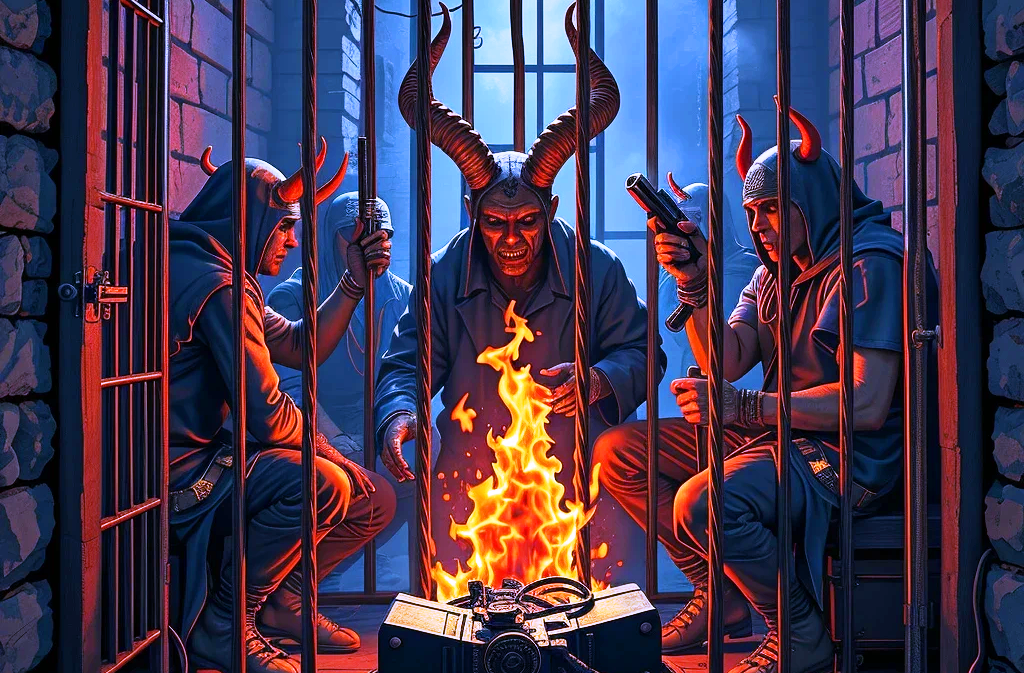
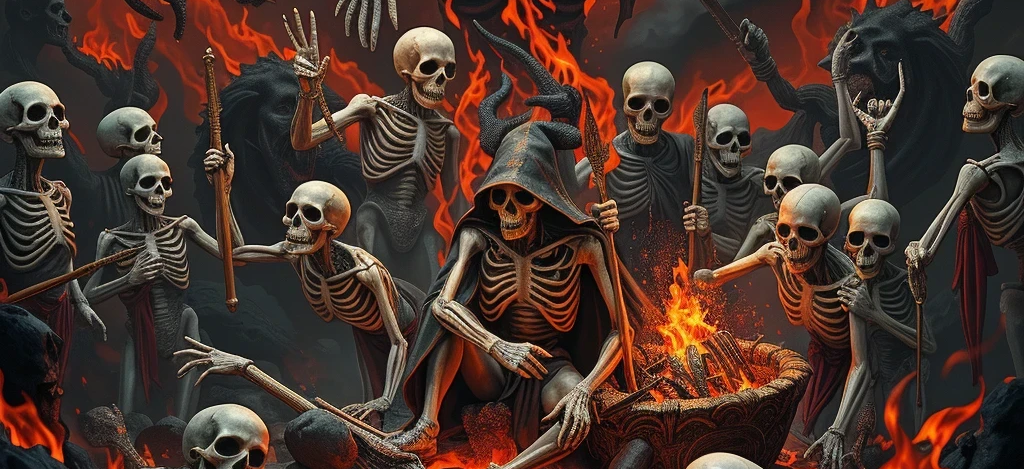
What exactly are the demons and the damned doing in hell, anyway? It is my recollection that certain demons forced from hiding in exorcisms give as their names the various capital sins. While it is speculative, might each of these devils be the chief tormentor for the select damned under the jurisdiction of its foundational sin: pride, avarice (greed), lust, envy, gluttony, wrath (anger), and sloth? It may be that in hell people become their sins. Comparable to a leprosy of flesh, their afflicted souls suffer corruption. Susceptibility to torment also suggests that the damned will be given their bodies, flesh made indestructible and yet not glorified. Just as in heaven where there is mastery over concupiscence and a spiritualization of the flesh, might the damned of hell know the antithetical where bodies are further enslaved by the passions? If heaven allows for divinization by grace, then hell likely ushers a descent backwards toward the bestial man or woman.

Hell is a real place where the damned forfeit the vision of God. The Scriptures testify to a terrifying fire and pain. It burns but does not consume. There is a material element to this fire, but it somehow impacts upon the spiritual fabric of the soul. I suspect that the tormenting fire is God’s last gift to those he wanted for his children. How is this? Does God take a sadistic satisfaction in watching the damned squirm? Would this not make God into a monster? If this were the case, the Almighty would be unworthy of our attention in worship. No, I am certain that there are other reasons for the fire. First, it signifies in justice a temporal punishment that can no longer be appeased. This must be contrasted to the souls in purgatory who will know purification and attain heaven. Such is not possible for the damned. Second, it constitutes in mercy a distraction from the loss of God for which we were made. The damned must suffer an existential frustration in that they will never be whole or fulfilled in meaning or purpose. Like a puzzle, there will always be a piece missing— and that piece is God. 

We can take it for granted that hell is not a pleasant place, but the damned will likely have their pursuits. Besides wading in the corruption or waste of iniquity, I would guess that some would pursue something of the intellectual life. This is likely the case of fallen angels and I would surmise by extension that of men. The intellect and will of men and angels would remain intact. While it is doomed to fail, they may even try to make a heaven of hell. What more can they do? They wanted no part of real heaven. While associations for rational discourse are likely in hell, there can be no abiding friendships because of their failure to love. The devil’s sycophants offer an empty and misdirected worship. As on earth, the relationships of staunch sinners would be manipulative and poisoned by their selfishness. The great would take advantage of the small. If heaven celebrates redemption and freedom in Christ, hell is the ultimate prison where there is bondage to Satan.  

Graced or Imbued with the Divine Life

Just as the Spirit of God makes possible the transformation of the Eucharistic gifts into the real presence of the risen Christ; this same Spirit configures or changes us, forming us into the likeness of Christ. It all begins with faith and baptism. The infusion of grace makes possible a spiritual transformation. We are disposed or made into tabernacles or suitable vessels for God, living temples of the Holy Spirit (1 Cor. 3:16; 2 Cor. 6:16). Of course, any and each Person of the Trinity draws to itself the fullness of God.  As the classical definition reminds us, there are three divine Persons in one divine nature— one God. We can distinguish between the Persons of the Trinity but must be vigilant against heresy. Some fall prey to modalism wherein the triune God is defined by his activities and not by name. Others wrongly speak about the divine Persons as distinct gods, signifying a practical polytheism. Both constitute grievous sins against the divine godhead.  

We are adopted sons and daughters of the Father. We are kin to Christ and Mary is our Queen Mother.  God the Father first sends the eternal Word, his Son, to ransom us from sin. Next God sends his Spirit that we might become his adopted children (Galatians 4:4-7). The Spirit of God that hovered over the waters of creation now makes possible something of the divine life in us. We are invited to enter God the Trinity. Christ promises to send the Advocate, his Spirit of truth upon the Church (John 14:16-17). It is within the context of salvation history that the Trinity comes to light as the central revelation of the Gospel. Jesus reveals the face of God. It is in Jesus that we appreciate God as Abba or Father. It is in Jesus that we will receive the Holy Spirit.  God communicates himself to us through Christ, the living Word. All this is so that we might have a genuine relationship with the Lord. It is a basic principle that you cannot have a relationship with someone you do not know.  We are called to know and to love the Lord. While we can speak about the Trinitarian or inner life of God within us by grace; it must also be admitted that we cannot trap or utterly contain the divine presence. God saturates us and yet we make poor sponges; he drips and leaks from us. It is not simply God inside us but also all around us. We leave puddles. We soak those with whom we come into contact. God exudes or emanates from the saints.  Changing from the image of water to light, that is why artists often portray saints with halos or whole-body auras. They do not hinder the light but amplify it for all to see. Something of this is intimated with the Virgin Mary who responds to the angel, “My soul doth magnify the Lord. And my spirit hath rejoiced in God my Savior” (Luke 1:46-47 – Douay-Rheims).

I am reminded of a child coloring the pictures of a coloring book.  Little children always fail to color between the lines with their crayons. Similarly, we are colored or given life by God, but the colors of his presence also fail to stay between the lines. They cross lines and bleed through the pages. Again, we cannot completely contain or trap the divine presence.  But this is okay. If faith is real, then it must be shared. We must give away what we have.  Faith is not private but communal. Yes, the goal of every Christian is to go to heaven. But more than this, we should want to take others with us. What many fail to appreciate is the identification of heaven with the Trinity. We are called to live within God forever. Knowing the beatific vision, everywhere the saints look, they see God.

We often view love or charity as either a sentiment of the heart or as an action of benevolence. The measure of the Cross would have us evaluate it in terms of sacrifice and surrender. This is the ruler imposed upon every married couple and parent, as well as any who would be a missionary for Christ.  The command of Jesus to take up the cross and to follow is an order to love one another. While not negating the value of our own life and happiness, we look beyond ourselves to prize those who are dear to us.  The radical nature of Christ’s Gospel is that this command must be applied to those who are hard to love.  This love that so often falls short among humanity is given an infinite value or measure in Christ and his relationship with the Father.  Indeed, infinite or perfect love must be granted the highest standing that we can imagine, literally personhood. It is for this reason that we speak of God as love or of the Holy Spirit as personified LOVE. Those who would be graced with the inner life of God must necessarily share in this divine LOVE.   We read in John 14:15-17: “If you love me, you will keep my commandments. And I will ask the Father, and he will give you another Advocate to be with you always, the Spirit of truth, which the world cannot accept, because it neither sees nor knows it. But you know it, because it remains with you, and will be in you.” This reference to remaining “with” and “in” us is not figurative but real.  We tend to be good at explaining the real presence in the Eucharist, but we often stumble in appreciating this real presence in the human heart.  Do we treat our “persons” or “bodies” with the respect to which they are entitled as vehicles for the divine? This is so very important that Jesus will repeat himself, “Whoever loves me will keep my word, and my Father will love him, and we will come to him and make our dwelling with him” (John 14:23).