• Our Blogger

    Fr. Joseph Jenkins

  • The blog header depicts an important and yet mis-understood New Testament scene, Jesus flogging the money-changers out of the temple. I selected it because the faith that gives us consolation can also make us very uncomfortable. Both Divine Mercy and Divine Justice meet in Jesus. Priests are ministers of reconciliation, but never at the cost of truth. In or out of season, we must be courageous in preaching and living out the Gospel of Life. The title of my blog is a play on words, not Flogger Priest but Blogger Priest.

  • Archives

  • Categories

  • Recent Posts

  • Recent Comments

    Barbara King's avatarBarbara King on Ask a Priest
    Ben Kirk's avatarBen Kirk on Ask a Priest
    Jeremy Kok's avatarJeremy Kok on Ask a Priest
    Barbara's avatarBarbara on Ask a Priest
    forsamuraimarket's avatarforsamuraimarket on Ask a Priest

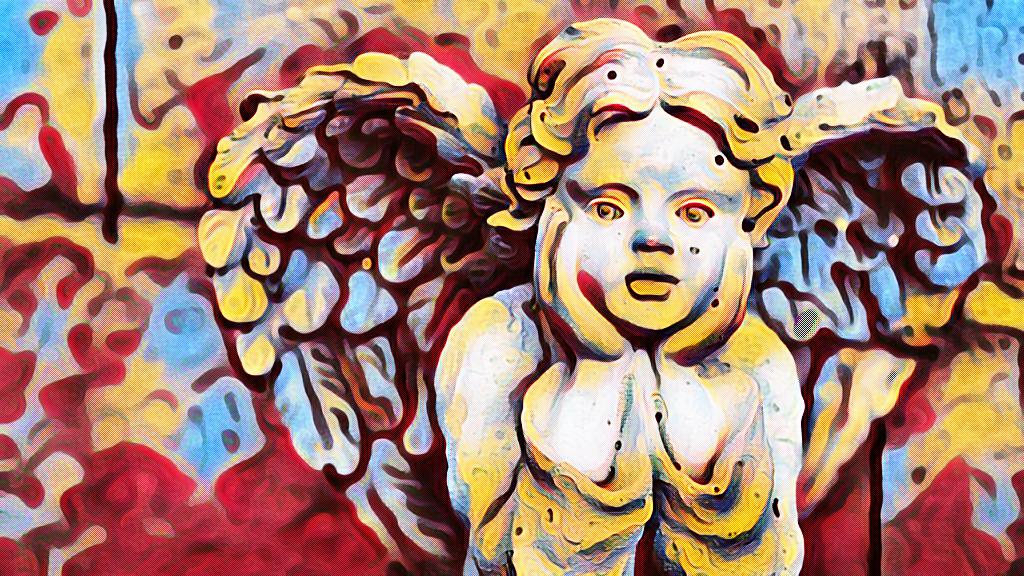
The Ranks of Angels

The fact that there are ranks of angels is a truth that I would concede. However, I must honestly admit that all efforts to denote them strike me as contrived and speculative. Focusing on the Scriptures, the Jews tend to speak of ten ranks while Catholics detail nine broken down into sets of three. The source for Christians is Pseudo-Dionysius the Areopagite from the fifth or sixth century and his work entitled, On the Celestial Hierarchy. It is all remarkably interesting but is it credible?

  • Highest Rank – Seraphim (Is. 6:2), Cherubim (Ez. 10:15,20), Thrones (Col. 1:16)
  • Middle Rank – Dominions, Virtues, Powers (all mentioned in Eph. 1:21)
  • Lowest Rank – Principalities (Eph. 1:21), Archangels (Jude 1:9), Angels (throughout Bible)

How are they distinguished? The highest or first rank of angels focus immediately upon the godhead. They bask in the presence of God. They praise him as holy Wisdom. They clearly acknowledge God as the Judge of all. Those of the middle or second rank possess governing authority over the universe and have power over natural creation. The lowest or third rank is where we find the guardians or messengers of God. These are the angels we most invoke for intercessory prayer.

What are my thoughts about this? The substantial form in human beings is the immortal soul. It is what separates us from animals. If the soul leaves the body, it survives as a ghost. The body, however, would become a corpse. It cannot live without the soul. The soul is the principle of life. By contrast, an angel is pure form without matter. That is why angels cannot die. An angel is a spiritual creature that can know, will and act. The primary activity of an angel is to see, know, and love God as the greatest good. Beginning with its creation, every angel is its own form or species. There is no matter to be determined (formed) as in the race of men. While matter is our principle for individuation, such is not the case for angelic beings. Given the lack of informed matter, there can be no membership in any angelic species. Every angel has its own unique form. While they share a common spiritual essence, each angel is a species of one. I have heard it argued that there is a radical self-determination by the angel’s act of will at creation. The angels of God would sort themselves by their species and office. While all adore, some are drawn to proclamation or governance or revelation or blessing or whatever. This is apart from the orientation that separates the good from the bad angels.

The rebellion among the angelic hosts constitutes the most important distinction between the good and the bad angels. There must have been some kind of veil at the beginning so that there might be freedom regarding the acceptance (or rejection) of God as the greatest good. Otherwise, the compelling attraction of the greatest good would strip away any choice.

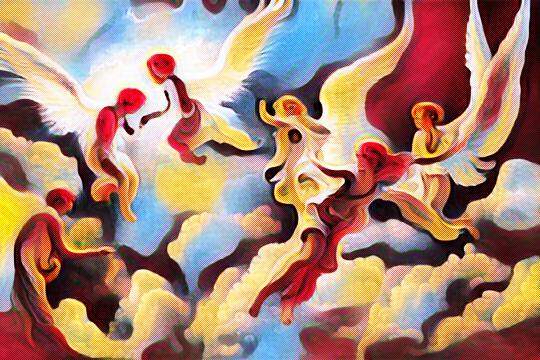
Great and small, not all angels are the same. Cherubim are imaged as with four wings and many eyes or faces. They are understood as all seeing. Isaiah 6:1-3 describes those of the highest rank— the Seraphim. They are as sentinels before the throne of God. “Seraphim were stationed above; each of them had six wings: with two they covered their faces, with two they covered their feet, and with two they hovered. One cried out to the other: ‘Holy, holy, holy is the LORD of hosts! All the earth is filled with his glory!’” Imaged with six wings, the Seraphim are associated with fiery purification. St. John of the Cross writes that the seraphim covering its face with its wings symbolize “the darkness of the intellect in God’s presence.” He continues that the covering of the feet symbolizes “the blinding and quenching of the affections of the will because of God.” It thus constitutes humility of the creature before the Creator. “With the two remaining wings they flew, indicating both the flight of hope toward things that are not possessed and the elevation above all earthly or heavenly possessions that are not God” (The Ascent of Mount Carmel, II, 6.5).

As a closing aside, various authorities regard Lucifer or Satan as either a Seraphim or Cherubim (Ezekiel 28:11–17). Such a lofty standing among the angelic hierarchy, would denote two things: (1) he would possess tremendous angelic powers (even without grace) and (2) his was a most terrible fall and loss. Satan brings upon himself an alienation from God that portends to a frustration of his very purpose. What are we to make of a corrupted creature called to resound the thrice Holy name of God? Instead of a hymn or prayer, is he a living curse? Akin to Dante’s frozen Satan, is he eternally silent— locked in a moment of hesitation— unable to adore the one who is Holy, Holy, Holy?

The Truth about Angels

There are so many misconceptions about angels. Many imagine they are simply human souls that have been rewarded with wings in the afterlife.  This is not the case.  Many have their religious formation from Hollywood and not from the source that is truly holy. Angels like us are “persons” with will and intellect.  They are both good and bad. However, other than that, they are utterly alien to humanity.  They are purely spiritual entities without bodies and thus they do not reproduce, do not age and cannot die. We often fantasize about them with flowing robes, wings, and halos. But in truth they look like nothing at all. If God should allow them, they can appear before men, but only as phantasms or caricatures of human beings.  Beneath the appearances, they are something utterly beyond our comprehension. The good angels obey and will never tarry to answer God’s summons.  They adore the Lord as a host or angelic choir.  They love God and they love us.  While they are not human, they are counted among the saints of heaven.  They intercede and pray for us. The bad angels turned from God. Unlike mortal men this rebellion has permanently misaligned their orientation. The West, unlike certain Eastern churches, does not believe that angels can repent and return to God’s good favor.  Demons will always be demons.  They may know an intellectual life with the other damned of hell, but they have forever forfeited grace. Where there should be love there is hatred or indifference.  At death the souls of the departed are also fixed, either orientated toward God or away from him.  It is said that as many as a third of the angels rebelled against God.  Many of the ancient Church fathers thought that their fall was due to a repudiation of the providential incarnation. Unlike the angels of the nativity, they had refused to bend the knee to the Christ Child.  The good angels always adore the Lord and praise the godhead as Holy, Holy, Holy. 

As spiritual and not material beings, the angels know duration but not time as we do.  They have no gender. They do not have our five physical senses. They do possess angelic powers.  However, as “persons” they are aware, can know and love and choose. All the angels that would ever exist were created in the same moment.  This is contrasted to human beings who are created throughout time.  However, at the end of the world, our numbers will also be fixed.             

The word “angel” means messenger and they are periodically sent by God in the history of salvation. Note what is said in the universal catechism.

CCC 332Angels have been present since creation and throughout the history of salvation, announcing this salvation from afar or near and serving the accomplishment of the divine plan: they closed the earthly paradise; protected Lot; saved Hagar and her child; stayed Abraham’s hand; communicated the law by their ministry; led the People of God; announced births and callings; and assisted the prophets, just to cite a few examples. Finally, the angel Gabriel announced the birth of the Precursor and that of Jesus himself.

CCC 333From the Incarnation to the Ascension, the life of the Word incarnate is surrounded by the adoration and service of angels. When God “brings the firstborn into the world, he says: ‘Let all God’s angels worship him.’” Their song of praise at the birth of Christ has not ceased resounding in the Church’s praise: “Glory to God in the highest!” They protect Jesus in his infancy, serve him in the desert, strengthen him in his agony in the garden, when he could have been saved by them from the hands of his enemies as Israel had been. Again, it is the angels who “evangelize” by proclaiming the Good News of Christ’s Incarnation and Resurrection. They will be present at Christ’s return, which they will announce, to serve at his judgment.

Given the identity of Jesus as God’s only Son and the Second Person of the Blessed Trinity, the angels are preoccupied with Christ— announcing his birth with the hymn of heaven, ministering to him after his temptation scene with the devil, and giving him consolation in Gethsemane before the ordeal of his betrayal and passion. Angels are also heralded to accompany the risen Christ on the day of judgment.  They are imaged as harvesters of souls.  Similarly, we are informed that angels can minister to us (Hebrews 1:14) and function as special guardians (Matthew 18:10).  The Roman Canon of the Mass even speaks of an angel that takes the oblation of the Eucharist to the heavenly Father. 

While angels belong to the supernatural realm, they are limited by their nature to angelic power and to whatever divine grace allows for them.  Just as we can make things, only God can create from nothing.  Similarly, neither angels nor demons (fallen angels) can truly create, as this requires infinite power. New Age religion erroneously corrupts this understanding by having its adherents praying to angels as if they were deities.  Such an angelology is an utterly offensive idolatry as it seeks through superstition to usurp divine sovereignty.

Will the REAL Eve, Please Stand Up!

I recall a few years ago that certain Christian apologists responded excitedly to the breakthrough in DNA and genetic studies about the so-called “Mitochondrial Eve.” Many acclaimed it as proof for the story of Adam and Eve in Genesis.  However, it merely asserted that a line had been traced to the most recent female ancestor of all living human beings. It was estimated to extend back some 155,000 years. The estimate for Y-chromosomal Adam was vaguely estimated to go back some 200,000 to 300,000 years. It must be said, however, that the “Mitochondrial Eve” is not the first woman or the biblical Eve. Indeed, given the dating, there were other females around at the time she lived.  If there were other mitochondrial lines, they are now extinct. All women living today can trace their line to her. A selection of other ancient women may also have descendants alive today but not in a direct female line. We are told by reputable scientists that nuclear DNA studies indicate that the effective ancient human population size was always measured in the tens of thousands.

We need to be careful in trying to absolutely connect the evidence of genetics or evolution with the creation story of Genesis.  The Bible is not a science book. We know for certain that the world is far older than the biblical 6,000 years.  The cosmology of the Jews is also figurative and cannot be employed to reject a round earth or the fact that the earth revolves around the sun. Catholicism is not fundamentalist, and we believe in the complementarity of truth. Ours is not a faith at war with science. Could God use evolution and the development of species to bring about the first true man and woman? Yes.  Were there once different types of men and women? While even the Bible speaks of giants, again we can turn to the clear discovery of bones and artifacts. Yes, there were other branches in the human family.  While we are Homo sapiens (going back some 300,000 years), the Neanderthals roamed the world from 400,000 to 40,000 years ago. Many of us may even carry remnants of their DNA. They made tools and lived in community. Their abilities demonstrate that they were not mere apes or animals.  Thus, they must have had souls and were truly human, albeit different from us.  This would push any true Adam and Eve much further back into human history. 

There is a mystery to our origins that cannot be unveiled. This is because there is a divine operation beyond our scrutiny. God infuses an immortal soul. While the body might develop from proto-human creatures, there is no evolution of the human soul. This was the chief heresy that Darwin espoused, a point of contention for believers as well as atheists (who deny the immaterial soul). The first ensouled would be Adam and Eve. It is dubious to think that they were blue eyed, white skinned and blond haired. However they looked, the gift of a soul made them self-aware and gave them a reflective understanding unknown to other creatures. There came a moment when our first parents were alerted to their high calling, inspired by their place in creation and moved by the presence of God they immediately experienced.  It was a turning point. They could have answered their high calling and there would have been no fall.  Creation itself would have known a harmony that comes with being grafted to the heavenly kingdom.  But the fall of Adam and Eve has a terrible cost— no preternatural gifts— and suffering, sin and death would be our lot. Instead of standing tall in their vocation as men and women, they fell to all fours on the level of the beast. It is so much easier to play the part of an animal then to live up to the dignity and responsibility of a man or woman.

Just as we might have known the blessings of Adam, the Church teaches that all humanity would suffer the cost of original sin.  It is inherited or passed on through human descendants. This truth is clarified by Pope Pius XII in his encyclical Humani Generis. The error of Polygenism or multiple first parents is condemned. Although different from the biblical appreciation, modern science would prefer Monogenism or a common decent for humanity, often linked to “out of Africa” speculation.     

The Wonderful Absurdity of the New Eve

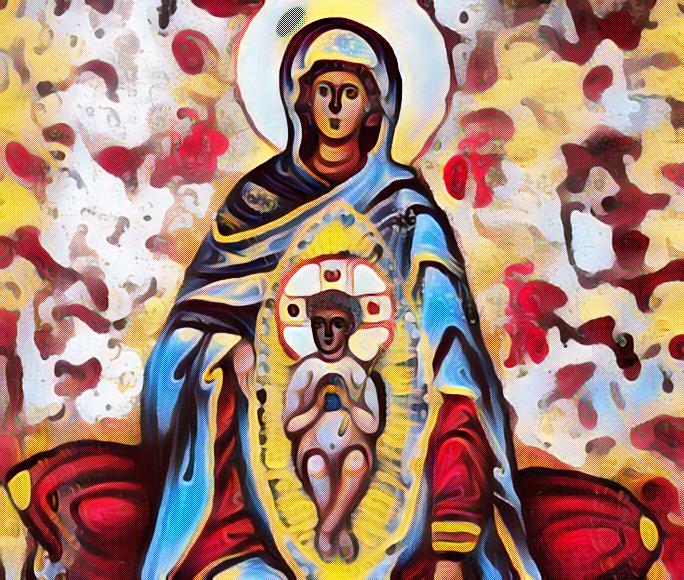
Granting that the role of Mary is a manifestation of truth, it still stands out to many as a theological absurdity.  Her place in the history of salvation becomes a point of contention in the early Church.  She plays a singular part in cooperating with the redemptive work of her Son.  And yet, we affirm that Jesus is the one Redeemer— the Way, the Truth, and the Life.  There is no other WAY to the Father except through him. Concurrently, Mary is acclaimed as the Theotokos (Bearer of God) or Mother of God. Indeed, given that Jesus is a divine Person (God), the genuine adversary of Satan (an angelic creature) is the Virgin Mary (a human person and creature of flesh and spirit). It astounds us that almighty God would make himself dependent and entrust himself to a creature.  How can the first principle for all things proceed from that which is secondary?

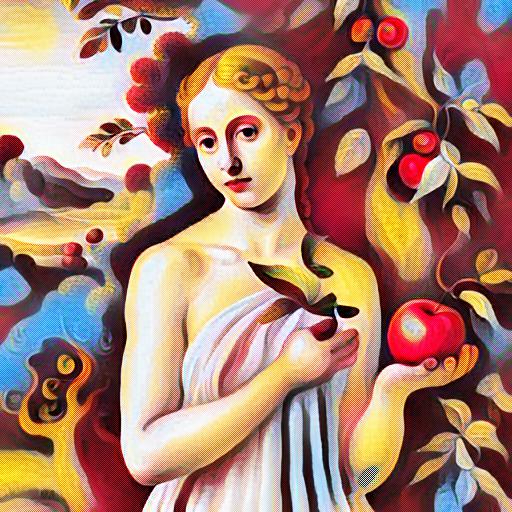
Something of this mystery is spoken about in the primordial garden.  Satan as the serpent tempts the first Eve with fruit from the forbidden tree, saying, “God knows well that when you eat of it your eyes will be opened and you will be like gods, who know good and evil.” The irony here is that there is a twisted truth hidden behind the deception.  Our first parents would know good and evil because they would literally “know sin” and stand before God as guilty of a disobedience that would bring disharmony to all creation. Whenever humanity usurps the sovereignty of the deity, the very first of the commandments is violated— it is the highest in the hierarchy of sins. But how does this speak to the person and role of Christ’s Mother?  The words of the serpent are fully realized in a manner that mocks the devil.  While Adam and Eve will not themselves be “as gods,” over the expanse of time a Savior would be born to humanity, a new Adam who literally is the incarnate Second Person of the Blessed Trinity.  Jesus as a son of Adam is also the eternal Son of God. Christ comes to restore what was lost.  While Eve is the vehicle for Adam’s transgression by giving him the forbidden fruit to eat; Mary is the handmaid of the Lord who gives us all the saving “fruit” of her womb, Jesus. The devil despises the woman as she is beneath him in the hierarchy of being. He is a pure spirit, albeit fallen, while the sons and daughters of Adam and Eve are akin to animals, sacks of skin filled with blood.  Of course, Mary has that which the devil has forever forfeited, sanctifying grace.  Those who are children of God in faith and baptism, and thus sons and daughters to Mary, also share this divine favor that allows us to be spiritually born again.  Satan hates the Blessed Mother and all who take refuge under her mantle.   

Her YES to God at the annunciation is made not just for herself but for all humanity.  She has been preserved from sin so that she might serve as the immaculate vehicle or conduit through which God would enter the world of men. The sacramental value of the cross reaches backward into human history and touches her at the first moment of her existence in the womb of St. Ann. Unlike the first Eve, she will treasure her righteous standing before God, remaining sinless and now interceding for us as the Queen of Heaven.

Although only a blessed creature and not divine, she is called upon as “Mother” throughout the world and the many passing centuries.  She is the first disciple of her Son. She is at the creche, at the Cross and in the Upper Room.  She holds out her newborn child at Bethlehem and extends her arms again to receive him on Calvary. The Mother of the Redeemer becomes the Mother of all the redeemed.         

Awaiting the Messiah, any woman could have been the vehicle through which the ancient promise would be fulfilled. Despite the lies of our times, this signifies that gender does matter and is never irrelevant.  There is a profound miracle to the feminine potency for motherhood. It is a hallmark of God’s plan that clashes with human capriciousness and fanciful denial. A similar discordance arises between a secular world and the meaning of Mary’s Son as the incarnate Christ. We view something of the Christ Child in the countenance of every child.  Any child could have been the Christ Child. That is why the Good News will always be a Gospel of Life. Mary becomes a guidepost, not only to Christ, but to the dignity of motherhood and the person. If the first Eve ushers forth death, Mary as the new Eve is the cradle of life. Of course, this is through her cooperation with her Son.  “For just as in Adam all die, so too in Christ shall all be brought to life . . .” (1 Corinthians 15:22). The apostle repeats this message in Romans 5:19: “For just as through the disobedience of one person the many were made sinners, so through the obedience of one the many will be made righteous.”

After condemning the serpent to crawl on its belly, the divine judgment against the devil plays a part in our understanding of Mary as “the woman” or new Eve: “I will put enmity between you and the woman, and between your offspring and hers; They will strike at your head, while you strike at their heel” (Genesis 3;15). That last line is sometimes translated as “her heal” making the connection with Mary even more striking.  While we often posit the image of Mary as meek and humble, as the new Eve she is not only a sovereign of the kingdom but a warrior queen. The first Eve rebels within the safe and peaceful confines of the garden; Mary’s fidelity comes to realization on the battlefield of a dangerous world. The first woman forfeited grace while the immaculate Virgin Mary is hailed as full of grace. The first Eve fostered division between God and man as well as within the human family. The new Eve would know an intimate unity with the Lord which she would share with all her children.        

Dealing with the Mystery of Death

There is something about our nature that instinctively resists death and finds the notion repugnant.  Many are fearful of death. Others forestall it through positive eating and drinking habits, exercise and medical intervention. Despite all the talk about quality of life and growing advocacy for euthanasia, we all know of heroic souls who cling at great physical and mental cost to every breath and heartbeat remaining to them. Indeed, although finding ourselves in a culture of death that excuses the termination of millions of unborn children, we are self-seeking and defiant in defending our own lives.  Celebrities are infamous for plastic surgeries, hair dyes, and body augmentation— all to at least feign youthfulness and vigor.  We appreciate all-to-well that we are on a trajectory with the Grim Reaper. Aging, ailment, and accident are the “Three A’s” about which we are wary.  Advancing years bring us ever closer to our time of departure from this world.  However, if a passage of the years offers a period of preparation for the inevitable; disease and accident are a lot less forgiving. Disease is the handmaid to aging.  Accident is the worst as even the most robust and healthy can be quickly taken out— here one moment and suddenly gone the next.  Modern people are very uncomfortable with death. Notice that we dress up and paint the dead in caskets as if they were alive.  The preference for cremation removes the body entirely from the funeral scenario.  The so-called ashes are a token of a life, remembered in photos, but increasingly even without a formal grave. Traditional Christian sensibilities insist upon a grave or place of internment for ashes— why? It is because we are a people of faith who employ sacraments and sacramentals. When we remember those who have passed, it is always with the accompanying hope that the beloved dead are alive in the Lord. The “sacramental” gives us something visible or tangible to grasp for that, which is in truth, unseen and beyond our senses.  It is no denial of reality or an escape into the fanciful. But we prefer to believe that we exist for a reason and that we do not live and die in vain. Those who deny the existence of God and life after death can only find comfort in a nostalgic remembrance.  It is sad because the person recalled is no more.  When the few remaining who know the deceased should die or suffer from Alzheimer’s, then the remnants of the dead become no more than tattered photographs of ghosts without names or stories.  The Gospel looks to Jesus and how he transforms the mystery of death. Indeed, at Mass we remember Christ in an “anamnesis” that makes present the one remembered. We are to similarly ponder the dead but remembering them as alive and as still loving and praying for us. The gravity moves from “us remembering” to the fact that “God remembers” and never forgets us.         

We often weep when friends and families die.  We are touched by death while still living in this world because the deceased remain a part of us.  Our stories are interwoven and there are ties that remain unbroken, even by death. Often, we hear mourners cry things like, “Why O Lord, why did he have to die? Lord, could you not have taken me, instead? How could you have let this happen?” The question, “Why do human beings die?” is an important one.  We want to live. We might not want to be vampires, but the prospect of eternal life is appealing. Those who study history often wish they could have lived in the past. Those who delight in science fiction want to see the future.  Many in their preoccupation with collecting things and advancing their wealth live as if they will be around forever. But such is a lie.

Then he told them a parable. “There was a rich man whose land produced a bountiful harvest. He asked himself, ‘What shall I do, for I do not have space to store my harvest?’ And he said, ‘This is what I shall do: I shall tear down my barns and build larger ones. There I shall store all my grain and other goods and I shall say to myself, “Now as for you, you have so many good things stored up for many years, rest, eat, drink, be merry!”’ But God said to him, ‘You fool, this night your life will be demanded of you; and the things you have prepared, to whom will they belong?’ Thus will it be for the one who stores up treasure for himself but is not rich in what matters to God.” (Luke 12:16-21)

As in the parable, when death comes, to whom will their piled-up bounty go?

Despite the harsh reality of death as the great equalizer, coming to the rich and poor alike, we have an intuition that dying has been interjected into the human equation.  It is not the way things are supposed to be. The serpent in Genesis 2:17 urges disobedience to God, discounting the consequence of death for forbidden knowledge.  This so-called knowledge is “to know sin” and such changes the agent, clipping the relationship with God and a vital connection with the one who is the source of life. Why do all men die? The answer is simple and terrible— despite our abhorrence of death, we have chosen it. Not long after the fall, one brother would kill another. Rebellion against God brings about death, indeed, more than this, it invites murder.  The sin of Adam and Even was the signing of warrants against them. A bounty was placed upon their heads and those of their children.  We are all murderers. This truth is fully realized in the passion and death of Christ. We all have blood on our hands. And yet, the bounty is paid not by our deaths but by the sacrifice of our Lord.

Sin and death enter the world through Adam. The new Adam or Christ brings forth grace and life.

For since death came through a human being, the resurrection of the dead came also through a human being. For just as in Adam all die, so too in Christ shall all be brought to life . . . (1 Corinthians 15: 21-22).

What We Have Lost

Death enters the world due to sin. Regardless of whether there was spontaneous creation or development of species as through evolution, the Church teaches that death enters the world because of sin. Had Adam and Eve remained faithful, our first parents would either have never known death or it would have been as merely opening a door and walking from one room to another.  Human rebellion would cost us preternatural gifts and usher forth suffering, sickness and dying.  It is a crucial hallmark of Christian anthropology, that these dark mysteries are not the result of the divine active will, but rather of his passive will— God makes space for the misuse of human freedom.  While he does not preserve us from the consequences of sin, he does not forget us and makes a promise of redemption. 

After the fall, our first parents hide themselves in shame of their nakedness.  They forfeit their profound union with God.  An awareness that raised them ahead of all other creatures of material creation was accompanied by a duty or responsibility to honor the Almighty.  However, their love and fidelity fall short. Eve falls to the serpent and Adam is emasculated in complying with the demand of Eve.  They would remain stewards of creation but as deeply flawed sentinels in a now broken world. The sin of our first parents brings about a woundedness to all creation. The bridge collapses between heaven and earth. It would only be in Christ our “pontifex” that the bridge would be restored, albeit in the form of a cross.  While hope remains, our pilgrimage would henceforth include struggle and suffering. The actions of Adam and Eve do not mean merely death to a few but death to many. As in any mortal sin, they are stripped of sanctifying grace.  This is still how we enter the world and why faith and baptism are so essential. Another lesson learned is that just as the cost of original sin is passed down to every child of humanity save Mary; all sin, even the most personal and hidden, touches others because we then cannot witness as the saints we should be. Indeed, one of the imperatives for the sacrament of penance is that we might be healed as members of the mystical body, the Church.  The sin of any one of us is a cause of diminishment for all.  We are called not simply as individuals but as a new People of God or New Israel.    

Compounding the gravity of Adam and Eve’s rebellion is that within their intense intimacy with God comes a heightened awareness of intellect, sometimes referred to as infused science. Not only have we lost this supernatural gift, but today many seem to possess only a vague appreciation of human nature and our true place in the world. Consciences are numbed to the truth about the sanctity of human life and the dignity of persons— divine light is displaced by a satanic darkness. Every school kid is aware of this loss because learning often does not come quickly and requires constant study and repetition to store information in memory.  What should be easy becomes difficult or arduous.

Original sin also strips away our sense of integrity, making us capricious and prone to the urging of concupiscence.  It is hard to do the good and easy to do the bad. The symphony of harmony in us and in creation is disrupted. The fruitful blessings of the garden would be traded for the struggle of the arid wastes— men would toil for their food and women would know the pains of childbirth.

Hypocritical or Faithful?

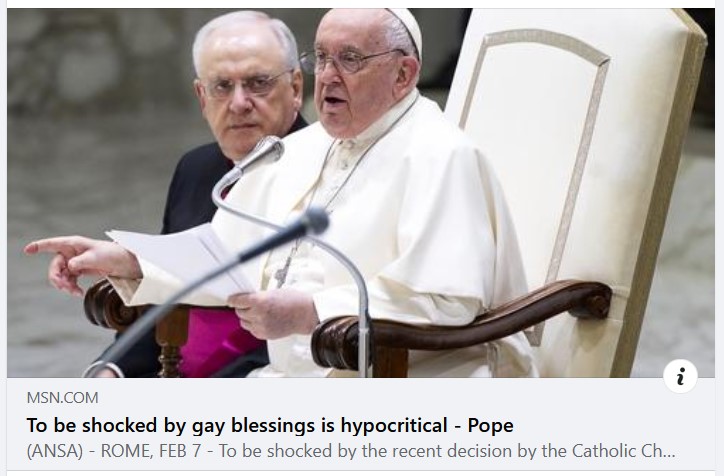
It was reported by ANSA on February 7, 2024, that Pope Francis judged it “hypocritical” to be shocked that the Catholic Church would authorize the blessing of gay couples. He offered the rebuttal in Credere, “No one is scandalized if I give a blessing to a businessman who perhaps exploits people – and this is a very serious sin.” I am tempted to give the retort that the comparison is between apples and oranges. But in truth many of us would anticipate that no cleric would give approbation through a blessing to anyone in grievous sin.  The proper parallel would be with pro-abortion politicians. Many of us would very much hope that the Holy Father would refrain from either blessing or giving Holy Communion to those who scandalously parade their vices as virtues— and both sexual depravity and the murder of children constitute mortal sin and testify to an anti-gospel.   

He says that the heart of the controversial declaration is “welcome.” But many learned authorities interpret it as going further and seeking the regularization of that which cannot be normalized for believers. No one contests that the Pope has a soft heart for homosexual persons.  However, he sometimes seems to demonstrate a hardness to his priests and to those who place the truth prior to any pastoral accommodation. He states: “People suffer so much, we clerics sometimes live in comfort. . . it is necessary to see the work, the suffering of the people.” It may not be his intent, but this is a slight against caring priests. Clergy who uphold the teachings and values of the Church are not ogres who delight in the pain of others.  Often these pastors suffer alongside their people and count themselves as the first among sinners. The promises made by men consecrated to the Lord’s service bring both delight and pain.  We have the privilege to be Christ’s instruments in feeding and healing God’s people; but we also suffer the personal loss of a wife and family given our celibate love. We are also not our own men but stand under lawful authority— to our bishops and yes, certainly to the Pope.  But ultimately all of us, clergy of every station and the laity, must be subject to God and his laws.  Here is the crucible between sin and fidelity. 

The interview leaves orthodox readers with further distress or anxiety because the Holy Father makes the aside, that “opening work in the Curia to women is important.  In the Roman Curia there are now several women because they perform better than men in certain positions.” Where is this going?  No one in his or her right mind would suggest that the Church should deny the benefits of female genius; but the hierarchical authority of the Church is appointed by Christ as exclusive to his apostolic men.  That factor is beyond our control or power to revise. In any case, as with the men, the women chosen for various commissions or roles of participatory leadership should be exclusively selected from those who are faithful and not from the dissenters.  This is an important qualification that is sometimes left unsaid and maybe unfulfilled.

When it comes to his health and mobility issues, Pope Francis remarked, “The Church is governed using the head, not the legs.”  This is a good answer, although lately it seems that the Church is being increasingly governed by the heart than either by the head or the legs. This might appeal to some critics, but it can have disastrous consequences. Without the compass of truth, love is quickly misdirected and loses its way.  We have seen many instances where without the guidance of the Gospel, an intended compassion becomes oppressive and tyrannical.   

It is Wrong & I Will Not Do It!

Individual priests should not have to say what the Magisterium and the entire Church should insist upon, and yet we have entered a strange new land where absurdity rings true, and sin is excused in private if not in public. Therefore, echoing the Scriptures, the catechism, and the legacy of the saints, let me affirm that the Church cannot directly bless or affirm sin. There should be no confusion about the covenant of marriage as strictly between one man and one woman in a bond to be maintained until “death do they part.”  While the clergy can bless congregations and individual sinners; they give scandal should they specially bless couples who come before them in either adulterous or same-sex unions outside the sacrament.  Despite the recent declaration Fiducia supplicans from the Dicastery for the Doctrine of the Faith, as a priest of the Church, I cannot extend blessings over such couples.  It is my conviction, with a fully informed conscience, that any such requests for these novel blessings must be denied for the good of souls. Given just opposition around the world, it is my hope and prayer that the declaration will be retracted, and that Cardinal Fernández will be removed as the prefect who authored the egregious document. He has quickly and utterly lost any semblance of credibility among orthodox believers. I fully concur with Cardinal Müller who has characterized the possibility of these errant blessings as both “impossible” and as “blasphemy.” Not only has ambiguity and scandal been fermented for the faithful; the deviation from biblical truth has caused incalculable damage within legitimate ecumenical outreach with non-Catholic Bible Christians.

It is true that the declaration reaffirms Church teaching about marriage and sexual-relations as exclusive to male-female couples.  But what the text states in principle it then undermines or takes back in terms of praxis. An explication for conditions to allow what cannot be permitted quickly strays into rhetorical incoherence— we are told the blessings must be private, unscheduled, not in sacred space or chapels, and not in fancy-dress clothes.  What moral difference does any of this make? None! Even informal or pastoral blessings are liturgical because the agents are clergy! We are told that these are individual blessings and not benedictions over same-sex unions; however, those coming forward are specifically seeking these types of blessings and validations over their bonds and lifestyles.  The given rationale trespasses from the dubious to the deceptive.

While I take exception to the statement that “an informal blessing” could be extended to those cohabiting in a homosexual relationship, the document does give an escape clause that I would enact in that these blessings “should only be given if there is no risk of causing confusion about the Church’s doctrine on sexual morality, including the nature of marriage.” It is my estimation, as a pastor of souls, that such blessings would not only risk but always CAUSE such confusion.  Thus, they cannot in practice be conducted by me or anyone. Note that those excited about such blessings are on the record saying that they are an important “first step.” These dissenters, for that is what they are, routinely schedule these blessings, photograph them, and then publicize the whole mess for the media. Proscriptions for the blessings are violated with impunity. What are we to make of the fact that there is little in the way of rebuke from lawful authority for doing all this? Indeed, those who criticize are judged as harsh and ideological.  I would simply use the word, “faithful.”

The Feminization of the Church?

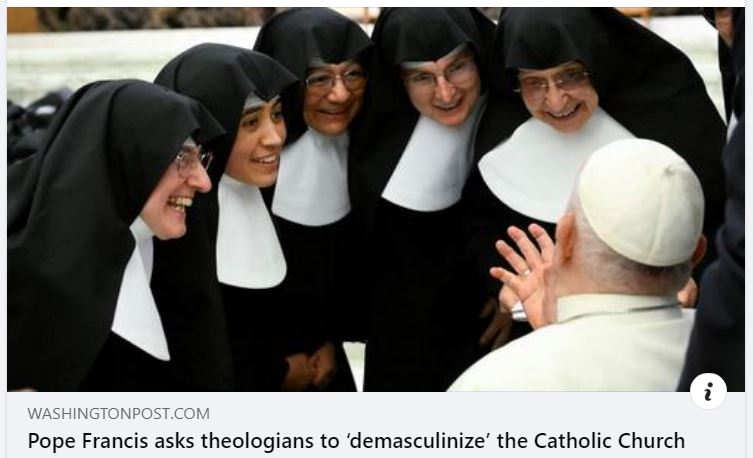
The title of the news article alone gives me the shivers. Do we really want to speak of “demasculinizing” the Church?

Yes, it is true that there is something unique about the feminine genius that can add to our theological insights; however, the basic truths of faith are what they are, regardless of the gender associated with the theologian or philosopher.  Where I sometimes perceive a difference is that women thinkers tend to be more pragmatic or earthbound in their perspective. I suspect this emanates from their natural position as the caregivers of the home, making sure that family members are healthy, well-fed and secure.  Note that there are few women philosophers in comparison to men— such often requires a detachment from particular terrestrial things so as to better reflect upon basic principles or absolutes. Indeed, women often get annoyed by men who have their minds in the sky instead of firmly grounded in the practical business of day-to-day existence. This is not to say that men are utterly detached. Good husbands and fathers are certainly aware of the sacrifices and hard work they must accomplish to provide for their families. But note that priests (who make up the majority of theologians in Catholicism) are directed to celibacy so as to free them from such concerns. Of course, the pastors of parishes are also rarely counted among great theologians simply because they do not have the time to sit down for extended theological reflections.  Indeed, Pope Francis is insisting upon a new theology that would not focus upon the priest at his desk or even (perhaps) before the monstrance.     

The Holy Father lamented at a recently gathering of theologians that only five out of thirty were female. My interest would be less in the gender breakdown and in the particular names and agendas of those assembled.  Fortunately here in the United States, the liberal feminist theologians like Mary Daley (81 years old), Rosemary Radford Ruether (85 years old), Elisabeth Schüssler Fiorenza (85 years old) and Elizabeth Johnson (81 years old) are getting older and fewer while the more conservative, i.e. orthodox women theologians are tending to be much younger and growing in number.

Women have been invited to join the International Theological Commission since 2004. As women are given more representation in the commission and other church bodies, we can only hope that the women and men chosen will not be dissenters. It infuriates aging feminist theologians when women authorities are selected who embrace the Theology of the Body from Pope John Paul II or argue for a male-only priesthood. But these are the right sort of women who place fidelity to revealed truths over contemporary fads and politics. 

I would suspect that the role of women in the Church is analogous to her role in the family. We speak of the Church with feminine imagery as “Mother Church.”  I suspect there is a close approximation between the Immaculate Heart of Mary and this appreciation of our faith community where we are born again at the baptismal font, the spiritual womb of the Church. The best of women theologians would ruminate upon the gift of life and how the Church sustains her children. Further the Church is referenced in the liturgy as not only Mother to us but as the Bride of Christ. Analogies should never be taken too literally but they do speak to truth. This same Church is also regarded as the Mystical Body of Christ and that is discernably male given this designation from the incarnation.   

The Holy Father desires the inclusion of women in the synodal process.  This need not be something to fear, again if we make sure the right women are chosen— practicing Catholics, pro-life, dedicated to preserving the deposit of faith and urging all to keep the commandments and to live moral lives. I am reminded of the Supreme Court. The liberal voices clamor for more women and people of color but then never fail to gripe about Clarence Thomas and Amy Coney Barrett.  

I cannot say I understood why the October Synod required a theological reflection on the possibility of deaconesses. Why consider what is already a moot point given the absolute prohibition of ordaining women? We are either going to frustrate or anger dissenters or there is a movement afoot to hijack the Church.

What precisely is the “male-dominated view” that still exists in society and the Church? The real danger to women is in the Trans movement where biological men are dressing up like girls and destroying women’s sports and worse yet, the very definition of “womanhood.” This is the ultimate feminization of men. Real men are struggling with emasculation in society— they do not know how to act and are thus increasingly failing to fulfill the manly role in the family and public forum. Do we want to do the same in the Church? Already, many critics are complaining that too many homosexuals have been ordained priests and that heterosexual clergy are finding themselves marginalized in the ministry.

Yes, women have always been important to the Church and we even count some important theological doctors among their number. Indeed, there are a multitude of female saints including the greatest of all, the Blessed Virgin Mary.  All this has been made possible despite the so-called male-domination of the Church.  Indeed, with the massive destruction of the women’s religious orders— today, more than in the traditional past— the value and talents of women are being minimized.  Instead of the modern enlightenment we claim; we are actually moving backwards. 

The Pope states: “The Church is woman and if we cannot understand what a woman is, what is the theology of women, we will never understand the Church. One of the great sins we have witnessed is ‘masculinizing’ the Church.” What? Should we really devalue or malign the theological reflections of great men like Augustine, Aquinas, Duns Scotus, Bellarmine, von Balthasar, de Lubac, Congar, Ratzinger and others? I pray not, but the Holy Father commands all the same, “This is the job I ask of you, please: Demasculinize the church.” 

Pope Francis is correct that theology should emerge from theologians “on [their] knees’ in adoration to God. Indeed, this is not new because Pope Benedict XVI also spoke about the necessity of humility. Of course the latter pope would also insist upon the perennial nature of truth as emerging from divine revelation— not as something that can be pushed as part of a political agenda or inserted by dissenters that would make a break with the past. It is here that I find very worrisome a charge for a new theology, “a paradigm shift, a brave cultural revolution,” that would further the novel ecclesial synodality. As of yet this synodality has shown no fruits, only dissention.  Should we be hasty to embrace something unproven and controversial? So far many questions have been asked that are begging for answers.  Those answers will please some and disappoint others.  They will also unite and move the Church forward, or, in the worst case scenario, foster schism. As of right now, it is not dialogue that targets the voices on the right or those who prefer tradition to novelty; rather, we are experiencing with a degree of shock the intimidation of raw power.  While the left and dissenters are largely left free to discuss whatever they want. Those who speak for objective truths or the aesthetic of tradition are increasingly silenced and censured.  What surprises me is that even progressives who often tout freedom and the right to dissent are demanding pressure against their ideological opponents and their silencing.  Who would have thought? It was the demand for ecclesial harmony that helped to fuel the behind-the-scenes efforts to hush up pedophile clergy. I am not saying that there is no place for ecclesial power and reprimand as a last recourse— but it should be against those who challenge the truths of the deposit of faith that come to us through Sacred Scripture and Sacred Tradition— not the other way around.  However, there should always be transparency and the use of argument or debate or dialogue before recourse to censure and anathema. The truth need not fear the challenges of falsehood.

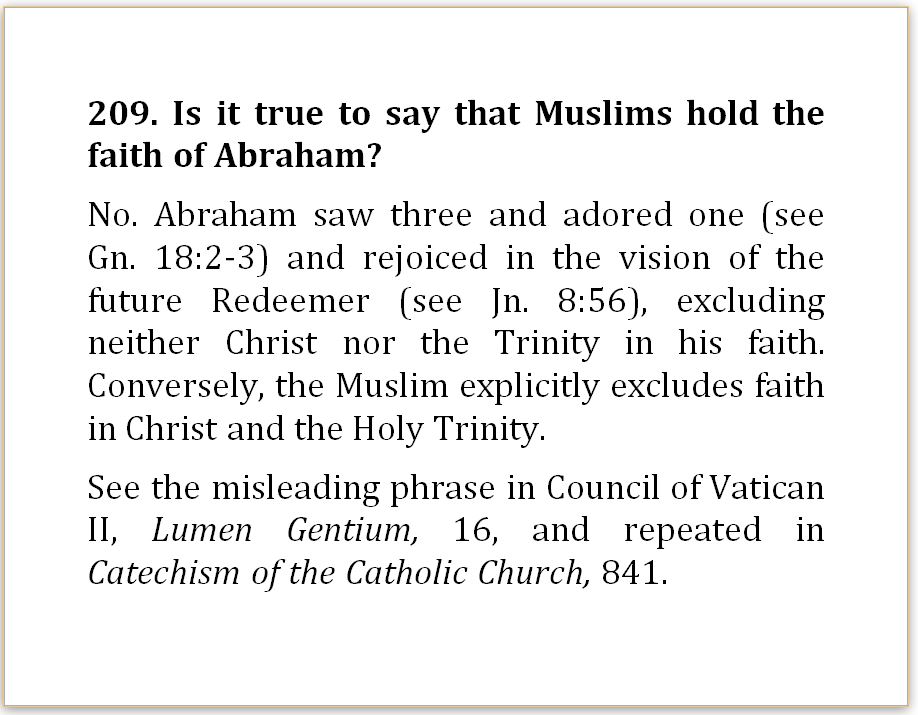
Bishop Schneider’s CREDO #209

Again, note that Bishop Athanasius Schneider presumes to correct recent popes, Vatican II and the universal catechism.

His arguments are not new, as they have often been mouthed, not simply by the SSPX but by sedevacantists who argue the chair of Peter as vacant since Pope John XXIII. Bishop Schneider will not come out and deny papal authority; however, he does make various insinuations, especially later in the text when he speaks about the lack of certainty regarding canonizations. Is he sowing doubt about the newest saints, Pope John XXIII, Pope Paul VI and Pope John Paul II?

He renders a rather peculiar interpretation of Genesis in light of John 8:56 as a revelation of the Trinity given to Abraham long before the New Testament. Biblical exegetes suggest it is merely a reference to the birth of Isaac (the child of promise) and the start of salvation history— it all begins with the pledge about Abraham’s seed coming to pass.

Here is the passage in the universal catechism that he calls misleading, i.e. wrong:

CCC 847 – “This affirmation is not aimed at those who, through no fault of their own, do not know Christ and his Church: ‘Those who, through no fault of their own, do not know the Gospel of Christ or his Church, but who nevertheless seek God with a sincere heart, and, moved by grace, try in their actions to do his will as they know it through the dictates of their conscience – those too may achieve eternal salvation.”

Pope John Paul II quoted the Council, saying:

“The Church also views with esteem the Muslims, who worship the one and only God, living and subsistent, merciful and omnipotent, the Creator of heaven and earth” (Declaration on the Relation of the Church to Non-Christian Religions 2).