
• Our Blogger

    Fr. Joseph Jenkins

  • An important theme for this blog is the scene in the New Testament where Jesus can be found FLOGGING the money-changers out of the temple. My header above depicts a priest FLOGGING the devils that distort the faith and assault believers. The faith that gives us consolation can and should also make us very uncomfortable. Both Divine Mercy and Divine Justice meet in Jesus. Priests are ministers of reconciliation, but never at the cost of truth. In or out of season, we must be courageous in preaching and living out the Gospel of Life. The title of my blog is a play on words, not Flogger Priest but Blogger Priest.

  • Archives

  • Categories

  • Recent Posts

  • Recent Comments

    Father Joe's avatarFather Joe on The Prayer to Saint Michael at…
    Inveilis's avatarInveilis on Ask a Priest
    Joanne M Rowan's avatarJoanne M Rowan on Reflecting Upon SSPX Dissent…
    Joanne M Rowan's avatarJoanne M Rowan on The SSPX Makes It Itself Out M…
    Jeremy's avatarJeremy on Ask a Priest

Wailing & Grinding of Teeth

157453468758285119 (3)

Matthew 8:11-12 – “I say to you, many will come from the east and the west, and will recline with Abraham, Isaac, and Jacob at the banquet in the kingdom of heaven, but the children of the kingdom will be driven out into the outer darkness, where there will be wailing and grinding of teeth.”

We should not presume that just because we are Catholics in the true Church that we are necessarily saved and all others are damned.

It is true that the Church is the great sacrament of saving encounter with Christ. However, there are too many Sunday saints who are weekday devils. Many have compromised the faith. Most Catholics fail to keep the precepts of the Church and rarely go to Mass. They pray when they want something but rarely offer prayers of praise, thanksgiving and contrition. They are formed more by the world than by the Gospel. As for those who attend Mass, yesterday on the celebration of Christ the King, I asked, “Do you belong to Christ as a member of his royal family and kingdom or are you owned by the world?” The values of the kingdom make believers into living signs of contradiction to the world. This is why so many are listed as martyrs of the pagan Roman Empire. Jesus tells his disciples that they must love those who hate them, forgive those who hurt them, and give to those who steal from them. (Rome thought the Christians were insane and dangerous for a military kingdom that preferred the fear of enemies over mercy.) The proclamation of the Gospel still makes the world nervous. The Church speaks for the dignity and rights of immigrants, even those so desperate that they cross our borders without authorization. The Church speaks for the sanctity of life for children from conception to birth; and yet there are so-called Catholics who rejoice over the legalization of murdering children ready to be born. The Church speaks for the stewardship of a planet that gives honor to the Creator and against any short-term exploitation that will have lasting dire consequences. The Church speaks for the poor and their advancement and value even when so many of their so-called champions secretly look down upon them and promote dependency. There are Catholics on both sides of the divide but it is more than differences of opinion or just partisan politics— to which kingdom do we really belong? One is affiliated with the communion of the saints in heaven. The other belongs to the “outer darkness.”

Luke 13:24-30 – “Strive to enter through the narrow door, for many, I tell you, will attempt to enter but will not be strong enough. After the master of the house has arisen and locked the door, then will you stand outside knocking and saying, ‘Lord, open the door for us.’ He will say to you in reply, ‘I do not know where you are from.’ And you will say, ‘We ate and drank in your company and you taught in our streets.’ Then he will say to you, ‘I do not know where you are from. Depart from me, all you evildoers!’ And there will be wailing and grinding of teeth when you see Abraham, Isaac, and Jacob and all the prophets in the kingdom of God and you yourselves cast out. And people will come from the east and the west and from the north and the south and will recline at table in the kingdom of God. For behold, some are last who will be first, and some are first who will be last.”

Some seem to suppose that pretty much everyone will be invited into heaven.

There is way too much presumption about salvation. Given that I am more stout or rotund than two men put together, I have often joked that I seek to make as many friends among the saints as possible. Why? So that when I find myself at the narrow door I will have friends pulling me from within and pushing me from behind. Maybe that will be my purgatory? The narrow door is likened to the gate into Jerusalem known as the Eye of the Needle. It is low and narrow so that even the camels have to enter on their knees. That is the secret that Jesus tries to get across. What would be impossible can be made possible by the favor of God. The man rich in the world but spiritually bankrupt will have trouble entering the narrow door. What might save such men is a posture of genuine humility and sorrow for sin. I am reminded of the parable of the Pharisee and the Publican (Luke 18:8-14). The Pharisee lacks humility and takes self-righteous delight in his standing and virtue as compared to the tax collector who honestly acknowledges his sinfulness and beseeches God for forgiveness. Given the recent scandals, I have to wonder that even church leaders will stand before the Lord and hear those most terrible words, “I tell you, I do not know you.” St. Pope John Paul II speculated about an invisible church. Not denying the unique salvific value of the Catholic Church, God can save whom he wills and he knows human hearts. When it comes to social and moral efforts as with helping the poor and promoting the sanctity of life, we have many coworkers outside the Catholic Church. Indeed, Catholics who take their discipleship seriously are often surprised to find kindred spirits who love Jesus in other denominations while many fellow Catholics live as if there be no God.

Matthew 13:40-43 – “Just as weeds are collected and burned up with fire, so will it be at the end of the age. The Son of Man will send his angels, and they will collect out of his kingdom all who cause others to sin and all evildoers. They will throw them into the fiery furnace, where there will be wailing and grinding of teeth. Then the righteous will shine like the sun in the kingdom of their Father. Whoever has ears ought to hear.”

Are we wheat or weeds?  What have we planted in others?

The Lord gives us a powerful apocalyptic vision. I have imagined the sky opening up and angels bursting forth each waving a sickle to harvest souls. Every one of us needs to reflect upon his or her life and standing before God. Are we wheat or are we weeds? The wheat is food and has value. Do we feed others with our very selves in imitation of Christ who joins with to us and makes himself our saving food? We are commissioned to share the faith so that others might come to the table of the Eucharist. The Lord feeds us with his Word and sacrament. Discipleship means not only making sacrifices or giving up things; we must surrender something of ourselves. As churches announce in fiscal campaigns, we are called to give “time, talent and treasure.” We work with others for the common good. Jesus is the bread of life and grace will transform us into what we receive— the mystical body of Christ, a saving bread for others. The parable of the wheat and the weeds comes to mind (Matthew 13:24-30). An enemy plants weeds among the farmer’s wheat. Given that pulling out the one would hurt the other, the weeds and the wheat are permitted to grow together. When harvest time comes, they will be sorted and the weeds will be tied into bundles and burned. The wheat will be placed into the barn. The wheat or the righteous will have a lasting place in the kingdom. The weeds or the damned will know judgment and fire. Weeds are good for nothing. St. Augustine speaks about this as two cities living one within the other. As to which city we belong will not be disclosed until the harvest.

Notice that the weeds are likened to those “who cause others to sin and all evildoers.” There are many people today who enable or encourage the sins of others. They step back and say things like, “who am I to judge” when we should give voice to the commandments of God. (Each of us needs to judge right and wrong in conscience as informed by the commandments of God and the teaching Church.  However, we leave the ultimate judgment of individual souls to almighty God.) How many times have we heard people say that they were “personally opposed” to abortion or accepted Church teaching against “homosexual acts” but did not want to “impose” their faith and values upon others? Many couples cohabitate without marriage and many others live in irregular unions (adulterous relationships or same-sex bonds) and we either turn a blind eye or “accompany them” through life as if this is normative or pleasing in the eyes of God. (“Accompaniment” in its true sense means assisting brothers and sisters to walk in the way of Christ, sharing the truth about right and wrong and giving good witness.  It does not mean a passive tolerance for sin and/or silence when others need to hear the saving Word.) The righteous or holy person would be understood as those who do good works and inspire others to do so as well. The righteous will “shine like the sun.” This might be another hint that the fire that destroys the weeds will leave the wheat unharmed. As with the burning bush, we will be imbued with the fire of the divine presence but will not be harmed.

Hell is Never Saying You’re Sorry

157453468758285119 (1)

I was asked one time, “Father, do you think the damned in hell are sorry for their sins?”  Given the terms we use in the Act of Contrition, the answer is no.  The damned souls carry with them their malevolence or spite.  The animosity or ill will that precipitated evil acts has eternally infected them.  Perfect contrition would require loving God and regretting how they have dishonored him.  This love cannot enter hell.  The pain derived from the loss of heaven and the fear of hell in imperfect contrition might have saved them but they tarried too long in returning to the Lord.  This level of sorrow only has meaning outside of hell and in this life.  Death forever fixes a person’s spiritual state, either convicted of sin in hell or as one found worthy of heaven, albeit possibly after purgation.  The damned might not like the consequences of their sins but that is inconsequential.  It changes nothing.  It amounts to nothing.  Like the demons, they wear their sins; they become sin.  If there is any regret it is understood in terms of resentment toward judgment.  Popular depictions of hell are often heavily weighted toward sadism.  But it is probably wrong to assume that all the damned find satisfaction in suffering or giving pain.  The sense of loss is real and lasting.  There is a frustration that cannot be escaped.  They were made for God and yet they have denounced him.  They have damaged themselves.  They are irrevocably broken and can never be fixed.  They settled for less when they could have had everything that mattered.  Dante imagined that the regions of hell reflect the sins with which people most commit.  This bondage is made permanent after death.  Even in this life people tend to identify themselves by their sins.  They could be ever so much more.  Important questions arise for those still in pilgrimage here on earth:

  1. Do you love God and neighbor as you should?
  2. Do you hate sin and are you sorry for offenses?
  3. Have you repented and made an amendment of life?
  4. Have you sought God’s mercy and his absolution in the Church?

God is not capricious but time is quickly running out.  Too many have become comfortable living in mortal sin.  These are the living dead among us.  Yes, there is a tragedy for those who die in sin and are lost; however, there is a tragedy here-and-now for missed opportunities.  How many others might be lost because we failed to be the Christians we were called to be.  How many have been forced to suffer abandonment, oppression, poverty and pain because of our failure to care— our failure to love?  We do not know the day or the hour that the Lord will come for us.  That last moment we live in this world will be frozen for eternity.  What is our spiritual and moral orientation?  Are we molded by grace and discipleship so as to be transformed into saints?  Are we spiritually disfigured by vice and sin into something monstrous and shameful?

The measure for spiritual transformation is always charity.  Jesus tells us a parable about a rich man who ignores the needs of a beggar that lives on his doorstep.  His state is so lamentable that the dogs licked his sores.  Where there is a failure to love, people are often stripped of dignity.  The beggar Lazarus is walked over like a doormat; worst yet, he is reduced to dog food.  The rich man is aware of his plight but just he does not care.  Death balances the scales.  The beggar is translated to the side of Abraham in paradise; the rich man finds himself tormented in the abode of death.  He is literally in hell.  The rich man does not rejoice at the beggar’s good fortune.  There is no praise for divine justice.  Even in hell, the rich man remains locked in his preoccupation with self.  He cries from far off, “Father Abraham, have pity on me. Send Lazarus to dip the tip of his finger in water and cool my tongue, for I am suffering torment in these flames” (Luke 16:24).

The damned have neither a bucket nor a cup.  They cannot cup their hands as it looks too much like a gesture for prayer.  Jesus makes himself the great sin offering, dying in our stead.  Nevertheless, even on the crosses beside his, there is one who trusts Christ and another who curses him.  Jesus says, “I thirst.”  This thirst is a consequence of all the sins of the world, a burden that he takes upon himself on Calvary.  He would thirst for a moment so that those who believe in him might receive a living water and never thirst again.  Those in hell have rejected this refreshment.  Their thirst cannot be satisfied.  Yes, even if the water be brought to them they would still thirst.  Not only do the damned have no cups— they have forgotten how to drink.

Three Points about Hell

157453468758285119

A priest friend of mine wrote recently that given the current cultural climate any reasonable discussion about hell is difficult.  While I would admit that many wrongly deny the existence of hell or any form of external judgment toward what the Church deems as “sinful” behavior; I would disagree that this makes such a conversation difficult.  We live at a time in human history where certain sins cry out to heaven for judgment.  Millions of children are destroyed in the womb as unwanted and unloved.  Christians are suffering martyrdom at the hands of militant Islamic religious extremists around the globe on a scale that is staggering.  Women and children, in particular, are increasingly victimized by human trafficking, prostitution and pornography.  Much of the world is weighed down by oppression, wars and a crushing poverty.  While there may be jobs, too often people do not make a livable wage.

Whenever and wherever the theological virtues are assaulted, a window is opened to the reality of hell.  Dante understood this with his entry warning to those who would cross over to the Inferno, “Abandon hope all ye who enter here.”  Those who have despaired and lost hope are already beginning to experience hell.  The gift of hope is closely aligned to the mystery of love.  We do not live in vain.

We are loved by God and valued as precious and irreplaceable.  The growing atheism gives people a taste of the alternative, abandonment.  It is the price tag that comes with not believing.  The larger cosmos does not love us.  It does not care if we live or die.  Often people think that the opposite of love is hate and that it is hate that rules hell.  I suspect that it is not hate but an apathetic indifference that prevails.  We are not prized enough by the devil to even be on his radar.  Hatred at least would signify acknowledgment.  The devil hates humanity but individual persons are invisible to him— they are nothing and have nothing of value to him.  He couldn’t care less what happens to us.  Note that while the Church speaks of the communion of the saints in heaven, we do not mention any appreciable community in hell.  It is as if there be as many hells as heads, each soul locked in a cell of its own making— shut off from God— cut off by inward looking selfishness from any other person, human or angelic.

In addition to hope and love, we are called to keep faith in Christ, our saving Lord.  Deliberately turning away from Christ, plants us on the road to perdition.  We cannot save ourselves.  We are made for God.  Separated from the Lord and we are eternally frustrated, unable to be what we are called to be.  The pieces of the puzzle that make up our existence are assembled and yet when all is said and done, the damned person finds that a piece is missing.  He or she will never be whole or complete.  Only God can fill the emptiness inside.  Without God, flame or no flame, the darkness consumes us.  If there is a good God then there must be judgment.  Given the gravity of sins around us, divine justice demands it.  The scales must be balanced.  If heaven and purgation are expressions of the Divine Mercy, then hell is the full and necessary realization of divine justice.

The active will of God seeks our salvation.  The mystery of sin and hell can only be understood in terms of God’s permissive will.  God created the human race, not to be mere animals of instinct or remotely controlled robots.  God gives us a profound and terrible freedom.  This freedom is abused by our first parents and their rebellion is confirmed by the sins of men and women throughout history.  It is only in Christ that we can respond to God as we are commanded.  God does not directly intend evil.  He would have us rightly use our freedom; but, he will also not stop us from misusing it.  Divine providence will prevail as we see with the resurrection of Christ after having endured at our hands his passion and death.

1.  What God creates, God creates.

The divine economy will not permit the annihilation of souls.  This teaching is challenged by the Seventh-day Adventists and by the Jehovah Witnesses.  God by knowing us keeps us in existence from moment to moment.  He will not destroy those who refuse to love him in return and reject a place in his kingdom.  He will not forget us.  The mystery of Christ teaches us that love is stronger than death.  It is in Jesus that divine love conquers the grave.  We are made in the image of God.  While bodies without souls are corpses, our souls have no parts and cannot break down or die.  We are promised restoration, body and soul.  Jesus tells us that in his house there are many rooms.  He will not force us to enter his house.  The damned refuse the invitation to make a home with God.  If heaven is fashioned by God; hell is built brick by brick by the damned, themselves.

2.  God’s love for us is unconditional and eternal.

God is immutable and can no more stop loving us than he can deny himself as personified love.  God loves everyone, including sinners who reject his love. This teaching is rejected by the Calvinists and Jansenist churches.  They would insist that God hates unrepentant sinners as well as the damned in hell.  It is a tenet of Jansenism that God wills for the damnation of most; only a certain few are predestined for salvation and that only they would be moved to repentance and to receive divine grace.    By contrast, we as Catholics speak of Christ dying for all while only the many would make the redemptive offering of Christ their own and thus embrace salvation.  Salvation is a gift that must be accepted.  It requires a disposition of openness toward God and his love.  Our Lord wants us to imitate divine love and mercy.  He tells us to love those who hate us; and to forgive those who hurt us; to give to those who steal from us.  Indeed he says that we must be made perfect as the heavenly Father is perfect.  The soul that rejects Christ, either in venial or mortal sin, is the perpetrator for the passion and death of Christ.  Some of our number will reject the overture of redemption.  They will play the part of Judas and Herod.  Christ dies on the Cross loving those who murder him with their sins.  There is an eternal dimension to this love.  This is the measure of meaning behind the Sacred Heart devotion.

The theme of love and life are joined in the Christian faith.  The love of Jesus makes possible our redemption and share in eternal life with God in heaven.  Eternal death is not annihilation but damnation in hell.  Just as we are commanded to love our enemies; God loves his and sustains them in existence. The damned suffer but God withdraws as much as possible knowing that their hatred and his love is a tormenting combination. He draws away all but a spark of his loving presence so that the damned souls may remain in existence.

Perhaps at the very first instant of creation, God veiled something of his infinite goodness and allowed the angelic hosts a decisive moment that either perfected or corrupted their nature forever.  The good angels remained in heaven, always seeing the face of God and giving him glory.  The demons fled to hell, fleeing the divine presence so as to hide their shame and spite.  Our own first parents failed their test in the primordial garden.  They were cast out of paradise.  There would be no preternatural gifts.  They had broken off their friendship with God.  But God would not give up on them.  He promised a messiah and a future reconciliation.  That is realized in the saving work of Christ.  At the moment of death, like the angels before us, our stance before God is made permanent.  God loves us but he will not force us to love him.

3.  Hell is not the opposite of heaven.

Nothing compares to heaven.  The saints find their communion in divine love.  They are invited to live within the Trinity forever.  They see God who is the perfection and source of every good.  The saints possess God but they can never perfectly envelop him.  The distance between the creature and the Creator is infinite.  The divine mystery can never be exhausted.  Hell is defined not so much by what it has but by what it is missing.  Except for the spark of God’s love that torments the damned and keeps them in existence, God has withdrawn his face.  The master of hell, if it has one, is not divine but a creature.  Satan or Lucifer may have been a great archangel, likely a Seraph although some have speculated that he might have been an uppity Cherub.  He epitomizes the old saying, “the bigger they are, the harder they fall.”  He loses everything.  It may be that a third of heaven rebelled with him.  When speaking of Hell, the late Catholic evangelist Frank Sheed spoke of it as doctrine but said that we can hope that the devil is “lonely” even if unlikely.  Where heaven has joy; in hell there is pain to the senses (fire) and the pain of loss.

Hell is an abode of evil but there is no such thing as pure evil.  Evil is defined as the privation of a good that should be present.  What goods can we find in hell?  There is life or existence, even if there is pain or unhappiness.  The damned are aware.  Their wills are corrupted but still operative.  Angels and men in hell also have working minds. Unfortunately, fallen angels and damned men, alike, have forfeited saving grace.  God is not a monster.  He does not want us to suffer.  Art and literature often depicts the demons and damned as having make themselves into monsters.  Just as our Lord speaks of many rooms in his heavenly house; I suspect that there are various levels of hell depending upon the depth of one’s rejection of God and sinfulness.  However, it is difficult and probably unhelpful to reflect upon what constitutes commensurate suffering among the damned.  When I have pondered how the damned might keep busy it seems that all that really remains is the employment of the intellectual life.  But I would not want to take this too far and speculate about the nature of discourse or debate in hell.  When I mentioned this to one critic, he said, “Great, you would put the theologians who wrestle with God’s truths in heaven where they can find absolute certitude and you would deposit the philosophers in hell where they can endlessly debate the meaning of life with its decisions, actions and consequences.”

Reflections on World Day of the Poor Homily

This past Sunday was WORLD DAY OF THE POOR the Holy Father gave a homily that weaved a message about how we should concentrate upon the things that last and the need to acknowledge the poor.

world-day-of-the-poor-logo

Pope Francis states that “we must not follow the alarmists who fuel fear of others and of the future, for fear paralyzes the heart and mind.” Yes, fear must be confronted if we are to have a courageous faith. I have seen people freeze in their tracks because they are frightened or anxious. The apostles demonstrate in the garden that those who are afraid often try to run away or go into hiding. Of course, none of us can escape the gaze of God. Today we are fearful about many things. We worry about paying our bills, about the lessening state of our health, about what will become of our children, and about the negative changes and confusion in the world and in the Church around us

It may be we often have just cause to be fearful of the future, just as the Holy Father has presumed in terms of the environment. Have not many become alarmists about pollution, global warming and the extinction of species. The desired response here is not to come to a grinding halt; but to act in a sensible way to avoid cataclysm and to insure a better tomorrow. It seems to me that many have their hands dirty if this “haste and fear” about the future is a always a negative temptation.

The Pope goes on to say:

“Yet how often do we let ourselves be seduced by a frantic desire to know everything right now, by the itch of curiosity, by the latest sensational or scandalous news, by lurid stories, by the screaming those who shout loudest and angriest, by those who tell us it is ‘now or never.’”

I am not sure what to say about this. One has to wonder as to whom this is directed. The desire to know the truth is a noble conviction. Many of us have a profound trust in revelation and in the long-standing teachings taught in the Catechism of the Catholic Church. We appreciate that the Pope and the Magisterium is not the master of these truths but rather their divinely-inspired interpreter or servant. No man stands above the Word of God, only under it. I would hope that the Pope intends no judgment against those offended by the abuses during the Amazonian synod (false worship and idolatry) or who insist that any pastoral “accompaniment” must also respect the traditional moral laws (amendment of life for adulterous unions).

157358893444805185 (9)The Pope is correct in his assessment that many today are “considered disposable.” He asks, “How many elderly, unborn, disabled and poor persons are considered useless?” He links the theme of haste to wealth arguing, that gaps are increasing, that the greed of a few is adding to the poverty of many others.” The parable of the rich man and Lazarus comes to mind. However, is the cause for the list of maladies here simply a love of riches? It seems to me that there is a deeper complexity here: the hardness of hearts, the development of the welfare state, an improper formation of values, the worship of youth, the failure of families to care for elders, the high cost of healthcare, etc.

Is it greed and the accumulation of wealth that principally fuels the reduction of persons as commodities? The false love of Satan certainly depersonalizes others. I know few people of wealth who deliberately and directly want to make life hard for senior citizens, or to turn a blind eye toward those with special needs and challenges, or to hurt and kill children or to oppress the poor. Indeed, many of them are very generous and charitable. Our Lord said that we will always have the poor among us. Is this “poverty” not a symptom of a broken world and original sin? The irony is that many so-called political champions of the poor seek to perpetuate the dependency of the poor rather than to expand opportunity and upward mobility. While a desire for inordinate wealth is often a problem, many who are rich use their resources to help others and to improve the world around them. The solution is not to make everyone poor or to punish ingenuity and hard work.

Pope Francis says that Jesus proposes “perseverance.” He defines it as a gift that preserves other gifts, keeping our eyes set on the Lord and neighbor and not passing things. The definition is a tad unusual. Persistence is usually understood as “doing something despite difficulty or opposition.” It is closely aligned to endurance. While such is definitely a theme in the Sunday Gospel, I do think that the Holy Father is forcing a number of themes into the Scripture passage. Awe at the sight of the physical structure of the temple is not really a love of wealth. Further, the theme of “perseverance” is not only about Christ’s “single-mindedness.” It is most fundamentally his instruction to take up our crosses and to follow him. We read:

“They will seize and persecute you, they will hand you over to the synagogues and to prisons, and they will have you led before kings and governors because of my name. It will lead to your giving testimony. Remember, you are not to prepare your defense beforehand, for I myself shall give you a wisdom in speaking that all your adversaries will be powerless to resist or refute. You will even be handed over by parents, brothers, relatives, and friends, and they will put some of you to death. You will be hated by all because of my name, but not a hair on your head will be destroyed. By your perseverance you will secure your lives.”

I would contend that this “perseverance” is more than “single-mindedness.” Rather, it is principally a profound dedication to the truth. We are to take up the work of Christ. We are to witness by word and action. When our Lord encountered Pilate, he told him, “For this I was born and for this I came into the world, to testify to the truth. Everyone who belongs to the truth listens to my voice” (John 18:37).

The Pope interprets Christ’s warning not to follow the many that will come in his name as a warning against “self-centeredness.” I would view this as the danger of deception. We are warned not to fall astray. There will need to be a measure of spiritual discernment. He is right that it is not enough to wear the label “Christian” or “Catholic.” There is much going on right now that feigns true faith. Orthodoxy is questioned. A false compassion has taken root.

Pope Francis uses the Gospel reading to discuss the tension between the rich and the poor. While it is quite true that the Church regards the poor as her treasure for which to care and protect; the reading really says nothing about this topic. Nevertheless, intricately linked to the Gospel passage or not we should note his words:

“The poor are valuable in the eyes of God because they do not speak the language of the self: they do not support themselves on their own, by their own strength; they need someone to take them by the hand. The poor remind us how we should live the Gospel: like beggars reaching out to God. The presence of the poor makes us breathe the fresh air of the Gospel, where the poor in spirit are blessed (cf. Mt 5:3).”

It is true that the poor remind us that we all play the part of the poor man before God. Everything is a gift. We are utterly dependent. However, do they necessarily “not speak” the language of self? There are many poor in the slums who are consumed by penthouse dreams. They may be materially poor but they are NOT always “poor in spirit.” I would not idealize the minds and hearts of the poor. A few become desperate and turn to crime. Many are angry at God and the world. A good number feel ashamed and want an opportunity to work and raise themselves out of abject poverty. Others feel abandoned and it is here we need to let them know that they are loved by God and the Church. The Church illumines this love as real by her intervention.

157358893444805185 (10)

Pope John Paul II stated:

“As individuals and as a nation, therefore, we are called to make a fundamental ‘option for the poor’. The obligation to evaluate social and economic activity from the viewpoint of the poor and the powerless arises from the radical command to love one’s neighbor as one’s self. Those who are marginalized and whose rights are denied have privileged claims if society is to provide justice for all. This obligation is deeply rooted in Christian belief” (Economic Justice for All, paragraph 87).


Reform & Failure of Cohabitation

157358893444805185 (8)

Challenge to Reform

We need to address a phenomenon which is rapidly becoming the norm in regards to those seeking marriage: premarital sexual relations and cohabitation. In reflecting upon this issue, the story comes to mind of Jesus meeting the Samaritan woman at the well. He challenges her to reform with the accusation that even the man she is living with now is not her husband. He offers living water which will never leave her thirsty. He is, of course, offering her a chance to reform, a new beginning. In response, she runs to the town and proclaims her witness to this figure Jesus who knows everything about her. Instead of avoiding her, as Hebrew men of that time are accustomed to do in reference to strange women, he speaks to her, a woman, a foreigner, and a sinner. Instead of condemning her, he allows her sins to speak for themselves and as a balm to the shame they precipitate, he offers forgiveness and healing. This incident is important for us. Couples need to discern that their personhood is intricately bound up in their sexuality and that its full expression can only adequately be within the covenant of marriage. Anything else falls into the category of sin. In addition, this story speaks to those who are the shepherds of the Church, who while not collapsing proper moral values under the weight of secular-materialism and post-Christian hedonism, need to exhibit compassion and understanding.

Failure of Living Together

The charge is sometimes made that living together prior to marriage gives a couple an insight as to how they shall interact as husband and wife. Many thus see these informal unions as trial marriages. However, the statistics show that the divorce rate among couples who live together before marriage is higher than among those who do not. Those who remove God from the equation are stumped for a logical rationale for this statistic. My answer is that God remembers those who remember him. A relationship, not approved by God and a matter of mortal sin, can neither claim comparison to Christian marriage nor act as a preparation for it. God grants his favor and pours actual graces into valid marriages; he offers no such helps to those in serious sin.

What happens when divine help and grace is withheld? During my ministry, I have been much taken aback by the number of individuals, both male and female, who have come to the rectory door in terrible grief over the estrangement of a partner. No sooner would they reach the parlor that they would burst into tears. One young man told me that just the night before, he and his girl had made love. Repeatedly, she confessed her love to him. Come that morning, after a two year relationship, she was gone, leaving only the pain of rejection and a note pinned to his pillow saying that she did not love him anymore. Did this make any sense? No, but he should not have expected permanence from a lifestyle engineered for transience.


In the News: Women Priests

wpriests

I am reminded of a quote: “You can call a hen ‘a rooster’ but it still won’t make much of a difference in the chicken coop.”

Unless Christ intended women to be priests then this is only “dress-up.” Any action against the expressed will of the Lord would forfeit both the sacrament of holy orders and the Mass. That is too terrible a chance to take. This fact is evidence that despite many good intentions these women have a distorted understanding of priesthood, viewed more as personal empowerment than as gifted servanthood on behalf of the Church and directed toward the salvation of souls. Indeed, they place themselves at risk by incurring excommunication from Christ’s holy Church.

CLICK image for online article.

Preserving Purity

157358893444805185 (6)

As I pondered revising my remarks about cohabitation and premarital relations, written about thirty years ago, I wondered if maybe I had made a mistake by addressing bad behavior instead of giving the gravity to good or wholesome behavior. I suppose I thought that everyone should already know right from wrong. This presupposition does not hold today and I am not sure it did then. Maybe 66% or more of those asking for marriage in the Church are already living together? Large numbers of such couples are no longer seeking true marriage, ever!

How should couples act prior to marriage? I would like to offer certain recommendations:

FIRST, the whole dating scene is a mess. We should opt for the older practices of courtship. Dating today is an excuse for “making out” and compromising virginity. Younger children should not go out on dates and older teens should be chaperoned. Young adults need the mindset that stepping out with the opposite sex is not simply for a good time, but part of the search for a future mate. Dating is transitory. Courtship plays for keeps!

SECOND, both men and women should prize their purity and do all they can to preserve it as a gift for their future spouse. There should be no double-standard or leniency for men to misbehave. As for women, it is not true feminism or liberation to be as sleazy as certain men. Restraint in this area shows strength of character and a discipline that will keep them in good stead within marriage. Today, we must also contend with sexually transmitted diseases which infect millions, sometimes with lethal consequences. Sex kills! This is contrary to its very purpose. The only sure way to remain clean of infection is for a couple to remain pure and to enter upon the marriage bed undefiled.

THIRD, modesty in speech and dress should rule the day. Vulgar flirtation and immodest dress is in vogue starting with pre-teens and going into adulthood. Many complain that styles are so risqué that it is hard for true ladies to find decent clothing. Some women have resorted again to making their own dresses. Men and women are not the same. One pretty but flirtatious girl who had every boy’s eye remarked to me that she stopped short of getting the boys’ motors running. Poor thing, I explained, boys’ motors are always running! The best of young men can be quite weak in the flesh and they need good girls to keep them good. Young men should not lie or compel favors from women with their physical strength. Women should not tempt men with their clothes, or lack of clothes, and suggestive speech. Those who play games with the flames of passion are likely to get burned.

FOURTH, we should avoid those persons, places or things that can lead us into sin. Bad companions are problematic for both children and adults. Those who would lead us into sin and refuse efforts at conversion or change are best avoided. Girls who like dangerous bad boys often pay a terrible price and the loss of a good reputation. Boys should hang out with nice girls, the kind they might find regularly at church. Church groups, respectable public places, clean movies, and a parent’s dinner table are great places to meet and spend time. Bars and secluded car parks are no good. Definitely they should not share motel rooms or cohabitate. When couples are alone the defenses often go down. Things can also corrupt relationships, like bad movies, dirty magazines and lewd television programs.

FIFTH, while showing compassion to those who make mistakes, we need to retain a sense of shame for scandalous activity. I recall a teenage girl who had a child and everyone kissed and admired the beautiful baby. We were thankful that a pro-life decision was made. However, I was troubled that she showed no remorse or embarrassment at having given away her virginity or having an illegitimate child. Most babies in the past born to such girls were given up for adoption. The stigma served a purpose and its eradication is no service to other girls who might make a similar mistake. God draws good out of evil. But our sin remains and needs confession and absolution.

SIXTH, it is best to pursue love interests among friends who share our faith and values. Just because another person is Catholic is no longer insurance that he or she takes our faith and morals seriously. Mixed marriages (with non-Catholics) should be discouraged but, in any case, the young man and woman should be on the same page about morality and the significance of marriage. If they should decide to get married, they should both affirm that divorce will never be in the cards. Chastity is important because fornication before marriage opens the door to adultery after marriage. Once you take sex out of marriage it is very hard to put back into the box. Spouses should be best friends. There will be differences, but also many preoccupations held in common.

SEVENTH, we should insist upon a component of prayer and worship with those who are courted. If the couple do what is right, pray regularly and go to Mass together, the odds are that they will remain faithful to marriage until one of them dies.

Sacred Cross or Sacred Tree?

157358893444805185 (3)

The ceremony in the Vatican gardens to Mother Earth should be a warning to us about the dangers of any environmentalism that is detached from good science and sound religious teachings about our stewardship over creation. We take care of the world because it is God’s gift to us and what God creates is good. There is no divinity that can be identified with nature. We do not worship the world but rather the one who made the world. We do not preserve nature for its own sake. Rather, we realize that we diminish or hurt ourselves by the destruction of our habitat and the species with which we share the earth.

The female indigenous leader who planted a “sacred tree” in the Vatican Gardens was quite clear about the syncretistic and pagan meaning associated with the idols and rituals. She explained that it was to “satisfy the hunger of Mother Earth” and reconnect with “the divinity present in the Amazonian soil.” Catholicism has always rejected any pantheism that identifies the divinity with the things of nature.

All created things possess something of the divine spark or God’s power that sustains them in existence; however, God cannot be identified with any created things other than the God-man, Jesus Christ. The idolatry here is deeper than the “pachamama” statues but also includes the soil and the “sacred tree.” Indeed, the “pachamama” as a false deity is historically regarded as a harsh goddess demanding sacrifices. Her worship signifies the inclusion of paganism into what should now be a Christian culture. It is also a feature in current New Age religion or cults.

The Brazilian Ednamar de Oliveira Viana offered an explanation about the Vatican Garden tree-planting ceremony:

“To plant . . . is believing in a growing and fruitful life to satisfy the hunger of Mother Earth’s creation. This brings us to our origin by reconnecting divine energy and teaching us the way back to the Creator Father.”

Instructing the participants to bow before the “pachamama” statues, she added:

“The Synod is to plant this tree, water and cultivate, so that the Amazonian peoples are heard and respected in their customs and traditions experiencing the mystery of the divinity present in the Amazonian soil.”

Pope Francis helped to shovel the dirt but little more. The video of him doing this reminded me of our planting of trees as school children on Arbor Day. But there is something much more sinister behind this. (A connection might be made with the so-called “sacred trees” of present-day Wiccans with their nature worship. Similarly, Celts and Druids worshipped trees until St. Patrick’s victory over paganism.) Peruvian “sacred” trees are regarded as sacred beings. Again, it is associated with “living energy” and “spirits in nature.” Given this understanding, I would not be surprised if someone were to soon give the tree the axe and we were to see it following the “pachamama” down the Tiber. The one true tree that matters to Christians is the cross of Jesus. We must be ever mindful that sin, suffering and death come from the living tree in the primordial garden; mercy, healing and eternal life come from the dead tree of the cross.

The Pachamama Crusaders

157358893444805185 (5)

The now famous or infamous online video of the young Austrian men (led by Alexander Tschugguel) throwing the “pachamama” idols into the river may be an action that subsequently speaks louder than the entire official synod on the Amazon. Many of us who earnestly seek to be orthodox in faith and worship could not help but to respond favorably: “Good work boys!” We venerate statues of holy persons, but we do not worship them. These monstrosities crossed the line. Those who allowed false worship and idolatry in the Vatican should race to confession and beseech the mercy of Christ. Critics have been severe in their judgment: “Those who defended their inclusion must be morally and spiritually sick.”

While it was explained to him that they were “signs of fertility, of Mother Earth, and integral ecology,” Alexander Tschugguel saw the idols for what they were, a violation of the first commandment. The Holy Father explained that no idolatry was intended and he apologized to those offended by what the boys did. The first part of the Decalogue is clear:

“I am the LORD your God, who brought you out of the land of Egypt, out of the house of bondage. You shall have no other gods before me. You shall not make for yourself a graven image, or any likeness of anything that is in heaven above, or that is in the earth beneath, or that is in the water under the earth; you shall not bow down to them or serve them” (Exodus 20:2-5; cf. Deuteronomy 5:6-9).

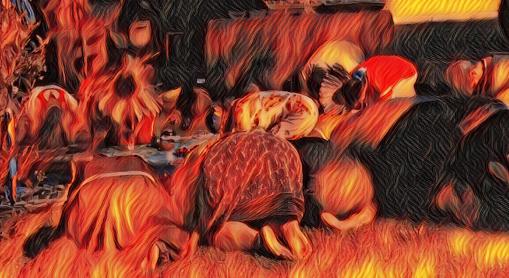
What many of us would consider witchcraft in the Vatican Gardens included a ritual dance around a blanket on the grass upon which were two idols of a naked woman, apparently a pagan goddess. Next to them was a statue of a man with an erection. A female shaman, wearing a feathered headdress, lifted up her hands for an invocation. Her sixteen concelebrants knelt and bowed to the idols that rested upon the blanket.

When the idol was presented to the pope, he crossed himself. The shaman shook her rattle around those assembled. The syncretism of pagan and Christian elements was clear. Although a few churchmen suggested that the idols were depictions of Our Lady of the Amazon (which looks totally different), Fr. Giacomo Costa, an official with the Amazon synod, explained that the wooden depictions of a nude pregnant woman were not of the Virgin Mary, but were figures symbolic of life. Nevertheless, in truth the “pachamama” was reckoned as much more, as Mother Earth or literally “World Mother.”

157358893444805185 (4)

Idolatrous intent or not, these are idols and false worship was permitted (there is video proof). This ranks with the biblical scene where the Almighty tells Moses that his people have corrupted themselves.

“They have quickly turned aside from the way I commanded them, making for themselves a molten calf and bowing down to it, sacrificing to it. . . .”

Although made of wood, the “Pachamama” idols signify the worship of a fertility goddess of the earth. This new “golden calf” had no business within the church dedicated to Saints Peter and Paul. Infuriated by the idolatry, a couple of young Austrian men took the idols from the church where they were on display and threw them into the Tiber River. The images were recovered later and the Pope apologized for what the boys did. I think bishops and priests in leadership need to apologize to the Church and to God. Are we more concerned about not hurting feelings or about saving souls? We should thank the boys for reminding everyone that our focus is on Jesus Christ as our Lord and Savior. The passive toleration and extolling of false pagan worship is a sin. My only complaint with the boys is that the figures should have been physically destroyed before being discarded into the Tiber. Were the boys criminals? I would argue that they answered to a higher law. As with the Arian crisis, if the bishops should fall into heresy or fail to act, there is a faithful remnant that will uphold the true faith.

The statues were recovered but not exhibited during the closing Mass of the synod.


A Synod & an Uncomfortable Pope

157358893444805185 (2)Despite attestations to the contrary, the images and video recordings of rituals around the “pachamama” statues at the Amazon synod has led to charges of idolatry and has ironically damaged efforts at evangelization. Indeed, many of the evangelical Protestants and/or Pentecostals (who are making converts in droves) are now pointing to this scandal as so-called proof that Catholicism is not a genuine form of Christianity. It may be that so much attention was given to the orchestration of the dialogue and documents that insufficient guidance was given to the scandalous indigenous images and questionable rituals that many wrongly felt were the fluff of the synod.

I mentioned in a previous posting that “Some have suggested that given the charges of syncretism and idolatry leveled at the peripheral activities around the synod deliberations, any conclusions from the conferences forfeit credibility and importance for any later papal exhortation or summary based upon them.” Rather than a message that is conditioned by culture; should we not be emphasizing the Gospel as a counter-cultural proclamation anywhere and everywhere? Speaking for myself, I find it hard to believe that the pope, cardinals, bishops and priests involved with the Amazon synod intended to be complicit with any sinful act of idolatry. It is my suspicion that the designated handlers for the side-event either lacked the theological sophistication to appreciate the ramifications of certain elements or else the ceremonials got quickly out of their control. It is evident that many of those involved or in attendance were confused about what was happening.

Various contradictory explanations were offered by churchmen that also conflicted with the expressed paganism spelled out by the indigenous people given charge. The “pachamama” images were errantly detailed as images of the Virgin or as depictions of Mary and Elizabeth at the Visitation or as symbols for life. However, it became increasingly clear that critics condemning this as idolatry were apparently correct. Subsequent remarks by involved churchmen and even by the Pope were efforts at damage control. The worry about the theft and the discarding of the images was that the indigenous people invited to the synod would feel insulted or hurt.

Note in the garden ceremony the pope did not sit in what appeared to be a presider’s chair but deliberately sat with other observers. He looked uncomfortable. When presented with a black tucum ring (associated with liberation theology) he quickly took it off. Notice also the posture of the Holy Father during the garden service. He tended to cast his eyes downward, toward his feet. When presented with the “pachamama” he hesitated in blessing it and instead crossed himself. When there was some insistence that he receive the object, he made a small sign of the cross over it. Was he blessing the object, as he does routinely for so many things presented to him, or was he trying both not to offend and to offer a minor exorcism over the statue? He set aside anticipated comments so as to avoid making any statement pro or con. Did the pope’s heart go out to those involved, confident that they meant well and not desiring to humiliate them publicly? Might he had forgiven them as little children dancing in a circle and playing a game of “Here We Go Round the Mulberry Bush”? However, the ambiguity of his actions and the clear syncretistic idolatry of the participants was certainly scandalous. The shaman would make the sign of the cross several times herself but the mixture of pagan and Christian piety would not give the activity legitimacy. While there was no “idolatrous intent” on the Pope’s part (as he says); this cannot be said for everyone else involved. The activity that was enabled was arguably wrong and a matter of serious sin.

While it might seem unbelievable, the Italian Episcopal Conference published its own pagan prayer to Pachamama back in April 2019.  Entitled, “Prayer to Mother Earth of the Inca Peoples,” it is as follows:

“Pachamama of these places, drink and eat this offering at will, so that this earth may be fruitful. Pachamama, good Mother, be favorable (propitiated)! Be favorable (propitiated)! Make that the oxen walk well, and that they not become tired. Make that the seed sprout well, that nothing bad may happen to it, that the cold may not destroy it, that it produce good food. We ask this from you: give us everything. Be favorable (propitiated)! Be favorable (propitiated)!”

Aside from the question of who is or is not complicit, it is in light of such paganism that we must turn to genuine Christian prayer and make reparation.

Here is an oration recommended by a holy churchman:

PRAYER OF REPARATION
Recommended by Bishop Athanasius Schneider

imagesMost Holy Trinity, Father, Son and Holy Spirit, receive through the hands of the Immaculate Mother of God and Ever Virgin Mary from our contrite heart a sincere act of reparation for the acts of worship of wooden idols and symbols during the Synod for the Amazon, which occurred in Rome, the Eternal City, the heart of the Catholic world. Pour out in the heart of Our Holy Father Pope Francis, of the Cardinals, of the Bishops, of priests and lay faithful, your Spirit, who will expel the darkness of their minds, so that they might recognize the impiety of such acts, which offended your Divine majesty and offer to you public and private acts of reparation.
Pour out in all members of the Church the light of the fullness and beauty of the Catholic Faith. Enkindle in them the burning zeal of bringing the salvation of Jesus Christ, true God and true man, to all men, especially the people in the Amazon region, who still are enslaved in the service of feeble material and perishable things, as the deaf and mute symbols and idols of “mother earth.” Enkindle the light of faith in those persons, especially in the persons of the Amazonian tribes who do not yet possess the liberty of the children of God, and who do not have the unspeakable happiness of knowing Jesus Christ and having in Him a participation in the life of your Divine nature.

Most Holy Trinity, Father, Son and Holy Spirit, you are the one true God, besides Whom there is no other god and no salvation, have mercy on your Church. Look especially upon the tears and contrite and humble sighs of the little ones in the Church. Look upon the tears and prayers of the little children, of the adolescents, of young men and young women, of the fathers and mothers of families and also of the true Christian heroes, who in their zeal for your glory and in their love for Mother Church threw into the water the symbols of abomination which defiled her. Have mercy on us: spare us, O Lord, parce Domine, parce Domine! Have mercy on us: Kyrie eleison! Amen.