















 The Lord is ever so patient with us. Look at Matthew 13:24-43. Weed (sinners) and wheat (saints) are allowed to grow together. Where are we in this? What is our response to salvation and Christ’s coming kingdom?
We are told that God’s “mastery over all things makes [him] lenient to all” (Wisdom 12:16). In other words, God has nothing to prove. Just as God is almighty, and along with his power comes divine justice, he also possesses a boundless mercy. Indeed, he is forgiveness itself. As believers in Christ, along with the first people called by God, we are also called sons and daughters of God. “And you gave your sons good ground for hope that you would permit repentance for their sins” (Wisdom 12:19). While the promise of salvation has been fulfilled in Christ, the working out of the saving mystery in our lives is our occasion for hope. The difficulty is not with God but with us. Will we repent and believe? Will we remain steadfast afterwards? These are the fundamental questions that must be asked and finally answered for each one of us.
Turning to Matthew 13:24-43, we are given the parable of the wheat and the weeds, the mustard seed, and the yeast. Prior to the harvest, it may be difficult to distinguish the weeds from the wheat. It is the same way with people. A young woman argued with me once that there was no such thing as hell. All people, she said, are basically good. Over and over again, she asserted that a loving God would never do such a thing to anyone. Years later, after the divorce from an abusive marriage and the assault of her daughter by an assailant, she confided that sometimes she had trouble thinking God was good or that he cared. In any case, she had little difficulty in believing in hell as she had experienced a taste of it. Evil is real, although it is sometimes well disguised. The Church requires that we believe in the existence of hell, although as the lay theologian and street preacher Frank Sheed once insisted, we can hope that the devil is lonely.
Charity is the ingredient that distinguishes the wheat from the weeds. If the love of God and of neighbor is not present, then the yield is worthless. Wheat is made into bread and bread is life. We feed one another with our very selves in love, surrendering our lives for one another. Weeds are good for nothing other than burning. They give nothing– not life and not love. Do we take the existence that God has given us as an opportunity to pour ourselves out in loving service? Or, do we manipulate and drain the life out of others?
The parable of the mustard seed has been taken as an analogy for the mysterious and rapid growth of the Church, the kingdom of God breaking into the world. There is a similar understanding for the yeast. However, some authorities have also seen in them a message about the kingdom in each and every believer. The Hebrews saw the mysterious and life-giving hand of Jesus in the seed and in the yeast added to the flour. The soul must be willing to receive the seed or yeast. It must allow watering or kneading. In any case, the work is entirely that of God. The Father kept his promise in sending a deliverer, Jesus. Jesus is the Son of God who allows himself to be planted in the ground after he is taken from the tree of the Cross. He comes back to life and grants us a participation in his new life. We can see something of this organic model in the analogy of the vine and the branches.
If we refuse to allow ourselves to die with Christ, to remain grafted to him, then we cannot possess eternal life. The weeds mimic life, but offer nothing. This is what makes the matter so tragic and confusing. Good people sometimes do bad things. Bad people sometimes, despite themselves or for ulterior reasons, do good things. Who is who? It is no wonder that hypocrisy made Jesus furious.
Sometimes our error is not that we do things clearly wrong, but through omission, fail to do the works of love we should do. A wonderful story about this comes to mind regarding the famous essayist Thomas Carlyle.
He married his secretary Jane Welsh, an intelligent and good-looking woman. A number of years into the marriage she came down with cancer and became bedridden. Being a workaholic, Thomas only spent small snatches of time with her. After lingering for a while, she died. Following the funeral he happened by her diary next to her bed. What he read traumatized him to the depths of his soul. She had written a single line on one page, “Yesterday he spent an hour with me and it was like heaven; I love him so.” He began to awaken from his moral slumber. He had been too busy to be there for her. All the wasted time came to mind when he had ignored her. He felt the knife pierce his heart with the turning of the page, reading, “I have listened all day to hear his steps in the hall, but now it is late and I guess he won’t come today.” After reading a little more, he threw the book down and raced from his home. Friends discovered him at his wife’s grave, his face buried deep in the mud. He wept uncontrollably. It seemed he was trying to bury himself with her. He rambled again and again, “If I had only known, if I had only known.” Carlyle lived another 15 years, but his illustrious writing career ended that day. He had trouble forgiving himself for his preoccupation with fame and fortune, and his failure to love.
(Source: Article from “American Family Association” Newsletter, date unknown. Dr. Donald E. Wildmon, President).
All sin is a failure to love. We can bury our faces in the mud; but the remedy is to repent of our hardness of heart. If we truly love God and neighbor then we will regret our negligence and seek to bury ourselves with Christ, the one we murdered with our sins– the one we have often failed to appropriately love above all things.
St. Augustine tells us that in this world we cannot know for sure who belongs to what kingdom. However, manipulation and selfishness are true indicators of spiritual disease and maybe death. Should this cause us concern? Yes, most assuredly it should do so. However, while there is still mortal life there is hope that we will be counted among the elect, no matter how wicked we have been. Romans 8:26-27 tells us that “the Spirit too helps us in our weakness,” that our prayer and life might be brought to sincerity and authenticity. Psalm 86:16 gives us the posture or openness we need to render for the Spirit: “Turn to me, and have pity on me; give your strength to your servant.” We are all sinners. We have all fallen short of the glory of God. We are not the masters of our lives. Repentance is a prerequisite for faith— and love makes it all real.
For more such reflections, contact me about getting my book, CHRISTIAN REFLECTIONS.
Filed under: Catholic, Confession, Discipleship, Forgiveness, Redemption, Reflection, Repentance | Leave a comment »
 Sometimes the Church is falsely charged with the wrongful coercion of people into guilt-trips and/or with brain-washing the young through religious indoctrination. This allegation is unfair. What the Church wants people to know is that while we are guilty as sinners, we can know the forgiveness of sins in Christ. Religious formation in the truths of faith respects human freedom and conscience; but, objective truth remains what it is. Others skip condemnation of the Church and directly charge the Judeo-Christian God with intimidation and harshness, especially in regard to hell and judgment. Believers would argue that the critics have it backwards; intimidation and/or manipulation are precisely the tools of sin and the relationship of devils. If there is no genuine love, what other cohesive force is there for control? C. S. Lewis paints an image in his writings of big devils that literally eat the lesser ones– in other words, they use them to their own advantage without regard to their personhood and rights. Sometimes we might paint a picture of God’s justice that falsely falls into such a category. Hellfire images that threaten damnation from a wrathful God are a case in point. Do not get me wrong. Fearing the loss of heaven and suffering the fires of hell have their place. These are real tragedies. But people choose this fate for themselves, more so than by divine imposition. The prophets and our Lord were willing to endure any hardship for the saving message they delivered. Did they do this out of fear of almighty God or out of love? The answer is love. A true parent does not abuse or lie or callously manipulate children. Rather, he or she speaks the truth, even when it is unpopular, and makes every sacrifice to insure the well being of the family. May we all be imitators of God and speak with his voice.
 Peter stands before us in Acts 4:8-12 much transformed from the miserable figure we knew who denied our Lord three times. We are told that he is filled with the Holy Spirit and proclaims the Gospel without qualification or self-aggrandizing. A cripple is healed as a sign that his words ring with the truth. It is all realized in the name of Jesus Christ. He explains that Jesus, the stone rejected, has become the cornerstone: “There is no salvation in anyone else, for there is no other name in the whole world given to men by which we are to be saved” (verse 12).
 It is sometimes complained that Christians of the West seem apt to neglect the role of the Holy Spirit in their prayer, worship, and reflection. The Catholic emphasis often centers upon Jesus, his mother Mary, and the saints. However, the Holy Spirit is not utterly forgotten and is implicitly invoked every time we make the sign of the cross. The early Church discerned the power of the Holy Spirit in their midst as a personal encounter with God.
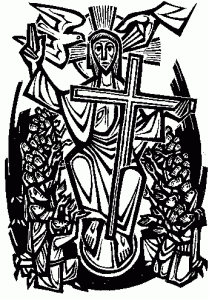 At this point I would like to say something about the liturgical year; more precisely, I would like to give a quick summary of the first week of Easter. The Gospels relate the resurrection appearances of Jesus. Easter Sunday, we have the discovery of the empty tomb; Monday there is the story of Jesus appearing to the women; Tuesday there is the sending of Mary Magdalene to tell the disciples of his restoration; Wednesday he reveals his identity in the breaking of the bread to the two men on the road to Emmaus; Thursday he reappears to these two while they are recounting the incident to his disciples; Friday he appears upon the shore while his friends are fishing; Saturday there is a brief summary from Mark of his earlier appearances and the narration of his coming to his followers while at table. Finally, John offers us two occasions where Jesus appears to his friends while assembled in the upper room.
 Jesus appears to his friends and wishes them peace (Luke 24:35-48). I want to speak briefly about this appearance and a connection we can make with it in our lives. When his friends doubt it is him, or fear that it might be a ghost, he tells them to look, to see, and to touch. He shows them his wounds and says, “…a ghost does not have flesh and bones as I do.” Then he accepts and eats a piece of fish with them. St. Luke is adamant in having us understand that he is really in this scene and no mere ghostly apparition or simply an internal feeling that he is present, as we sometimes sense at prayer. He is much more here.
 The cast of characters and events in John 20:1-9 fuel our hope. They include Mary Magdalene, Simon Peter, and John. But notice who is absent in our reading; although it is a Gospel and therefore about Jesus, he is neither seen nor heard. All we have is the empty tomb and some surprised disciples. The story, of course, goes on; but, the Church in its wisdom feels that this passage alone would suffice on Easter morning at Mass. Why is that? Let us look at the story.
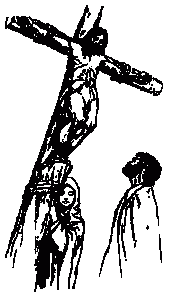 Jesus is our High Priest. Unlike the Jewish priests, he was not given his role by human authority and neither did he have any personal sin for which he needed to make an offering. Jesus took upon himself the punishment that was rightfully ours. Certainly his death on the Cross brings immediately to mind the great offense of our sins. We did not deserve such a Savior who would make himself priest and saving victim. Looking upon the Cross should serve as a remedy for our pride and lust, unless we have desensitized ourselves to human suffering. Jesus repairs the damage inflicted by Adam and Eve. His death will render satisfaction for all the sins of their children.
 The long-awaited Jewish Messiah comes into the world (Matthew 1:1-25). The Genealogy of Jesus is traced to his stepfather, Joseph and the remaining Gospel text affirms the virgin birth. It was customary for people to marry within their tribe. Thus, if Joseph was of the line of David then Mary would be as well. Despite the fact that the conception was made possible through the intervention of the Holy Spirit, it was customary to trace the family line through the father. Again, affirming that Jesus was the promised Messiah of the line of David, Joseph and Mary go to David’s town of Bethlehem for the census (Luke 2:1-14). The story is familiar; there was no room at the inn and so the Christ-child was placed in a manger, a feed box for animals. Today, upon the manger of the altar, we again find Jesus, who makes himself a saving food for men and women. The angel makes the wonderful pronouncement to shepherds and the hosts of heaven rejoice. It is part of Christian folklore that the devil and the other fallen angels were thrown out of heaven precisely because they refused to have any part in this angelic rejoicing. He would not bend the knee or give glory to a God dressed in human flesh and made vulnerable to human caprice. The shepherds visit the nativity (Luke 2:15-20). Mary “treasured all these things and reflected on them in her heart,” an indication from St. Luke that Mary was one of his sources for the nativity narrative. The great theologian of the evangelists, John, speaks of the pre-existent Word that became flesh, the only Son of God come into the world to save us and to bring us to the Father (John 1:1-18). The Jewish Messiah is revealed as the World Savior and God come among us.













 Blogger Priest