
Is it not wrong to honor saints and angels since the Bible says, “You shall adore the Lord your God, and him alone you shall serve” (see Lk 4:8; Mt 4:10)?
Certain critics misinterpret Catholic teaching on this matter. Catholics adore or worship God alone. He is the one we serve. The honor we show the saints is of a secondary order. It is no more an offense against God than the honor and respect we show our parents and friends.
How can Catholics rationalize such an attitude given the clear Scriptural prohibitions, as in Isaiah 42:8, “I am the LORD, that is my name; my glory I give to no other”?
There is no deep rationalization here, only common sense and courtesy. Of course, the mindset of those who have refashioned Christianity into a privatized sect, seeking a direct link with Christ while ignoring any semblance of a family of faith– living and dead– would have a hard time appreciating the communion of saints. As I said before, the highest honor and adoration goes to God alone; however, the very fact that we have natural bonds (with blood kin) and supernatural ones (in the family of the Church) demands some level of respect and affection.
What is the difference between showing honor and giving adoration?
Adoration is the term we properly use regarding the highest honor we show and this is directed to God. We recognize his Lordship over all creation. By honoring angels and saints we give glory to God who has worked wondrous deeds and has instilled divine virtues in them.
Does the Bible say that we should honor angels?
Most certainly, it does. Three angels appeared to Abraham. His response was to bow his face to the ground and to honor them (Genesis 18:2; 19:1). Similarly, Joshua raised his eyes and saw what he at first took to be a man, standing over against him, holding a drawn sword and proclaiming, I am “commander of the army of the LORD. . .” (Joshua 5:15). We read in Exodus 23:20-21, God saying: “Behold, I send an angel before you, to guard you on the way and to bring you to the place which I have prepared. Give heed to him and hearken to his voice, do not rebel against him, for he will not pardon your transgression; for my name is in him.”
But, does not St. Paul say, “To God alone is due honor and praise” (see 1 Timothy 1:17)?
The apostle means that the highest honor and praise is reserved to God. Note what he says in Romans 12:10: “Love one another with brotherly affection; outdo one another in showing honor.”
What does it really mean to pray to saints?
It is a particular kind of prayer. Ultimately, it is a prayer of supplication that finds its ultimate source in God, himself. We are asking the saints to pray for us and with us. Our prayers of adoration are reserved to God, all glory and praise is his.
Does the Bible say it is permissible to ask the saintsto pray for us?
Yes, it does. The Bible tells us that there is a real value in requesting the prayers of people on earth and the prayers of the angels in heaven. This being the case, it is only logical that the saints, who reign with Christ in heaven and who are still a part of our family of faith, can pray and intercede for us. St. Paul makes this request: “I appeal to you, brethren, by our Lord Jesus Christ and by the love of the Spirit, to strive together with me in your prayers to God on my behalf” (Romans 15:30). He said similar things in Ephesians 6:18 and Thessalonians 5:25.
Does the Bible say anything about angels and saints praying for people who walk the earth?
There is evidence for this. Zechariah 1:12 documents an angel praying for the Jewish people: “O LORD of hosts, how long wilt thou have no mercy on Jerusalem and the cities of Judah, against which thou hast had indignation these seventy years?” God heard and responded to the angel’s prayer, noting that his words were “gracious and comforting” and that he would have mercy on Jerusalem. Note these words from the chief apostle (2 Peter 1:15):
“And I will endeavour that you frequently have after my decease whereby you may keep a memory of these things” (Douay-Rheims).
“And I will see to it that after my departure you may be able at any time to recall these things” (Revised Standard Version – Catholic Edition).
While the language sounds a bit convoluted, one might claim that the apostle is saying, “And I will do my endeavor that after my death also you may often have prayers whereby you may keep a memory of these things” (2 Peter 1:15).
St. Peter wished to pray for his friends even after his death. The clincher that the saints pray for us is in the Book of Revelation where St. John saw four and twenty ancients who “fell down before the Lamb, each holding a harp, and with golden bowls full of incense, which are the prayers of the saints” (Revelation 5:8).
But how can angels and saints be mediators when St. Paul tells us that “There is one mediator between God and men,” and his name is “Christ Jesus” (see 1 Timothy 2:5)?
Jesus is our Mediator. However, this does not rule out secondary intercessors that are assisted and used by Christ. Remember, St. Paul, himself, asked for prayers from his brethren.
Why not pray to God in a direct way, according to the fashion that Jesus taught us?
There are many instances where we do pray directly to God. However, we acknowledge that we do not come to God alone. Just as God called to himself a People of God in the Jewish nation, so too he summons a new people in the Church. We pray with and for one another. Death is no barrier to this solidarity. We beckon the saints to pray for our needs. There is a great humility in this form of prayer. We recognize our unworthiness and ask the saints to obtain for us that which may be just out of our grasp. Both prayer forms are recommended.
But if the dead are either asleep or too far off to hear us, then what use are our petitions?
The saints know rest in the Lord, but this does not mean that they have been relegated, even temporarily, to oblivion. Further, the ties that bind us, particularly our faith and love in Christ, transcend the barrier of death. There is a legitimate mystery here and yet we trust the Word of God, which testifies that angels and saints do, indeed, hear us. “Just so, I tell you, there is joy before the angels of God over one sinner who repents” (Luke 15:10). The saints have joined the angels of heaven. They hear our voices.
But does not Jeremiah 17:5 say, “Cursed is the man who trusts in man”?
The prophet only meant that trust in men should not displace trust in God. Note that God himself told us to observe and trust his angel (Exodus 23).
Do not Catholics go too far in calling various saints “our hope, our mercy,” etc.?
These are merely signs of affection and thankfulness to our special friends among the saints. Such expressions should not be interpreted crudely as denying the singular place of God and his operation in our lives.
Why do Catholics pay special and heightened honor to the Virgin Mary?
She was chosen by God to be the Mother of our Savior. Should we not honor the mother of the one who has saved the world? Sure we should.
The appearance and the words of the angel honored Mary with titles befitting her dignity: “Hail Mary, full of grace, the Lord is with thee, blessed art thou among women.” Is it right to echo the salutation of a heavenly messenger? Certainly it is.
Jesus desired that we take notice of his mother and honor her, saying to John from the cross, “See your mother” (John 19:27). Are we obliged to carry out the last words of our crucified Lord? Without question, this is the case.
The first Christians honored Mary with a most intense and intimate love. Should we do the same as brothers and sisters to Christ, adopted children of the Father, and spiritual children to Mary? Yes, the pattern and connection is clear.
After God himself, Mary is the most perfect model of purity, justice, and holiness for us to imitate. If Mary is the queen of the saints, then is her spiritual perfection worthy of imitation? Quite so.
Those who have honored her have been wondrously rewarded by God; the lame walked, the blind regained their sight, the sick recovered, etc. Practically speaking, we would be fools to ignore such a person and the incredible manner that God continues to use her. In many ways, the miracles and messages attributed to her remind us that God is still very much aware and concerned about our plight.
Again, does it not defame God to give so many honors to a mere creature?
This honor we show her does not degrade God in the least. As a matter of fact, the respect and veneration we show Mary pleases God. We give glory to God in honoring the woman who was so wonderfully made free from sin and who said YES to God for all humanity.
Did the Virgin Mary have other children besides Jesus?
No, the Bible calls her “a virgin betrothed to a man whose name was Joseph, of the house of David; and the virgin’s name was Mary” (Luke 1:27). The Scriptures also tell us that she remained a virgin up to the birth of Jesus (Matthew 1:25). Her perpetual virginity was an accepted fact in the early Church community, taught by the Nicene Creed and the early fathers as “the glorious EVER virgin Mary.”
But does this conflict with what the evangelist actually says, that Joseph “knew her not until she had borne a son; and he called his name Jesus” (Mt 1:25)?
There is no conflict, just a problem with language and translation. The wording, “until” or “not till” does not mean that her virginity ended at that point or at some time after. It merely stresses again that Jesus was specially conceived by divine intervention. Given that Mary was a sacred vessel for the presence of God, Joseph would do nothing to defile her. After the birth of Christ, and knowing full well the identity of his foster Son, Joseph and Mary lived a virginal marriage. The language here shares some similarity with Genesis 8:7: “. . . and sent forth a raven; and it went to and fro UNTIL the waters were dried up from the earth.” The raven did not return at all. As with the virginity of Mary, it was a perpetual status. The same expression is used in 1 Kings 15:30.
But if Jesus is called Mary’s FIRST BORN, does not this readily imply other children?
No, and again, language is a serious issue in biblical interpretation. The term “first born” was applied to the FIRST BORN of every Jewish woman, regardless of whether other children followed. A case in point is Joshua 17:1. The frequent mention of the brethren of Jesus finds several reliable explanations. There is evidence that in some cases it refers to cousins (especially when a woman other than Mary is mentioned as their mother) and in other instances it may simply be an extension of referring to his followers as his brethren.
Does the Bible say that Mary was always free from original sin?
We read in Genesis 3:15: “I will put enmity between you and the woman, and between your seed and her seed; he shall bruise your head, and you shall bruise his heel.” The seed is interpreted as Christ Jesus, the woman is the Virgin Mary, and the serpent is Satan. Certain older Catholic renditions translated the last line here as “She shall crush your head.” Thus, in statuary and other imagery, she is often envisioned stepping upon a serpent. This translation peculiarity is fortuitous in that modern scholarship tells us that a more exact rendering would be, “They [all the descendants of the woman] will strike at your head.” The Mother of the Redeemer is now the Mother of the Redeemed. She is the image and model of the Church. The enmity between her sons and daughters against those in league with the devil is a perpetual one. Such an interpretation would not admit to even a momentary moment of reconciliation. She has always been, and always will be, the one made holy by Christ’s saving grace– a favor which reached from the cross backwards through history, to the very moment of her conception– all so that the divine and all-holy one might pass through a sinless vessel. The angel’s salutation affirms this truth, “Hail full of grace.” There is no space or vacuum in her for sin. The angel continues, “blessed art thou among women” (Luke 1:26,33). The holiness of Mary distinguishes her from all other women.
Are there any other reasons that might prove that Mary was free from original sin?
It would have been unbecoming of an infinitely pure God to be incarnated in a woman who was or had been under the dominion of sin, even if just for a moment.
Christ takes his flesh from the flesh of Mary; as God and as untouched by sin, he could not assume a sinful flesh.
The Holy Spirit has guided the Church on this matter and thus it can be trusted.
Mary appeared at Lourdes in France and declared herself the IMMACULATE CONCEPTION. As verification of this message, healing water sprung mysteriously from the ground and as a lasting testimony thousands have been cured by it from all kinds of diseases.
Filed under: Bible, Catholic, God, Jesus, Mary, Questions | 6 Comments »















 Luke 11:27-28 has had a long and sometimes mangled tradition among those who call themselves Christians. I recall reading some years ago a believer of another Christian community using this very passage to deride Mary, the Mother of God. He criticized stringently the Catholic stress upon her cooperative role with Christ in our redemption. He insisted that we, because of our faith in Christ, are much superior to her. The impression was that she was a stupid girl of which God made use. Of course, if the text were taken simply in how it first impresses us, his argument might have a leg to stand upon. However, we who are called to see things with two-thousand year old eyes, view the text for what it truly is — an elevation of Mary’s dignity and a reaffirmation of Christ’s call for us to be like her.
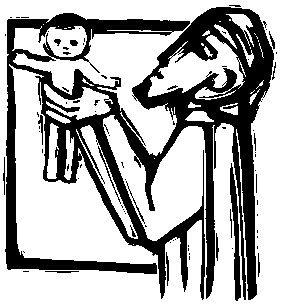 Jesus revealed himself publicly in the synagogue as the promised messiah. Although initially pleased with his learned exhortations, they quickly begin to question his authority (Luke 4:21-30). Those who knew him as a child or knew his family begin to gossip about him. Hidden in these words is their disbelief that the promised one could possibly be one from their own midst, and a poor man at that! Their acceptance of him swiftly soured into rejection. They no longer wanted to hear what he had to say.
 The presence and participation of girls as altar servers has become fairly commonplace since their official introduction in the 1990’s. Just as we would hope that our young men might be inspired to consider a vocation to the priesthood; it is desired that our young ladies might give some thought toward a calling to the religious life as either a sister or a nun. While it is only “private” revelation, I have routinely shared with our altar girls the following citation from Mary of Agreda’s CITY OF GOD about the Virgin Mary’s service in the temple: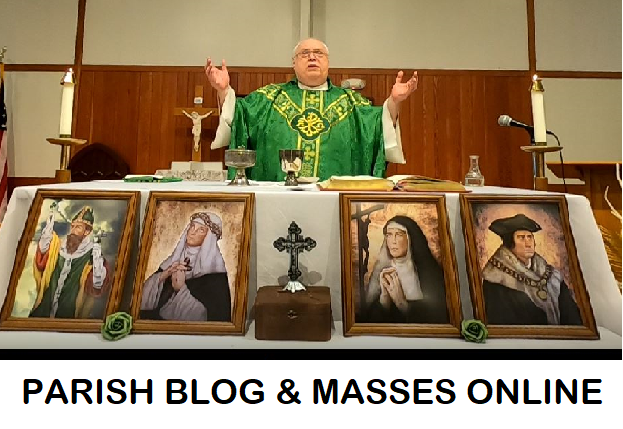


















 Blogger Priest