• Our Blogger

    Fr. Joseph Jenkins

  • The blog header depicts an important and yet mis-understood New Testament scene, Jesus flogging the money-changers out of the temple. I selected it because the faith that gives us consolation can also make us very uncomfortable. Both Divine Mercy and Divine Justice meet in Jesus. Priests are ministers of reconciliation, but never at the cost of truth. In or out of season, we must be courageous in preaching and living out the Gospel of Life. The title of my blog is a play on words, not Flogger Priest but Blogger Priest.

  • Archives

  • Categories

  • Recent Posts

  • Recent Comments

    Anonymous's avatarAnonymous on Ask a Priest
    Michael J's avatarMichael J on Ask a Priest
    Jeremy Kok's avatarJeremy Kok on Ask a Priest
    Mike Zias's avatarMike Zias on Ask a Priest
    Jeremy Kok's avatarJeremy Kok on Ask a Priest

To Share Food is to Share Life

You may have noticed how often the resurrection appearances are linked with meals. I have already mentioned the story of the two men on the road to Emmaus who recognized Jesus in the breaking of the bread. Jesus also took and ate a fish to demonstrate that he had actually risen from the dead.

In John 21:1-14, he directs his disciples to throw their net into the sea and there is a miraculous catch. When some of it is cooked, he “came over, took the bread and gave it to them, and did the same with the fish.” The Eucharistic themes are unavoidable. He makes himself present to us when we gather in his name and eat the bread of life. The symbol of the fish, because of its recurrent use, has also become a signature of sorts for the presence of the risen Lord. Indeed, in the midst of persecution, Christians would often draw a fish upon the ground as a secret sign that it was safe to speak, that they were all among friends.

It is no accident that the Lord uses the occasion of the meal to repeatedly reveal himself to his friends. It is an ancient maxim that to share food is to share life. What better sign could there be then for the resurrection to be seen in its greatest glory. The disciples recall all the past times when they would gather with their master and share nourishment. We can imagine that these were occasions of great intimacy and bonding. When the Christian community was exiled from the synagogues, and we can see such friction as this in Acts 4:1-12, the meal they celebrated in common upon the following day increased in importance. In the early days of the Church, this agape or love feast included a regular banquet where they recalled the stories of Jesus and was followed by the commemoration of the Lord’s Last Supper with his friends — the Eucharist. As time passed, and the first meal became unwieldy, it was dropped and the celebration of the sacrament became the principal meal that Christians celebrated as a family. It is still in this spiritual food that the risen Jesus is made present in our midst. He gives it to us and it is he. Just as we need food for physical nourishment; so too do we need the Eucharist to nurture us and to keep us spiritually alive in faith.

For more such reflections, contact me about getting my book, CHRISTIAN REFLECTIONS.

Our Bodies Are Us

Jesus appears to his friends and wishes them peace (Luke 24:35-48). I want to speak briefly about this appearance and a connection we can make with it in our lives. When his friends doubt it is him, or fear that it might be a ghost, he tells them to look, to see, and to touch. He shows them his wounds and says, “…a ghost does not have flesh and bones as I do.” Then he accepts and eats a piece of fish with them. St. Luke is adamant in having us understand that he is really in this scene and no mere ghostly apparition or simply an internal feeling that he is present, as we sometimes sense at prayer. He is much more here.

It is this stress upon his risen bodily presence which, I believe, offers us much consolation. The human person is not a disembodied spirit; nor is it angelic. We are created with both bodies and souls and it constitutes who and what we are. That is why the Church is so insistent that on the final Judgment Day, we will be restored body and soul. Although this mystery goes beyond our feeble minds, we see hints to how it might be in Christ. Notice that he is both the same and different; at first they did not recognize him. This is no wonder. Could any of us recognize a human countenance where all the wrinkles of age, the scars of disease, the marks of pain, and where all tears have been wiped away? Think what such a person might look like. However, after awhile, especially in the breaking of the bread, they come to see him for who he really is. Indeed, he still carries the marks of the crucifixion which are his badges of honor in his victorious fight against sin and death.

In Acts 3:11-26, the cured lame man signifies that what happened to Jesus will touch each and every one of us who believe in him. As a sign of this belief, we need to respect our bodies as his temples and extensions in the world. Our bodies are who we are and therefore we need to take care of them. We are our bodies! This message emerges in our celebration of both Christmas and Easter where our humanity is elevated and then restored. This message touches all the doctrines and feasts of the Church. Yes, it touches moral theology, too. After all, in the various arguments about abortion, euthanasia, artificial contraception, etc. we are speaking not so much about the body as a shell or robot which we can manipulate as we wish; but rather, we are talking about our very selves and our personhood. People who see the issues of the Church disjointed do not realize that to allow selfishness to rewrite our moral principles would ultimately destroy the meaning of the coming of Christ into our world and his resurrection.

For more such reflections, contact me about getting my book, CHRISTIAN REFLECTIONS.

The Gates are Opened

The story of Jesus appearing to two men on the road to Emmaus is one of the most famous of our resurrection accounts (see Luke 24:13-35). The last phrase, “. . . they had come to know him in the breaking of the bread,” speaks to us about how we encounter the risen Lord in our Eucharist. The Eucharist is Christ’s living legacy to us. No matter what age it might be, he does not abandon us. After his ascension, the Lord continues to abide in his early disciples as well. He sends them his Spirit and works his ministry through them.

We see one incident of this in Acts 3:1-10. Peter and John are going up to the temple to pray. Outside the edifice, at the temple gate, is a beggar who for years has been at the practice of begging from those who come to worship. It is interesting that he is outside the temple because as a cripple he is also outside the hearts and lives of many of his own people. He is tolerated, but looked down upon. He must beg for his sustenance. He is a man whose dignity has been tarnished by a situation beyond his control. Peter is poor in worldly riches; but, he has already begun to save up for himself treasure from heaven. He possesses Christ and he gives Christ. In the name of Jesus, he heals the crippled man and orders him to walk. In that single incident, the poor man’s dignity is restored. He would no longer be a castoff from society. He is whole again. This is the meaning of Easter. We may be weighed down by our sins, be of ill health, be lonely, or sad; and yet, Jesus offers us healing and forgiveness. We had cut ourselves off from God and from his friends by our rebellion; now we can be reconciled and aliens no longer. Our shame from the primordial rebellion is no longer imputed against us and our hearts can be turned around — making Christ our greatest treasure — living only to serve and love God.

Notice what the first act of the lame man is once he is healed. No longer merely at the gate of the temple, he walks inside the temple with them. Through the suffering, death, and resurrection of Christ, the gates of our heavenly Jerusalem are now open to us. May we be filled with the same joy as this healed lame man, entering heaven by “walking, jumping about, and praising God.”

For more such reflections, contact me about getting my book, CHRISTIAN REFLECTIONS.

Our Belief & Unbelief

From the very beginning, there would be those who would doubt the resurrection of Christ. Indeed, even one of his disciples, Thomas, would have to be challenged by Jesus himself to touch his wounds before his skepticism could be swept away. However, the Gospel chronicles another type of rejection as well, one far more resistant to the truth (see Matthew 28:8-15). The chief priest has an inkling that the story of Christ’s coming back from the dead might bear some truth. It is this possibility which he and his cronies seek to hide behind lies. So, they bribe the soldiers to say that Jesus’ disciples had stolen the body at night.

When Jesus stood before the Sanhedrin, it was this same rigid rejection of his messiahship which catapulted him to the crucifixion. Despite the evidence of multiple witnesses, they later disregarded his resurrection. It was not so much that they doubted Jesus, but that they did not want to know who he was. His claims challenged their positions of prestige and power. His assertions about his own personhood shook their accepted norms in regard to monotheism. What did he mean when he said that he and the Father were one? What was this Spirit he would promise to send? Who was he to forgive sins, especially of those who had come nowhere near them in keeping all the precepts of the law?

Such a man was dangerous to them and had to die. And, what is more, he had to remain dead. We might ask, why did Christ not reappear immediately before the Pharisees and chief priests who had orchestrated his demise? If we look closely, this is already obvious for a couple of reasons. The first has already been mentioned; many of them were not interested in the truth of the situation. They hid it from themselves and tried to veil it from others. Back in 1977, George Burns played the deity in a film called Oh God! As proof, God appears before skeptics; but no sooner had God vanished from the courtroom that they began to explain him away as mass psychosis or illusion. Would these ancient figures have been any different? Probably not; the Scriptures would be fulfilled in their regard which says that they would not believe, even if one were to rise from the dead. The second reason is the most telling and we find it in the Gospel where John looked into the empty tomb — he saw and believed. Jesus would not appear or be present to those who did not believe in him. Even Paul, who had persecuted Christians, was only able to see Christ as a light. The reason he could experience the risen Lord at all probably had to do with the fact that he had been mislead about Jesus and yet was still a man very much in love with God. For those who had killed this love, no vision was possible and no witness credible.

The vast host of witnesses to the risen Christ in this period and the Church’s experience of the Holy Spirit throughout the ages stand for us as a most staunch underpinning to our faith. May we always be open to belief and struggle sincerely to help transform our unbelief.

For more such reflections, contact me about getting my book, CHRISTIAN REFLECTIONS.

To See More Than an Empty Tomb

The cast of characters and events in John 20:1-9 fuel our hope. They include Mary Magdalene, Simon Peter, and John. But notice who is absent in our reading; although it is a Gospel and therefore about Jesus, he is neither seen nor heard. All we have is the empty tomb and some surprised disciples. The story, of course, goes on; but, the Church in its wisdom feels that this passage alone would suffice on Easter morning at Mass. Why is that? Let us look at the story.
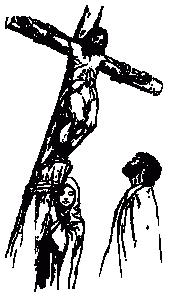
The first to reach the tomb and to make the discovery that the stone had been rolled away is Mary Magdalene. In the long history of the Church, venerable piety would link her to the prostitute whom Jesus reformed. Although modern exegesis would place this in some doubt; she, nonetheless, stands out as one of the so-called weaker sex, a woman who in that society often possessed a third class status behind oxen and other forms of property. To the eyes of many, she would be worth nothing and invisible. And yet, this Scripture and Luke (mentioning the women), places the female first at the tomb. Maybe this honor falls upon her to demonstrate how Christ has come to raise up the downtrodden and to grant all of us an equal dignity in the eyes of God? He comes for the poor, the oppressed, and the sinful. Mary Magdalene, maybe more so in that culture than our own, would come to highlight that mission. If as a child he could be worshiped by lowly shepherds then why could he not first appear to a woman who herself was lowly in the eyes of many?

In this version of the story, she is afraid and runs to Peter with the news. The second person to reach the tomb is called “the disciple Jesus loved” and we in our tradition have discerned this to be John. But, notice what he does. Although he has outrun Simon Peter, he hesitates at the entrance of the tomb and waits for him. John is nothing if he is not humble. He knows quite well whom Jesus has placed in charge of the disciples — it is Peter. Peter is the one who first recognizes Jesus to be the Messiah, the Son of the Living God. But, remember what has happened recently. He has denied Christ three times. Unlike John, he runs and hides himself. He would not even be present at the Cross. Now, he is at the tomb. He is slowly recovering from his betrayal. With Jesus gone to the Father, it would be Peter who would be the rock of Christ’s Church. In the tomb he sees the various wrappings, but we are not told whether he discerns more. We like Peter might also sometimes find ourselves in the paradox of both betraying Christ by our sins and yet searching earnestly for him. Where is he, we might ask?

After Peter looks into the tomb, John takes his turn. With John there is no mention of the various wrappings and artifacts which the human eye can see. No, it is John this time who sees deeper than the rest. With the same eyes which witnessed the Crucifixion and somehow did not totally abandon hope, he sees and believes. He sees with eyes of faith. It is no mere empty tomb for him. Something new has happened — something unheard of — something which only a madman or a man of faith might hold — a man has risen from the grave. Notice that I say this is something new. In similar stories as with the little girl or Lazarus, a person comes back to life; but it is more like resuscitation than resurrection. Jesus would never die again. Jesus is totally transformed. Everything he is becomes something new and wonderful — beyond suffering — beyond sickness — beyond death. Suddenly the quote from Jesus, that if his temple is destroyed it would be restored in three days, makes sense. He means his very own person.

Later on the Gospels would relate episodes where the risen Lord, who is man and yet also very much God, would appear to his followers. He would greet his friends from a beach. He would appear to them in the locked upper room. He would appear to a couple of followers along the road to Emmaus and be recognized in the breaking of bread, an incident which is intensely important for us who also seek Christ in his bread of life broken for us at the Eucharist. These other incidents are wonderful treasures in our heritage from God; but we must first take seriously the initial response of John and then later the other disciples. In our own personal stories we see little more than what we find in our Gospel about the empty tomb. Jesus does not regularly manifest himself in a sensible fashion in our homes. Even in our Church, the reality of the risen Christ can only be present in the sacraments which reveal him to our eyes of faith and yet veil him to our five physical senses.

However, we like the early Church, know in our hearts that Christ is indeed risen and that his Spirit is among us right at this moment. He promises that he would never abandon us, even unto the end of the world. In my fondness for history, I recall a passage from the great French general Napoleon after his final bid for power fails. He remarks that in his very own lifetime, his followers have forgotten him and that he is utterly deserted. And yet, Jesus who lives and dies a millennium and a half earlier still possesses disciples willing to surrender their lives for him. For Napoleon, in those last years of his life, this becomes evidence that the Spirit of the risen Christ is still alive among his disciples in the Church. This continues to be the case for us. Not only is the risen Christ made manifest in the seven sacraments and especially in the Eucharist; he is also revealed in his Mystical Body — ourselves.

We are given a share of that life. In baptism, we die with Christ (Good Friday) so that we might rise with him (Easter). We do not deserve this gift. But, in return for our faithfulness, it is offered all the same. Everyone who has ever died is still alive. All those who have believed in our Lord and were faithful now possess a happiness and life we could never even imagine. In the face of death, the resurrection is our one true consolation. Otherwise, we would be tempted to complete despair. Imagine, we will one day meet Christ face to face, and in him, everyone else who has believed, whom we have lost and loved — our friends — our parents — our brothers and sisters — even our enemies, whom we sometimes ironically miss more than certain friends — all those who have at least on some level of their life held Jesus as their treasure. Every year, starting on Holy Saturday, our Easter Candle burns tall and bright once again, a symbol that after we have burned ourselves up bringing Christ’s light to those in darkness and his warmth to those in the coldness of sin, that we like him will be restored and made new.

For more such reflections, contact me about getting my book, CHRISTIAN REFLECTIONS.

Our Faithful High Priest

Jesus is our High Priest. Unlike the Jewish priests, he was not given his role by human authority and neither did he have any personal sin for which he needed to make an offering. Jesus took upon himself the punishment that was rightfully ours. Certainly his death on the Cross brings immediately to mind the great offense of our sins. We did not deserve such a Savior who would make himself priest and saving victim. Looking upon the Cross should serve as a remedy for our pride and lust, unless we have desensitized ourselves to human suffering. Jesus repairs the damage inflicted by Adam and Eve. His death will render satisfaction for all the sins of their children.
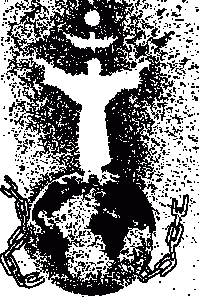
The question is asked, if Jesus died for all, why do we still experience suffering and death? Why are we still punished for original and personal sin? The reason is simple. Christ has won the victory and yet in time we must become receptive of the fruits of his self-offering. It is still possible to reject the saving work of Christ. The providence of God determines who will accept the merits of Christ’s passion. As a people of faith we cry out for the blood of Christ to wash us and to make us new. Such is human freedom that we must will to be saved. We need to cooperate with Christ in breaking the bonds of our enslavement. If we fail to make use of his grace to do so, the fault is ours.

Jesus could surrender himself as a sin-offering because he had been made man; he had the authority to efface our sins because he was almighty God. A wrong against an infinite being could only find reparation from one of equal dignity. While God could have magnanimously forgiven us; he opted to fulfill the demands of divine justice. It is for this reason that in Jesus, both mercy and justice meet.

Christ suffered in his humanity while his divinity gave infinite value to his passion. This is at the heart of Christ’s identity as the God-Man. Jesus bought us back from the devil, literally redeemed us. Christ’s Cross merits all necessary graces. Just as the blood of a paschal lamb delivered the Hebrews from death; Jesus is the new Lamb of God who takes away the sins of the world and gives us a share in eternal life.

Jesus truly died. He was not play acting as some contend. His soul separated from his body, although his divinity remained with both. The soul of Jesus descended to the dead, the limbo of the fathers or righteous dead of the Old Testament. As the one high priest, he does this to lead the righteous into paradise. His death had unbarred the gates of heaven and now they were free to go to their just reward. Meanwhile, Christ’s body was taken down from the Cross and placed into a borrowed tomb. We know what happens next. Jesus rises body and soul from the grave.

Jesus continues to be our one high priest and mediator to the Father. All Catholic priests participate in this one priesthood, acting at the altar in the person of Christ, head of the Church. His sacrifice is re-presented upon our altars and his grace is infused into men’s souls. Jesus is present to us, albeit invisibly, and he sits at the right hand of the Father as our eternal advocate.

Jesus has made peace to God on our behalf. This reconciliation is sealed in his blood. He has redeemed us and he pleads our cause. His one sacrifice brought with it all the sacrifices of the old law and alone appeased the throne of heaven, the almighty Father. This restoration of the primal unity between God and man will be consummated at the end of the world.

For more such reflections, contact me about getting my book, CHRISTIAN REFLECTIONS.

Messiah, Savior and Lord God

The long-awaited Jewish Messiah comes into the world (Matthew 1:1-25). The Genealogy of Jesus is traced to his stepfather, Joseph and the remaining Gospel text affirms the virgin birth. It was customary for people to marry within their tribe. Thus, if Joseph was of the line of David then Mary would be as well. Despite the fact that the conception was made possible through the intervention of the Holy Spirit, it was customary to trace the family line through the father. Again, affirming that Jesus was the promised Messiah of the line of David, Joseph and Mary go to David’s town of Bethlehem for the census (Luke 2:1-14). The story is familiar; there was no room at the inn and so the Christ-child was placed in a manger, a feed box for animals. Today, upon the manger of the altar, we again find Jesus, who makes himself a saving food for men and women. The angel makes the wonderful pronouncement to shepherds and the hosts of heaven rejoice. It is part of Christian folklore that the devil and the other fallen angels were thrown out of heaven precisely because they refused to have any part in this angelic rejoicing. He would not bend the knee or give glory to a God dressed in human flesh and made vulnerable to human caprice. The shepherds visit the nativity (Luke 2:15-20). Mary “treasured all these things and reflected on them in her heart,” an indication from St. Luke that Mary was one of his sources for the nativity narrative. The great theologian of the evangelists, John, speaks of the pre-existent Word that became flesh, the only Son of God come into the world to save us and to bring us to the Father (John 1:1-18). The Jewish Messiah is revealed as the World Savior and God come among us.

For more such reflections, contact me about getting my book, CHRISTIAN REFLECTIONS.

Invitation to the Little Ones

“Father, Lord of heaven and earth, to you I offer praise; for what you have hidden from the learned and the clever you have revealed to the merest children. Father, it is true. You have graciously willed it so” (see Matthew 11:25-30).

We may remember, that long ago, when the Messiah at last came into the world, he was not all that well accepted. The stories of his rejection are numerous; indeed, they fill the entire Gospel. When he came into the world, he chose to be born like all the rest of us, as a child. In the quiet of a cold night he came, with only a small star shining above to herald this newborn king. But, if he were a king, the only mantle he wore was his swaddling clothes, and his throne, a meager manger among a court of animals. His mother and foster father were simple people, and yet a people made rich in their holiness and love for him. The first to see him were not the elite among his own people, but mere shepherds still covered in the dust and sweat of a hard day’s labor.

Perhaps they saw something of the lamb in him, in a city filled with wolves? And when the wise men or kings finally did come, they saw something akin to them in this child, for they were all strangers in an alien land. So much did they realize it that they fled instead of informing the Jewish king, Herod, of the Messiah’s presence. They did well, for Herod would be the forerunner of all those to come who would reject this child of promise. As a man, Jesus would even speak of himself as the prophet rejected in his own land. The zealots looked for a military general who would come with great blood-letting might and power. The Pharisees looked for one who would come hopefully in the distant future, one who would be like themselves and who would reaffirm their own legalism and security. It was no wonder that they were all terribly disappointed in this Jesus.

He ate with tax collectors and sinners. He associated with the poor and with the unclean. How could he really be important if he found it so easy to relate to these kinds of people. Perhaps, they thought, he was no better than the rest of the trash? He forgave sins — by what authority? He healed the sick — could it be by the power of demons? The so-called learned of Israel would charge him with this!

Messiah? How could he be? He traveled around; surrounded not by other learned scribes but by stupid men of the earth — dumb fishermen and traitoress tax collectors. The only one among them that showed some promise in his foresight and knowledge was the last to join him, that one they called Judas Iscariot. Jesus had virtually nothing more than the clothes on his back and lived essentially from the charity of others. Even the room in which he and his friends celebrated his last supper was simply on loan to them. He himself said one time that the son of man has nowhere to rest his head.

Jesus is the most shining example that just because people may have nothing, it does not mean they are nothing. His life and message has touched us like no other has.

We too need the same kind of humility. The Lord showed just how much when he reprimanded his disciples for keeping curious children away from him. Jesus told them that it was for such as these that his kingdom belonged. We need to become, not childish, but child-like in our lives and faith. It is in this kind of witness that God most brilliantly shines forth. Sometimes things like wealth, social position, and even religion (when they become self-righteous and snobbish), can get in the way of this kind of humility. Like a small child trusting his parents, no matter what — that is the trust we need in regards to our Heavenly Father. The disposition of humility makes us more aware and receptive to the needs of those who are small, weak, broken, and hurting. The irony of our faith, which shines in figures like St. Francis of Assisi and Mother Teresa, is that in Christ weakness can become strength, and adversity an opportunity for miraculous witness.

For more such reflections, contact me about getting my book, CHRISTIAN REFLECTIONS.

Questions & Answers About Mary & the Saints

Is it not wrong to honor saints and angels since the Bible says, “You shall adore the Lord your God, and him alone you shall serve” (see Lk 4:8; Mt 4:10)?

Certain critics misinterpret Catholic teaching on this matter. Catholics adore or worship God alone. He is the one we serve. The honor we show the saints is of a secondary order. It is no more an offense against God than the honor and respect we show our parents and friends.

How can Catholics rationalize such an attitude given the clear Scriptural prohibitions, as in Isaiah 42:8, “I am the LORD, that is my name; my glory I give to no other”?

There is no deep rationalization here, only common sense and courtesy. Of course, the mindset of those who have refashioned Christianity into a privatized sect, seeking a direct link with Christ while ignoring any semblance of a family of faith– living and dead– would have a hard time appreciating the communion of saints. As I said before, the highest honor and adoration goes to God alone; however, the very fact that we have natural bonds (with blood kin) and supernatural ones (in the family of the Church) demands some level of respect and affection.

What is the difference between showing honor and giving adoration?

Adoration is the term we properly use regarding the highest honor we show and this is directed to God. We recognize his Lordship over all creation. By honoring angels and saints we give glory to God who has worked wondrous deeds and has instilled divine virtues in them.

Does the Bible say that we should honor angels?

Most certainly, it does. Three angels appeared to Abraham. His response was to bow his face to the ground and to honor them (Genesis 18:2; 19:1). Similarly, Joshua raised his eyes and saw what he at first took to be a man, standing over against him, holding a drawn sword and proclaiming, I am “commander of the army of the LORD. . .” (Joshua 5:15). We read in Exodus 23:20-21, God saying: “Behold, I send an angel before you, to guard you on the way and to bring you to the place which I have prepared. Give heed to him and hearken to his voice, do not rebel against him, for he will not pardon your transgression; for my name is in him.”

But, does not St. Paul say, “To God alone is due honor and praise” (see 1 Timothy 1:17)?

The apostle means that the highest honor and praise is reserved to God. Note what he says in Romans 12:10: “Love one another with brotherly affection; outdo one another in showing honor.”

What does it really mean to pray to saints?

It is a particular kind of prayer. Ultimately, it is a prayer of supplication that finds its ultimate source in God, himself. We are asking the saints to pray for us and with us. Our prayers of adoration are reserved to God, all glory and praise is his.

Does the Bible say it is permissible to ask the saintsto pray for us?

Yes, it does. The Bible tells us that there is a real value in requesting the prayers of people on earth and the prayers of the angels in heaven. This being the case, it is only logical that the saints, who reign with Christ in heaven and who are still a part of our family of faith, can pray and intercede for us. St. Paul makes this request: “I appeal to you, brethren, by our Lord Jesus Christ and by the love of the Spirit, to strive together with me in your prayers to God on my behalf” (Romans 15:30). He said similar things in Ephesians 6:18 and Thessalonians 5:25.

Does the Bible say anything about angels and saints praying for people who walk the earth?

There is evidence for this. Zechariah 1:12 documents an angel praying for the Jewish people: “O LORD of hosts, how long wilt thou have no mercy on Jerusalem and the cities of Judah, against which thou hast had indignation these seventy years?” God heard and responded to the angel’s prayer, noting that his words were “gracious and comforting” and that he would have mercy on Jerusalem. Note these words from the chief apostle (2 Peter 1:15):

“And I will endeavour that you frequently have after my decease whereby you may keep a memory of these things” (Douay-Rheims).

“And I will see to it that after my departure you may be able at any time to recall these things” (Revised Standard Version – Catholic Edition).

While the language sounds a bit convoluted, one might claim that the apostle is saying, “And I will do my endeavor that after my death also you may often have prayers whereby you may keep a memory of these things” (2 Peter 1:15).

St. Peter wished to pray for his friends even after his death. The clincher that the saints pray for us is in the Book of Revelation where St. John saw four and twenty ancients who “fell down before the Lamb, each holding a harp, and with golden bowls full of incense, which are the prayers of the saints” (Revelation 5:8).

But how can angels and saints be mediators when St. Paul tells us that “There is one mediator between God and men,” and his name is “Christ Jesus” (see 1 Timothy 2:5)?

Jesus is our Mediator. However, this does not rule out secondary intercessors that are assisted and used by Christ. Remember, St. Paul, himself, asked for prayers from his brethren.

Why not pray to God in a direct way, according to the fashion that Jesus taught us?

There are many instances where we do pray directly to God. However, we acknowledge that we do not come to God alone. Just as God called to himself a People of God in the Jewish nation, so too he summons a new people in the Church. We pray with and for one another. Death is no barrier to this solidarity. We beckon the saints to pray for our needs. There is a great humility in this form of prayer. We recognize our unworthiness and ask the saints to obtain for us that which may be just out of our grasp. Both prayer forms are recommended.

But if the dead are either asleep or too far off to hear us, then what use are our petitions?

The saints know rest in the Lord, but this does not mean that they have been relegated, even temporarily, to oblivion. Further, the ties that bind us, particularly our faith and love in Christ, transcend the barrier of death. There is a legitimate mystery here and yet we trust the Word of God, which testifies that angels and saints do, indeed, hear us. “Just so, I tell you, there is joy before the angels of God over one sinner who repents” (Luke 15:10). The saints have joined the angels of heaven. They hear our voices.

But does not Jeremiah 17:5 say, “Cursed is the man who trusts in man”?

The prophet only meant that trust in men should not displace trust in God. Note that God himself told us to observe and trust his angel (Exodus 23).

Do not Catholics go too far in calling various saints “our hope, our mercy,” etc.?

These are merely signs of affection and thankfulness to our special friends among the saints. Such expressions should not be interpreted crudely as denying the singular place of God and his operation in our lives.

Why do Catholics pay special and heightened honor to the Virgin Mary?

She was chosen by God to be the Mother of our Savior. Should we not honor the mother of the one who has saved the world? Sure we should.

The appearance and the words of the angel honored Mary with titles befitting her dignity: “Hail Mary, full of grace, the Lord is with thee, blessed art thou among women.” Is it right to echo the salutation of a heavenly messenger? Certainly it is.

Jesus desired that we take notice of his mother and honor her, saying to John from the cross, “See your mother” (John 19:27). Are we obliged to carry out the last words of our crucified Lord? Without question, this is the case.

The first Christians honored Mary with a most intense and intimate love. Should we do the same as brothers and sisters to Christ, adopted children of the Father, and spiritual children to Mary? Yes, the pattern and connection is clear.

After God himself, Mary is the most perfect model of purity, justice, and holiness for us to imitate. If Mary is the queen of the saints, then is her spiritual perfection worthy of imitation? Quite so.

Those who have honored her have been wondrously rewarded by God; the lame walked, the blind regained their sight, the sick recovered, etc. Practically speaking, we would be fools to ignore such a person and the incredible manner that God continues to use her. In many ways, the miracles and messages attributed to her remind us that God is still very much aware and concerned about our plight.

Again, does it not defame God to give so many honors to a mere creature?

This honor we show her does not degrade God in the least. As a matter of fact, the respect and veneration we show Mary pleases God. We give glory to God in honoring the woman who was so wonderfully made free from sin and who said YES to God for all humanity.

Did the Virgin Mary have other children besides Jesus?

No, the Bible calls her “a virgin betrothed to a man whose name was Joseph, of the house of David; and the virgin’s name was Mary” (Luke 1:27). The Scriptures also tell us that she remained a virgin up to the birth of Jesus (Matthew 1:25). Her perpetual virginity was an accepted fact in the early Church community, taught by the Nicene Creed and the early fathers as “the glorious EVER virgin Mary.”

But does this conflict with what the evangelist actually says, that Joseph “knew her not until she had borne a son; and he called his name Jesus” (Mt 1:25)?

There is no conflict, just a problem with language and translation. The wording, “until” or “not till” does not mean that her virginity ended at that point or at some time after. It merely stresses again that Jesus was specially conceived by divine intervention. Given that Mary was a sacred vessel for the presence of God, Joseph would do nothing to defile her. After the birth of Christ, and knowing full well the identity of his foster Son, Joseph and Mary lived a virginal marriage. The language here shares some similarity with Genesis 8:7: “. . . and sent forth a raven; and it went to and fro UNTIL the waters were dried up from the earth.” The raven did not return at all. As with the virginity of Mary, it was a perpetual status. The same expression is used in 1 Kings 15:30.

But if Jesus is called Mary’s FIRST BORN, does not this readily imply other children?

No, and again, language is a serious issue in biblical interpretation. The term “first born” was applied to the FIRST BORN of every Jewish woman, regardless of whether other children followed. A case in point is Joshua 17:1. The frequent mention of the brethren of Jesus finds several reliable explanations. There is evidence that in some cases it refers to cousins (especially when a woman other than Mary is mentioned as their mother) and in other instances it may simply be an extension of referring to his followers as his brethren.

Does the Bible say that Mary was always free from original sin?

We read in Genesis 3:15: “I will put enmity between you and the woman, and between your seed and her seed; he shall bruise your head, and you shall bruise his heel.” The seed is interpreted as Christ Jesus, the woman is the Virgin Mary, and the serpent is Satan. Certain older Catholic renditions translated the last line here as “She shall crush your head.” Thus, in statuary and other imagery, she is often envisioned stepping upon a serpent. This translation peculiarity is fortuitous in that modern scholarship tells us that a more exact rendering would be, “They [all the descendants of the woman] will strike at your head.” The Mother of the Redeemer is now the Mother of the Redeemed. She is the image and model of the Church. The enmity between her sons and daughters against those in league with the devil is a perpetual one. Such an interpretation would not admit to even a momentary moment of reconciliation. She has always been, and always will be, the one made holy by Christ’s saving grace– a favor which reached from the cross backwards through history, to the very moment of her conception– all so that the divine and all-holy one might pass through a sinless vessel. The angel’s salutation affirms this truth, “Hail full of grace.” There is no space or vacuum in her for sin. The angel continues, “blessed art thou among women” (Luke 1:26,33). The holiness of Mary distinguishes her from all other women.

Are there any other reasons that might prove that Mary was free from original sin?

It would have been unbecoming of an infinitely pure God to be incarnated in a woman who was or had been under the dominion of sin, even if just for a moment.

Christ takes his flesh from the flesh of Mary; as God and as untouched by sin, he could not assume a sinful flesh.

The Holy Spirit has guided the Church on this matter and thus it can be trusted.

Mary appeared at Lourdes in France and declared herself the IMMACULATE CONCEPTION. As verification of this message, healing water sprung mysteriously from the ground and as a lasting testimony thousands have been cured by it from all kinds of diseases.

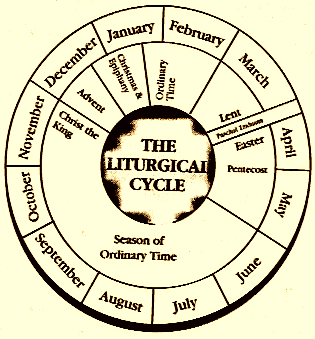
Questions & Answers About the Church Year

What is the meaning of Advent?

This season of four weeks before Christmas represents the four thousand years (according to the Scriptural reckoning) that mankind had to wait for the coming of the Redeemer.

What is the object of Advent?

We become aware of ourselves as spiritual Jews, recalling the advent of Christ’s first appearance while awaiting his Second Coming. It should light the spark of desire for this definitive encounter and for the graces he gives us as our Savior and Redeemer. Advent prepares us for the birth of Christ.

Why do we call Jesus’ birthday Christmas?

It is because the Church celebrates the festive day with Masses that specially commemorate the birth of our Lord.

Why do we traditionally offer three different Christmas Masses?

It is seen as a threefold act of thanksgiving to the divine persons of the Blessed Trinity who participated in our redemption.

What is the feast of the Presentation of the Lord?

On the fortieth day after Christ’s birth, Mary, in obedience to the law, offered her divine Son to his heavenly Father. It was once called the Purification because Mary offered the required clean oblation in the temple.

Why is it also called Candlemas Day?

It is because the priest blesses candles on this day. Candles are symbols for Jesus who is the Light of the World. Simeon proclaimed him to be the light of enlightenment of the Gentiles (Luke 2:32). Candles are blessed on this day with beautiful prayers and hymns: “May we who carry them to praise your glory walk in the path of goodness and come to the light that shines forever.” A procession is made to the church where Mass will be offered.

What is done on Ash Wednesday?

Ashes are blessed by the priest and placed on the heads of the faithful.

What makes up the ashes?

They are the remnants from blessed palm used the previous year. The ashes remind us that our bodies are destined to soon return to dust. That is why the priest says: “Remember, man, you are dust and unto dust you will return.

What are the ceremonies of Passion (Palm) Sunday?

It is a pious custom to cover the crucifix, statues, and pictures in violet to represent the brief time before the passion that Jesus hid from the Jewish authorities, following his terrible humiliation by them in the temple. Since it is also Palm Sunday, we also celebrate Christ’s triumphant entrance into Jerusalem. Palms are blessed in the church. The Jewish people greeted Jesus with palm branches and hailed him as their king. We know, of course, that he was not the kind of king they wanted and that Jesus really came to Jerusalem to die.

Why is the last week of Lent called Holy Week?

It is because we specially commemorate the events making up our redemption. Many graces are given us in this most holy time.

What takes place during Mass on Holy Thursday?

The Church commemorates the institution of the Eucharist (and the Priesthood). As a special sign of joy, the Gloria is sung and bells are rung during its recital. Extra hosts are consecrated for special reservation that evening and for communion on Good Friday. The Eucharist is carried in procession to the repository at a side altar. The organ and bells are now silent until the Gloria on Holy Saturday. This expresses the deep bereavement of the faith community over the passion and death of Christ.

Why is this the customary day for the consecration of holy oils?

Although sometimes moved to another day like Monday or Tuesday (for practical reasons) of Holy Week, the bishop consecrates the oils that are used at baptism, confirmation, anointing of the sick, and certain consecrations. Holy Thursday is chosen since it is the day that Jesus instituted the priesthood and made the apostles dispensers of his graces through the sacraments. Priests renew their promises.

Why are the altars stripped after Holy Thursday Mass?

This indicates our sorrow at the pitiful exposure of our Lord during his scourging and crucifixion.

What does the washing of the feet signify?

It is connected to the calling of the apostles as the first priests. The deep humility of Christ must also be found in his servants and ministers. St. Augustine associated it to our faith and baptism. Jesus washed the feet of his apostles before instituting the Eucharist. This reminded them of the purity and humility of heart that should be theirs before receiving and distributing Holy Communion.

What are the observances for Good Friday?

This is not a feast day, and no Mass is said. There may be special readings of the passion, Stations of the Cross, and Veneration of the Cross. We remember the death of Jesus. Various supplications are prayed.

Why do priests prostrate themselves at the foot of the altar on this day?

It expresses our profound grief at the suffering and death of Jesus.

What does the Church pray for in the great Supplications?

In the context of solemn petitions, the priest prays for the Church, the Holy Father, the bishops, the clergy and laity, the country, those preparing for baptism and/or reception, the suffering, separated brethren, Jews and other non-Christian people of faith, etc. We actually dare to pray that they might share in the fruits of Christ’s saving death. After all, our Lord died for all men and women.

How is the Veneration of the Cross conducted?

The priest or deacon holds up a Cross at three areas in the church: the back, middle, and front. If veiled, he reveals another of its three points as he moves toward the sanctuary. He proclaims: “This is the wood of the Cross on which hung the Savior of the world.” The people respond, “Come, let us worship.

How is the Cross worshipped or adored?

The priest lays the uncovered Cross before the altar, and then he kneels and kisses it. Traditionally, he would kneel three times at different distances and would finally kiss the wounds on the figure (corpus).

What does the choir traditionally sing?

They sing the reproaches that Christ must have made to his ungrateful people on this day.

Why is no Mass celebrated on Good Friday?

It would be unbecoming to celebrate the UNBLOODY renewal of the sacrifice of the Cross on the day we commemorate the BLOODY sacrifice of the Cross.

Also, every Mass makes really present the saving activity and presence of our RISEN Lord. Today we remember the shadows and not the light directly.

What does Holy Saturday bring to mind?

Many things come to mind. The darkness, candles, sacred silence and repose brings us to the Lord’s borrowed tomb and his descent to the limbo of the fathers (the righteous dead who awaited their Savior). But also, the festivities of the evening press upon us. We will soon celebrate our Easter joy.

What are the services for Holy Saturday?

The most elaborate liturgy of the year it is also the most beautiful and profound. There is the blessing of the new fire and the lighting of the Paschal Candle. There are a whole series of readings that trace our salvation history. There is also an incredible Easter Proclamation called the Exsultet. The Litany of the Saints is recited and baptismal faith is reaffirmed. A blessing is made over the baptismal water in preparation for the initiation and reception of new members into the faith.

What does the blessed fire of the candle signify?

The Paschal Candle is a symbol for Christ. Extinguished on Good Friday, it is restored brand new (resurrected) on Holy Saturday. The fire of the candle, from which other candles in the church are lit, signifies Christ as the Light of the World who dispels the darkness and gives warmth against the cold world and sin. Five incense grains are pressed into the candle representing the five wounds of Christ.

How is the baptismal water blessed in this celebration?

A whole series of Old Testament prophesies that point to baptism is read and prayers are made for the neophytes and those who reaffirm their faith. After the blessing and renewal of baptismal promises, the priest sprinkles the people. During the blessing, the Paschal Candle is dipped three times into the water as an invocation is made to the sanctifying power of the Holy Spirit. The water reminds us that the waters of baptism cleanse the world of sin.

What does the Church celebrate at Mass on this day?

The Church celebrates the resurrection of Christ. The Gloria is chanted, bells are rung, and the solemn Alleluia is sung.

What does the word Easter mean?

Easter or “East star” is derived from the rising of the sun or the resurrection of Jesus. It has also been called Pascha, a name taken from the Jewish festival when a lamb was slain in memory of the blood of the lamb that saved the first born of the Israelites. Jesus is the new Lamb of God who was slain on the cross and whose blood will save us.

What is the Ascension?

Forty days after Easter we commemorate Christ’s triumphant ascent into heaven.

What ceremony is peculiar to this day?

It is customary to extinguish the Paschal Candle, symbolizing the departure of Christ from earth to his Father in heaven.

What is Pentecost?

This is the commemoration of the descent of the Holy Spirit and it traditionally occurs ten days after the Ascension, or fifty days after Easter. We celebrate it on Sunday.

What are the Holy Days of obligation?

In the United States they are as follows:

  • Solemnity of Mary – Jan. 1
  • Ascension Thursday – (40 days after Easter)
  • Assumption of Blessed Virgin Mary – Aug. 15
  • All Saints – Nov. 1
  • Immaculate Conception – Dec. 8
  • Christmas – Dec. 25

Canada: Holy Days are Christmas and Solemnity of Mary, Mother of God

What is Ordinary Time?

This is a name given to the liturgical time outside of the seasons of Advent, Christmas, Lent, and Easter. Of course, in a sense, no time is ordinary. Every day and every liturgy is a wondrous opportunity to grow closer to the Lord and to live out our discipleship.

For more such material, contact me about getting my book, CATHOLIC QUESTIONS & ANSWERS.