• Our Blogger

    Fr. Joseph Jenkins

  • The blog header depicts an important and yet mis-understood New Testament scene, Jesus flogging the money-changers out of the temple. I selected it because the faith that gives us consolation can also make us very uncomfortable. Both Divine Mercy and Divine Justice meet in Jesus. Priests are ministers of reconciliation, but never at the cost of truth. In or out of season, we must be courageous in preaching and living out the Gospel of Life. The title of my blog is a play on words, not Flogger Priest but Blogger Priest.

  • Archives

  • Categories

  • Recent Posts

  • Recent Comments

    Barbara King's avatarBarbara King on Ask a Priest
    Ben Kirk's avatarBen Kirk on Ask a Priest
    Jeremy Kok's avatarJeremy Kok on Ask a Priest
    Barbara's avatarBarbara on Ask a Priest
    forsamuraimarket's avatarforsamuraimarket on Ask a Priest

Priestesses: Not Ordination but Subordination?

What are we to make of St. Paul’s writings about women? Those who reject the inspiration of Scripture do not really care what he has to say. Others will try to distinguish changeable disciplines from doctrines, but not everyone draws the line in the same places. Many conservative voices might make light of hair coverings or even silencing women in churches, but still resist a more gender neutral partnership in marriage and more leadership roles for women in the Church. Are St. Paul’s teachings simply culturally conditioned or does his viewpoint reflect God’s timeless mind about matters.

St. Paul is the source for the major texts on the “subordination” of women. Nevertheless, critics of the status-quo of a male-only priesthood often quote his words about equality in grace found in Galatians. Paul is not schizophrenic. His words must not be forced to say things that he did not intend.

Regarding ministry and marriage, Paul is clear.

“What I want you to understand is that Christ is the head of every man, man is the head of woman, and God is the head of Christ . . . a man . . . is the image of God and reflects God’s glory; but woman is the reflection of man’s glory . . . and man was not created for the sake of woman, but woman was created for the sake of man. . . . However, though woman cannot do without man, neither can man do without woman, in the Lord; woman may come from man, but man is born of woman — both come from God” (1 Cor. 11:3, 7-8, 11-12).

Speaking of the organization of spiritual gifts, he demands:

“Women are to remain quiet at meetings since they have no permission to speak; they must keep in the background as the Law itself lays it down. . . . Anyone who claims to be a prophet or inspired ought to recognize that what I am writing to you is a command from the Lord” (1 Cor. 14:34, 37).

Illustrating his sincerity, he repeats himself to Timothy:

“During instruction a woman should be quiet and respectful. I am not giving permission for a woman to teach or to tell a man what to do. A woman ought not to speak, because Adam was formed first and Eve afterwards, and it was not Adam who was led astray but the woman who was led astray and fell into sin. . . .” (1 Tm. 2:1-14).

St. Paul is regarded as infamous in certain circles for his view of marriage:

“Wives should regard their husbands as they regard the Lord, since as Christ is head of the Church and saves the whole body, so is a husband the head of his wife; and as the Church submits to Christ, so should wives to their husbands, in everything. Husbands should love their wives as Christ loved the Church and sacrificed himself for her, to make her holy. . . . In the same way husbands must love their wives as they love their own bodies; for a man to love his wife is for him to love himself. A man never hates his own body, but he feeds it and looks after it; and that is how Christ treats the Church, because it is his body — and we are its living parts. . . . This mystery has many implications; but I am saying it applies to Christ and the Church” (Ephesians 5:22-25, 28-32).

Leaving out commentary, I suspect some readers are already angry. These Scripture texts seem to fly in the face of what many know of the contemporary experience. I have known Christian feminists who gave blunt appraisals of St. Paul. They saw him as sexist and utterly patriarchal. I still remember one frustrated woman of WIT (a group at Catholic University called “Women in Theology”) who just admitted angrily, “I hate Paul!” If she could, she would have torn his writings out of her bible. But there is the catch. St. Paul is in the Bible and many of us believe that we must wrestle even with those texts that challenge us and are hard to accept. St. Paul is the great apostle to the Gentiles. The Pauline community and its beliefs will become pivotal to the Church’s understanding of sin and the measure of faith, ministry, the family and the Church.

The analogy of the spousal relationship is directly attached to Christ’s relationship to the Church. It is this analogy that is operative at Mass, wherein the priest signifies Christ, the head of the Church; the congregation is immediately reflective of the rest of the Mystical Body. The priest is one with the divine bridegroom; the assembly, representative of the bride of Christ, is identified with the Church. As I have mentioned before, unless one is going to overlook “sacramental lesbianism,” a woman cannot fulfill the function of priest in such a theological framework.

St. Paul wanted women to know their faith and to hand it on in the domestic setting; however, they were not allowed to offer the official teaching that is associated with the presbyter at liturgy. Paul makes it definitively clear that this prescription is tied up with the God-given order of creation (1 Cor. 11:7; Gn. 2:18-24). He further admits to a specified “command from the Lord” (1 Cor. 14:37). Although this command is not known to us, it should not be dismissed. Paul is not a liar. Christ is perceived as the ultimate author of a corpus of religious teaching that must be handed on in exact detail and preserved by the teachers of faith (1 Cor. 11:23, 15:1-2; 2 Tm. 1:13). Several times Paul encountered serious assaults upon his person and office (1 Cor. 1:12, 4:3; 2 Cor. 10-12); if he had invented this “command from the Lord” to shore up his arguments, he would quickly have been stripped of his authority and unveiled as a deceiver. Such did not happen.

Will we allow the truths of Christ via St. Paul to speak to us today? I pray it will be so. I only hope it is not too late. As an experiment I read these passages to several fine women in my parish and even the most docile took some offense. How deep is the secular infection in the hearts and minds of believers? How can we recover St. Paul so that traditional values about ministry and the home can be preserved while women might still be empowered and given the respect they deserve?

POPE JOHN PAUL II: “I declare that the Church has no authority whatsoever to confer priestly ordination on women and that this judgment is to be definitively held by all the Church’s faithful” (Ordinatio Sacerdotalis).

Apostolic Tradition Vetoes Priestesses

The early Christian community kept faith with the practice of Jesus in depending entirely on male priests. The Scriptural witness is ratified at every turn. Although the Virgin Mary occupied an honored status among them (Acts 1:14), there was never any hint that she should replace Judas as one of the twelve (Acts 1:15-26). Further, on Pentecost, despite the universal showering of the Holy Spirit upon the infant Church (Acts 1:13-14), it was left to “Peter and the Eleven” to take on the initial preaching of the Gospel (Acts 2:1, 14). Looking to St. Paul, it is evident that he relied heavily upon the help of women, maybe even more than Jesus did. Paul makes known Phoebe who served the Church in Cenchreae and also many other women who assisted him in his labors (Romans 16:1-16). He counted Priscilla and her husband Aquila among his friends (Romans 16:3), even entrusting to them the completion of his instruction of Apollos in Ephesus (Acts 18:26). Paul, who said some formidable things about the place of women, is left speechless when Lydia insists that he receive her hospitality at Philippi (Acts 16:14). The great apostle takes it for granted that men and women alike will pray and prophesy when the community gathers for public worship (1 Cor. 11:4-5, 13). Yet, even in the face of all this, he insisted that the leadership in the community and the official teaching come from male office-bearers. I mention all this because sometimes certain post-Christian and anti-patriarchal feminists caricature the early Church as a woman-haters’ club. Far from it, the apostolic community was in many ways more liberating for its women than pagan society; however, women were still not ordained. They felt the very real need to perpetuate the model of ministry established by Christ.

POPE JOHN PAUL II: “I declare that the Church has no authority whatsoever to confer priestly ordination on women and that this judgment is to be definitively held by all the Church’s faithful” (Ordinatio Sacerdotalis).

The Mind of Christ About Priestesses

Emotionalism often pollutes the debate about women’s ordination. As in so many liberal dissents, there seems to be the impression that shouting and acts with shock value can replace rational discussion and humble obedience to the Magisterium and the sacred deposit. Personal biases spouted in slogans will help no one. The sober question has to be asked, what does our Lord reveal to us about this question in the Scriptures and faith of the Church? It is crystal clear that he did not call any women into the number of the apostles (Mark 3:13-19).

First, this fact alone takes on heightened importance because certain women accompanied the group on their journeys and financed their needs (Luke 8:2-3). None of them were given priesthood.

Second, Jesus did not hesitate in dismissing then current religious and cultural attitudes in relating to females. He disregarded the hemorrhaging woman’s legal impurity (Matthew 9:20); he allowed the disreputable woman in Simon the Pharisee’s house to approach him (Luke 7:37); he sided with the adulteress (John 8:11); and he undermined the Mosaic Law in espousing the equal rights of men and women in marriage, protecting the woman from abandonment in divorce (Mark 10:2; Matthew 19:3). Obviously, Jesus could not be coerced by societal prejudices to prohibit women priests; it must have been his own choice.

Third, he illustrated in his stories an unheard of empathy with the lives of women as in the parable of the good housewife (Luke 15:8-10) and of the widow before a crooked judge (Luke 18:1-8). It can be assumed that Jesus did not feel that his exclusion of women from holy orders was any real slight to them.

Fourth, as his disciples, many of the women showed a courage greater than that of the apostles, even so far as to stand at the foot of his Cross (Mark 15:40-41). Individual qualifications apparently took a backseat to other concerns; perhaps the inability of female humanity to image Christ as the head of the Church? Does not the laity, as feminine, still look upon the Cross now transformed into an altar at which the priest renders Christ’s sacrifice? Yes.

Fifth, they were the first to proclaim the Good News on Easter morning, and to the apostles themselves (Matthew 28:7; Luke 24:9; Jn 20:11). Does this not tell us how much the Lord prizes the laity in the Mystical Body? Maybe the problem is not that we esteem the ordained priesthood too highly, but that we look upon the laity too disdainfully. The bulk of all evangelism is still done by the people in the pews. However, despite all this, the women were not mentioned at the Last Supper (Mark 14:17). Surrounded only by the apostles, this absence is made all the more striking since the Passover is a family meal at which women and children were customarily present (Exodus 12:1-14).

In light of this evidence, one can readily conclude that the exclusion of women from priesthood must have been freely and directly willed by Christ.

POPE JOHN PAUL II: “I declare that the Church has no authority whatsoever to confer priestly ordination on women and that this judgment is to be definitively held by all the Church’s faithful” (Ordinatio Sacerdotalis).

SOLT Press Release on Father Corapi

The Society of Our Lady of the Most Holy Trinity has put out an official press release on the FATHER CORAPI SCANDAL. Fr. Gerard Sheehan, the superior writes:

“While SOLT does not typically comment publicly on personnel matters, it recognizes that Fr. John Corapi, through his ministry, has inspired thousands of faithful Catholics, many of whom continue to express their support of him. SOLT also recognizes that Fr. Corapi is now misleading these individuals through his false statements and characterizations. It is for these Catholics that SOLT, by means of this announcement, seeks to set the record straight.”

While I can appreciate the need for a statement, I must admit that I am surprised at the bluntness and the depth of revelation. He remarks about the investigative process and what they discerned from emails, witnesses and other sources that has been going on during the time of the priest’s public ministry:

  • Fr. Corapi already handed in his resignation in early June.
  • He paid $100,000 to silence the woman making charges.
  • Other witnesses were similarly silenced and Fr. Corapi refused to release them for testimony to the investigative team.
  • He had violated his promise of poverty by holding legal title to over one million dollars in real estate, luxuary cars, boats, etc.
  • He cohabitated in two states with a known prostitute, recently began sexting one or two women and resorted to repeated drug and alcohol use.

I would not normally even post about such matters, but I can well appreciate the frustation of his superior.  Fr. Corapi is a powerful communicator and people love him.  If he is guilty of such things and is falsely placing the blame on the leadership of the Catholic Church, then public correction needs to be made.  Having said this, I think that the leadership in SOLT must be faulted for allowing this situation to grow so out of hand.  They should have reigned him in years ago.  Their passivity has now made for a far worse and more scandalous situation.  The press release continues:

“SOLT has contemporaneously with the issuance of this press release directed Fr. John Corapi, under obedience, to return home to the Society’s regional office and take up residence there. It has also ordered him, again under obedience, to dismiss the lawsuit he has filed against his accuser.”

A letter of resignation would not release him from his priestly promises and those made to SOLT. A good priest does as he is told. This is a bad situation all around. I wonder how Fr. Corapi will respond? I suppose die-hard fans will contend that the evidence is contrived and that the priest is innocent. And indeed, I would still argue that if he is innocent then he should make his case and work with the process. It is unfortunate that Fr. Corapi has forced this whole matter and scandal into the public forum. But souls are at stake and this delicate situation is about more than one man. If he is guilty, then he should demonstrate sorrow and contrition, placing his ministry and future into the hands of his lawful superiors. It would be a wonderful teaching moment and maybe the highpoint of his ministry.  Christ is speaking to him through his superiors.  That is how priestly obedience works. But will he listen? Will he fight for his priesthood?  This battle cannot be won with militant rhetoric or tactics of subterfuge.  He can only find victory by being a faithful son of the Church and a humble priest.  He must be courageous and forthright about any revelations exposed by the truth.  He must reckon himself as any confessor to be the first among sinners, “Mea culpa, mea culpa, mea maxima culpa.”  Things will never be the same but God may not be finished with him yet.  I pray that Fr. Corapi will make the right choice and work with God’s grace in this.

An element which really upsets me about this situation is how one segment of the Church is set against another. Father Corapi comes under investigation and the priest comes out with a statement that the bishop and his superior have a right to do what they do; but next he talks about the real enemies of the Church and we all know he is targeting those who put him on administrative leave. Then he claims obedience but his personal corporation makes a statement that they are under no one’s thumb and the ministry media business will continue as if nothing has happened. By the beginning of June he submits his resignation and tells his fans weeks later that the Church has forced him out. Bishop Michael Mulvey and his lawful superior, Fr. Gerard Sheehan, SOLT, seek to clarify matters but then there is the public intervention on his behalf of the founders of SOLT, Father Flanagan and the Bishop Emeritus of Corpus Christi, Bishop Rene Gracida. Critics and fans of the priest can now take their pick and decry the other side as wrong-headed or evil. The impression is given that the Church is fighting with herself. Despite the lament of Fr. Corapi that this is a plot of the liberals who are out to get him, the battleground that emerges is between very conservative or orthodox churchmen and laity. Liberal revisionists are no doubt having a delight in watching the so-called “religious right” of the Church rip itself apart over the media priest. This has all the makings of a new voyeuristic television program called THE BATTLING BISHOPS. Since the clarification released from SOLT, I notice now that Bishop Gracida seems to have shifted somewhat from supporting Fr. Corapi to attacking SOLT for allowing the situation to develop in the first place. However, it seems to me that the stage was set by those who initially allowed Fr. Corapi to set up his independent operations. In other words, there is blame enough to go around. It is troubling that Bishop Gracida took a public stand against a man’s lawful superiors even though he admits that he has not talked with the priest for years! Now Fr. Corapi is telling his fans on Twitter to look forward to an important announcement on Thursday.  Enough already!  I discern a manipulation of good men behind all these tensions that is due to evil human machination and/or to the intrusion of something devilish.

Phil Lawler at CATHOLIC CULTURE succinctly tells it as it is:

Like the late Father Marcial Maciel, the disgraced founder of the Legion of Christ, John Corapi has worked for years as a celebrity priest: encouraging a cult of personality, setting his own agenda, raising large sums of money that he spent at his own discretion, and—most dangerous of all—accountable to no one. It was a formula for disaster, and now the disaster has occurred. Again.

I would beg people to separate the truths Father taught from the possible failings of the messenger. All are tempted, but the devil delights in targeting priests; while he could not seduce the high priest Christ, he often settles for corrupting those men who participate in his priesthood. Pray for priests, pray for Father Corapi and pray for “the little ones” who might despair of their faith.

I am done with this topic, but will give Father Corapi the last word:

FINANCES…”From the earliest days (more than twenty years ago) the Founder of the Society of Our Lady, Fr. James Flanagan, encouraged me to support myself and the Church as well.”

IMPROPRIETY…”I have never had any promiscuous or even inappropriate relations with her.”

INVESTIGATION…”As standard practice, my legal counsel advised me not to cooperate with the investigation until I was able to determine that the Commission’s process was fair and I had adequate rights to defend myself.”

HUSH MONEY…”I never paid anybody off to remain silent.”

RESIGNATION…”I resigned because the process used by the Church is grossly unjust, and, hence, immoral. I resigned because I had no chance from the beginning of a fair and just hearing.  As I have indicated from the beginning of all this, I am not extinguished!”

CLICK HERE  to read the SOLT press release.

CLICK HERE  to read my post on this matter last month.

A good friend feels that this topic and the argumentation associated with it is not good for me. It is true that I find it very upsetting. I love the priesthood and the Church. I get defensive when they are threatened. I also worry deeply about the good of souls. It is true too that the plight of a brother priest is always felt very personally. Many of the comments, moderated and mostly not posted, are unreasoning and angry. So I am going to end it here.  Orignally I posted a video here that gave Father Corapi the last word, albeit with an advertisement tagged to it.  However, he has liquidated his business and removed all signs of his web presence.  He is gone from sight, but maybe not from our minds and hearts.  Keep him and the people he impacted in prayer.

Mary is the Signpost to Jesus

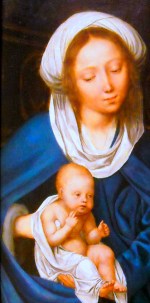
Mary always brings us back to her Son. The Eastern churches have such a high appreciation of this truth that all icons of Mary have her holding the child, Jesus. A possible exception to this was brought to my attention with an icon of Mary in an Eastern chapel at the Basilica Shrine of the Immaculate Conception in Washington, DC. However, looking closer we find that Jesus is still present, albeit through a stole she holds emblazoned with the Greek, Alpha and Omega. Jesus is the beginning and end of all things. The stole signifies Christ the High Priest. He is our Mediator. No one comes to the Father except through him.

It has been argued in Catholic circles that just as the titles and history around Mary have insured an orthodox Christology; so too is Mary and our devotion toward her necessary for a full and genuine Christian faith. A priest friend long involved with Lutheran-Catholic dialogue was challenged about this in an ecumenical setting. He said no slight was intended toward our Protestant brothers and sisters. Nevertheless, he insisted that Mary still had to figure in the equation of faith. Catholics would give her direct recognition; but my friend insisted that any good Lutheran who loved Jesus Christ still gave Mary a degree of unspoken or indirect honor. Jesus will always be the Son of Mary.

A genuine love of Jesus makes room for love of Mary.

Mary’s Titles Inform Our Own Calling

I would go to some lengths to show how Mary is singularly honored by God; in truth, a number of her titles and benefits could be applied to others, even if only analogously or in a lesser and contingent fashion. Mary is rightly called the Mother of God and such a title is strictly reserved to her; but every child reflects the Christ Child and every pregnancy shares “in potency” the promise of a Messiah. Other titles would be more easily shared, like that of the Daughter of the Father and the Temple of the Holy Spirit. Our baptism and faith makes us adopted sons and daughters of the heavenly Father. Granted the gift of sanctifying grace, we are also made into temples of the Holy Spirit. Of course, Mary is the great precursor, for both the whole Church and her individual members.

Before the Spirit of God descended upon the apostles in the upper room, the Holy Spirit had already intervened in her life, preserving her from sin and conceiving the Christ. Mary is the Spouse of the Holy Spirit. She is also called the Ark of the Covenant. Just as the sacred tablets of stone revealed God’s law, this time around he reveals his loving mercy.

The New Covenant is literally the flesh and blood of Christ. He is the Covenant. Similarly, we are to be bearers of Christ for our world today.


Mary at the Annunciation

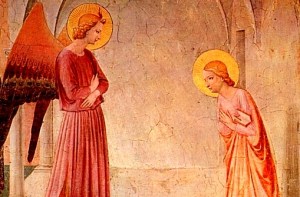
We trace the Hail Mary prayer to the singular citation of the angel Gabriel to Mary, “Hail, full of grace, the Lord is with you” (Luke 1:28). This greeting puzzled Mary, not because of ignorance of her own character, but because of the depth of her humility. We might also wrongly posit timidity in her stance, but such was an expression of reverence and not fear. Here, before her, was an emissary of the Most High God. All the power behind the throne accompanies her heavenly visitor. Nevertheless, she faces him with courage and an openness of both heart and mind. The angel explains, “Behold, you will conceive in your womb and bear a son; you shall call his name Jesus” (Luke 1:3). The angel brings with him a divine wisdom. Angels are wholly committed to the will of God. He recognizes in Mary a creature of flesh who utterly shares his disposition toward divine providence. Mary embodies a true freedom that always says YES to God. “Behold, I am the handmaid of the Lord, let it be done to me according to your word” (Luke 1:38). Mary’s consent was part of a celestial symphony, where God is both the composer and conductor and where she plays her part in the orchestral music of salvation.

What the marital act is for a husband and wife in the natural course of things, Mary’s response was to God’s message; the fruit was the incarnation of the Redeemer.

Mother of God & Queen Mother of the Church

Pope Pius IX said of Mary:

“From the beginning and before all ages, God selected and prepared for His only Son the mother from whom, having taken flesh, He would be born in the blessed fullness of time. He loved her by herself more than all creatures and with such a love as to find His delight in a singular way in her” (Ineffabilis Deus).

Mary is given many titles and each speaks to distinctive elements which point to Christ. Against Nestorius, she is called the Mother of God. This acknowledges that Jesus is a divine person. It answers the question, who is Jesus? She is also called the Mother of the Redeemer and the Mother of the Savior. They immediately answer the question, what does Jesus do? He is the sin-offering who buys us back from the devil and offers us the gift of salvation.

The Jews awaited a Messiah from the royal line of King David. They thought this warrior king would restore their political place in the world and vanquish the Romans and any other enemies of God’s people. The genealogy of Joseph was of this line and while he was only the foster father of Jesus, it was typical that couples married within their tribe.

Mary was also of the line of David. Since Jesus is born of the Virgin Mary, he is the new Jewish king.

Mary, the Messiah and a New Nation

The People of God began as a family, later grew into a tribe and eventually became a great nation. But they would also know upheaval and exile. The one prophet who spoke most forcibly about restoration and the coming of a Messiah was Isaiah. He gives a broken people the gift of hope:

“The Lord will give you a sign in any case: It is this: the young woman is with child and will give birth to a son whom she will call Immanuel” (Isaiah 7:14).

This young maiden or virgin is Mary (Matthew 1:23). Similarly, the prophet Micah also speaks of a woman who would restore Israel. Understanding that those of the Church, Jew and Gentile alike, are members of the New Israel or New Zion, the prophecy fits Mary quite nicely:

“Hence Yahweh will abandon them only until she who is in labor gives birth, and then those who survive of his race will be reunited to the Israelites” (Micah 5:3).

Given her unique role in salvation history as the vehicle through whom the All Holy One would enter our world, she herself is preserved from every stain of sin as the first fruits of his saving works (Proverbs 8:22-35).

Priestesses & a Flawed Interpretation of Galatians

There is much confusion in the argument for women’s ordination around the hackneyed use of St. Paul’s Letter to the Galatians. The passage in question is in reference to a baptismal formula and is not a justification for priestesses. It regards the universal offer of salvation in Christ, not the makeup of the sacrament of holy orders. Arguing that “there is neither male nor female; for you are all one in Christ Jesus” (Galatians 3:28) as a qualification for priestesses is nothing more than a cheap classical reductionism. What is the statement actually saying? The phrase, “neither male nor female” is not focused on biology or psychology, just as “nether slave nor free” is not a statement of sociology and “neither Jew nor Greek” fails to center on anthropological realities. Moving away from fundamentalism or literalism, the statement in Galatians is heavenly, even apocalyptic language. This particular unity does not emanate from a common humanity but rather from God’s election. It is similar to that for which Jesus appealed: “I pray not only for them, but also for those who will believe in me through their word, so that they may be one, as you, Father, are in me and I in you, that they may also be in us, that the world may believe that you sent me. And I have given them the glory you gave me, so that they may be one, as we are one, I in them and you in me, that they may be brought to perfection as one, that the world may know that you sent me, and that you loved them even as you loved me” (John 18:20-23).

This unity for which Christ prays is not yet fully realized. During our earthly pilgrimage, the Church must be sufficiently sacramental so as to perceive the current realities of sex, position, culture, etc., raising up that which is of value in each and discarding that which profanes both God and men. Fr. George Rutler writes:

Secular exploitation of sexual differences in fields which theoretically have no sexual restrictions violate the Christian mind but that is a far different matter from the divine discrimination which merely states the reality of different sexes. St. Paul’s statement about male and female eradicates the fact of maleness and femaleness no more than his statement about bond and free or Jew and Greek denies the reality of Onesimus and Philemon or the fundamentals of geography. Certainly his readers know this; that is the source of one of the great ironies of the ordinal controversy: proponents of priestesses quickly label St. Paul an anti-feminist on the grounds of his abiding awareness of the different order of men and women yet they simultaneously use his own writing in Galatians 3:28 as a proof text for the indistinguishability which he himself found so grim. Having sighted the careful line between representation and misrepresentation, these exegetes have approached it with all the temerity of Caesar at the Rubicon. (Priest and Priestess, pp. 21-23).