























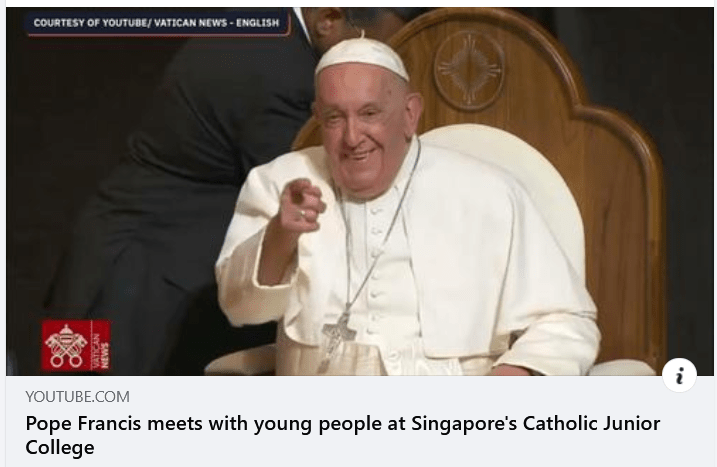
Pope Francis left his scripted remarks and spoke “spontaneously” to the youth of Singapore on Friday, September 13, 2024. The Holy Father made a distinction between a courageous person who seeks the truth as a “critical” thinker and the critic with “endless words” who offers “destructive criticism.” He asked them this question, “Do you have the courage to criticize but also the courage to let others criticize you?”
Impressed with the capacity of youth for interfaith dialogue, he stated: “This is very important because if you start arguing, ‘My religion is more important than yours…,’ or ‘Mine is the true one, yours is not true….,’ where does this lead?” One of the young people answered, “Destruction,” and the Pope responded, “That is correct.”
He went on to say, “Religions are seen as paths trying to reach God. I will use an analogy; they are like different languages that express the divine. But God is for everyone, and therefore, we are all God’s children. ‘But my God is more important than yours!’ Is this true? There is only one God, and religions are like languages that try to express ways to approach God. Some Sikh, some Muslim, some Hindu, some Christian. Understand? Yet, interfaith dialogue among young people takes courage. The age of youth is the age of courage, but you can misuse this courage to do things that will not help you. Instead, you should have courage to move forward and to dialogue.”
He went on to speak about the need for respect and the danger of bullying. He concluded by saying, “And now, in silence, let us pray for each other. In silence. May God bless all of us. In the future, when you are no longer young, but you are elderly and grandparents, teach all these things to your children. God bless you and pray for me, don’t forget! But pray for, not against!”
Is the Holy Father’s emphasis the methodology of dialogue or the reality of God as revealed in world religions? I suspect it is the former. It is true that interfaith dialogue does not go very far when the different sides disrespect and deride each other. People of conviction feel that they are right and take exception to challenges toward what they believe. Pope Francis is correct that we must resist the temptation to argue and name-call. Civility demands that we temper our emotions, especially against criticisms that are quickly taken to heart and are painful. Those of us with pugnacious natures, instinctively want to hit back. History is largely written with such a lack of toleration that leads to violence, censorship, holy wars, torture, imprisonment and even death. The language of hate allows for no dialogue and little in the way of successful debates. Instead of discussing ideas, there is a harsh attack against persons— the opposition are decried as “heretics,” “heathens,” and “infidels.”
Each of us likely believes that his or her religion is the best or the truest, such is even the case for atheists who posit their non-religion or anti-religion as having a higher epistemological value. As Catholics, the most resolute believers are correct to maintain that our faith is the genuine revelation of God through the mediation of Jesus Christ. The New Covenant is the consummation of the Old. Both Judaism and Christianity are judged as true religions. Of course, a natural religion has been surpassed by a supernatural religion that understands God to be both one and a Trinity. Other religions may have elements of the truth, but they are also weighed down by serious errors. Traditionally, apologetics would list all the many false teachings and practices of these other belief systems. By contrast, Pope Francis is saying that this is not where dialogue begins. Such an approach closes minds to the truth and to any possible consensus. It is best to begin dialogue by examining the elements of faith that are shared. This will vary between creeds. Catholics and Jews both embrace Abraham as our father in faith. We have taken the Hebrew Scriptures as our own. Islam also believes in one God and claims facets of a shared revelation. The Hindus are arguably polytheists, but some of their modern-day teachers suggest that their many deities may in truth be manifestations of a single God. Where such thinking will go, I cannot say. Even if there should be no or little congruence on matters of theology, dialogue can be judged as successful if we learn to live in peace and to work together for a better world where human rights and freedoms are respected.
Yes, religions are seen as paths to reach God. However, we as Jews and Catholics understand religion as also the story of how God comes looking for us. There is a two-fold movement. God establishes relationships (covenants) with his people. The analogy of religions as different languages to express the divine is accurate. Left unsaid is that some languages are better in their evocative and descriptive power. Christianity not only espouses God-talk but has been given the revelation of how the eternal Word becomes flesh. The lack of such an appreciation is a defect that handicaps all other religions. God gives us his Word in Scripture, but more importantly writes his revelation upon human flesh in the incarnation. Jesus is the face of God and the revelation of the Father. He is the way and the truth and the life. There is no way to the Father except through him. Other religions, if they do not go off in the wrong direction, can only take their adherents to the door of the kingdom; it is Christ that lets us inside. His Church and the sacraments constitute the key to that door.
Are we all God’s children? As in the catechism and at Vatican II, a distinction must be made. Spiritually, through faith and baptism, we are made adopted sons and daughters of the Father. It is in this sense of grace and a new creation, that those of other religions are not children of God. However, the meaning of Pope Francis is in the sense of creation. All in the human family are creatures and children of the earth. Our source is almighty God. Regeneration aside, we are all arguably children made in the image of God. We are creatures of flesh and blood and soul. We are so much more than the animals around us. This notion speaks to human dignity. It is a major element of the Gospel of Life. In or outside the womb, God looks upon us with a Father’s love.
Knowing that he is speaking to a crowd of mixed faiths, Pope Francis asks that they might pray for each other in silence. Notice that he prays that God might bless them, but he refrains from asserting the saving name of Jesus. While we might question timidity regarding the name of Jesus and/or making the sign of the cross, we should remember Pope Francis’ words about courage. Certain Christians will not pray with Catholics. While we can pray the psalms with Jews, it is quite problematical to pray with non-Christians. We do not want to open such young people to rebuke or punishment from their own religious leaders. Importantly, we as Catholics must not subscribe to any form of religious indifferentism or the notion of universal salvation. Silent prayer is probably the best for all in such a situation.
ADDENDUM
Anyone with a smidgen of Italian can appreciate that the text on the Vatican website (yesterday) is not actually what the Pope said to young people in Singapore. Previous popes tended to be more careful with off-the-cuff or spontaneous remarks. Officially, the text that matters is the written one, today on the Vatican website and/or included in the published Acta.
When I was informed about a translation change, I went immediately to the Vatican site. What the hell? The official translation had at least corrected the Pope’s remarks. Now, the Vatican has returned to what comes across as deeply problematical. Last night, the text read, “Religions are seen as paths trying to reach God.” Yes, this is true, regardless as to whether they do so. This morning it has been changed to “All religions are paths to God.” This is not true. Even those in false religions reject this notion. Reading further, the initial papal text asserted, “There is only one God, and religions are like languages that try to express ways to approach God.” Yes, this is true, even defective religions are efforts to approach the transcendent. But the new version is as wrong as wrong can get, “There is only one God, and religions are like languages, paths to reach God.” Not all religions target the true God. Indeed, it is Christ as the term of salvation that makes possible our reconciliation with the Father. None are saved apart from Christ and his Church. Further, not all religions are the same. Satanism and demon worship are counted as religions, but there is no redemption, just alienation and loss. Certain religions worship false gods or even demons.
Filed under: Uncategorized | Tagged: Bible, christianity, Faith, Jesus, Religion |




















 Blogger Priest
It is possible to discuss trueness without philosophy? How would modern Judaism compare to Orthodox Christianity with her Philosophical language and metaphysics? If religions are different languages that express the devine, then what is the soul and her preexisting language for?
Likely if it was translated differently it would contain even more Philosophical errors than it does now.
To bring forth the world these terms must be defined. Christ the Logos of God did that. Buddha didn’t claim that, but Christ did.