• Our Blogger

    Fr. Joseph Jenkins

  • An important theme for this blog is the scene in the New Testament where Jesus can be found FLOGGING the money-changers out of the temple. My header above depicts a priest FLOGGING the devils that distort the faith and assault believers. The faith that gives us consolation can and should also make us very uncomfortable. Both Divine Mercy and Divine Justice meet in Jesus. Priests are ministers of reconciliation, but never at the cost of truth. In or out of season, we must be courageous in preaching and living out the Gospel of Life. The title of my blog is a play on words, not Flogger Priest but Blogger Priest.

  • Archives

  • Categories

  • Recent Posts

  • Recent Comments

    Barbara King's avatarBarbara King on Ask a Priest
    Ben Kirk's avatarBen Kirk on Ask a Priest
    Jeremy Kok's avatarJeremy Kok on Ask a Priest
    Barbara's avatarBarbara on Ask a Priest
    forsamuraimarket's avatarforsamuraimarket on Ask a Priest

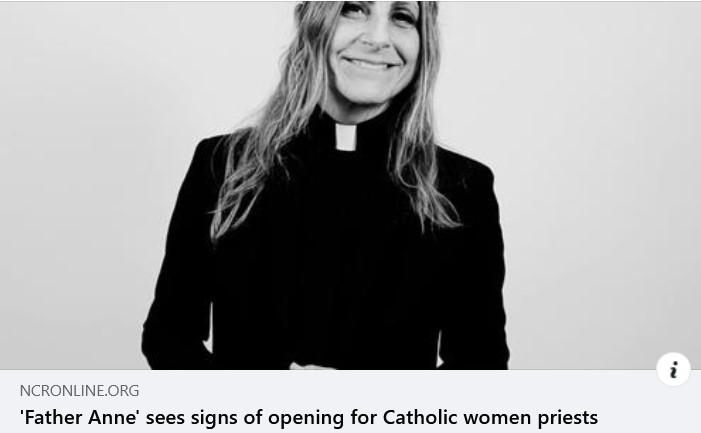
Misguided Priestess for a Counterfeit Church

Anne Tropeano claims that she is Father Anne and that she was ordained a Catholic priest in 2021. But this is not true. Her act of defiance was a formal disassociation from the Catholic Church. Not only was she excommunicated, but she also became a Protestant minister. The fact remains, that while such was true for paganism, there is no such thing as a woman priest or priestess in the Church directly established by Jesus Christ.  The Vatican synodality may discuss such matters as women clergy but nothing will change. The ordination of women would fracture the Church and create a parallel false Catholicism.

Influenced by the liberal Jesuits, she decided that she could not wait for the Church to change its position on this issue. She procured her so-called ordination, not through valid channels, because none were open to her. Instead, she went to a group that calls itself the Association of Catholic Women Priests. Of course, a cat can call itself a dog and yet it is still a cat. She places her own personal presumption over the judgment of the magisterium of the Church. That is what the Protestant reformers did. Again, it is clear she is a Protestant. Indeed, her attempted ordination in October of 2021 took place in the Cathedral of St. John in Albuquerque, NM, an Episcopal and not a Catholic place of worship. She appealed to an organization that dissents from Catholic teaching and had herself “ordained,” not for genuine priestly ministry but “to bring the church into alignment with God’s desire for women’s full participation.” What she really means to say is that she wanted to coerce Church leadership and even force the hand of God to accept her (and others like her) as priests.  It is never going to happen. Further, attesting to her new Protestant and not Catholic affiliation, her first effort to offer Mass, only sacramental simulation, was on the next day in St. Paul Lutheran Church in Albuquerque, NM. While Episcopal orders are compromised, Lutheran churches make no claim to valid and apostolic orders.

Her fraudulent ordination was conducted by so-called Bishop Bridget Mary Meehan. Bridget was ordained a fake priest in Pittsburgh on July 31, 2006 by three fake bishops:  Patricia Fresen, Gisela Forster, and Ida Raming. Her attempted consecration as a bishop was in Santa Barbara, California on April 19, 2009, at the hands of three women who were themselves playing “bishop.” They again included Fresen and Raming, with the addition of Christine Mayr-Lumetzberger. The ridiculous situation had bogus women bishops making more bogus bishops and priests.

Is God calling women to the priesthood? This question cannot be answered through dissent to the Holy See.  The distinction between many Protestant churches and Catholicism is precisely the communitarian or corporate element of faith. Ours is not a solely personal or interior faith. We are part of something larger. It is the movement of the Holy Spirit in the worldwide or Catholic faith community where the faith is protected, and the sacraments are given their efficacy. What the Church might give as a gift cannot be taken from her hand as an entitlement.  The Church has definitively judged herself as incapable of extending Holy Orders to women. We are locked into a male-only priesthood by the pattern given us by Christ and the apostles. Any action otherwise would threaten both the validity of the priesthood and the Eucharist. This is too great a price to pay for the appeasement of women who dissent, not only on the matter of priestly ordination, but upon the disciplines attached to it and other questions of the moral life.    

We are told that Anne Tropeano is leading a campaign to influence the Synod of Bishops (and other invitees), as they discuss the role of women in the Church. But the backdrop to any discussion is the absolute prohibition of women’s ordination from Pope St. John Paul II and the recent absolute exclusion of women as deacons from Pope Francis. How is she to have any influence, given her status as one excommunicated and without a formal invite?

She claims that while they want a claim to all three tiers of Holy Orders, there is a lack of openness or transparency on the question of female deacons. However, this is not true. There is absolute clarity, and the answer is NO. What she objects to is the answer given by the Church. It is understandable because it invalidates what she imagined to be a personal calling from God. Granted that mixed signals were sent by the Vatican when an invitation to Anglican bishops included women as with Jo Bailey Wells.  However, we must remember that the Church even questions the apostolic nature and reality of orders given to men in the Anglican communion.   

Anne Tropeano says she will never abandon the Catholic Church and the Mass. When she attends Mass “in the institutional church,” she says that she receives a blessing instead of communion. This shows some small semblance of respect to the true faith; however, we are judged not simply for where we in conscience stand but by our posture before almighty God and his Church. We can seek a blessing at Mass but are we disposed to the graces that it would ordinarily extend? Even validly ordained men can damn themselves. What should be the status of one who beguiles the ignorant into thinking she is a real priest? What about those who take communion from her table, expecting the body and blood of the risen Jesus, only to receive a cheap wine and a morsel of stale bread? How will God treat a person who has led his little ones astray?

Any effort to re-frame the question is simply trying to get around the set answer. A few men and no women are called to be deacons, priests, and bishops. Word games will not prevail on this matter. No one is questioning the value of female genius and the value of their service to the Church or their capacity for holiness. But all this stands apart from what has been revealed to us about the priesthood. It is not a matter of many in the Church “wanting” to ordain women; rather, the point is that we are not given any certain warrant to do so. We have not been reliably enabled to ordain women. Indeed, the tradition of faith is weighed heavily against such a change.

The argument raised by certain theologians that women should be ordained, since they are already involved in pastoral ministry, albeit without sacramental recognition, is utterly fallacious. Indeed, it signifies two things. On one extreme, there has been a wrongful effort to clericalize the laity. On the other, the clerical vocation should not be elevated by demeaning the lay state. The apostolate of the laity, especially regarding social justice and charity, should not be undermined or minimized.  

Tropeano asks a loaded question; she wonders why women cannot be ordained deacons given that they served a sacramental role in the past. But it is clear, that while women may have been called deacons, they were not ordained. The Council of Nicaea strictly forbade the “laying on of hands” upon women. The nomenclature in the early Church lacked sufficient specificity and proved fluid. Deaconesses were either women married to deacons or simply holy women who cared for female neophytes preparing for baptism. Their successors today are women in Altar Guilds and consecrated female religious.    

Apologists for women clergy wrongly collapse the meaning of being remade “into the likeness of Christ” by saving grace and the significance of a priest acting “in the person of Christ” at our altars by the new signification of ordination. Just as there are different modes of real presence between the Word and the sacrament, a distinction must be made between our union with Christ in the Church or mystical body and his identification with the priest in the Mass. The Word is associated with the proclamation of the Gospel or the Scriptures. The Eucharist is the bread and wine consecrated into the body and blood of the risen Christ. The Church signifies our membership with each other and our union in Christ’s body. Applying another familiar analogy, Jesus is the vine, we are the branches. The caricature impressed upon us at baptism, makes us Christians. The caricature impressed upon a man at ordination, makes him an “Alter Christus” or another Christ.  Just as the Eucharist requires bread and wine, Holy Orders requires a man (not a woman) disposed for the sacrament. Gender is not accidental or something interchangeable, despite the widespread dysphoria of our times.    

She insists that the Church must take a prophetic stance. What she fails to understand is that is precisely what the Church has done. Just like the prophets of old, the Church’s message is counter-cultural, it is a message that is opposed.  Tropeano is speaking, not for the Lord and the Church, but for a secular modernity that distorts gender and applauds same-sex deviancy. The so-called growing awareness of humanity is merely a growing resistance and supplanting of the things of God for the whims of humanity. Indeed, one might argue that the new awareness is really the discovery of something very old, the re-emergence of pre-Christian paganism with its priestesses, oracles and libertine values.

She writes: “The Roman Catholic Church has grown. It’s one of the largest nongovernmental providers of education and health care in the world. It has a seat at the U.N. When the church comes into alignment with God’s will for women’s participation in the world, it will be a massive force of renewal.” It should be reiterated that the Church has always given opportunities to brilliant and talented women, as shown by their inclusion in the canonized saints and doctors of the Church (particularly as women religious). The rapid loss of sisters and nuns is a negative sign in the modern Church, a retreat from their formative role as teachers to the young and as the chief handmaids of the Lord. The Church is all for women taking their rightful place in the secular world alongside men, but this no more means they should be deacons, priests or bishops than that fathers and mothers should exchange or utterly confuse their roles. Some matters are fixed by God and by the nature of creation. The alignment that she demands would not signify the conversion of the world but rather the final surrender and defeat of the Church.

What is an Evangelical Catholic?

I recently responded to a query from a young man preparing for reception into the Catholic Church. He comes from an Evangelical background and has yet to tell his family. Given that his baptism is recognized by the Catholic Church, I urged him to find a priest to serve as his spiritual director and confessor. As opposed to the “once saved, always saved” mentality I also urged a spirit of repentance and regular recourse to the act of contrition prayer. Often such candidates struggle with a sense of betrayal to their former religious sect and to those who introduced them to faith in Christ. There is a hesitance to announce what is going on.  But ultimately courage must prevail, and others must know. If the family practices a strong Protestant faith, then questions will immediately follow, along with efforts to dissuade. That means the candidate must be prepared with the reasons for his “continuing conversion” and be ready to accept the consequences. Instead of enmity, the new Catholic should always show respect and gratitude to those family, friends, and ministers, who first introduced him to a saving faith and love of Jesus Christ. Becoming a Catholic should be understood, not as a betrayal or simple rejection of faith, but rather as a continuation of one’s religious journey.    

Since a person cannot be baptized twice, the inquirer makes an act of reception, is anointed with chrism (Confirmation) and receives Holy Communion at Mass. Here in the United States, many Evangelicals have become Catholic, merging in a sense the best characteristics of both. What does it mean to be an Evangelical Catholic. The trailblazer for this was the late Father Richard John Neuhaus. His conversion from Lutheranism came in the context of the vibrant papacy of Pope St. John Paul II.

What are the essential characteristics?

First, while acknowledging the backdrop of Sacred Tradition, the committed Catholic exhibits a strong evangelical spirit regarding Sacred Scripture.  We must both know the truths of the Bible and be willing to share them. The Catholic Church claims ownership of the Scriptures. She inherited the Hebrew Scriptures and later collected and agreed upon the New Testament canon. The Church is the Mother of the Bible.

Second, in proclamation of the Word and in the celebration of the sacraments, we must always focus upon the Paschal Mystery. This mystery is defined as the passion, death, resurrection, and ascension of Jesus. Jesus is the one Savior. His is the saving name. He is the Way, the Truth, and the Life. None come to the Father but through him.

Third, we are called both to a personal and a corporate or communal faith in the Lord.  Jesus is the ultimate term of salvation. Saving faith in Christ is defined by loving obedience.  Conversion must be real. Even if baptized as a child, we must own our faith and pursue a genuine relationship with the risen Christ.

Fourth, we must be dedicated to what Pope Francis calls the New Evangelization. In truth it is very old, but believers have become complacent. One cannot truly possess the faith or the Gospel unless there is a deep commitment to give it away.  A failure to share faith is a failure to love. We must proclaim the Good News to friends, family, and even enemies (and thus make them friends).  

A Papal Message to Traditionalists at Angelus?

The Holy Father introduced the Angelus on August 11, 2024, to 12,000 pilgrims in Saint Peter’s Square with a few words about John 6:41-51 taken from the day’s Mass. The Pope explained that those who knew Christ questioned how he could say that he came down from heaven. It should be obvious that those who thought they knew him, did not know him well enough. The Holy Father asserts, “They are obstructed in their faith by their preconception of his humble origins, and they are obstructed by the presumption, therefore, that they have nothing to learn from him.” As the Pope offers his words, one must wonder if he has mistakenly shifted to another text, Matthew 13:54-58:

“He came to his native place and taught the people in their synagogue. They were astonished and said, ‘Where did this man get such wisdom and mighty deeds? Is he not the carpenter’s son? Is not his mother named Mary and his brothers James, Joseph, Simon, and Judas? Are not his sisters all with us? Where did this man get all this?’ And they took offense at him. But Jesus said to them, ‘A prophet is not without honor except in his native place and in his own house.’ And he did not work many mighty deeds there because of their lack of faith.”

The Pope’s observation is true in its proper context, but the theme to the actual Gospel for the day is Jesus as the Eucharist. 

Turning to the correct reading, Jesus tells the crowd, “I am the bread that came down from heaven.” Pope Francis seems to miss or at least bypass the core meaning of the Gospel selection— that Jesus will feed his people with his very self. Our Lord makes himself painfully clear: “I am the living bread that came down from heaven; whoever eats this bread will live forever; and the bread that I will give is my flesh for the life of the world.” This is why his listeners “murmur.”

It is not simply that they have closed hearts. Our Lord is testing them with a message that sounds absurd or irrational to their ears. Their law would have them refrain from the blood of animals and yet what Jesus proposes sounds like cannibalism. They cannot make sense of it. It has not been revealed to them that Jesus is God. The claim that Jesus makes is wild, maybe even deemed as madness. Many of the Jews will walk away. It is here that there is a major disconnect with what Pope Francis tells the crowd:

“Preconceptions and presumptions, how much harm they do! They prevent sincere dialogue, a coming together, of brothers and sisters: beware of preconceptions and presumptions. They have their rigid mindsets, and there is no space in their heart for what does not fit into them, for what they are unable to catalogue and file-away, in the dusty shelves of their security. And this is true: very often our securities are closed-up, dusty, like old books.”

Dusty old books often retain the great treasures of inspiration and wisdom gathered over the ages.  Why should the Holy See elevate the novel and untried over the ancient and proven? After all, it is the Church’s ancient apostolic pedigree that singles her out from among her ecclesial rivals.

Nothing about the Eucharist is mentioned. How can this be? The Jews are wronged for that which they did not and could not yet know. It is not their fault that they fail to understand. Indeed, our Lord would turn to his apostles and ask if they would leave him, too.  Peter will affirm to Jesus that while he will not abandon him, like the others, he can make no sense of his message either. He remains because he personally believes that Jesus has the words of eternal life. He stays because of a forged relationship, not because he yet understands.  

The Holy Father’s message is not an exegesis of the immediate text but the imposition of a thinly veiled polemic against the obstinacy of traditionalists and those who maintain what he regards as a rigid faith. What are the harmful “preconceptions and presumptions”? One would expect the Pope, before all others, would affirm settled doctrine and maintain perennial truths against the errors of our times. But he has become notorious for ambiguity. Yes, we can be compassionate to those in same sex relationships and in irregular unions. However, we cannot condone sin but must call all to repentance and conversion. Whatever ritual used for Mass, God is praised, and the children of God encounter the saving oblation of Calvary and receive the resurrected Christ in communion. Should we exclude any Mass, old rite or new, that nourishes the People of God, forgives sins, and saves souls? Should we not err on the side of freedom and not seek to hurt the faith sensibilities of believers?

The Pope argues that those who resist and abandon Jesus do so because “they carry out their religious practices not so much to listen to the Lord, but rather to find in them the confirmation of what they think. They are closed to the Word of the Lord and look for confirmation of their own thoughts.” Again, it becomes clear that this is not a homily on the Scriptures, but another of many assaults on the resistance of traditionalists. Granting the Holy See every respect, is there not something presumptuous about the negative stamp impressed upon traditionalists and so-called conservatives? Why would he view those who prefer the Traditional Latin Mass as having a hollow faith?  Can he read hearts? How does he know that they are “closed” to the living Word? Is it wrong for them to have confidence in the truth, particularly in a revelation that comes from the Lord and the legacy of faith?   

Returning to the actual Scripture text, the difference between the murmuring Jews and the obstinate traditionalists is crucial. While the Jews are in the cold and our Lord has not yet instituted the Eucharist, the latter group (good Catholics) have received the fullness of revelation. The catechism can be trusted as passing down the truths of Sacred Scripture and Sacred Tradition. The papacy is organized precisely to preserve and define the Church in perennial truths, not to challenge or undermine the faith.

Equating the complaining traditionalists with the murmuring Jews, is he fearful of schism just as many Jewish disciples walked away from Jesus? The analogy is a poor one. It is no secret that the Holy Father is not happy with many, i.e. EWTN and “conservative” or “orthodox” news services, traditional critics on social media, books by clergy and laymen who oppose his synodality effort and how he promotes the reform of the Mass. He impugns their faith, saying, “they are convinced, and they shut themselves in, they are closed in an impenetrable fortress. And so, they are unable to believe.”

Should anyone negate the faith of critics who emphasize the head over the heart? We must recognize the normal progression:  to know, to love, and to serve.  Is it not wrong to view this as a resistance to truth? He writes: “When you find a person who is closed in their mind, in prayer, that faith and that prayer are not true.” No, the mind for many of his critics is not closed to the truth but to error. We are not talking about liberal dissent but rather men and women who seek to think with the Church. True development of doctrine starts with what we know as genuine and reliable. There is no reversal of revealed truth. Truth builds upon truth. The Christian acknowledges that there are some questions that have been answered definitively. Marriage is only between a man and a woman. There are only two genders. Sex outside of marriage is always wrong and sinful. The human soul is infused at conception and this constituted person has a sacred dignity and a right to life. Any legitimate Mass, both the Novus Ordo and the Traditional Latin, constitute the re-presentation of Calvary in a clean oblation to the Father wherein propitiation is made, and we are redeemed. Jesus makes himself fully present in the bread and wine that is transformed into his body and blood. Christ is our one mediator. None are saved apart from Christ and his Church. The Church is governed by an apostolic hierarchical authority. Only men can be ordained as bishops, priests and deacons. The commandments and precepts of the Church bind us under the law of God. The seven sacraments give grace. Priests act in the person of Christ as head of the Church at our altars. We are given beatitudes, corporal works and spiritual works of mercy. The Lord’s Prayer shows us how to pray and Jesus shares something of his relationship to the Father with us. None of this is up for grabs. It is imposed from on high, and no synodal process from below can change any of it.      

All this said, Pope Francis regularly laments the harm caused by critics on the right, viewing their stance as a failure to love. But given his treatment of traditionalists, the many insults against priests, and the vindictive retaliation against faithful bishops, we must ask in all humility, is his heart fully open to love? It is here that I hope the Holy Father takes his own words to heart. He writes:

“Let us pay attention to all of this, because at times the same thing can happen to us too, in our life and in our prayer: it can happen to us, that is, that instead of truly listening to what the Lord has to say to us, we look to Him and others only for a confirmation of what we think, a confirmation of our convictions, our judgements, which are prejudices. But this way of addressing God does not help us to encounter God, to truly encounter Him, nor to open ourselves up to the gift of His light and His grace, to grow in goodness, to do His will and to overcome failings and difficulties. Brothers and sisters, faith and prayer, when they are true, open the mind and the heart; they do not close them.”

What the Pope prays in theory becomes more problematical in practice. He would have us ask ourselves a series of questions.

  • “In my life of faith, am I capable of being truly silent within myself, and listening to God?”
  • “Am I willing to welcome His voice, beyond my own mindset, and also, with His help, to overcome my fears?”

We should all find a silence within ourselves to listen to God. But God speaks to us in his Word and through the truths taught by the Church. The confusion emerges when dissenting opinions emerge from a secular modernity that seem to conflict with what Christ revealed and with what the Church has always taught. God cannot teach falsehood. Living popes must agree with dead ones on matters of immutable doctrine and morality. We must also be able to discern between the true voice of God and that which is a snare from the devil or from ignorance. The posture of the true disciple should always be one that is open to correction and enlightenment. While we can practice accompaniment, we must not walk with others away from the Lord on the road of sin; rather, we should get those that are lost to accompany us on the one way of Christ. The development of doctrine must always be organic and reasonable. The irrational or chaotic or disordered is not from the Lord.  Rather, these traits belong to the prince of the world.

The Pope prays, “May Mary help us to listen with faith to the Lord’s voice, and to do His will courageously.” Just as the teaching authority of the papacy should never be taken for granted; neither should the magisterial theologians have their voices or teachings dismissed with impunity.  It seems to me that many priests and bishops seek to speak truth to power, and do so courageously, not as a form of disrespect but with confidence in Christ and a love for the Church.