









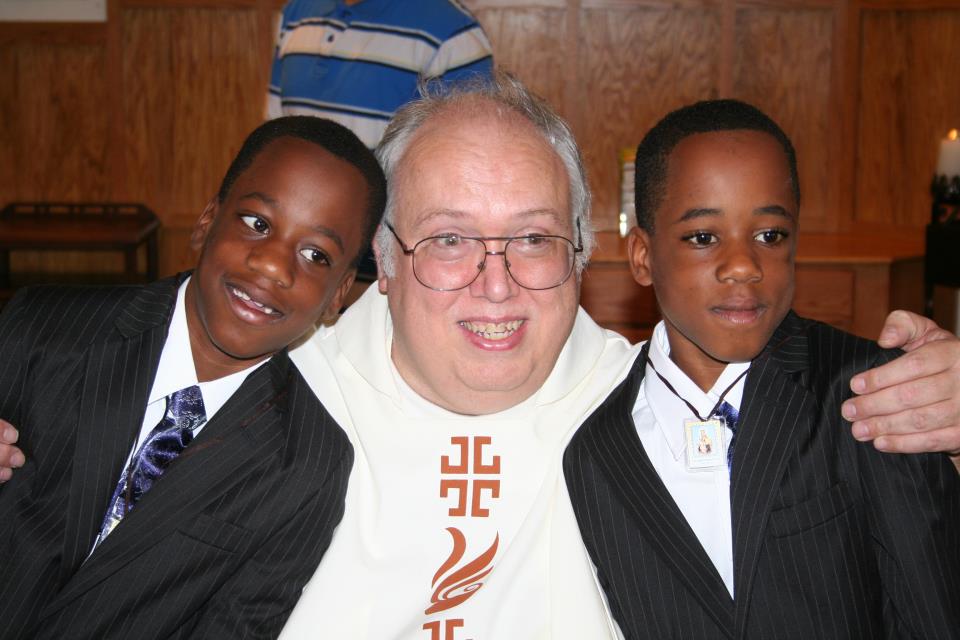





Until recently, the celibacy of Catholic priests was regarded by their own religionists as uncontested. If you wanted to be a priest then you had to forsake the possibility of a wife and children. Such was the complete package and a man could not sign up for one without the other. Now changes both inside and outside the Church have brought that complementary dualism into question. My personal concern is that some celibate priests may come to resent married clergy and that married priests might regard celibate men as oddly eccentric, aloof and angry. How can a faithful celibate priest, who fell in love but kept his promises with distance, prayer and tears, not feel a wound in his heart reopened when he must work side-by-side with a married priest who has both his religious calling and his beloved spouse and children? He would have to be an absolute ice-man or robot to avoid real internal pain. Bishops seem aware of this and that may be why married priests, formerly of the Episcopalian tradition, are frequently given special assignments removed from the regular pastoral duties of celibate priests. I also have to wonder if such were a factor in the growing Anglican-usage parishes. This allows them to be Catholic but makes for distance from traditional settings and celibate clergy while grouping them with other former Protestants who have sought reunion with Rome.
The question was always, why have married priests? But now everything is turned around. The question becomes, why have celibate priests? There are three basic arguments:
- Given that celibacy is obligatory and made as a vow or promise, the first rationale is ecclesial authority and long-standing tradition.
- Given that the priest must go where he is needed and immediately do as he is told, the second argument is availability and that he lives to serve the family of God, not for himself.
- Given that he is an eschatological sign of the kingdom, the third assertion is that his witness as “the poor man” and his cultic service as a priest of the altar should point toward spiritual realities unmarred by entanglement in matters of the flesh and the world, notably sexual expression.
The first reason was challenged by the manifold changes after Vatican II. Everything seemed to be in a state of flux. The liturgy changed overnight, fast laws were modified or abrogated, and there was a paradigm shift in our attitude toward the world and other religions. Many priests were ordained thinking that the policy on priestly celibacy would change and become retroactive. However, it did not change and thousands of priests left ministry, particularly in the 1960s and 1970s. It is no wonder that Pope Benedict’s emphasis on tradition also included a reaffirmation of priestly celibacy. Unfortunately, many are presumptuous that Pope Francis will be more accommodating to those who hope to see the discipline made optional or dismissed. I do not believe it will happen. Why? It is because of how the other two reasons fit into the model of poverty and living for others that are thematic for his papacy. If he demands that priests live simply and drive used cars, then he definitely would not want to see priests caught up with the worldly affairs of a wife and family.
The other two reasons are assaulted by the charge that celibacy is a discipline, not an intrinsic doctrine that is essential to priesthood. This is actually the consensus or general thinking of the Church; however, a few of us wonder if the distinction might be too pact or simplistic. God seemed to tolerate polygamy and divorce in the Old Testament but Christ made it clear that such does not reflect the true mind of God and human nature. Given the great need, the novelty of Christianity, the rapid growth of the Church and the lack of viable single candidates, could it be that God tolerated married men in his priesthood until such became unnecessary? The apparent fact that men called to holy orders in the early Church often lived as if they were not married, in perfect continence with their wives, would seem to give substance to this supposition.
A further support to this view is the long-standing predominance of celibacy into the modern era. Just as the Holy Spirit safeguards the authority of the Church and the faithful transmission of the deposit of faith, might the celibate priesthood be an expression of his work that is reflective of divine providence? Yes, it is true that a few married priests (but not bishops) minister in the small Eastern rites of the Church; but these few exceptions are dwarfed by the number of celibate priests serving in the West. What about the Orthodox churches? As Pope Benedict XVI rightfully reminded us, while their sacraments are efficacious, they do not accept the full juridical authority of the Holy See. The Orthodox churches are true churches, albeit defective. The Protestant denominations are classified “theologically” as ecclesial communities. Such means that Protestants have lost apostolic succession and thus have no authentic priesthood or Mass. The Orthodox have both but they also suffer the dire loss of the Petrine see and thus forfeit the full protection of God against error. Their teachings and practices would not “immediately” inform Catholicism given the juridical break. The witness of the Eastern rite churches (in union with Rome) is more significant and must be given a certain consideration on all questions of faith and discipline. In any case, note that the Orthodox have both married and celibate priests but ONLY celibate bishops. Even they seem to discern that there is a serious difference. Roman Catholicism readily recognizes this and wants all her priests to match the same high standard. The Church needs it and God deserves it.
Please note that references to other denominations are not intended to be pejorative, just informative of a demarcation between them and Catholicism. It is not possible today to speak about Christian ministry and to avoid comparisons. Only briefly hinted at in this posting, many Protestant churches would reject any definition of their ministers as priests; others would define the priesthood differently or have a disrupted apostolic succession. Their views would have little or no standing in the Catholic context. Catholic deacons can do all that a Baptist minister can do: baptize, celebrate a communion service, witness a wedding, visit the sick, preach from the pulpit, teach, etc. Our deacons are both married and unmarried. The similarity or comparison between many Protestant churches and Catholicism in ministry is not between the priest and minister, but between the minister and deacon. Of course, the deacon is also in Holy Orders and is ranked among the clergy.
Filed under: Anti-Catholicism, Apologetics, Catholic, Celibacy, Discipleship, Marriage, Morality, Priests, Religion, Sacraments, Sexuality |














 Blogger Priest
I agree with Francis Philip. A single man/woman can go ahead and do what they wish as to being celibate but, it is completely different for the ordained. I think Fr. Joe is proving that by his comment, he doesn’t seem to understand.
If a priest or nun has taken that vow yes, they should stick to it but then the higher ranking church don’t stick to the ‘rules’ but the fact is, celibacy should not have been put in place at the beginning and it is only a pope who can change that but for the reason of greed he won’t.
There have been many changes within the Catholic church over the decades one was the priest had his back turned to the congregation until he was to serve Holy Communion, and used to go straight into the Sacristy right after Mass but, now they face them and stand at the back of the church and talk to anyone who needs help.
But, let’s not forget that they are human as we the ‘congregation’ are human, but the Catholic church loves to turn away from that, in that direction it is like living the life of a monk or a Carmelite Nun, if they are shut away for the best part of their lives-like when the priests used to have their backs turned then, it is no wonder this problem as started because, they have been starved of nature, starved of reality and with people who are outside the world not realising what is going on and they turn their back on that fact that celibacy should be abolished because, they don’t know what is going on and priests and nuns have been hidden from the public and now look what has happened, there is all this crisis and in that direction it is no wonder that Alter boys have been sexually abused, I am far from saying it is right because it is sick, the point I am making is, if they have been locked-up in a closet for a good part of their lives (because in that way they have) everything festers and in the end it all breaks out and then all the abuse starts and they want everyone to keep quiet because they are rightly ashamed but….it is because they have been ‘locked-up’.
And it has far from the victims fault which in the end the Catholic church would love it to be their fault, it is the fault of the Catholic church and that is what Pope John Paul II, Pope Benedict XVI and Pope Francis I is trying to deny it all happening but putting the blame on the victims is not the answer the blame lies deeply within the Catholic church and well they know it and the reason they pass the blame to the victims is, there is far too much money to pay our to the victims and that is why they pass the blame.
BUT, they do need to “Get real” and take responsibility and take action as it is their fault and celibacy should be abolished, it is a necessity to remove celibacy, the Catholic church knows perfectly well it is truly not working, it is beside the point as to if it works for some, just remove it and if it does only work for some then, let just the some remain celibate, they don’t and shouldn’t have to take that vow bachelor’s and spinsters don’t take the vow, and if they change their minds and want to marry after all, then so be it, there should not be a problem. Honestly, life should be so simple so why does the Catholic church make it so darn hard-in the name of God just remove it and stop being childish and greedy.
Thank you
Christa, I recall speculation back in the 1980’s along the same lines, that older men, particularly among the permanent deacons, might be invited to become priests and serve where there were shortages and parishes without a priest. Just as we used to have the category of a “junior” priest with limited faculties, these men would be ordained with a very limited scope of ministry. However, there was a rather strong reaction against it and a renewed emphasis in permanent diaconate programs that this was not on the table. In my own archdiocese, however, several single permanent deacons went to seminary and became priests.
You stated, “similarity or comparison between many Protestant churches and Catholicism in ministry is not between the priest and minister, but between the minister and deacon. Of course, the deacon is also in Holy Orders and is ranked among the clergy.”
What are you saying about Catholic Deacons here and the power of the Sacrament of Order? Please be clear.
Sorry, I left something important out: I meant to say older married men who are already deacons might be interested in becoming priests.
Hi Father, I’m in no way trying to diminish the sacrifices that the celibate priest makes. But, I don’t have a problem with a married clergy either. I think that both can serve well and bring their different perspectives. I can understand that there are different takes on this subject; but, i honestly don’t understand people who get really hostile about it (not saying you are doing that; your posts are very reasonable and invite discussion). Some folks just go off the deep end on this and I don’t get it. Perhaps a generational thing? I don’t know. Most younger people I know are open to the possibility of married priests.
I have to admit that I never considered the point you raised about currently celibate priests having to serve side-by-side with married ones and how they would feel about that. So, thanks for putting that forward. I always assumed that celibate priests lead a full and satisfying life and don’t really care about not being married.
Even in the Eastern Rites, as you point out, priests are already married before ordination and then cannot become Bishops.I am thinking that perhaps older men, already married, who might want to become priests is a possibility.
And I am grateful to those who commit their lives to the Priesthood and who make the orphans and widows their family. This is a good reason to be single (and celibate as a function of being single and dedicated to serving the needy as if they are one’s own family).
I don’t like this entry. I’m not going to elaborate here but suffice it to say: if a man is single, he does not have a good reason for having sex. So, he should be celibate. Period.