














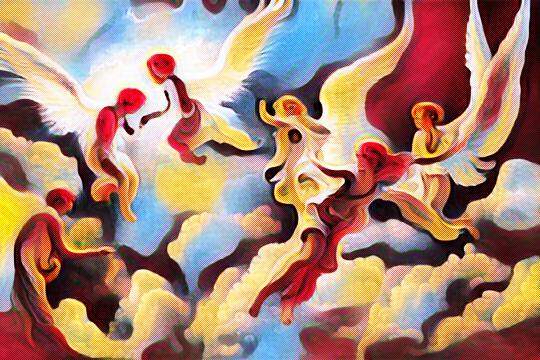
The fact that there are ranks of angels is a truth that I would concede. However, I must honestly admit that all efforts to denote them strike me as contrived and speculative. Focusing on the Scriptures, the Jews tend to speak of ten ranks while Catholics detail nine broken down into sets of three. The source for Christians is Pseudo-Dionysius the Areopagite from the fifth or sixth century and his work entitled, On the Celestial Hierarchy. It is all remarkably interesting but is it credible?
- Highest Rank – Seraphim (Is. 6:2), Cherubim (Ez. 10:15,20), Thrones (Col. 1:16)
- Middle Rank – Dominions, Virtues, Powers (all mentioned in Eph. 1:21)
- Lowest Rank – Principalities (Eph. 1:21), Archangels (Jude 1:9), Angels (throughout Bible)
How are they distinguished? The highest or first rank of angels focus immediately upon the godhead. They bask in the presence of God. They praise him as holy Wisdom. They clearly acknowledge God as the Judge of all. Those of the middle or second rank possess governing authority over the universe and have power over natural creation. The lowest or third rank is where we find the guardians or messengers of God. These are the angels we most invoke for intercessory prayer.
What are my thoughts about this? The substantial form in human beings is the immortal soul. It is what separates us from animals. If the soul leaves the body, it survives as a ghost. The body, however, would become a corpse. It cannot live without the soul. The soul is the principle of life. By contrast, an angel is pure form without matter. That is why angels cannot die. An angel is a spiritual creature that can know, will and act. The primary activity of an angel is to see, know, and love God as the greatest good. Beginning with its creation, every angel is its own form or species. There is no matter to be determined (formed) as in the race of men. While matter is our principle for individuation, such is not the case for angelic beings. Given the lack of informed matter, there can be no membership in any angelic species. Every angel has its own unique form. While they share a common spiritual essence, each angel is a species of one. I have heard it argued that there is a radical self-determination by the angel’s act of will at creation. The angels of God would sort themselves by their species and office. While all adore, some are drawn to proclamation or governance or revelation or blessing or whatever. This is apart from the orientation that separates the good from the bad angels.
The rebellion among the angelic hosts constitutes the most important distinction between the good and the bad angels. There must have been some kind of veil at the beginning so that there might be freedom regarding the acceptance (or rejection) of God as the greatest good. Otherwise, the compelling attraction of the greatest good would strip away any choice.
Great and small, not all angels are the same. Cherubim are imaged as with four wings and many eyes or faces. They are understood as all seeing. Isaiah 6:1-3 describes those of the highest rank— the Seraphim. They are as sentinels before the throne of God. “Seraphim were stationed above; each of them had six wings: with two they covered their faces, with two they covered their feet, and with two they hovered. One cried out to the other: ‘Holy, holy, holy is the LORD of hosts! All the earth is filled with his glory!’” Imaged with six wings, the Seraphim are associated with fiery purification. St. John of the Cross writes that the seraphim covering its face with its wings symbolize “the darkness of the intellect in God’s presence.” He continues that the covering of the feet symbolizes “the blinding and quenching of the affections of the will because of God.” It thus constitutes humility of the creature before the Creator. “With the two remaining wings they flew, indicating both the flight of hope toward things that are not possessed and the elevation above all earthly or heavenly possessions that are not God” (The Ascent of Mount Carmel, II, 6.5).
As a closing aside, various authorities regard Lucifer or Satan as either a Seraphim or Cherubim (Ezekiel 28:11–17). Such a lofty standing among the angelic hierarchy, would denote two things: (1) he would possess tremendous angelic powers (even without grace) and (2) his was a most terrible fall and loss. Satan brings upon himself an alienation from God that portends to a frustration of his very purpose. What are we to make of a corrupted creature called to resound the thrice Holy name of God? Instead of a hymn or prayer, is he a living curse? Akin to Dante’s frozen Satan, is he eternally silent— locked in a moment of hesitation— unable to adore the one who is Holy, Holy, Holy?
Filed under: Uncategorized | Tagged: Angels, Bible, Faith, seraphim, worship | Leave a comment »


















 Blogger Priest