
• Our Blogger

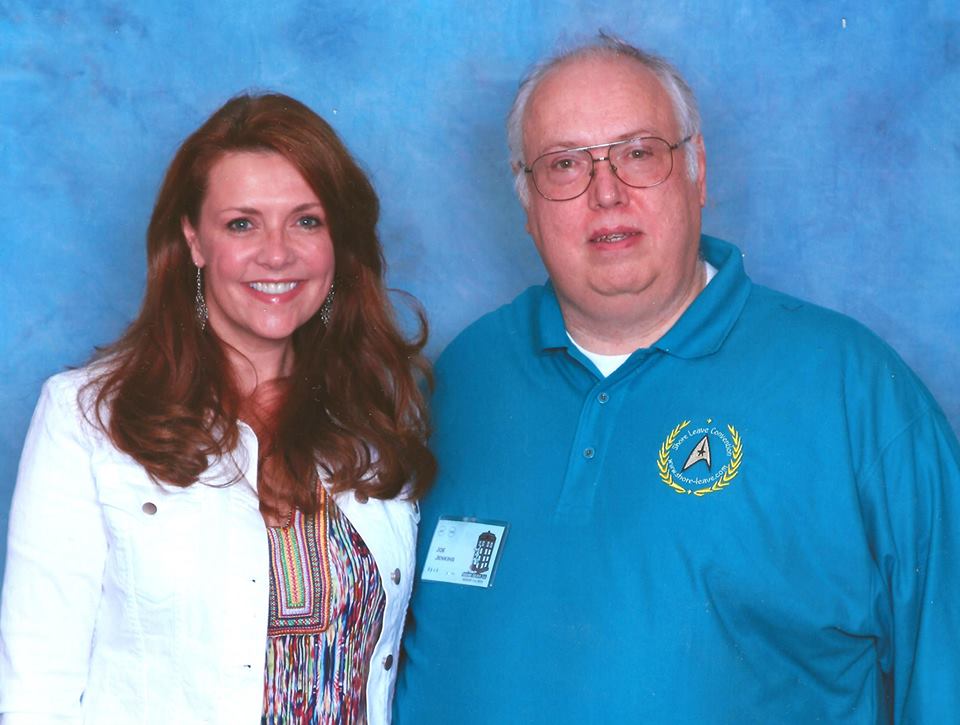
    Fr. Joseph Jenkins

  • The blog header depicts an important and yet mis-understood New Testament scene, Jesus flogging the money-changers out of the temple. I selected it because the faith that gives us consolation can also make us very uncomfortable. Both Divine Mercy and Divine Justice meet in Jesus. Priests are ministers of reconciliation, but never at the cost of truth. In or out of season, we must be courageous in preaching and living out the Gospel of Life. The title of my blog is a play on words, not Flogger Priest but Blogger Priest.

  • Archives

  • Categories

  • Recent Posts

  • Recent Comments

    Jeremy Kok's avatarJeremy Kok on Ask a Priest
    Gary Joseph's avatarGary Joseph on Old Mass or New, Does It …
    Barbara's avatarBarbara on Ask a Priest
    Anonymous's avatarAnonymous on Ask a Priest
    forsamuraimarket's avatarforsamuraimarket on Ask a Priest

What Did the Pope Say about Interfaith Dialogue?

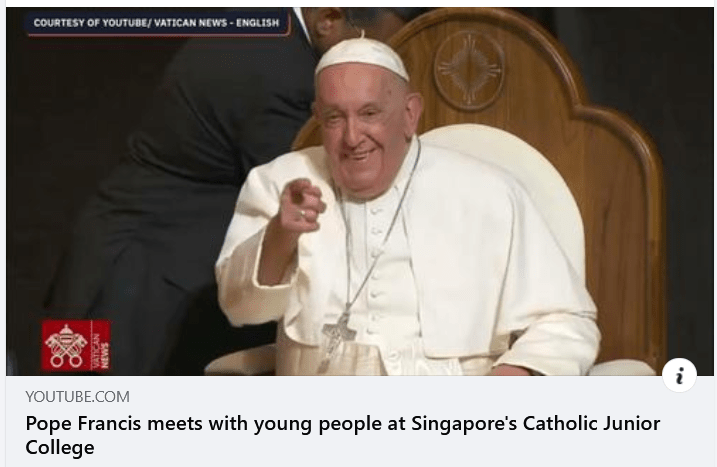
Pope Francis left his scripted remarks and spoke “spontaneously” to the youth of Singapore on Friday, September 13, 2024. The Holy Father made a distinction between a courageous person who seeks the truth as a “critical” thinker and the critic with “endless words” who offers “destructive criticism.” He asked them this question, “Do you have the courage to criticize but also the courage to let others criticize you?”

Impressed with the capacity of youth for interfaith dialogue, he stated: “This is very important because if you start arguing, ‘My religion is more important than yours…,’ or ‘Mine is the true one, yours is not true….,’ where does this lead?” One of the young people answered, “Destruction,” and the Pope responded, “That is correct.”

He went on to say, “Religions are seen as paths trying to reach God. I will use an analogy; they are like different languages that express the divine. But God is for everyone, and therefore, we are all God’s children. ‘But my God is more important than yours!’ Is this true? There is only one God, and religions are like languages that try to express ways to approach God. Some Sikh, some Muslim, some Hindu, some Christian. Understand? Yet, interfaith dialogue among young people takes courage. The age of youth is the age of courage, but you can misuse this courage to do things that will not help you. Instead, you should have courage to move forward and to dialogue.”

He went on to speak about the need for respect and the danger of bullying. He concluded by saying, “And now, in silence, let us pray for each other. In silence. May God bless all of us. In the future, when you are no longer young, but you are elderly and grandparents, teach all these things to your children. God bless you and pray for me, don’t forget! But pray for, not against!”

Is the Holy Father’s emphasis the methodology of dialogue or the reality of God as revealed in world religions? I suspect it is the former. It is true that interfaith dialogue does not go very far when the different sides disrespect and deride each other. People of conviction feel that they are right and take exception to challenges toward what they believe. Pope Francis is correct that we must resist the temptation to argue and name-call.  Civility demands that we temper our emotions, especially against criticisms that are quickly taken to heart and are painful.  Those of us with pugnacious natures, instinctively want to hit back.  History is largely written with such a lack of toleration that leads to violence, censorship, holy wars, torture, imprisonment and even death. The language of hate allows for no dialogue and little in the way of successful debates. Instead of discussing ideas, there is a harsh attack against persons— the opposition are decried as “heretics,” “heathens,” and “infidels.”

Each of us likely believes that his or her religion is the best or the truest, such is even the case for atheists who posit their non-religion or anti-religion as having a higher epistemological value. As Catholics, the most resolute believers are correct to maintain that our faith is the genuine revelation of God through the mediation of Jesus Christ. The New Covenant is the consummation of the Old. Both Judaism and Christianity are judged as true religions. Of course, a natural religion has been surpassed by a supernatural religion that understands God to be both one and a Trinity. Other religions may have elements of the truth, but they are also weighed down by serious errors. Traditionally, apologetics would list all the many false teachings and practices of these other belief systems. By contrast, Pope Francis is saying that this is not where dialogue begins. Such an approach closes minds to the truth and to any possible consensus. It is best to begin dialogue by examining the elements of faith that are shared.  This will vary between creeds. Catholics and Jews both embrace Abraham as our father in faith. We have taken the Hebrew Scriptures as our own. Islam also believes in one God and claims facets of a shared revelation. The Hindus are arguably polytheists, but some of their modern-day teachers suggest that their many deities may in truth be manifestations of a single God. Where such thinking will go, I cannot say. Even if there should be no or little congruence on matters of theology, dialogue can be judged as successful if we learn to live in peace and to work together for a better world where human rights and freedoms are respected.     

Yes, religions are seen as paths to reach God. However, we as Jews and Catholics understand religion as also the story of how God comes looking for us.  There is a two-fold movement. God establishes relationships (covenants) with his people. The analogy of religions as different languages to express the divine is accurate. Left unsaid is that some languages are better in their evocative and descriptive power. Christianity not only espouses God-talk but has been given the revelation of how the eternal Word becomes flesh. The lack of such an appreciation is a defect that handicaps all other religions. God gives us his Word in Scripture, but more importantly writes his revelation upon human flesh in the incarnation. Jesus is the face of God and the revelation of the Father. He is the way and the truth and the life.  There is no way to the Father except through him. Other religions, if they do not go off in the wrong direction, can only take their adherents to the door of the kingdom; it is Christ that lets us inside. His Church and the sacraments constitute the key to that door. 

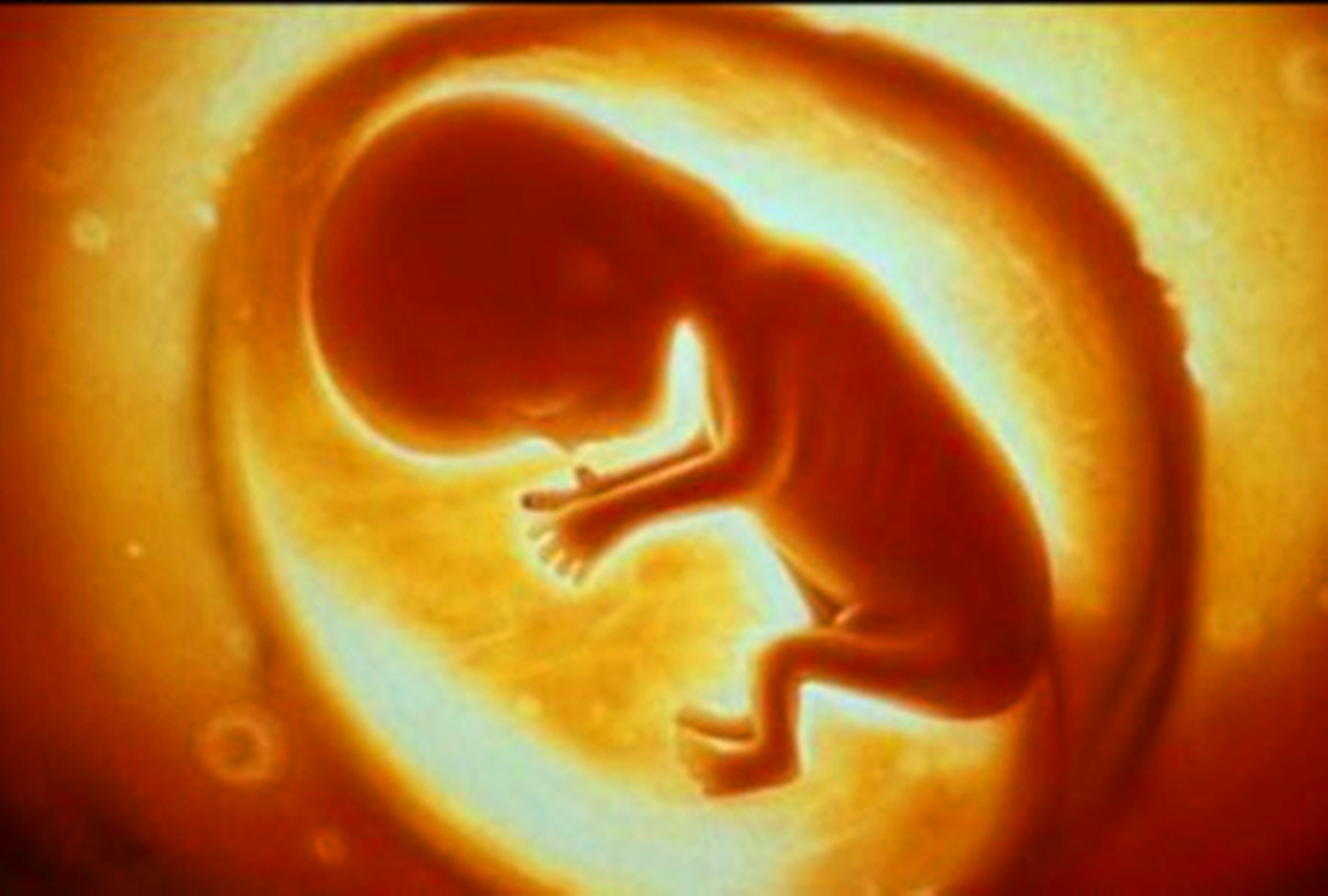
Are we all God’s children? As in the catechism and at Vatican II, a distinction must be made. Spiritually, through faith and baptism, we are made adopted sons and daughters of the Father. It is in this sense of grace and a new creation, that those of other religions are not children of God. However, the meaning of Pope Francis is in the sense of creation. All in the human family are creatures and children of the earth. Our source is almighty God. Regeneration aside, we are all arguably children made in the image of God. We are creatures of flesh and blood and soul. We are so much more than the animals around us. This notion speaks to human dignity.  It is a major element of the Gospel of Life. In or outside the womb, God looks upon us with a Father’s love.

Knowing that he is speaking to a crowd of mixed faiths, Pope Francis asks that they might pray for each other in silence.  Notice that he prays that God might bless them, but he refrains from asserting the saving name of Jesus.  While we might question timidity regarding the name of Jesus and/or making the sign of the cross, we should remember Pope Francis’ words about courage. Certain Christians will not pray with Catholics. While we can pray the psalms with Jews, it is quite problematical to pray with non-Christians. We do not want to open such young people to rebuke or punishment from their own religious leaders. Importantly, we as Catholics must not subscribe to any form of religious indifferentism or the notion of universal salvation. Silent prayer is probably the best for all in such a situation.

ADDENDUM

Anyone with a smidgen of Italian can appreciate that the text on the Vatican website (yesterday) is not actually what the Pope said to young people in Singapore. Previous popes tended to be more careful with off-the-cuff or spontaneous remarks. Officially, the text that matters is the written one, today on the Vatican website and/or included in the published Acta.  

When I was informed about a translation change, I went immediately to the Vatican site. What the hell? The official translation had at least corrected the Pope’s remarks. Now, the Vatican has returned to what comes across as deeply problematical. Last night, the text read, “Religions are seen as paths trying to reach God.” Yes, this is true, regardless as to whether they do so. This morning it has been changed to “All religions are paths to God.” This is not true. Even those in false religions reject this notion. Reading further, the initial papal text asserted, “There is only one God, and religions are like languages that try to express ways to approach God.” Yes, this is true, even defective religions are efforts to approach the transcendent. But the new version is as wrong as wrong can get, “There is only one God, and religions are like languages, paths to reach God.” Not all religions target the true God. Indeed, it is Christ as the term of salvation that makes possible our reconciliation with the Father.  None are saved apart from Christ and his Church. Further, not all religions are the same. Satanism and demon worship are counted as religions, but there is no redemption, just alienation and loss. Certain religions worship false gods or even demons.  

What Makes You So Sure That There’s Only One God?

Krystal Smith poses this question at STAPLER CONFESSIONS and states: “Most believers take the Bible or whatever their religious text may be as absolute truth. This is a matter of faith, something that atheists often have a hard time understanding or relating to.  Atheists often point out the unknowable nature of an all powerful creator or concept of God or many gods. Without scientific proof, they find it illogical to believe so strongly in something that plays such an important role.”

Critics of Scripture often play fast and loose with how Christian believers regard and use the Bible.  But of course, there is no unanimity between believers either. Protestant fundamentalists who believe in the Bible alone are a far cry away from Catholic integralists who interpret the Bible against the horizon of Sacred Tradition. There is also the tension between private interpretation and magisterial teaching authority.  The issue is not just that atheists reject “the book,” but they general question any supposed revelation or communication from God as either delusion or as deception.  Many refuse to seriously consider the arguments of either theologians or philosophers.  If God cannot be shown through their microscopes or telescopes, then no ground is given for his existence. 

While the atheist may find it illogical to believe in a “God” proclaimed from a book and not proven from science to his satisfaction, there may be far more anxiety with the prospect that we are alone and unloved in this vast universe. It is here that Pascal’s wager speaks to the agnostic. Pascal argued that if you believe in God and this truth should be realized, then you win everything. Whereas if he does not exist, then you have lost nothing regardless of your stance. While insightful, this approach is unsatisfactory for the believer because faith is about more than hedging your bets.    

The atheist narrows truth to the scientific and even that is restricted by their bias.  They make no distinction between the belief of one God and the notion of multiple deities.  However, Christians, Jews and Moslems insist that there is a God and he is ONE. True, Christians speak of a Trinity, but he is defined as one divine nature in three divine Persons.  The multiple deities of ancient pagans and the present-day Hindus are treated as idolatry and superstition.  Here we would agree with atheists. There are indeed counterfeit religions and false gods. The early Christians regarded the pagan gods as demons in disguise.  The Judaeo-Christian appreciation of one God signified a step forward to true religion and away from magic.

The pagan gods often behaved badly, and some were not even regarded as immortal.  They were more like the Marvel comics vision of such gods as super-powerful aliens.  Look at how Catholicism defines and speaks about God. He has within himself all perfections and is the Creator of all things.  You cannot have two omnipotent beings because such would cancel each other out.  God is perfect and that means he must logically be simple or one.  All creatures receive their existence from God or participate or share in his existence.  Nothing can exist apart from him. He keeps all things in being.

While we do not see God face-to-face, we know him in the created order from his effects. Revealing himself to us in salvation history, the God of reason becomes the God of faith.  He wants to establish a relationship with us. Sacred signs or miracles are performed to help our unbelief.            

Do You Believe People Can Still Be Moral Without Religion?

Krystal Smith poses this question at STAPLER CONFESSIONS and states: “Religion provides guidance for many people. It set laws and rules for ancient societies to abide by. And many religious people feel these laws are necessary to dictate what is right and wrong for humankind.  Many atheists feel that morality is innate and modern society’s laws are sufficient to govern mankind.”

The Church had hoped that a healthy universal respect for natural law would bring consensus and cooperation in forming a better and moral society.  However, the current clash in values is readily interpreted by believers as ample evidence that apart from God, men and women do not know how to be good. We would likely agree with the more reasonable atheists that there should be an innate sense of right and wrong, at least for most people. But we should not forget that human nature while good is also fallen. 

Morality includes not only prohibitive acts but also altruism for the good of others and the poor.  Ayn Rand’s thinking is particularly popular among conservative politicians on the right. She would also appeal to atheists. Her philosophy of selfishness shuns expressions of charity. It has been noted by certain atheists themselves that the charity and social justice efforts are disproportionately linked to churches and religious people.  Both the civil rights efforts for racial integration and the marches for the lives of the unborn are heavily populated by believers. The faithful and Christian organizations are often the first on the ground to support the poor and disadvantaged. Where would they be if people of faith were to disappear?    

Many a believer has prayed that he might be spared from the terrible compassion of non-believers with benign intentions but with a lack of guidance about right or wrong.  A mother panics about an unplanned pregnancy and destroys her unborn baby. A family frets about the pain that an elderly grandmother suffers and opts for euthanization to end her misery. The Christian places ultimate trust in God. By contrast, the atheist must place his trust in mankind alone, and in practice this means politicians and the state.  While believers speak of inalienable and God-given rights, what the state gives, the state can take away. Right and wrong becomes a capricious exercise of pandering to power. The wealthy and powerful will always win in this scenario. The poor and the weak will be victimized and manipulated.  It is in recognizing God that we safeguard human dignity and rights.  Nothing else satisfies as well.

Why Have So Many Wars Have Been Fought in the Name of Religion?

Krystal Smith poses this question at STAPLER CONFESSIONS and states: “From biblical times to modern day, it’s true that many wars have been fought in the name of religion. From the Spanish Inquisition and the Crusades, to modern religious extremists and terror attacks, many have suffered. However, most religious people don’t support going to war with people who have different beliefs. Those who have been mislead to resort to violence fail to see the peaceful messages that are present in virtually all religious texts. Some atheists feel that the world would be more peaceful without the impact of any religions.”

Were there many wars fought over religion? While Hitler ordered the holocaust of six million Jews, it was not really a war over religion. The first World War had to do with clashing empires, alliances and money. The Japanese wanted sovereignty over Asia and control of the Pacific Ocean. Korea and Vietnam was all about the aggression of Chinese atheistic Communism. The Inquisition employed religion as a tool but besides stamping out heresy was essentially a political effort to secure Europe from Moslem occupation. The Crusades preserved Europe from Islamic invasion. Religion was a factor in the Crusades because it was hoped that the Holy Land might be reopened to pilgrims. Religion is merely one factor among many in such questions about human congress and tension. It is not necessarily the single root-cause for hostilities.

Speaking in terms of Christianity, the pacifism of the earliest believers became increasing impracticable and hard to sustain. Believers were martyred like the killing of flies.  The Roman empire opposed the new religion because Christianity was intolerant of paganism and believers refused to compromise. One could not worship idols or the demons they signified and still claim the lordship of Jesus Christ. Old Rome saw the emergence of Christianity as a political threat to the empire— especially the language about turning the cheek, giving to those who take from you, and loving your enemies. Christians joined with Constantine to bring three centuries of persecution to an end. When it came to the relationship between the Church and Islam, the weight of guilt was more heavily upon Islam and its notion of jihad or holy war to force religious submission.  Islam was to Europe what the Soviet Union was to us during the Cold War. Our faith and civilization were all at stake.  The inquisition expelled an enemy from our midst. The crusades sought to open the holy land to pilgrims.  The tensions between Protestants and Catholics in Europe were part of a struggle for political power between princes, kings, and the Church.  The conflict was more about temporal matters than spiritual ones.   

While there are many apologists who argue that militant Islam is an aberration to a religion of peace, in truth every place that becomes 51% Islam experiences a repression of Christians, Jews and others.  We would concur with atheists that God’s children should not kill each other over religion; however, Christian believers have a right to defend themselves. When this becomes impossible, as with the Coptic men who had their throats cut, there is a witness to how we should remain faithful even if we must die. 

Those atheists who think that a world without religion would be more peaceful are delusional. Atheism has been tried, and as with Stalin, millions suffered the loss of rights and incarceration in the gulags. He killed 20 million of his own people.  The atheists who claim political power, subsequently treat their anti-god philosophy like a religion, seeking converts not through argument but through war and revolution.  When God is taken out of the picture, men assume his throne.  There can never be a vacuum.  While critics lament God’s laws and judgment, the verdict of men is much harsher. Separated from the Divine Mercy, why should we be surprised?

Why Do You Think Your Religion is the Correct One?

Krystal Smith poses this question at STAPLER CONFESSIONS and states: “Religious people tend to subscribe to just one religion and reject the others. Theists who are impartial to any specific religion might share the same sentiment as atheists in this regard. They might acknowledge the similarities between some world religions and suggest that which exact one a person follows isn’t as important as recognizing there is a God and praying. Atheists tend to believe that a person’s choice of religion is based solely on what culture they were born into, and is thus arbitrary.”    

Atheists are right that most people tend to join the majority religion of the culture and family into which they are born. However, we are not creatures of fate and many either change their affiliation or lose faith entirely. Further, given the missionary mandate of Christianity, many are moved by the preaching of the Church and the grace of God to become Christian or Catholic.

Catholicism views itself as the Church directly instituted by Christ and as the true religion.  There is a historical bond between Judaism (the first People of God) and the consummation of the covenant by Christ for the Catholic Christian community, the new People of God, or the Church.  Judaism and Islam are both natural religions with a belief in one God. Christianity is a supernatural faith given the belief in the mystery of the Trinity: three divine Persons in one divine Nature.

Just as scientific theories vary, so does religion. But the truth is still what it is.  The many religions of the world are an expression of how we were made for God and search out ultimate meaning.  Many are regarded by Christianity as wrong or incomplete.  We reject the negation of Buddhism and the polytheism of Hinduism. While certain Protestant affiliations emphasize a personal or individualized faith; Catholicism also insists upon the corporate faith. The Church is not merely for fellowship but is the essential sacrament of salvation. Christ is the Mediator and is the one and only Savior.  There is also no salvation outside the Catholic Church. It is for this reason that we intercede in prayer for those believers outside her fold.    

We would claim that Catholicism best answers the longings of the human heart and the need for meaning and answers about suffering, death and our place in creation. The problem of pain finds resolution in a profound solidarity with Christ where there is redemption. Sacrificial love becomes a hallmark of Christian self-donation and identity. We have not been orphaned by God. We have a purpose and no one need live and die in vain. The Christian faith offers the gift of HOPE and LIFE while atheism can only grant a temporary respite for some, despair for the many and ultimately oblivion for all.

The Buck Stops with the Pope!

While there has long been an invisible schism in the Church caused by the many loud liberal or progressive voices in the years since Vatican II, today matters have intensified with resistance from a growing arrogant traditionalism. Critics observe that the catalyst for the reaction on the right has been a papacy that represses the historical Latin Mass, sometimes pampers the Church’s enemies, glosses over what seem to be serious errors, and opts for diplomatic ambiguity when there is a pressing need for clarity and truth from the teaching office.  Admittedly, the pastoral accommodation that belongs to the pastors on the ground cannot be appropriated by the highest shepherds or by the one who sits in the chair of Peter without doing insufferable harm to the transmission and interpretation of the deposit of faith.  

Like the proverbial snowball rolling down a hill, many religious pundits who have made accurate assessments about what falls short of complete fidelity are now lashing out against anything and everything that comes down from Rome or the bishops in union with him.  They make themselves into mini popes who presume to tell the Holy Father what he is doing and saying wrong. They are hesitant to admit agreeing with the pope when he says or does anything wholly Catholic.

The First Vatican Council of 1870 expounded upon its definition of papal infallibility:

“Both clergy and faithful, of whatever rite and dignity, both singly and collectively, are bound to submit to this power by the duty of hierarchical subordination and true obedience, and this not only in matters concerning faith and morals, but also in those which regard the discipline and government of the Church.”

If schism is a failure to submit to the Holy See or to be in full communion with the Church he leads, then we are indeed entering such dark days. However, the current situation is so chaotic that many pay lip service even as they dissent in practice.  The mockery in social media, inclusive of those who flaunt their orthodoxy, is a clear denial of the Pope’s command authority. The left’s liturgical abuse and the right’s impugning of the Novus Ordo signifies both a refusal to embrace the Church’s current understanding of herself and her divine worship.  Left unsaid is when the line might be crossed into excommunication.        

When teaching upon faith and morals for the whole Church and doing so from the chair and in union with the world’s bishops, St. Peter and his successors are guaranteed the grace of infallibility from the Holy Spirit. Of course, they can interpret and explain but cannot invent anything entirely new or contrary to revealed truths. Popes are not always accurate in private opinions and the fact that they go to confession is proof that they are not impeccable. Just as St. Paul corrected and changed the mind of St. Peter at the council of Jerusalem, they can be admonished, particularly by other apostles or bishops.  But ultimately, much like the cat dropped from a height, the papacy lands on its feet. Those who would deliberately trip a pope up and then expose and laugh at his tumble, are not faithful sons of the Church. Instead of a true dialogue and shared creativity leading to a satisfactory consensus regarding matters like liturgy and morality; there is instead, a combative “us and them” attitude that is tearing the Church apart.  Traditionalists fight for anachronisms and progressives enshrine the trite and untried.     

Those who propose a rigid interpretation of “No Salvation Outside the Church” would often cite the 1302 papal bull of Boniface VIII: “. . . we declare, we proclaim, we define that it is absolutely necessary for salvation that every human creature be subject to the Roman Pontiff.” Catholicism takes seriously its divine institution by Christ and how its foundation is inseparable from the Petrine office:

“And so I say to you, you are Peter, and upon this rock I will build my church, and the gates of the netherworld shall not prevail against it. I will give you the keys to the kingdom of heaven. Whatever you bind on earth shall be bound in heaven; and whatever you loose on earth shall be loosed in heaven” (Matthew 16:18-19).

We pray that we will have saintly popes, but the charism is given to the good and the bad alike, not for their own sake but for the overriding good of the Church.  Historically they rule as absolute monarchs and for all practical purposes the popes constitute the Roman rite, with an emphasis upon living men over the dead. The latter point is essential to the so-called liturgical wars.

Article 12 of the Declaration on Human Dignity

Article 12 of the declaration speaks of the dignity to be found in Christ’s solidarity with humanity by being “born and raised in humble conditions.” Next, we are told that his public ministry “affirms the value and dignity of all who bear the image of God, regardless of their social status and external circumstances.” It should be clear that the Cardinal Fernández is not referring to the elevated supernatural dignity given by grace to persons regenerated through faith and baptism. Several religious pundits have attacked the him and the Holy Father on this front without conceding a dignity that is inherent firstly, as a rational creation of almighty God, and secondly, as one who shares a kinship with Christ due to the incarnation.  The whole point about the change of economy regarding images in the Decalogue is that God has now revealed himself through a human face.  While there is a discrepancy in how the terms are used, one might argue that we are all created in the image of God but that through the sacraments we are reborn into the likeness of Christ.  This natural dignity is very much a part of Pope John Paul II’s theology of the body.  Note that when it comes to the Gospel of Life, the unborn child (although lacking baptism) possesses a right to life and dignity that should not be assailed. 

Jesus also defended a moral dignity of persons, especially toward the oppressed and marginalized.  The Church must similarly be the voice for the voiceless.  Citing Scripture, the document takes note of his outreach to the tax collectors, women, children, lepers, the sick, strangers, and widows. The Cardinal writes that Jesus “heals, feeds, defends, liberates, and saves.”  The love of neighbor flows from our love of God and must be dynamic in the life of charity.

The one problematical element of this article is the following:

For Jesus, the good done to every human being, regardless of the ties of blood or religion, is the single criterion of judgment. The apostle Paul affirms that every Christian must live according to the requirements of dignity and respect for the rights of all people (cf. Rom. 13:8-10) according to the new commandment of love (cf. 1 Cor. 13:1-13).

Critics contend that the Cardinal Fernández and the Pope undermine religion as a basic factor in our judgment and salvation. However, we should remember that the document is written for believers, and it is taken for granted that the good being done is by Catholics in right standing with God. I doubt the Holy Father would undermine basic soteriology. There is no salvation apart from Christ and his holy Church. Further, any merit for good acts also requires that the agent be in a state of grace.  A person in mortal sin remains under God’s negative judgment until the remission of sin through heartfelt contrition and the sacrament of penance.  However, for the justified believer, grace builds upon grace.  Our good work is not limited to our own.  A disciple of Christ is compelled by love and truth to preserve human dignity and in justice to defend human rights.     

As a Christian I am required to be compassionate and just to all, even those who are not of my family or ethnicity or religion.  I can know the catechism backwards and forwards, but without charity I have nothing.  Again, on the level of creation, there is a duty to preserve basic human rights and dignity. I believe this is what the document is saying.  It connects to the teaching about the corporal works of mercy in Matthew 25:41-45:

“Then he will say to those on his left, ‘Depart from me, you accursed, into the eternal fire prepared for the devil and his angels. For I was hungry and you gave me no food, I was thirsty and you gave me no drink, a stranger and you gave me no welcome, naked and you gave me no clothing, ill and in prison, and you did not care for me.’ Then they will answer and say, ‘Lord, when did we see you hungry or thirsty or a stranger or naked or ill or in prison, and not minister to your needs?’ He will answer them, ‘Amen, I say to you, what you did not do for one of these least ones, you did not do for me.’”

I suspect that what Cardinal Fernández and Pope Francis are wanting to say is made clearer in 1 Corinthians 13:1-8: 

If I speak in human and angelic tongues but do not have love, I am a resounding gong or a clashing cymbal. And if I have the gift of prophecy and comprehend all mysteries and all knowledge; if I have all faith so as to move mountains but do not have love, I am nothing. If I give away everything I own, and if I hand my body over so that I may boast but do not have love, I gain nothing. Love is patient, love is kind. It is not jealous, love is not pompous, it is not inflated, it is not rude, it does not seek its own interests, it is not quick-tempered, it does not brood over injury, it does not rejoice over wrongdoing but rejoices with the truth. It bears all things, believes all things, hopes all things, endures all things. Love never fails. If there are prophecies, they will be brought to nothing; if tongues, they will cease; if knowledge, it will be brought to nothing.

Christianity is NOT a Book Religion

When I first began apologetics online in the mid-1990’s, the internet was brand new and while there was little to no Catholic presence, there was no shortage of bigots who spouted the anti-Catholicism that was popular a century or more earlier.  The “Bible alone” proponents were fundamentalist to the core and reduced Christianity to a “book religion.”  If a Catholic tried to employ Scripture, because we are the true bible Christians, they would lament that our translations could not be trusted and that we had added books.  Some would point to the missals used at Mass or the Breviary said by priests and religious, arguing that these papist books were what we substituted for the real Bible.  I remember having the most heated arguments with a Protestant apologist who argued that the only true Bible was the old King James Version without revision— “if it were good enough for Jesus,” he argued, “it is good enough for me!”  When it was explained that the Bible was originally in Greek and Hebrew, he would just delete the Catholic objections on his message board (there were no blogs in those days) as just so much spell casting and sorcery.  The “Bible alone” champions would use isolated proof texts to answer any challenge, no matter what the actual context was about.  They believed they had an immediate understanding of the biblical texts from God and that no commentaries, catechisms, and definitely no Catholic pope were necessary.  Debate was hard because they were slippery and far from honest or rational. 

What was the truth? The Christians inherited the Old Testament from the Greek speaking Jews of the diaspora.  Gospels were composed, letters written, and an oral tradition spoken, that became the nucleus for the New Testament.  A living sacred tradition has remained the backdrop for understanding the inspired Word of God.  There was no complete Bible and agreed upon New Testament for the first three centuries of the Church’s life.  The bishops gathering at Hippo (393 AD) would agree upon the canon. It would only be with the Vulgate Bible composed by St. Jerome that all 73 writings of the Bible were available in a single book, written in the vernacular Latin of the West. (English did not exist as a language.) Up until the invention of the printing press, there were few Bibles and they were very expensive.  That would coincide with the reformation and the general availability of bibles (for the past 500 years).  Given poor literacy rates, the main way that people absorbed Scriptural truths was from preaching, liturgy, and art.  The latter should not be forgotten because both statuary and stained-glass windows often brought to mind the saints and the stories in salvation history. This the fundamentalist condemned as idolatry! 

As the years passed, the winds have changed direction and I find myself in arguments with Catholics and Protestants alike who make a claim of the Bible but then ignore what it has to say. Essential salvation truth subsists in the Bible.  But the Church comes first in time, not the book.  The command to preach the Gospel is what gives birth to the Scriptures.