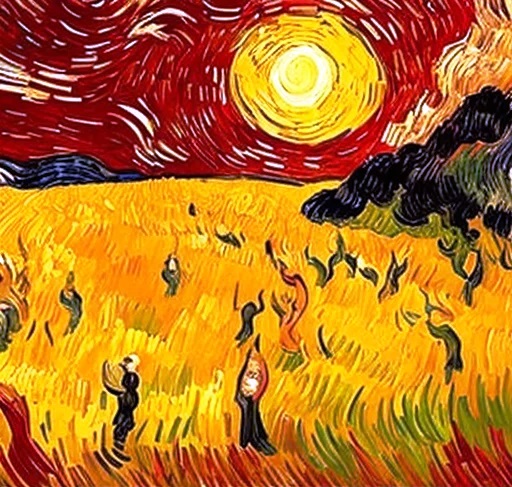
The blog header depicts an important and yet mis-understood New Testament scene, Jesus flogging the money-changers out of the temple. I selected it because the faith that gives us consolation can also make us very uncomfortable. Both Divine Mercy and Divine Justice meet in Jesus. Priests are ministers of reconciliation, but never at the cost of truth. In or out of season, we must be courageous in preaching and living out the Gospel of Life. The title of my blog is a play on words, not Flogger Priest but Blogger Priest.
What is heaven? Heaven is where we find God. Sin reflects a prevailing failure to love, either in hatred or indifference. The damned would not want any part of this love, either here on earth or in heaven. God is not a cherished part of their life. They might readily manipulate others, but they refuse to really care for their neighbor. What do saints and angels do in heaven? They worship God as the Holy, Holy, Holy. By contrast, if so-called Catholics cannot tolerate an hour a week at Sunday Mass, then why would they want to spend eternity at the nuptial banquet for the Lamb of God?
Those who reject the testimony of Scripture, dissenting from the teachings of the Church, already have one foot in hell. We are obliged to accept what has been revealed by God. We must obey the commandments. None of us should cast ourselves outside the pale of Christ, the one who is the Light of the World. What the children of darkness presume as enlightenment is in truth error and eternal night. While it is true that saints need not always be right, just holy; there must still be an assent from Catholics to the foundational truths and values of the faith. Otherwise, one is saying, “Not Thy will, but my will be done.” This is a critical contradiction to the kerygma, itself. One does not have to have a degree in theology but one should appreciate the creed and the commandments. Dissenters will often fashion a caricature of Jesus that is in contradiction to the one who appears in the New Testament and in the constant preaching of the Church. What dissenters fail to grasp is that “their Jesus” stands neither on the firm foundation of Scripture nor of Tradition. Those who would abandon the barque of Peter must seek refuge upon the worthless driftwood or flotsam of human whim and proximate pleasures. Instead of the moral base grounded upon natural and divine positive law, values emerge from a sham individualism that has no rudder other than the media and politics of secular humanism. The guideposts are literally the deadly sins. The worst of the lot is arguably pride as it most earned the ire of Christ against the pharisees. It makes a place for the other six sins. It poisons communion with God.
The stopgap of purgatory fuels our trust in Christ’s mercy but should not fool us into thinking it is a certain backdoor to heaven. We must aim for heaven. Anything less and we risk missing the target altogether. None of this means that salvation is a gamble. Those with a faith realized in loving obedience can walk in the sure and certain hope of their salvation in Christ. There is a profound mystery in this regard between the providence of God and human freedom, in either cooperating with or inhibiting the movement of divine grace.
As believers, the prospect of perdition might seem harsh, but God loved us so much that he wanted our loving response to him to be free. He could have made us like mindless robots or insects controlled by instinct; however, we were made in the image of God— by nature shy of the dignity belonging to angels, but as consciously aware, unique intermediaries between the spiritual and material worlds.
Divine judgment might seem harsh but ultimately, God gives us what we want. But do we really know what we want? I suspect that many have a false view of heaven where egos are bloated and narcissism reigns. This is a far cry from the Christian view of heaven as a realm focused entirely upon the Trinity. We must become God-centered with a selfless empathy for others. Many self-possessed people would object to a necessary deflation or spiritual emptying, so that Christ might be all in all. Indeed, many apparently confuse the definitions of heaven and hell.
I have imagined that the judgment of God comes along with “a great awakening,” a moment of personal awareness where we see ourselves as we really are. Note that this supernatural divulgement comes at the end of life because to see ourselves as God sees us would be horrifying for most and many would likely drop dead. Such judgment relies both upon mercy and truth. The Lord will salvage what he can but in the final analysis the truth prevails. There can be no deception or false humility under this light of verity. God will not force us to love him or waylay souls over the threshold into heaven.
Given his identity as a divine Person and the Savior, there is no avoiding the significance of Christ’s constant emphasis upon the reality and prospect of hell for many. Those critics who are quick to say that Jesus does not judge are fooling themselves and are in denial about our Lord’s stance in the Gospels. Indeed, while the number 144,000 for the Elect in the Book of Revelation may be symbolic, it is telling that the Bible admits to only a select few being saved. While there is a universal call to salvation, the unpleasant truth remains that while all humanity is the beneficiary of redemption, many misuse their freedom in rejecting the gift of salvation. We might hope and pray that the devil is lonely and that most go to heaven, but this is neither indicated by Scripture nor by the constant evidence of human iniquity. Indeed, the many apparitions of Mary attest to hell. The vision given to the children of Fátima is particularly frightening:
01. “. . . a vast sea of fire. Plunged in this fire, we saw the demons and the souls of the damned.”
02. “The latter were like transparent burning embers, all blackened or burnished bronze, having human forms.”
03. “They were floating about in that conflagration, now raised into the air by the flames which issued from within themselves, together with great clouds of smoke.”
04. “Now they fell back on every side like sparks in huge fires, without weight or equilibrium, amid shrieks and groans of pain and despair . . .”
05. “The demons were distinguished from the souls of the damned by their terrifying and repellent likeness to frightful and unknown animals, black and transparent like burning coals.”
The main element of the vision is fire. Lúcia admits that if it were not for the Blessed Mother’s promise of protection, they would have died from fright at the horrendous spectacle. It is interesting that she discerns a distinction between damned humanity and angelic demons. Men and women retain their human forms even though they have been blackened by the flames and have become translucent, thus lacking substance.
It is peculiar that the damned are thrashed about by explosive flames from within themselves. Note what Jesus says in John 14:23, “Whoever loves me will keep my word, and my Father will love him, and we will come to him and make our dwelling with him.” As with the natural world, the supernatural hates vacuum. Either we become temples to the Spirit of God and grace or else, something demonic will come to nest in the human heart. Hell is not simply around them but inside them.
The demons are similarly burned and transparent but are in the form of terrible beasts or monsters. There is nothing left of their angelic beauty.
While the term “antichrist” is reserved to the letters of John, that does not mean the rest of Scripture or Church tradition is silent on the subject. Given the importance of God’s revelation, we should examine the warnings of such prophecy with an inquisitive and sober faith. It is crucial to be informed about such a troubling figure. Of course, it is even more vital that we know and have a relationship with the Lord. While the word “antichrist” is seldom used in Scripture to identify an enemy of the Lord’s people, the word “Trinity” is not mentioned in the Bible at all, and yet, it is the most important revelation from Christ about the identity of God.
Concurring with the Church fathers, it is not a great stretch to associate the “antichrist” with the Pauline “man of lawlessness.” Our Lord tells us in 1 John 2:18 that there are “many antichrists.” This should not surprise us. How often have we attributed to the chief devil Satan what has transpired from his underling demons. No analogy can be made with the communion of saints; rather, there is always a parasitical relationship when it comes to evil. One cannot understand the devil and the damned without an appreciation of Legion and “their” relationship in spiritual manipulation, obsession and possession. I am reminded of the dictator Adolf Hitler. Everyone wonders how such a wicked man could come to power; and yet, he seduced much of a nation as accomplices in his horrific acts. Remember, he never personally or immediately tortured or murdered anyone; but he orchestrated the politics of hate and gave the orders. While there is likely a hierarchy, all who oppose Christ are antichrists.
Rejecting God & Denying that Jesus Christ is Lord
Our Lord also tells us that the antichrist is not simply one who has wicked designs or who commits overt sin. The bar is way lower than that. The title is granted to any who would deny that Jesus Christ is Lord (1 John 2:22). This goes far beyond the Jews of old who refused to acknowledge Jesus as the Jewish messiah. It would today include the vocal atheists who argue that Jesus did not rise from the dead and that there is no God or any source for intelligent design behind creation. They would reduce the universe to mathematics and chaos, two odd bedfellows for sure. Their assessment is damnable because such signifies that there is no ultimate meaning and that we are merely a cosmic accident. Thus, we are not loved by something unseen and when we die, we become merely the fodder for worms.
Oddly, it would sometimes seem that the atheist places greater credence in the devil than he does in almighty God. Noteworthy is the Satanic Temple, a pseudo-church for atheists who officially claim not to believe in either Satan or God. Viewing much of religion as superstition, they formally promote agnosticism. However, their feigned Satanism may be more real than they know, given their active promotion of abortion as their formal worship (check their website). The devil may most infest the souls of those who deny or doubt his existence. Abortion or child sacrifice was traditionally viewed as the chief worship of pagan idolaters toward false gods, regarded by the Church as the feeding of demons.
Those who are antichrists (note the plural) are preeminently fools. They are misled and they allow themselves to be misled. The evil that seduces them offers nothing of hope and joy. It targets God and people of faith with hatred or indifference. Rejecting God, the only thing they might possibly merit is deep existential despair.
The Spirit of the Antichrist
The antichrist is not merely someone or something coming (future tense); extending back some 2,000 years, we are told that “the spirit of the antichrist” was already in the world (1 John 4:2-3). While all the real power was with the Spirit of God, the spirit of the antichrist wrestled within divine providence for the souls of men. It was the terrible dynamo for the devil’s forces in a cosmic clash between kingdoms. Satan could not fathom the parables and a paradigm shift where love was stronger than hate and the cross was transformed from a sign of defeat to one of victory.
The spirit of the antichrist has Judas point Jesus out in the garden, betraying him with a kiss. It fueled the indignation of Caiaphas in condemning Jesus before the Sanhedrin. Like smoke, the air was thick with this dark spirit. Indeed, Pilate’s stark stoicism was shaken by this spirit. He was taken aback by the rumors about Jesus and was shocked by the cries of the crowd, “Crucify him! Crucify him?” Warned by his wife’s dream and struggling with the “truth” about Jesus as a king and an innocent man, he discerned something of the antichrist’s invisible presence enveloping Jerusalem. It was a twilight time of darkness and shadows. Fearful as the procurator over a rebellious nation, he gave the crowd what they wanted. Either from personal regret or as spite against the religious leaders, he labeled the Cross with a parchment, “Jesus of Nazareth, King of the Jews.” The crowd announced that “We have no king but Caesar!” Who would reign, Christ or antichrist? Christ’s followers would know persecutions, first by their own Jewish people and later by Rome. Caesar or the Emperor Nero would be identified as antichrist. But he would not be the last.
Also noted by Christ is that his own will confess that he has come in the flesh. Those who deny this truth are branded as guilty of deception and as antichrists (2 John 1:7). The apostle John speaks of the flesh of Christ in reference both to the incarnation and to the Eucharist. How many today might exclusively look to an earthly historical Christ (locked in the past) or to a biblical Christ (locked in the pages of a book)? Many may claim Christ but as a human prophet or sage, not as saving Lord. They fail to appreciate that we must encounter him now and in our lives. Otherwise, any relationship with him is inconsequential. Increasingly, I see shocked expressions when I exclaim, “Jesus is God!” The spirit of the antichrist cannot assail the real Christ so it must fashion a parody that is not divine and has no power to save.
The Antichrist versus the Eucharistic Christ
Millions of Christian believers claim Jesus but repudiate Catholicism and its Eucharistic Christ. And yet, along with his saving Word (which disposes us to the unbloody re-presentation of his oblation of the Cross and his Eucharistic real presence), this is the chief way in which we encounter and receive him. The kingdom of Christ and its worship is defined by the Eucharistic action and presence. Wherever we find the true Church, we find the Eucharist and vise versa. The spirit of the antichrist attacks the mystical Body of Christ and the Eucharist. It cannot help itself. While in truth the Eucharist is medicine for the soul, the spirit of the antichrist treats it as poison. Back in 2008, the atheist biology professor Dr. Paul Myers at the University of Minnesota told his students that Catholic teachings constitute “a crime against the human race.” He instigated the so-called EUCHARIST CHALLENGE where he urged students to steal and to profane hosts given out at Mass. Indeed, he recorded his own desecration of the Blessed Sacrament for YouTube. The antichrist prefers a real absence to any real presence. He caters to sacrilege over adoration or worship. He would have us focus upon the minister and not upon Christ in the sacrament or acting in the priest.
What is the context for John’s emphasis upon the flesh or real presence of Christ? The early Church struggled against the heresy of Gnosticism. They viewed flesh as evil and denied the humanity of Christ. They proposed the lie that Jesus only pretended to be human. Such a notion undermines the redemptive work of Christ. What is not assumed is not redeemed. The Gnostics and others guilty of heresy were and are antichrists.
The Man of Lawlessness & the End of Days
We are living in the last days. Indeed, the whole history of the Church takes place during this stage of salvation history. The question arises, are we entering the “conclusion” to the End of Days? While we might discern signs, only Christ knows for sure.
While some authorities would argue that the antichrist and the man of lawlessness are not one and the same, I would argue that there is a conjuncture between these two themes made popular in apocalyptic appreciation. St. Paul speaks of the man of lawlessness as one filled with hubris (2 Thessalonians 2:1–4). He would take to himself, as did Nero, the worship that belongs to almighty God alone. This is the tie in with the term antichrist. The early Christians were martyred because they refused to compromise their faith in Jesus by rendering false worship, not just to the pantheon of Roman deities but to the emperor. All they needed to do to satisfy the authorities was to throw a pinch of incense upon the fire at the emperor’s shrine. A failure to do so marked a person as an enemy of the state.
First, there is no denying that the Scriptures speak of many antichrists. However, such would not mean that the singular “man of lawlessness” referenced by St. Paul can be delineated from them. He is most certainly one of their numbers. The Jews, themselves, had suffered challenges from many would-be messiahs and false prophets. Of course, the leadership erred in supposing that Jesus was just another one that had come along. They were blind to the signs and wonders that pointed toward his legitimacy.
Second, there is ready confusion in the early Church between the time immediately following Christ’s ascension and the second coming of Christ and the End Times. Many supposed that the second coming would occur in their lifetimes. This was certainly the gossip about the apostle John. The destruction of the temple in 70 AD and the persecution of the Church by Rome would only add to the speculation of a more immediate eschaton that would consummate history and bring about the last judgment.
Thus, it is not overly precipitous to conflate the antichrist with the man of lawlessness. Nero becomes the archetype or standard for such a figure. He is the ruler of the world, a man regarded as a god, and his rule is hailed as the “peace of Rome.” Rome burns and he scapegoats the Christians. Believers are sent to the Colosseum to suffer the sword or to be devoured by wild beasts.
Personally, I am uncertain as to whether there will be a final charismatic antichrist or man of lawlessness at the end of human history. But I would not be surprised. What we can say is that there are many figures in the history of the world who would have been fitting candidates. Speculation does not really get us very far. The politics of hate in our own country has many pointing to President Trump as the apocalyptic figure. And yet he purportedly seeks to defend religious liberty and opposes abortion on demand. Many have suggested Hitler and Stalin. Others target men of great wealth and power. I suspect if he emerges, he will be a person of both charm and intelligence. He may even be an overtly religious person. But there will be something off about his presence. He will carry something of the occult or supernatural about him. I can only speak for myself, but I have a few guesses about the “son of perdition.” There is an odd interpretation of prophecy that he might be a man without a soul. I had always thought this was ridiculous, even impossible. Today, I am not so sure. The human soul is the indestructible element of the human composite. It is where we posit intellect and will. Lacking a soul, one would be a beast or machine.
Speculation about the Beast: A Man without a Soul
As a seminarian I was warned by a professor about wasting my time with bad books. What he meant were books that favored tradition over his so-called enlightenment of progressive dissent. I would argue that informed minds should read all sides of questions, giving gravity to magisterial teachings. At the time I was unaware of his theological bias and thought someone had informed him about my love of science fiction and comic books. The fanciful and speculative works gave me delight going back to the days of my youth. Why do I mention this? It is because you never know where you might pick up something useful for theological reflection. I recall yellowing copies of AMAZING STORIES from 1939 to 1942 that mesmerized me with tales of a sentient robot. Written by Eando and Otto Binder, the short stories followed the life of Adam Link, a robot who became self-aware. This was the inspiration for the later robot stories of Isaac Asimov. Many of the themes were also explored in the android Data from Star Trek the Next Generation television show and movies. These portrayals tend to be positive, and the machines come across as more “human” or innocent than the flesh-and-blood people around them. But how can a machine or mechanized mannequin possess self-reflective knowledge and genuine free will (loving) if there is nothing analogous to a human soul? Atheistic materialists might reduce everything to numbers, calculation speed and memory capacity; but people of faith believe that the immortal soul is what separates us from the animals. I am also reminded of the novel Colossus from 1966 by Dennis Jones. The first of three books, the first made into a movie, the novel centers around a couple of super-computers that take over the world. While not in any sense a man, the conjoined super-computers would certainly qualify as candidates for antichrist.
Let me spell out what I am trying to say, and it is all speculation at this point. The Book of Revelation claims that the “beast” will receive his power from Satan. Indeed, it has been suggested that instead of a soul, he would be animated by a demonic spirit. Again, such a hypothesis first struck me as impossible and mad. It would signify a dark and perverse parody of the incarnation. Would such a man be truly human? Why would God allow a monstrosity of this sort to be born? But maybe such a creature would emerge from our side of the equation. When the Archdiocese of Washington initiated its I.T. program, I reminded the presenters that “IT” was the name of the dark controlling mind in the 1962 children’s book, A Wrinkle in Time by Madeleine L’Engle. It was the first in a series about a cosmic battle between the light and the darkness. Today, we live during a time when (A.I) artificial intelligence and robotics can mimic men in discourse and visual movement. Even with only virtual bodies, we can be readily fooled into thinking the characters on screen and talking might be real. Along with this technological breakthrough, certain exorcists have argued that they have seen signs of demonic manipulation on the internet. Talk about the devil being in the details. If the demonic can invade men and their technology, might the feared beast be a child of humanity, not through the loins but through invention and technology. All this comes at a time when there is genetic manipulation and soon, we will have children with orchestrated DNA and produced from artificial wombs. Elon Musk is hailing the advent of Neuralink and human/computer hybrids with implantable brain–computer interfaces. While there might be benefits, have we fully thought out the perils that face us? If the man of lawlessness sees himself (or itself) as superior or immortal, might he not demand worship from those entirely fashioned by nature from the womb?
I read a recent posting that quoted the Russian orthodox priest, John of Kronstadt, on the matter of evil. He said that evil is simply “a chance misfortune, an illness, a devilish reverie.” He went on to say, “But the very essence of the person is the image of God, and this remains in him despite every disfigurement.” I immediately felt a need to make a qualification. It is broken down into thirteen points.
First, it is true that every human person is made in the image of God. However, this is a characteristic of every human being, both the Christian and the unregenerate. This speaks to the natural dignity of all human beings.
Second, our spiritual adoption as sons and daughters of the Father through faith and baptism takes this to a higher supernatural level. This adds upon our human dignity, divinizing or perfecting our nature by grace. Even the damned in hell were made in the image of God, it is more important that we should be remade into the likeness of Christ through the transformative power of divine grace.
Third, the essence of a person is the core of who he is. This sense of identity is intricately tied up with all the things that make each of us who we are— our values, faith, relationships, learning, emotions, etc. This is the awareness of self that we take with us in our trajectory of existence. Angels are purely “spiritual persons.” Men and women are “human persons,” literally spiritual-corporeal composites. A human person is neither a corpse nor just a ghost. That is why the resurrection of the body is essential. (The infused soul is understood as the locus for the mind and will. Dietrich von Hildebrand would also distinguish the “heart”). Jesus as the Son of God shares our human nature and even has a human soul; however, he is also the eternal Logos or Word and is thus a “divine person.” Personhood answers the question, “Who are you?” Jesus is God.
Fourth, the Catholic faith has a rich Christian anthropology that targets the human person, the plight of sin (both personal and original), his awareness, the matter of conscience, the value of virtue and the detriment of vice, and the supernatural impact of both sanctifying and actual grace.
Fifth, evil is not a mere accident like stumbling over a rock. While we reject strict determinism, nothing really happens by chance. The mysterious providence of God both directs an active divine intervention and permits a passive tolerance for natural maladies and the use and misuse of human freedom.
Sixth, fault is always on our side of the equation. All moral evil has a human or angelic agent. The primordial fall itself unleashed the further calamity of natural evil. Creation is good but damaged.
Seventh, while evil or sin might be likened to an illness or contagion, our Lord has given us the remedy in faith and the sacraments. More than a devilish “reverie,” evil is a negation, a miscalibration— more a deception than a fantasy.
Eighth, while our Lord can forgive evil acts, they cannot be blindly excused. Our Lord surrenders his life for sinners, as an act of satisfaction or propitiation for sin. He pays the price we cannot pay. Mercy is real but justice must be preserved. We must want to be forgiven. We must know a disposition in faith and sorrow for forgiveness. Indeed, it is evil that makes the incarnation and the subsequent redemptive act of Christ so very crucial. The gravity of evil is not in the acts but in the “persons” that commit them. We are properly formed by sacrifice and virtue. We are disfigured by selfishness and vice. The saints cooperate with divine grace and live out the commandments in love. The damned reject the favor and helps of God, preferring rebellion and self over others and the Lord. Putting it bluntly, if you do bad things then you may become a “bad” man or woman.
Ninth, our likeness to Christ can be forfeited by serious sin. It is a dogmatic teaching that there is no such thing as absolute evil, either angelic or human. Such would constitute the absurdity of metaphysical negation. This teaching is linked to the teaching of hell and the divine economy against annihilation. Nevertheless, evil need not be absolute to be damning. Unrepentant sin and hubris corrupt the person and distorts the likeness made possible by grace. While repentance and conversion are possible, a pattern of iniquity makes it increasingly unlikely. Such people become what Dr. Scott Peck calls “the People of the Lie.” While the Lord’s mercy is immense, his judgment is real and severe.
Tenth, priests would have penitents confess evil acts but ultimately their focus is upon the status of the person. Absolution is directed toward a person needing forgiveness and healing. A condition for mercy is sorrow for sin and amendment of life. The priest wants to fill the void left by sin in the person. The devil has nothing to give. We need both sanctifying and actual grace. A person without such grace is like the walking dead. Evil does not have to be absolute to be terrible and disfiguring. A Picaso painting of a person might be judged as a masterpiece, but if anyone actually resembled it, he or she would be judged a monstrosity. Any natural goodness becomes mute if we should die and face judgment while in deadly sin. Again, one can be evil without that iniquity being absolute. Such evil does not even require us to clearly hate God or neighbor. Indifference and not caring is sufficient to damn a soul.
Eleventh, most if not all of us wear masks, even virtuous men and women. Humility might hide the advanced compassion and holiness of a good person. We would urge the saints not to hide their light under a basket as it can guide others to the truth. Some would argue that sin and evil is a mask that certain people place before their goodness as creatures made in the image of God. I suspect that what is more common is a mask of false sanctity and charity worn to disguise that which is foul and selfish. There are also plenty of wolves in sheep’s clothing seeking to devour the flock. Is that not part of the scandal around abusive clergy? Yes, and about this we need an intense transparency. Evil must not be allowed to hide. Martin Luther argued for juridical imputation— that one is saved by disguise, literally allowing Jesus to stand before us and the Father. Catholicism would claim transformation— that the heavenly Father must see his Son alive inside of us. The plight of sin is that it would deprive us of this indwelling and that supernatural advancement of human nature.
Twelfth, if evil can be a mask, it is a poor one that always disfigures our likeness, even when it is removed through divine judgment. Just as we can be perfected by grace, we can become corrupted by vice— we literally become the lie. I am reminded of an episode of The Twilight Zone entitled “The Masks.” Taking place on Mardi Gras, a dying man coerces his family members into wearing grotesque masks reflective of their dark personalities. When it comes time to remove them, their faces are found to be molded into the ugly caricatures. Sin is more than hiding behind a lie. One can also become the lie.
Thirteenth, Jesus speaks to how evil disfigures the person. Referencing the ungodly and hypocritical, he states: “You belong to your father the devil and you willingly carry out your father’s desires. He was a murderer from the beginning and does not stand in truth, because there is no truth in him. When he tells a lie, he speaks in character, because he is a liar and the father of lies” (John 8:44). He also says: “Thus you bear witness against yourselves that you are the children of those who murdered the prophets; now fill up what your ancestors measured out! You serpents, you brood of vipers, how can you flee from the judgment of Gehenna?” (Matthew 23:31-33).
I become so infuriated with a presumptuous Pollyanna faith. We must remember that saints are made on earth, not in heaven. Salvation is a gift, but we must truly desire the gift. We are not promised perfect happiness in this world and death will not procure it for everyone. Evil is real and it is more than an accident or a mask to the good. It infects and corrupts and disfigures the person. Hell is real and the damned fashion it in the here-and-now. They carry it around with them. Like Milton’s Satan, they can cry out, “I myself am hell.” The tragedy is that many resist the grace and mercy of God. The two great motivations in the life of every Christian should be to worship the Lord and to save souls. Love is indeed the answer, but too often it is found wanting. We fail to pray. Many neglect the Mass. Too many are indifferent to the poverty, pain and oppression of others.
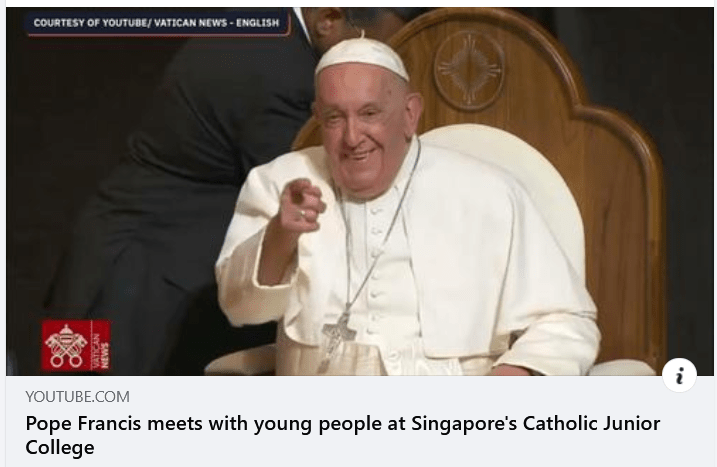
Pope Francis left his scripted remarks and spoke “spontaneously” to the youth of Singapore on Friday, September 13, 2024. The Holy Father made a distinction between a courageous person who seeks the truth as a “critical” thinker and the critic with “endless words” who offers “destructive criticism.” He asked them this question, “Do you have the courage to criticize but also the courage to let others criticize you?”
Impressed with the capacity of youth for interfaith dialogue, he stated: “This is very important because if you start arguing, ‘My religion is more important than yours…,’ or ‘Mine is the true one, yours is not true….,’ where does this lead?” One of the young people answered, “Destruction,” and the Pope responded, “That is correct.”
He went on to say, “Religions are seen as paths trying to reach God. I will use an analogy; they are like different languages that express the divine. But God is for everyone, and therefore, we are all God’s children. ‘But my God is more important than yours!’ Is this true? There is only one God, and religions are like languages that try to express ways to approach God. Some Sikh, some Muslim, some Hindu, some Christian. Understand? Yet, interfaith dialogue among young people takes courage. The age of youth is the age of courage, but you can misuse this courage to do things that will not help you. Instead, you should have courage to move forward and to dialogue.”
He went on to speak about the need for respect and the danger of bullying. He concluded by saying, “And now, in silence, let us pray for each other. In silence. May God bless all of us. In the future, when you are no longer young, but you are elderly and grandparents, teach all these things to your children. God bless you and pray for me, don’t forget! But pray for, not against!”
Is the Holy Father’s emphasis the methodology of dialogue or the reality of God as revealed in world religions? I suspect it is the former. It is true that interfaith dialogue does not go very far when the different sides disrespect and deride each other. People of conviction feel that they are right and take exception to challenges toward what they believe. Pope Francis is correct that we must resist the temptation to argue and name-call. Civility demands that we temper our emotions, especially against criticisms that are quickly taken to heart and are painful. Those of us with pugnacious natures, instinctively want to hit back. History is largely written with such a lack of toleration that leads to violence, censorship, holy wars, torture, imprisonment and even death. The language of hate allows for no dialogue and little in the way of successful debates. Instead of discussing ideas, there is a harsh attack against persons— the opposition are decried as “heretics,” “heathens,” and “infidels.”
Each of us likely believes that his or her religion is the best or the truest, such is even the case for atheists who posit their non-religion or anti-religion as having a higher epistemological value. As Catholics, the most resolute believers are correct to maintain that our faith is the genuine revelation of God through the mediation of Jesus Christ. The New Covenant is the consummation of the Old. Both Judaism and Christianity are judged as true religions. Of course, a natural religion has been surpassed by a supernatural religion that understands God to be both one and a Trinity. Other religions may have elements of the truth, but they are also weighed down by serious errors. Traditionally, apologetics would list all the many false teachings and practices of these other belief systems. By contrast, Pope Francis is saying that this is not where dialogue begins. Such an approach closes minds to the truth and to any possible consensus. It is best to begin dialogue by examining the elements of faith that are shared. This will vary between creeds. Catholics and Jews both embrace Abraham as our father in faith. We have taken the Hebrew Scriptures as our own. Islam also believes in one God and claims facets of a shared revelation. The Hindus are arguably polytheists, but some of their modern-day teachers suggest that their many deities may in truth be manifestations of a single God. Where such thinking will go, I cannot say. Even if there should be no or little congruence on matters of theology, dialogue can be judged as successful if we learn to live in peace and to work together for a better world where human rights and freedoms are respected.
Yes, religions are seen as paths to reach God. However, we as Jews and Catholics understand religion as also the story of how God comes looking for us. There is a two-fold movement. God establishes relationships (covenants) with his people. The analogy of religions as different languages to express the divine is accurate. Left unsaid is that some languages are better in their evocative and descriptive power. Christianity not only espouses God-talk but has been given the revelation of how the eternal Word becomes flesh. The lack of such an appreciation is a defect that handicaps all other religions. God gives us his Word in Scripture, but more importantly writes his revelation upon human flesh in the incarnation. Jesus is the face of God and the revelation of the Father. He is the way and the truth and the life. There is no way to the Father except through him. Other religions, if they do not go off in the wrong direction, can only take their adherents to the door of the kingdom; it is Christ that lets us inside. His Church and the sacraments constitute the key to that door.
Are we all God’s children? As in the catechism and at Vatican II, a distinction must be made. Spiritually, through faith and baptism, we are made adopted sons and daughters of the Father. It is in this sense of grace and a new creation, that those of other religions are not children of God. However, the meaning of Pope Francis is in the sense of creation. All in the human family are creatures and children of the earth. Our source is almighty God. Regeneration aside, we are all arguably children made in the image of God. We are creatures of flesh and blood and soul. We are so much more than the animals around us. This notion speaks to human dignity. It is a major element of the Gospel of Life. In or outside the womb, God looks upon us with a Father’s love.
Knowing that he is speaking to a crowd of mixed faiths, Pope Francis asks that they might pray for each other in silence. Notice that he prays that God might bless them, but he refrains from asserting the saving name of Jesus. While we might question timidity regarding the name of Jesus and/or making the sign of the cross, we should remember Pope Francis’ words about courage. Certain Christians will not pray with Catholics. While we can pray the psalms with Jews, it is quite problematical to pray with non-Christians. We do not want to open such young people to rebuke or punishment from their own religious leaders. Importantly, we as Catholics must not subscribe to any form of religious indifferentism or the notion of universal salvation. Silent prayer is probably the best for all in such a situation.
ADDENDUM
Anyone with a smidgen of Italian can appreciate that the text on the Vatican website (yesterday) is not actually what the Pope said to young people in Singapore. Previous popes tended to be more careful with off-the-cuff or spontaneous remarks. Officially, the text that matters is the written one, today on the Vatican website and/or included in the published Acta.
When I was informed about a translation change, I went immediately to the Vatican site. What the hell? The official translation had at least corrected the Pope’s remarks. Now, the Vatican has returned to what comes across as deeply problematical. Last night, the text read, “Religions are seen as paths trying to reach God.” Yes, this is true, regardless as to whether they do so. This morning it has been changed to “All religions are paths to God.” This is not true. Even those in false religions reject this notion. Reading further, the initial papal text asserted, “There is only one God, and religions are like languages that try to express ways to approach God.” Yes, this is true, even defective religions are efforts to approach the transcendent. But the new version is as wrong as wrong can get, “There is only one God, and religions are like languages, paths to reach God.” Not all religions target the true God. Indeed, it is Christ as the term of salvation that makes possible our reconciliation with the Father. None are saved apart from Christ and his Church. Further, not all religions are the same. Satanism and demon worship are counted as religions, but there is no redemption, just alienation and loss. Certain religions worship false gods or even demons.
Krystal Smith poses this question at STAPLER CONFESSIONS and states: “Theists suggest that God is omnipresent, and is in all living things, including us. Some claim to be able to feel God’s presence, or even suggest they’ve experienced divine intervention. These experiences are interpreted as signs from God. Atheists insist that there are no signs from God. They ask why God doesn’t just show himself to everyone to prove his existence.”
Beyond human ignorance and malice, the failure to see signs of God is not dissimilar from the Satanic veiling of consciences regarding the many crimes against the dignity of persons and the sanctity of life. If Catholic politicians are willing to celebrate legislation that promotes the termination of children fully formed after nine months in the womb, then why should we think they would recognize the presence of God or the divine in the world. Those of a secular humanist society have closed their hearts and minds to miracles both natural and supernatural.
Christian philosophers would contend that there needs to be some sort of initial demarcation between ourselves and God as “the greatest good” to preserve freedom. This was likely true for angels before the fall, and it is still the case with us. The acquisition of the greatest good in heaven ensures that one will always say YES to God as a saint.
We are promised that we will all stand before the Lord. But such will be a time of final commendation and reckoning. Those who would demand that God reveal himself immediately right now are literally invoking judgment day. It is for this reason that after death one’s orientation becomes permanent. What we know now is through faith and not through sight. This rationale is why God does not fully or immediately reveal himself to his material creation.
The Lord wants us to meet him part way instead of him doing all the work. He comes to us; we must also go to him. That is an element of the incarnation where Jesus is the human face or revelation of God. God relates to us as one of us, literally joining the human family. All this is to assist us in properly relating to God. The late Archbishop Fulton Sheen spoke about Christ becoming a man as the traversing of a greater distance than a man becoming an ant. The Old Testament asserts that none could see God as he is and live. Notice the transformation in the likeness of Moses after commingling with God on the mountain. God is fire and to encounter him threatens being burned.
Theists do more than suggest that God is “omnipresent,” he is necessarily keeping all things in existence. His role as Creator is not locked in a moment of history but is ongoing and necessary. If God were to neglect us even for a moment, we would cease to exist. Fortunately, the divine economy does not permit annihilation. The intervention of God also includes his interaction with us and a gradual revelation that finds fulfillment with the coming of Jesus Christ. The Lord establishes both a corporate or communal and a personal relationship with us. He desires to share awareness, life, and love with us. It is in this that we are made in the image of God. God has given us his Church and there are supernatural signs to reassure believers, such as apparitions and miracles. Believers trust the testimony of past witnesses and the teachings of Christ’s Church. They also open themselves to a sense of the Lord’s presence and form a real relationship with the living Christ. Believers do not believe they are delusional but rather that there is a real spiritual encounter and friendship. However, one must be open to a relationship with the Lord. Many non-believers are ill-disposed for the grace that comes with faith and love in Christ.
Krystal Smith poses this question at STAPLER CONFESSIONS and states: “Most theists believe that God is eternal and therefore always existed. Some might suggest that God created time, space, and the universe all at the same time. Atheists insist that something cannot come from nothing, and therefore something must have created God in the first place. The phrase ex nihilo nihil fit is Latin for “from nothing comes nothing.” This argument has been used by philosophers throughout history to refute the notion of an eternal God.”
Yes, Christians believe that God has always existed; however, the matter is far deeper. God is the ground for all existence. He is existence itself or the great “to be.” The problem with atheists is that they are thinking about “god” as just another thing. He is not. God as a pure spirit exists from all eternity, but he wanted to share the goodness of existence. We believe that he created spiritual beings called angels and that he created material beings, the highest of which are men and women. Material things find themselves situated in time and space. They come into and go out of being. We are immortal because the soul is immaterial and has no parts to break down or die. The Latin phrase, ex nihilo nihil fit, is actually an argument against atheists, not theists. The proper question is not, “Who created God?” but rather, who created us and everything else? An infinite regression is an absurdity. If “nothing comes from nothing” then there should be no humanity and no creation around us to reflect upon. God is the necessary being. The catechism asserts that almighty God creates us through an act of the divine will out of nothing. Even the much touted theory of the “big bang” was theorized by a Catholic priest. Note the confusion of non-believing scientists when asked what existed prior to the singularity that became the big bang. They really do not know and their speculation takes them into the realm of magic.
Krystal Smith poses this question at STAPLER CONFESSIONS and states: “Atheists might point out the idea that some believers could allow the concept of an afterlife, heaven and hell, or reincarnation to weigh the significance of the events in their worldly life. The presumption that death isn’t the end could have an influence of people’s behavior and day to day decision making.”
This is a no brainer. If religion with threats of eternal perdition cannot restrain some from evil acts, why should we expect atheism to do any better? Atheists have neither perfect contrition (sorrow for having offended God whom we are to love) or the imperfect (fear of the fires of hell and the loss of heaven). Where is the incentive to be good when we can only expect to be forgotten and the looming prospect of becoming worm food?
The Christian perspective is more complex than simple reward and punishment. The posture of the creature to the Creator is one of obedience and adoration. We have been promised a share in Christ’s life and the reward of happiness in the presence of God forever. However, we do not deserve salvation and could not merit it on our own. Humanity fell from grace and God made a promise to redeem us— but this is entirely on the level of gift, not entitlement (no matter how good we might be). Even if God should have decided to leave us estranged from him; we would still be obliged to worship and obey him. We thank God for what he gives us, but we praise or give him glory for who he is. This is the high ground of Christian discipleship. It is true that the resurrection is the hook of Christianity, and the prospect of heavenly reward or hellish punishment is real— but we are to love God because he is God. The gifts he gives us are wonderful but there is no bargaining with God. Our love must be freely returned to God. The love of a saint is not for sale and cannot be bought. If God can love us then we must freely love God in return, even if our lot is suffering, sickness and death. Many fail to understand this. Note that some equate prayer entirely with petition— they want this, that, and the other thing. The highest prayer of praise or adoration is very different— I love you; you know I love you; I will always love you. We sing glory to God, not to pamper a deity but to pour out hearts to a God for whom we were made.
Having said all this, some will only be good because there is reward or punishment. This appreciation is at the basis of most legal systems. Do something wrong and you will face fines or imprisonment. There is something of it in the classroom as well. Get an “A” and you pass and have promotion. Get an “F” and you fail and get sent back. But truthfully, the Christian perspective looks at all of us as failures. We receive merit or know victory in the salutary work of Christ and his Cross. Jesus pays the price for us. Of course, it is a gift that must be received. Disposition is everything.
The atheist must live with his failure. No matter what his earthly achievements, the end of one is the same for all. No matter whether one is rich or poor, powerful or weak, good or evil, healthy or sick— it all comes to the same thing— absolutely nothing. We along with all our works will be reduced to dust. We might find some short satisfaction in the present, but loss, pain and death will quickly follow. You cannot win. We all live in vain. Indeed, all the works of humanity will one day be destroyed and like the various species before us, we will know extinction. This view portrays humanity as a cosmic accident. There is no deeper meaning or purpose and definitely no hope.
“For I handed on to you as of first importance what I also received: that Christ died for our sins in accordance with the scriptures; that he was buried; that he was raised on the third day in accordance with the scriptures; that he appeared to Cephas, then to the Twelve. After that, he appeared to more than five hundred brothers at once, most of whom are still living, though some have fallen asleep. After that he appeared to James, then to all the apostles. Last of all, as to one born abnormally, he appeared to me.”
If we are to be fishers of men, the apostle Paul images the resurrection as the hook of Christianity. He asserts:
“But if Christ is preached as raised from the dead, how can some among you say there is no resurrection of the dead? If there is no resurrection of the dead, then neither has Christ been raised. And if Christ has not been raised, then empty too is our preaching; empty, too, your faith” (1 Corinthians 15:12-14).
What happens with the death of Christ on the Cross? Death is defined as the separation of the body and the soul. In the case of Jesus, his body and soul were still united to him as a divine Person. The creed stipulates that he descended into hell, or unto the quick, or to the dead. I recall an Eastern icon with devils reaching for the feet of Adam and Eve as Christ raises them up by their hair. However, despite the symbolism, this is not the hell of the damned. Our Lord descends to the Limbo of the Fathers to take claim of the righteous dead who from the beginning of the world were awaiting the opening of heaven’s gates. Jesus is literally the bridge or the way to the Father. The prophets, patriarchs, and other faithful waited in a passing abode for the dead. Also included among their number would have been godly gentiles. The Good News is preached by Jesus to those who preserved the promise and came before his redemptive work. We are reminded of Jesus’ words when he told his critics:
“And concerning the resurrection of the dead, have you not read what was said to you by God, ‘I am the God of Abraham, the God of Isaac, and the God of Jacob’? He is not the God of the dead but of the living” (Matthew 22:31-32).
We do not cease to be at death. The dead are alive. The Limbo of the Dead ceases to exist with the translation of its inhabitants to heaven. Between now and the end of the world there exists a transitory place of purification called purgatory. At the judgment that will also pass away. The two realities that will remain are heaven for the angels and saints and hell for the devils and damned. (Some argue for a Limbo of the Innocents, but many reckon it as only a Scholastic theory devised to keep unbaptized infants out of hell. The speculation is that they might be naturally happy but ignorant of God. Many of us hope that they will be granted so much more. We were made for God.) The chief apostle acknowledges Jesus’ proclamation to the dead. “In it he also went to preach to the spirits in prison” (1 Peter 3:19). Of course, Jesus did not stay dead. Those in the prison of Limbo find release and are given a share in Christ’s life. As a sign of this reality, we read in Matthew 27:52-53:
“. . . tombs were opened, and the bodies of many saints who had fallen asleep were raised. And coming forth from their tombs after his resurrection, they entered the holy city and appeared to many.”
This is the home of the AWALT PAPERS, the posting of various pieces of wisdom salvaged from the writings, teachings and sermons of the late Msgr. William J. Awalt.





























 Blogger Priest