• Our Blogger

    Fr. Joseph Jenkins

  • The blog header depicts an important and yet mis-understood New Testament scene, Jesus flogging the money-changers out of the temple. I selected it because the faith that gives us consolation can also make us very uncomfortable. Both Divine Mercy and Divine Justice meet in Jesus. Priests are ministers of reconciliation, but never at the cost of truth. In or out of season, we must be courageous in preaching and living out the Gospel of Life. The title of my blog is a play on words, not Flogger Priest but Blogger Priest.

  • Archives

  • Categories

  • Recent Posts

  • Recent Comments

    Anonymous's avatarAnonymous on Ask a Priest
    Michael J's avatarMichael J on Ask a Priest
    Jeremy Kok's avatarJeremy Kok on Ask a Priest
    Mike Zias's avatarMike Zias on Ask a Priest
    Jeremy Kok's avatarJeremy Kok on Ask a Priest

The Watchful Guardian Angels

Many adults regard prayers to a guardian angel to be the stuff of children only, along with the Tooth Fairy, the Easter Bunny and Santa Claus. As soon as they grow up, even fervent believers frequently cease beseeching the intercession of their spiritual guardians. Guardian Angels are NOT imaginary friends. We have it in good authority that they are real and are watching.  Jesus tells us, “See that you do not despise one of these little ones, for I say to you that their angels in heaven always look upon the face of my heavenly Father” (Matthew 18:10).  The statement is reassuring and staggering.  We are not alone.  Not only does God see everything but we have an angel watching us as well.  Of course, the angels must be all eyes because the good angels never lose sight of the beatific vision. 

Do we detect something of a warning in Christ’s statement?  The little ones are often associated with innocent children but in truth they would include all those who are marginalized and brushed aside by the world.  While we can take comfort in having spiritual guardians, they will always testify to the truth about what they see.  Our guardians may be one-and-the-same as the harvesting angels. Those who have had near-death experiences sometimes report encounters with angels and a looming light. Also experienced but understandably under-reported are when angels seek to draw souls into the fire of perdition. Angels can pray for us and maybe intervene in special situations, but they cannot save us from God’s judgment. 

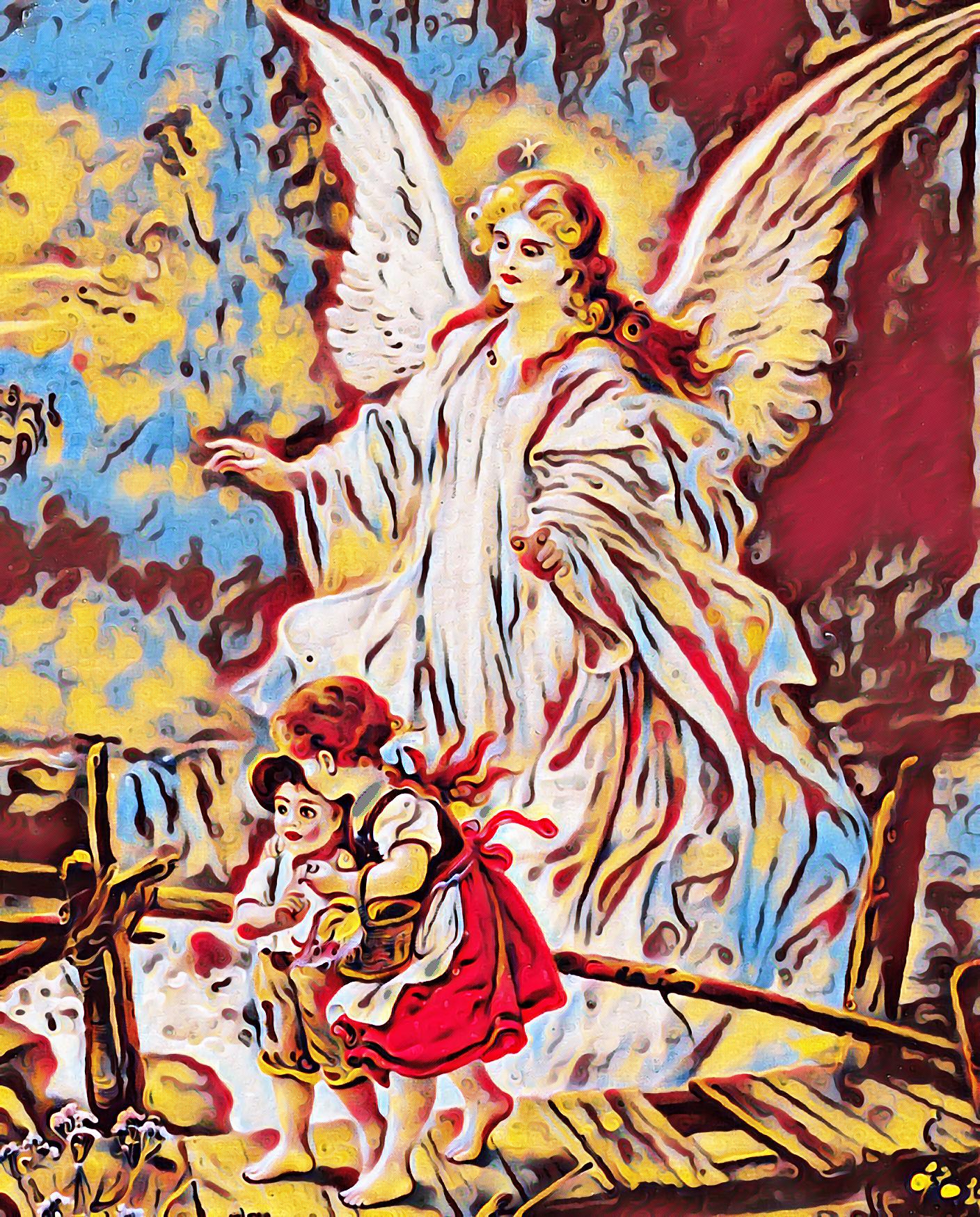
Cynics will point to the famous picture of an angel looming over small children who are on the edge of a dangerous bridge.  They ask, if such were real, then why do children fall off bridges or get sick or face abuse? Where is this proposed intervention? We must answer that the Guardian Angels do catch and rescue the innocent children— however, it is often the case that we fail to see the saving act.  Bodies might be lost but souls are saved.  I suspect that every pregnant woman is being followed by at least two angels, her own and the one appointed to the child in her womb.  These angels are not ghosts and they are certainly not demonic.  Indeed, I suspect that many blessed homes could avoid demonic disturbances if only we acknowledged the powerful spiritual presence of God’s angels.  It is sad that people increasingly get involved with the occult and pursue conversations with ghosts and demons, but never offer a prayer to their personal angel.  There is also evidence that gatherings of people as in churches or within nations are granted angelic protection, as with Fatima’s Angel of Portugal. 

Angels do not belong to themselves.  They are messengers for God but more— they are unique and personal instruments through which God acts.  Just as Jesus appoints men as his priests to extend his saving work of mercy; so too are angels the vehicles for God’s intervention and power.  The angels of God are always about the Lord’s business.  They reflect God’s love for us. They are saints and want us to join their number. 

A ghost or human soul outside the body is helpless but not angels. The presence of an angel in one’s home is not a haunting but a blessing. We read in the universal catechism: “From its beginning until death, human life is surrounded by their watchful care and intercession. ‘Beside each believer stands an angel as protector and shepherd leading him to life.’ Already here on earth the Christian life shares by faith in the blessed company of angels and men united in God.”

The Bible attests to these spiritual guardians.  Matthew 18:10 was already quoted.  We can also look to Psalm 34:7, Psalm 91:11, and Hebrews 1:14.

Psalm 34:8“The angel of the LORD encamps around those who fear him, and he saves them.”

Psalm 91:11“For he commands his angels with regard to you, to guard you wherever you go.”

Hebrews 1:14“Are they not all ministering spirits sent to serve, for the sake of those who are to inherit salvation?”

The Church has enshrined her belief in Guardian Angels within her liturgical year with their annual commemoration on October 2.         

The Ranks of Angels

The fact that there are ranks of angels is a truth that I would concede. However, I must honestly admit that all efforts to denote them strike me as contrived and speculative. Focusing on the Scriptures, the Jews tend to speak of ten ranks while Catholics detail nine broken down into sets of three. The source for Christians is Pseudo-Dionysius the Areopagite from the fifth or sixth century and his work entitled, On the Celestial Hierarchy. It is all remarkably interesting but is it credible?

  • Highest Rank – Seraphim (Is. 6:2), Cherubim (Ez. 10:15,20), Thrones (Col. 1:16)
  • Middle Rank – Dominions, Virtues, Powers (all mentioned in Eph. 1:21)
  • Lowest Rank – Principalities (Eph. 1:21), Archangels (Jude 1:9), Angels (throughout Bible)

How are they distinguished? The highest or first rank of angels focus immediately upon the godhead. They bask in the presence of God. They praise him as holy Wisdom. They clearly acknowledge God as the Judge of all. Those of the middle or second rank possess governing authority over the universe and have power over natural creation. The lowest or third rank is where we find the guardians or messengers of God. These are the angels we most invoke for intercessory prayer.

What are my thoughts about this? The substantial form in human beings is the immortal soul. It is what separates us from animals. If the soul leaves the body, it survives as a ghost. The body, however, would become a corpse. It cannot live without the soul. The soul is the principle of life. By contrast, an angel is pure form without matter. That is why angels cannot die. An angel is a spiritual creature that can know, will and act. The primary activity of an angel is to see, know, and love God as the greatest good. Beginning with its creation, every angel is its own form or species. There is no matter to be determined (formed) as in the race of men. While matter is our principle for individuation, such is not the case for angelic beings. Given the lack of informed matter, there can be no membership in any angelic species. Every angel has its own unique form. While they share a common spiritual essence, each angel is a species of one. I have heard it argued that there is a radical self-determination by the angel’s act of will at creation. The angels of God would sort themselves by their species and office. While all adore, some are drawn to proclamation or governance or revelation or blessing or whatever. This is apart from the orientation that separates the good from the bad angels.

The rebellion among the angelic hosts constitutes the most important distinction between the good and the bad angels. There must have been some kind of veil at the beginning so that there might be freedom regarding the acceptance (or rejection) of God as the greatest good. Otherwise, the compelling attraction of the greatest good would strip away any choice.

Great and small, not all angels are the same. Cherubim are imaged as with four wings and many eyes or faces. They are understood as all seeing. Isaiah 6:1-3 describes those of the highest rank— the Seraphim. They are as sentinels before the throne of God. “Seraphim were stationed above; each of them had six wings: with two they covered their faces, with two they covered their feet, and with two they hovered. One cried out to the other: ‘Holy, holy, holy is the LORD of hosts! All the earth is filled with his glory!’” Imaged with six wings, the Seraphim are associated with fiery purification. St. John of the Cross writes that the seraphim covering its face with its wings symbolize “the darkness of the intellect in God’s presence.” He continues that the covering of the feet symbolizes “the blinding and quenching of the affections of the will because of God.” It thus constitutes humility of the creature before the Creator. “With the two remaining wings they flew, indicating both the flight of hope toward things that are not possessed and the elevation above all earthly or heavenly possessions that are not God” (The Ascent of Mount Carmel, II, 6.5).

As a closing aside, various authorities regard Lucifer or Satan as either a Seraphim or Cherubim (Ezekiel 28:11–17). Such a lofty standing among the angelic hierarchy, would denote two things: (1) he would possess tremendous angelic powers (even without grace) and (2) his was a most terrible fall and loss. Satan brings upon himself an alienation from God that portends to a frustration of his very purpose. What are we to make of a corrupted creature called to resound the thrice Holy name of God? Instead of a hymn or prayer, is he a living curse? Akin to Dante’s frozen Satan, is he eternally silent— locked in a moment of hesitation— unable to adore the one who is Holy, Holy, Holy?

The Truth about Angels

There are so many misconceptions about angels. Many imagine they are simply human souls that have been rewarded with wings in the afterlife.  This is not the case.  Many have their religious formation from Hollywood and not from the source that is truly holy. Angels like us are “persons” with will and intellect.  They are both good and bad. However, other than that, they are utterly alien to humanity.  They are purely spiritual entities without bodies and thus they do not reproduce, do not age and cannot die. We often fantasize about them with flowing robes, wings, and halos. But in truth they look like nothing at all. If God should allow them, they can appear before men, but only as phantasms or caricatures of human beings.  Beneath the appearances, they are something utterly beyond our comprehension. The good angels obey and will never tarry to answer God’s summons.  They adore the Lord as a host or angelic choir.  They love God and they love us.  While they are not human, they are counted among the saints of heaven.  They intercede and pray for us. The bad angels turned from God. Unlike mortal men this rebellion has permanently misaligned their orientation. The West, unlike certain Eastern churches, does not believe that angels can repent and return to God’s good favor.  Demons will always be demons.  They may know an intellectual life with the other damned of hell, but they have forever forfeited grace. Where there should be love there is hatred or indifference.  At death the souls of the departed are also fixed, either orientated toward God or away from him.  It is said that as many as a third of the angels rebelled against God.  Many of the ancient Church fathers thought that their fall was due to a repudiation of the providential incarnation. Unlike the angels of the nativity, they had refused to bend the knee to the Christ Child.  The good angels always adore the Lord and praise the godhead as Holy, Holy, Holy. 

As spiritual and not material beings, the angels know duration but not time as we do.  They have no gender. They do not have our five physical senses. They do possess angelic powers.  However, as “persons” they are aware, can know and love and choose. All the angels that would ever exist were created in the same moment.  This is contrasted to human beings who are created throughout time.  However, at the end of the world, our numbers will also be fixed.             

The word “angel” means messenger and they are periodically sent by God in the history of salvation. Note what is said in the universal catechism.

CCC 332Angels have been present since creation and throughout the history of salvation, announcing this salvation from afar or near and serving the accomplishment of the divine plan: they closed the earthly paradise; protected Lot; saved Hagar and her child; stayed Abraham’s hand; communicated the law by their ministry; led the People of God; announced births and callings; and assisted the prophets, just to cite a few examples. Finally, the angel Gabriel announced the birth of the Precursor and that of Jesus himself.

CCC 333From the Incarnation to the Ascension, the life of the Word incarnate is surrounded by the adoration and service of angels. When God “brings the firstborn into the world, he says: ‘Let all God’s angels worship him.’” Their song of praise at the birth of Christ has not ceased resounding in the Church’s praise: “Glory to God in the highest!” They protect Jesus in his infancy, serve him in the desert, strengthen him in his agony in the garden, when he could have been saved by them from the hands of his enemies as Israel had been. Again, it is the angels who “evangelize” by proclaiming the Good News of Christ’s Incarnation and Resurrection. They will be present at Christ’s return, which they will announce, to serve at his judgment.

Given the identity of Jesus as God’s only Son and the Second Person of the Blessed Trinity, the angels are preoccupied with Christ— announcing his birth with the hymn of heaven, ministering to him after his temptation scene with the devil, and giving him consolation in Gethsemane before the ordeal of his betrayal and passion. Angels are also heralded to accompany the risen Christ on the day of judgment.  They are imaged as harvesters of souls.  Similarly, we are informed that angels can minister to us (Hebrews 1:14) and function as special guardians (Matthew 18:10).  The Roman Canon of the Mass even speaks of an angel that takes the oblation of the Eucharist to the heavenly Father. 

While angels belong to the supernatural realm, they are limited by their nature to angelic power and to whatever divine grace allows for them.  Just as we can make things, only God can create from nothing.  Similarly, neither angels nor demons (fallen angels) can truly create, as this requires infinite power. New Age religion erroneously corrupts this understanding by having its adherents praying to angels as if they were deities.  Such an angelology is an utterly offensive idolatry as it seeks through superstition to usurp divine sovereignty.