• Our Blogger

    Fr. Joseph Jenkins

  • The blog header depicts an important and yet mis-understood New Testament scene, Jesus flogging the money-changers out of the temple. I selected it because the faith that gives us consolation can also make us very uncomfortable. Both Divine Mercy and Divine Justice meet in Jesus. Priests are ministers of reconciliation, but never at the cost of truth. In or out of season, we must be courageous in preaching and living out the Gospel of Life. The title of my blog is a play on words, not Flogger Priest but Blogger Priest.

  • Archives

  • Categories

  • Recent Posts

  • Recent Comments

    Barbara King's avatarBarbara King on Ask a Priest
    Ben Kirk's avatarBen Kirk on Ask a Priest
    Jeremy Kok's avatarJeremy Kok on Ask a Priest
    Barbara's avatarBarbara on Ask a Priest
    forsamuraimarket's avatarforsamuraimarket on Ask a Priest

What if God Were One of Us?

Many years ago, when I was a seminarian, I recall a class discussion over Luke 2:51-52:

“He went down with them and came to Nazareth, and was obedient to them; and his mother kept all these things in her heart. And Jesus advanced in wisdom and age and favor before God and man.”

The context was the tension between the theological school of Antioch that emphasized the humanity of Christ with the school of Alexandria that focused upon his divinity. The latter school stressed John 1:1-3:

“In the beginning was the Word, and the Word was with God, and the Word was God. He was in the beginning with God. All things came to be through him, and without him nothing came to be.”

The biblical verse from Luke substantiated the claims of Antioch.  However, it seemed to fly in the face of the Church’s discernment that Jesus Christ was a divine person, albeit with two natures. While Jesus could certainly grow in age regarding his humanity, how could he really advance in wisdom and grace or holiness?  While we should be careful about presumptions toward the mind or psychology of Christ, it must be held that as God he assuredly knew all things. It would be absurd to imagine him as an amnesiac deity.  He knew from the womb who he was and his mission.  The best we can figure, so as not to destroy his human “experiential” knowledge, he must have pocketed or set aside the fullness of divine knowledge or awareness.  It was always there, but like a book that needed to be taken off a shelf.

An analogy can be made as to how we all know things.  While we can call upon our many memories and knowledge, it is an element of human psychology that we do not focus upon everything at once.  We concentrate on a few things or what we need at any given moment.  I suspect it was the same for the incarnate Christ.  However, when there was a need, he could call upon his infinite divine knowledge, as he does in prophesying his passion and reading souls that he would heal and forgive. Thus, Jesus could have learned carpentry from his foster father Joseph, even though in his divine knowing, he could have built wooden television consoles.  But Jesus is careful not to do anything that violates the parameters of his humanity that is situated in a particular culture within space and time. Further, the pocketing of his divine knowledge means that his experiential learning is real and that he is not a God pretending to be a human being.  Both elements of his being are sustained although the tension would precipitate much confusion and debate in the Church. 

More problematical is the fact that Jesus Christ is the source for all holiness.  How can he possibly grow in grace? Again, looking at the rest of us, something of the solution emerges.  When an infant is baptized it can be said that the holiest person in that family household is that child.  Like Jesus, we get older, are instructed in the ways of our faith and we mature.  We begin to manifest the fruits of faith and realize the graces received in the sacrament.  Similarly, our Lord is the living sacrament and uncreated grace starting in the womb of Mary.  Unlike us he will never forfeit or blemish his holiness through sin.  His trajectory or life in holiness is perfect while ours will know detours with needed repentance and God’s mercy along the way.

Jesus always sees the heavenly Father (the beatific vision). As a child in the womb, as a baby in the manger, indeed, throughout his whole life there was never any confusion in his mind between his foster father Joseph and God the Father.  It was in this sense that there was no ignorance or confusion in Christ. 

Our Lord will realize before men who he is and why he has come into the world.  His learning will amaze listeners and they will wonder where he received it. His presence will exude a welcoming and enriching grace that will attract many to him.  The transition is from his hidden life as the son of Joseph and Mary to his public life as the Son of God come to save us. His ministry begins when he is thirty years old, not when he immediately emerges from the womb. It is fitting that he is like us in all things except sin.  He knows what it is to grow up in a human family.  He is one of us although he is also the second person of the Trinity, the one true God.          

The Church teaches that the human and divine natures of Christ are perfectly joined in a hypostatic union (in one divine personhood). Jesus is both God and man, but he is a divine and NOT a human person.  This is still the case— the incarnate Christ in heaven is forever God and man. What Christ is by way of identity, we can share by the indwelling of grace by which we as human persons are remade into the likeness of Christ by the intervention of the Holy Spirit. 

What Does It Mean to be a Catholic?

I have had people angry with me because there was no formal way for them to disaffiliate with the Catholic Church. A few years ago, there was an effort to allow those intellectually and/or emotionally alienated from the faith to juridically separate themselves with a written document signed by their pastor and bishop.  But clergy largely refused to sign it.  The legitimacy of this whole business was called into question regarding dispensations, marriage annulment cases and tribunals. Complicating matters further, there was a disagreement between two Vatican congregations— Liturgy and Doctrine of the Faith. The pressing doctrinal fact remains that baptism is a once-and-forever sacrament.  Baptism cleanses us of original sin, infuses sanctifying grace, makes one an adopted child of the Father and a temple of the Holy Spirit.  We become a Christian and a member of the Church with privileges and duties.  Baptized a Catholic, one remains always a Catholic.  A person might become lapsed or start worshiping in a non-Catholic church, but he or she remains a Catholic and will be judged by God as a Catholic.

There are many others that insist upon being designated as “Catholic” when they have long since stopped living the faith.  Their religion is treated as a club or as an ethnic matter. When pollsters interview such people on beliefs and the value shifts of the day, the results are skewed to the left.  That is why those seeking serious statistics distinguish between those Catholics that regularly participate at Mass and those that do not. 

Can one be a Catholic in truth while abiding in mortal sin, literally with one foot in hell?  Remember that the deliberate failure (through our own fault) to go to Mass on Sundays and holy days is a grievous sin that brings us to perdition.  Status becomes even more dire when a host of other mortal sins are added like fornication, adultery, homosexuality, abortion, and various forms of contraception.  The failure to worship dishonors almighty God.  The so-called pelvis or sexual sins bring dishonor to created persons and human life. The trouble with the latter is not a misplaced preoccupation of the Church with human sexuality but rather a failure of men and women to respect themselves as bodily creatures.  Human dignity is violated through disobedience to both natural and divine positive law.       

It may be that many others go through the motions of faith but suffer from missing or inadequate religious formation. How many do not understand or reject the “real presence” of Christ in the Eucharist?  Does everyone in the pews appreciate that the Mass is an unbloody re-presentation of the immolation of Calvary?  Do we go to church solely from duty or do we intend to adore the trinitarian God?  Do we all pray? Are there some that do not know how?  Do we invoke the Holy Spirit and petition for the intercession of the saints? Do we see the priest at the altar as one who participates in the one priesthood of Jesus Christ?  He is so very different from a minister as in Protestant sects.   

At baptism we were anointed as priest, prophet, and king.  A priestly people render sacrifice, literally taking up their crosses to follow Jesus— spiritually grafting themselves to Jesus as an acceptable offering to the Father.  As a nation of prophets, we are commissioned to proclaim and share the Good News of the Lord to all whom we meet.  Given that Jesus is king, and Mary is the queen mother, we are made family members of the royal household of God. Do we acknowledge this privileged dignity and dutifully preach the truth and participate in Sunday Mass?

Salvation requires faith in Christ; however, it is more nuanced than the evangelical’s easy profession of Jesus as one’s “personal Lord and savior.” The Catholic appreciation takes into consideration the Gospel of Mark, the writings of Paul and the epistle by James.  We are not saved by faith alone, but by grace alone.  Works are important as well, because remade in his likeness, we allow the Lord to minister through us.  Whatever Jesus does, has value. Saving faith includes the ingredients of charity and obedience.  We must have both a personal and a corporate relationship with Christ that is realized through loving fidelity (John 14:15; 24).

Affiliation with the Church is not optional.  Just like the Jewish people of old, we are called to the Lord as members of his new People of God or New Zion— the Church.  The Church is the mystical body of Christ.  Just as Jesus is the one WAY to the Father, the Church is also necessarily the way— the means through which we sacramentally encounter Christ.  It is for this reason that we teach that there is no salvation outside the Church.  This provides the mandate for evangelization and for the Church’s prayerful intervention for everyone.  While the identities of “the many” that will be saved remains with divine providence, the Church cooperates in proclaiming the universal call to salvation. 

Our Lord makes a point of instituting the Church and giving Peter the keys to the kingdom.  Jesus gives the promise that the Church will prevail until the very end of the world. This is the same Church we proclaim in the Creed as one, holy, catholic, and apostolic.  These four marks find their home in Roman Catholicism.     

Too often we use political labels for the persuasion or depth of one’s Catholicism.  We say that this or that person is “liberal” or “conservative.”  The true measure of faith is between “orthodoxy” and “heresy.” One cannot be a good Catholic and subscribe to false doctrines or immoral practices. We are also obliged to remain in union with the pope who is the Vicar of Christ and the successor to St. Peter.  Such relationships can be strained when bishops of Rome promote their fallible ideas over immutable truths; but we trust that the Holy Spirit will preserve both the faith and the papacy.  The Pope is the servant of the Word and not its master.  His trust is to preserve and to pass on the timeless faith.  It is for this reason that Catholics have an obligation to know the Scriptures and the Catechism. Too many are ignorant and easily swayed by the changing fads and whimsy of the day. Indeed, many have spoken of an unofficial schism that afflicts the Church. We should make the firm resolution to practice the Catholic faith, despite outside pressures, disappointments inside the Church, and personal doubts and weaknesses. 

Christianity is NOT a Book Religion

When I first began apologetics online in the mid-1990’s, the internet was brand new and while there was little to no Catholic presence, there was no shortage of bigots who spouted the anti-Catholicism that was popular a century or more earlier.  The “Bible alone” proponents were fundamentalist to the core and reduced Christianity to a “book religion.”  If a Catholic tried to employ Scripture, because we are the true bible Christians, they would lament that our translations could not be trusted and that we had added books.  Some would point to the missals used at Mass or the Breviary said by priests and religious, arguing that these papist books were what we substituted for the real Bible.  I remember having the most heated arguments with a Protestant apologist who argued that the only true Bible was the old King James Version without revision— “if it were good enough for Jesus,” he argued, “it is good enough for me!”  When it was explained that the Bible was originally in Greek and Hebrew, he would just delete the Catholic objections on his message board (there were no blogs in those days) as just so much spell casting and sorcery.  The “Bible alone” champions would use isolated proof texts to answer any challenge, no matter what the actual context was about.  They believed they had an immediate understanding of the biblical texts from God and that no commentaries, catechisms, and definitely no Catholic pope were necessary.  Debate was hard because they were slippery and far from honest or rational. 

What was the truth? The Christians inherited the Old Testament from the Greek speaking Jews of the diaspora.  Gospels were composed, letters written, and an oral tradition spoken, that became the nucleus for the New Testament.  A living sacred tradition has remained the backdrop for understanding the inspired Word of God.  There was no complete Bible and agreed upon New Testament for the first three centuries of the Church’s life.  The bishops gathering at Hippo (393 AD) would agree upon the canon. It would only be with the Vulgate Bible composed by St. Jerome that all 73 writings of the Bible were available in a single book, written in the vernacular Latin of the West. (English did not exist as a language.) Up until the invention of the printing press, there were few Bibles and they were very expensive.  That would coincide with the reformation and the general availability of bibles (for the past 500 years).  Given poor literacy rates, the main way that people absorbed Scriptural truths was from preaching, liturgy, and art.  The latter should not be forgotten because both statuary and stained-glass windows often brought to mind the saints and the stories in salvation history. This the fundamentalist condemned as idolatry! 

As the years passed, the winds have changed direction and I find myself in arguments with Catholics and Protestants alike who make a claim of the Bible but then ignore what it has to say. Essential salvation truth subsists in the Bible.  But the Church comes first in time, not the book.  The command to preach the Gospel is what gives birth to the Scriptures.    

The Watchful Guardian Angels

Many adults regard prayers to a guardian angel to be the stuff of children only, along with the Tooth Fairy, the Easter Bunny and Santa Claus. As soon as they grow up, even fervent believers frequently cease beseeching the intercession of their spiritual guardians. Guardian Angels are NOT imaginary friends. We have it in good authority that they are real and are watching.  Jesus tells us, “See that you do not despise one of these little ones, for I say to you that their angels in heaven always look upon the face of my heavenly Father” (Matthew 18:10).  The statement is reassuring and staggering.  We are not alone.  Not only does God see everything but we have an angel watching us as well.  Of course, the angels must be all eyes because the good angels never lose sight of the beatific vision. 

Do we detect something of a warning in Christ’s statement?  The little ones are often associated with innocent children but in truth they would include all those who are marginalized and brushed aside by the world.  While we can take comfort in having spiritual guardians, they will always testify to the truth about what they see.  Our guardians may be one-and-the-same as the harvesting angels. Those who have had near-death experiences sometimes report encounters with angels and a looming light. Also experienced but understandably under-reported are when angels seek to draw souls into the fire of perdition. Angels can pray for us and maybe intervene in special situations, but they cannot save us from God’s judgment. 

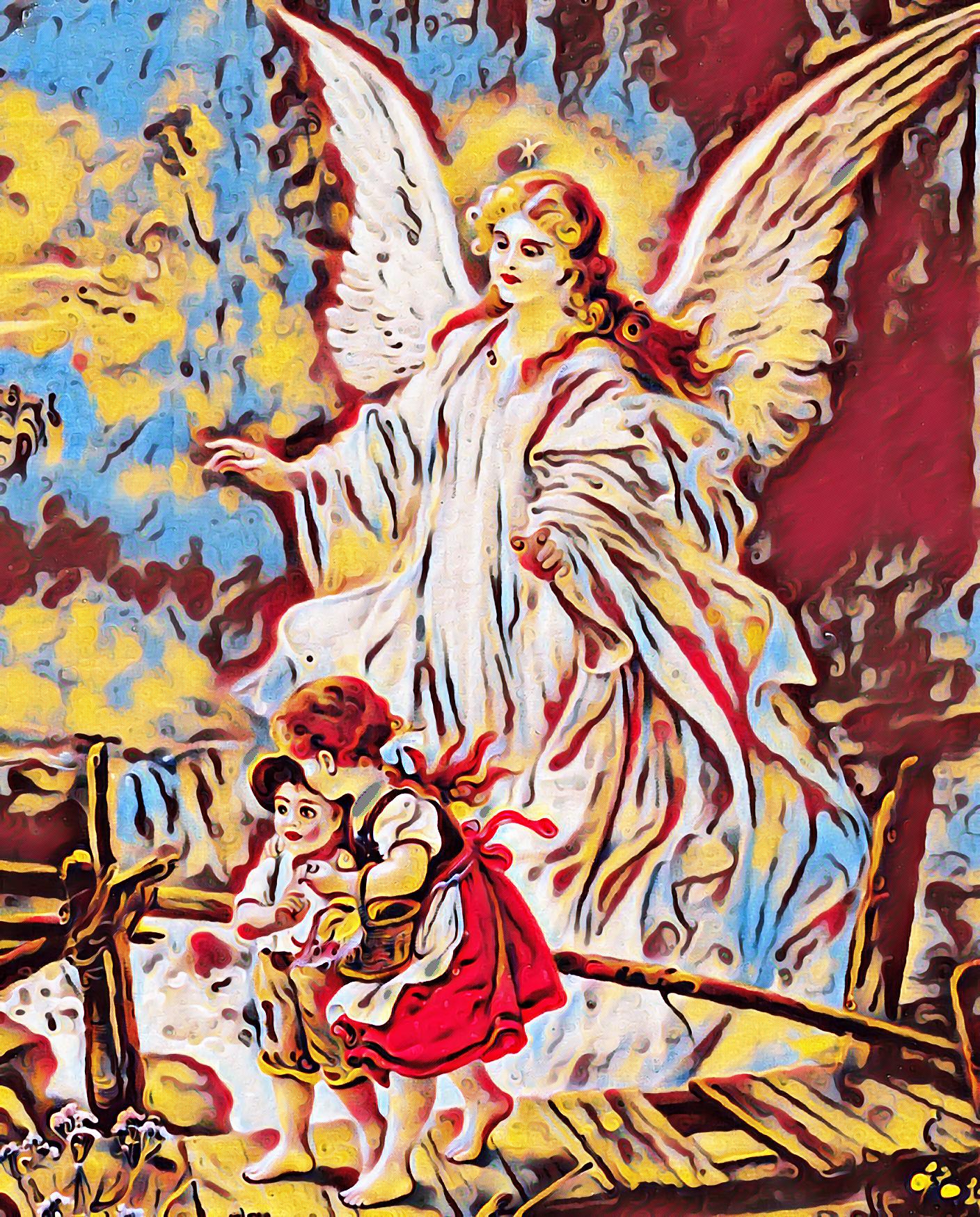
Cynics will point to the famous picture of an angel looming over small children who are on the edge of a dangerous bridge.  They ask, if such were real, then why do children fall off bridges or get sick or face abuse? Where is this proposed intervention? We must answer that the Guardian Angels do catch and rescue the innocent children— however, it is often the case that we fail to see the saving act.  Bodies might be lost but souls are saved.  I suspect that every pregnant woman is being followed by at least two angels, her own and the one appointed to the child in her womb.  These angels are not ghosts and they are certainly not demonic.  Indeed, I suspect that many blessed homes could avoid demonic disturbances if only we acknowledged the powerful spiritual presence of God’s angels.  It is sad that people increasingly get involved with the occult and pursue conversations with ghosts and demons, but never offer a prayer to their personal angel.  There is also evidence that gatherings of people as in churches or within nations are granted angelic protection, as with Fatima’s Angel of Portugal. 

Angels do not belong to themselves.  They are messengers for God but more— they are unique and personal instruments through which God acts.  Just as Jesus appoints men as his priests to extend his saving work of mercy; so too are angels the vehicles for God’s intervention and power.  The angels of God are always about the Lord’s business.  They reflect God’s love for us. They are saints and want us to join their number. 

A ghost or human soul outside the body is helpless but not angels. The presence of an angel in one’s home is not a haunting but a blessing. We read in the universal catechism: “From its beginning until death, human life is surrounded by their watchful care and intercession. ‘Beside each believer stands an angel as protector and shepherd leading him to life.’ Already here on earth the Christian life shares by faith in the blessed company of angels and men united in God.”

The Bible attests to these spiritual guardians.  Matthew 18:10 was already quoted.  We can also look to Psalm 34:7, Psalm 91:11, and Hebrews 1:14.

Psalm 34:8“The angel of the LORD encamps around those who fear him, and he saves them.”

Psalm 91:11“For he commands his angels with regard to you, to guard you wherever you go.”

Hebrews 1:14“Are they not all ministering spirits sent to serve, for the sake of those who are to inherit salvation?”

The Church has enshrined her belief in Guardian Angels within her liturgical year with their annual commemoration on October 2.         

Dealing with the Mystery of Death

There is something about our nature that instinctively resists death and finds the notion repugnant.  Many are fearful of death. Others forestall it through positive eating and drinking habits, exercise and medical intervention. Despite all the talk about quality of life and growing advocacy for euthanasia, we all know of heroic souls who cling at great physical and mental cost to every breath and heartbeat remaining to them. Indeed, although finding ourselves in a culture of death that excuses the termination of millions of unborn children, we are self-seeking and defiant in defending our own lives.  Celebrities are infamous for plastic surgeries, hair dyes, and body augmentation— all to at least feign youthfulness and vigor.  We appreciate all-to-well that we are on a trajectory with the Grim Reaper. Aging, ailment, and accident are the “Three A’s” about which we are wary.  Advancing years bring us ever closer to our time of departure from this world.  However, if a passage of the years offers a period of preparation for the inevitable; disease and accident are a lot less forgiving. Disease is the handmaid to aging.  Accident is the worst as even the most robust and healthy can be quickly taken out— here one moment and suddenly gone the next.  Modern people are very uncomfortable with death. Notice that we dress up and paint the dead in caskets as if they were alive.  The preference for cremation removes the body entirely from the funeral scenario.  The so-called ashes are a token of a life, remembered in photos, but increasingly even without a formal grave. Traditional Christian sensibilities insist upon a grave or place of internment for ashes— why? It is because we are a people of faith who employ sacraments and sacramentals. When we remember those who have passed, it is always with the accompanying hope that the beloved dead are alive in the Lord. The “sacramental” gives us something visible or tangible to grasp for that, which is in truth, unseen and beyond our senses.  It is no denial of reality or an escape into the fanciful. But we prefer to believe that we exist for a reason and that we do not live and die in vain. Those who deny the existence of God and life after death can only find comfort in a nostalgic remembrance.  It is sad because the person recalled is no more.  When the few remaining who know the deceased should die or suffer from Alzheimer’s, then the remnants of the dead become no more than tattered photographs of ghosts without names or stories.  The Gospel looks to Jesus and how he transforms the mystery of death. Indeed, at Mass we remember Christ in an “anamnesis” that makes present the one remembered. We are to similarly ponder the dead but remembering them as alive and as still loving and praying for us. The gravity moves from “us remembering” to the fact that “God remembers” and never forgets us.         

We often weep when friends and families die.  We are touched by death while still living in this world because the deceased remain a part of us.  Our stories are interwoven and there are ties that remain unbroken, even by death. Often, we hear mourners cry things like, “Why O Lord, why did he have to die? Lord, could you not have taken me, instead? How could you have let this happen?” The question, “Why do human beings die?” is an important one.  We want to live. We might not want to be vampires, but the prospect of eternal life is appealing. Those who study history often wish they could have lived in the past. Those who delight in science fiction want to see the future.  Many in their preoccupation with collecting things and advancing their wealth live as if they will be around forever. But such is a lie.

Then he told them a parable. “There was a rich man whose land produced a bountiful harvest. He asked himself, ‘What shall I do, for I do not have space to store my harvest?’ And he said, ‘This is what I shall do: I shall tear down my barns and build larger ones. There I shall store all my grain and other goods and I shall say to myself, “Now as for you, you have so many good things stored up for many years, rest, eat, drink, be merry!”’ But God said to him, ‘You fool, this night your life will be demanded of you; and the things you have prepared, to whom will they belong?’ Thus will it be for the one who stores up treasure for himself but is not rich in what matters to God.” (Luke 12:16-21)

As in the parable, when death comes, to whom will their piled-up bounty go?

Despite the harsh reality of death as the great equalizer, coming to the rich and poor alike, we have an intuition that dying has been interjected into the human equation.  It is not the way things are supposed to be. The serpent in Genesis 2:17 urges disobedience to God, discounting the consequence of death for forbidden knowledge.  This so-called knowledge is “to know sin” and such changes the agent, clipping the relationship with God and a vital connection with the one who is the source of life. Why do all men die? The answer is simple and terrible— despite our abhorrence of death, we have chosen it. Not long after the fall, one brother would kill another. Rebellion against God brings about death, indeed, more than this, it invites murder.  The sin of Adam and Even was the signing of warrants against them. A bounty was placed upon their heads and those of their children.  We are all murderers. This truth is fully realized in the passion and death of Christ. We all have blood on our hands. And yet, the bounty is paid not by our deaths but by the sacrifice of our Lord.

Sin and death enter the world through Adam. The new Adam or Christ brings forth grace and life.

For since death came through a human being, the resurrection of the dead came also through a human being. For just as in Adam all die, so too in Christ shall all be brought to life . . . (1 Corinthians 15: 21-22).