The blog header depicts an important and yet mis-understood New Testament scene, Jesus flogging the money-changers out of the temple. I selected it because the faith that gives us consolation can also make us very uncomfortable. Both Divine Mercy and Divine Justice meet in Jesus. Priests are ministers of reconciliation, but never at the cost of truth. In or out of season, we must be courageous in preaching and living out the Gospel of Life. The title of my blog is a play on words, not Flogger Priest but Blogger Priest.
Krystal Smith poses this question at STAPLER CONFESSIONS and states: “Most theists believe that God is eternal and therefore always existed. Some might suggest that God created time, space, and the universe all at the same time. Atheists insist that something cannot come from nothing, and therefore something must have created God in the first place. The phrase ex nihilo nihil fit is Latin for “from nothing comes nothing.” This argument has been used by philosophers throughout history to refute the notion of an eternal God.”
Yes, Christians believe that God has always existed; however, the matter is far deeper. God is the ground for all existence. He is existence itself or the great “to be.” The problem with atheists is that they are thinking about “god” as just another thing. He is not. God as a pure spirit exists from all eternity, but he wanted to share the goodness of existence. We believe that he created spiritual beings called angels and that he created material beings, the highest of which are men and women. Material things find themselves situated in time and space. They come into and go out of being. We are immortal because the soul is immaterial and has no parts to break down or die. The Latin phrase, ex nihilo nihil fit, is actually an argument against atheists, not theists. The proper question is not, “Who created God?” but rather, who created us and everything else? An infinite regression is an absurdity. If “nothing comes from nothing” then there should be no humanity and no creation around us to reflect upon. God is the necessary being. The catechism asserts that almighty God creates us through an act of the divine will out of nothing. Even the much touted theory of the “big bang” was theorized by a Catholic priest. Note the confusion of non-believing scientists when asked what existed prior to the singularity that became the big bang. They really do not know and their speculation takes them into the realm of magic.
Krystal Smith poses this question at STAPLER CONFESSIONS and states: “Many theists believe that the existence of man, the world, and the universe are all proof that God exists. They argue that everything we see is God’s creation, and the forces of the universe serve as proof that only something as powerful as God could have created it. Atheists suggest that the big bang is origin of the universe and that beyond that everything can be explained by science. They claim that any existence at all before the big bang simply unknown, or even unknowable.”
The assertion that everything before the “big bang” is unknowable is a bit of a cop out. Avoiding the question of ultimate origins, it reflects a linear thinking about time and the limitations of the scientific method. Observation and celestial mathematics require something to see or measure. What was going on before the beginning? Most throw up their hands and say that cannot be answered or even asked. Frustration about this is known by believers as well. We claim a faith seeking understanding. But sometimes we must be humble. Atheism from scientists is frequently exhibited alongside a hubris for their calling and a disdain against believers. St. Augustine posed the question differently in his Confessions, “What did God do before he made heaven and earth?” He jokingly answered, “Preparing hell for those who pry into such mysteries.”
Of course, the Christian would respond that our existence is itself the answer to the question of God’s existence. Which seems more reasonable, that the universe and rational human life emerged on its own from nothingness or that there is a creator God? The cosmological argument insists that nothing comes from nothing. The universe exists and can be studied. If the atheists are right then we should not be here— not us, not the earth, not the stars— nothing. But the fact remains, we exist and know we exist. There is objective reality. As rational creatures we can observe, make deductions, and ponder the great questions. Are we to imagine that we are merely a cosmic accident?
Besides the cosmological argument that assumes God’s existence from that of the created universe, there are various other efforts to prove God’s existence. Many are familiar with the ontological argument of St. Anselm that God is the “being of which no greater can be conceived” and as such by necessity must exist. Descartes would argue that the existence of a good God under-girds the credibility of our senses to the objective world. Aquinas gives us his Five Ways (the unmoved mover, the first cause, the necessary being, the perfection of attributes or goodness, and the final cause).
Throughout history there have been many efforts to prove the existence of God or ways to know that he is real. Christians believe that philosophy and human reason can bring us to this awareness, but that revelation is necessary to know that he is a personal God who loves us and wills to save us.
Krystal Smith poses this question at STAPLER CONFESSIONS and states: “Creationists, or people who take a literal translation of Genesis, the first book of the Bible, feel that scientific evidence for evolution was put here by God, possibly to test their faith. Atheists tend to believe strongly in Darwinism (the findings of Charles Darwin), and feel that it’s undeniable evidence that life evolved on our planet from simple life forms to all of the species we have now. There are some theists who believe in evolution, and believe in both modern science and the existence of God.”
Catholics are not fundamentalists who subscribe to a literal biblical interpretation of everything in the Old Testament. Believers are free to believe or not to believe in evolution. However, most scientists and no Catholics believe in strict Darwinism as one of his tenets was the evolution of the human soul. Atheists reject the existence of the soul. Catholics admit that the body might develop from more elementary forms but that the soul is directly infused by almighty God.
The Protestant notion of faith over reason would make God and not the devil into a prankster with the fossil record. This is ridiculous. Given that we live in a rational world with objective truths, there can be no competition between the truths of science, philosophy, and religion. All truth is complementary. Catholicism, which is Christianity 101, sees order in creation and makes the deduction of intelligent design and a first cause.
The complexity of creation and even the prospect of evolution points to an intelligence behind it all. It is ludicrous to imagine that given enough time and the right chemical stew that one might find the current complexity and vast diversity in the animal kingdom that we know. Order does not emerge from chaos and random accidents. The analogy is given of the first man to land on Mars. If he finds a watch, he will not surmise that it developed on its own from the natural properties of the planet. He would conclude that someone designed and built it. While this is a mechanical and not a biological find, we must admit that the complex diversity and interaction of systems in a human being are of a far greater level. A man might make a watch but only God can make a man— meaning from scratch!
Krystal Smith poses this question at STAPLER CONFESSIONS and states: “Religious people tend to subscribe to just one religion and reject the others. Theists who are impartial to any specific religion might share the same sentiment as atheists in this regard. They might acknowledge the similarities between some world religions and suggest that which exact one a person follows isn’t as important as recognizing there is a God and praying. Atheists tend to believe that a person’s choice of religion is based solely on what culture they were born into, and is thus arbitrary.”
Atheists are right that most people tend to join the majority religion of the culture and family into which they are born. However, we are not creatures of fate and many either change their affiliation or lose faith entirely. Further, given the missionary mandate of Christianity, many are moved by the preaching of the Church and the grace of God to become Christian or Catholic.
Catholicism views itself as the Church directly instituted by Christ and as the true religion. There is a historical bond between Judaism (the first People of God) and the consummation of the covenant by Christ for the Catholic Christian community, the new People of God, or the Church. Judaism and Islam are both natural religions with a belief in one God. Christianity is a supernatural faith given the belief in the mystery of the Trinity: three divine Persons in one divine Nature.
Just as scientific theories vary, so does religion. But the truth is still what it is. The many religions of the world are an expression of how we were made for God and search out ultimate meaning. Many are regarded by Christianity as wrong or incomplete. We reject the negation of Buddhism and the polytheism of Hinduism. While certain Protestant affiliations emphasize a personal or individualized faith; Catholicism also insists upon the corporate faith. The Church is not merely for fellowship but is the essential sacrament of salvation. Christ is the Mediator and is the one and only Savior. There is also no salvation outside the Catholic Church. It is for this reason that we intercede in prayer for those believers outside her fold.
We would claim that Catholicism best answers the longings of the human heart and the need for meaning and answers about suffering, death and our place in creation. The problem of pain finds resolution in a profound solidarity with Christ where there is redemption. Sacrificial love becomes a hallmark of Christian self-donation and identity. We have not been orphaned by God. We have a purpose and no one need live and die in vain. The Christian faith offers the gift of HOPE and LIFE while atheism can only grant a temporary respite for some, despair for the many and ultimately oblivion for all.
Krystal Smith poses this question at STAPLER CONFESSIONS and states: “Atheists might point out the idea that some believers could allow the concept of an afterlife, heaven and hell, or reincarnation to weigh the significance of the events in their worldly life. The presumption that death isn’t the end could have an influence of people’s behavior and day to day decision making.”
This is a no brainer. If religion with threats of eternal perdition cannot restrain some from evil acts, why should we expect atheism to do any better? Atheists have neither perfect contrition (sorrow for having offended God whom we are to love) or the imperfect (fear of the fires of hell and the loss of heaven). Where is the incentive to be good when we can only expect to be forgotten and the looming prospect of becoming worm food?
The Christian perspective is more complex than simple reward and punishment. The posture of the creature to the Creator is one of obedience and adoration. We have been promised a share in Christ’s life and the reward of happiness in the presence of God forever. However, we do not deserve salvation and could not merit it on our own. Humanity fell from grace and God made a promise to redeem us— but this is entirely on the level of gift, not entitlement (no matter how good we might be). Even if God should have decided to leave us estranged from him; we would still be obliged to worship and obey him. We thank God for what he gives us, but we praise or give him glory for who he is. This is the high ground of Christian discipleship. It is true that the resurrection is the hook of Christianity, and the prospect of heavenly reward or hellish punishment is real— but we are to love God because he is God. The gifts he gives us are wonderful but there is no bargaining with God. Our love must be freely returned to God. The love of a saint is not for sale and cannot be bought. If God can love us then we must freely love God in return, even if our lot is suffering, sickness and death. Many fail to understand this. Note that some equate prayer entirely with petition— they want this, that, and the other thing. The highest prayer of praise or adoration is very different— I love you; you know I love you; I will always love you. We sing glory to God, not to pamper a deity but to pour out hearts to a God for whom we were made.
Having said all this, some will only be good because there is reward or punishment. This appreciation is at the basis of most legal systems. Do something wrong and you will face fines or imprisonment. There is something of it in the classroom as well. Get an “A” and you pass and have promotion. Get an “F” and you fail and get sent back. But truthfully, the Christian perspective looks at all of us as failures. We receive merit or know victory in the salutary work of Christ and his Cross. Jesus pays the price for us. Of course, it is a gift that must be received. Disposition is everything.
The atheist must live with his failure. No matter what his earthly achievements, the end of one is the same for all. No matter whether one is rich or poor, powerful or weak, good or evil, healthy or sick— it all comes to the same thing— absolutely nothing. We along with all our works will be reduced to dust. We might find some short satisfaction in the present, but loss, pain and death will quickly follow. You cannot win. We all live in vain. Indeed, all the works of humanity will one day be destroyed and like the various species before us, we will know extinction. This view portrays humanity as a cosmic accident. There is no deeper meaning or purpose and definitely no hope.
While there has long been an invisible schism in the Church caused by the many loud liberal or progressive voices in the years since Vatican II, today matters have intensified with resistance from a growing arrogant traditionalism. Critics observe that the catalyst for the reaction on the right has been a papacy that represses the historical Latin Mass, sometimes pampers the Church’s enemies, glosses over what seem to be serious errors, and opts for diplomatic ambiguity when there is a pressing need for clarity and truth from the teaching office. Admittedly, the pastoral accommodation that belongs to the pastors on the ground cannot be appropriated by the highest shepherds or by the one who sits in the chair of Peter without doing insufferable harm to the transmission and interpretation of the deposit of faith.
Like the proverbial snowball rolling down a hill, many religious pundits who have made accurate assessments about what falls short of complete fidelity are now lashing out against anything and everything that comes down from Rome or the bishops in union with him. They make themselves into mini popes who presume to tell the Holy Father what he is doing and saying wrong. They are hesitant to admit agreeing with the pope when he says or does anything wholly Catholic.
The First Vatican Council of 1870 expounded upon its definition of papal infallibility:
“Both clergy and faithful, of whatever rite and dignity, both singly and collectively, are bound to submit to this power by the duty of hierarchical subordination and true obedience, and this not only in matters concerning faith and morals, but also in those which regard the discipline and government of the Church.”
If schism is a failure to submit to the Holy See or to be in full communion with the Church he leads, then we are indeed entering such dark days. However, the current situation is so chaotic that many pay lip service even as they dissent in practice. The mockery in social media, inclusive of those who flaunt their orthodoxy, is a clear denial of the Pope’s command authority. The left’s liturgical abuse and the right’s impugning of the Novus Ordo signifies both a refusal to embrace the Church’s current understanding of herself and her divine worship. Left unsaid is when the line might be crossed into excommunication.
When teaching upon faith and morals for the whole Church and doing so from the chair and in union with the world’s bishops, St. Peter and his successors are guaranteed the grace of infallibility from the Holy Spirit. Of course, they can interpret and explain but cannot invent anything entirely new or contrary to revealed truths. Popes are not always accurate in private opinions and the fact that they go to confession is proof that they are not impeccable. Just as St. Paul corrected and changed the mind of St. Peter at the council of Jerusalem, they can be admonished, particularly by other apostles or bishops. But ultimately, much like the cat dropped from a height, the papacy lands on its feet. Those who would deliberately trip a pope up and then expose and laugh at his tumble, are not faithful sons of the Church. Instead of a true dialogue and shared creativity leading to a satisfactory consensus regarding matters like liturgy and morality; there is instead, a combative “us and them” attitude that is tearing the Church apart. Traditionalists fight for anachronisms and progressives enshrine the trite and untried.
Those who propose a rigid interpretation of “No Salvation Outside the Church” would often cite the 1302 papal bull of Boniface VIII: “. . . we declare, we proclaim, we define that it is absolutely necessary for salvation that every human creature be subject to the Roman Pontiff.” Catholicism takes seriously its divine institution by Christ and how its foundation is inseparable from the Petrine office:
“And so I say to you, you are Peter, and upon this rock I will build my church, and the gates of the netherworld shall not prevail against it. I will give you the keys to the kingdom of heaven. Whatever you bind on earth shall be bound in heaven; and whatever you loose on earth shall be loosed in heaven” (Matthew 16:18-19).
We pray that we will have saintly popes, but the charism is given to the good and the bad alike, not for their own sake but for the overriding good of the Church. Historically they rule as absolute monarchs and for all practical purposes the popes constitute the Roman rite, with an emphasis upon living men over the dead. The latter point is essential to the so-called liturgical wars.
“For I handed on to you as of first importance what I also received: that Christ died for our sins in accordance with the scriptures; that he was buried; that he was raised on the third day in accordance with the scriptures; that he appeared to Cephas, then to the Twelve. After that, he appeared to more than five hundred brothers at once, most of whom are still living, though some have fallen asleep. After that he appeared to James, then to all the apostles. Last of all, as to one born abnormally, he appeared to me.”
If we are to be fishers of men, the apostle Paul images the resurrection as the hook of Christianity. He asserts:
“But if Christ is preached as raised from the dead, how can some among you say there is no resurrection of the dead? If there is no resurrection of the dead, then neither has Christ been raised. And if Christ has not been raised, then empty too is our preaching; empty, too, your faith” (1 Corinthians 15:12-14).
What happens with the death of Christ on the Cross? Death is defined as the separation of the body and the soul. In the case of Jesus, his body and soul were still united to him as a divine Person. The creed stipulates that he descended into hell, or unto the quick, or to the dead. I recall an Eastern icon with devils reaching for the feet of Adam and Eve as Christ raises them up by their hair. However, despite the symbolism, this is not the hell of the damned. Our Lord descends to the Limbo of the Fathers to take claim of the righteous dead who from the beginning of the world were awaiting the opening of heaven’s gates. Jesus is literally the bridge or the way to the Father. The prophets, patriarchs, and other faithful waited in a passing abode for the dead. Also included among their number would have been godly gentiles. The Good News is preached by Jesus to those who preserved the promise and came before his redemptive work. We are reminded of Jesus’ words when he told his critics:
“And concerning the resurrection of the dead, have you not read what was said to you by God, ‘I am the God of Abraham, the God of Isaac, and the God of Jacob’? He is not the God of the dead but of the living” (Matthew 22:31-32).
We do not cease to be at death. The dead are alive. The Limbo of the Dead ceases to exist with the translation of its inhabitants to heaven. Between now and the end of the world there exists a transitory place of purification called purgatory. At the judgment that will also pass away. The two realities that will remain are heaven for the angels and saints and hell for the devils and damned. (Some argue for a Limbo of the Innocents, but many reckon it as only a Scholastic theory devised to keep unbaptized infants out of hell. The speculation is that they might be naturally happy but ignorant of God. Many of us hope that they will be granted so much more. We were made for God.) The chief apostle acknowledges Jesus’ proclamation to the dead. “In it he also went to preach to the spirits in prison” (1 Peter 3:19). Of course, Jesus did not stay dead. Those in the prison of Limbo find release and are given a share in Christ’s life. As a sign of this reality, we read in Matthew 27:52-53:
“. . . tombs were opened, and the bodies of many saints who had fallen asleep were raised. And coming forth from their tombs after his resurrection, they entered the holy city and appeared to many.”
I have spoken before about what Christ knew as a man and yet questions remain. There is no way that we can absolutely penetrate this issue. Why is it important? Particularly for those of us who pursue an active intellectual life, living largely in our heads, this matter touches the depths of our own sense of identity. What we know and believe largely defines us and our place in the human family. The operations of the human soul, knowing and willing, speak to our appreciation of faith and our convictions— separating us from animals and machines.
As a pastor of souls, I have also accompanied families in their dealing with aging relatives suffering from Alzheimer’s and other ailments of the mind. Families confessed to losing loved ones, not all at once, but a little at a time. Eventually they must deal with loving someone who does not even know his or her name. It is our firm confidence that the soul retains that which escapes the grasp of physical brains. We hope that one day we will be restored body and spirit— sharing something of Christ’s resurrection.
I mention this, because I firmly believe that if we and the world forget— God will never forget. This is very pertinent to Christ because when as a man he is most vulnerable on the Cross, as God he is the most powerful in offering himself for each of us by name. Jesus knows us better than we know ourselves. Such is the wonder and necessity of his divine knowledge.
Christ possesses both his divine and human intellect. Further, as the new Adam, he would claim what our primordial parents had lost— an infused science that complements experiential knowing. Further, he always enjoys the beatific vision. As a divine person, Christ knows all things. His conceptual knowledge could not expand because it was already infinite. While the general awareness of Christ is unbounded, his experiential knowledge is mysteriously shielded or preserved. When he walked the earth as one of us, his human experiential knowledge came through his physical senses. While his divine knowing and infused knowledge were always a part of him, in his humanity he could ask questions (see John 18:4 and John 6:5-6).
Variations of Gnosticism plagued the early high Christology of the Church. Docetism was a heresy that Jesus was fully divine but only appeared or pretended to be human. Monothelitism also stressed the divinity of Christ but denied he had a human will, just a divine will. Apollinarianism reduced Jesus’ body to a shell for his divinity, with no human soul (and thus no human mind and will). Others would assault the identity of Christ from the perspective of a low Christology, viewing Jesus more as a creature than the Creator: Nestorians (viewing Mary as the “mother of the man” but not as the Bearer of God) and Arians (defining Jesus as a spiritual demiurge but not truly divine). All these false roads also espouse an erroneous psychology in the Lord.
The business about Christ’s identity and awareness is still explored and often gotten wrong, particularly in films, television, and popular books. The novels about Jesus from the late Anne Rice appealed to the apocryphal and were dangerously shallow in trying to speak from Jesus’ perspective. Her Jesus was neither omniscient nor omnipotent. He was liable to error and was more human than divine. As a corrective, we have the life of Christ given us by the late Pope Benedict XVI. He writes in regard to the finding of Jesus in the temple:
On the one hand, the answer of the twelve-year-old made it clear that he knew the Father— God— intimately. Only he knows God, not merely through the testimony of men, but he recognizes him in himself. Jesus stands before the Father as Son, on familiar terms. He lives in his presence. He sees him. As Saint John says, Jesus is the only one who rests in the Father’s heart and is therefore able to make him known (cf. Jn 1: 18). This is what the twelve-year-old’s answer makes clear: he is with the Father, he sees everything and everyone in the light of the Father. And yet it is also true that his wisdom grows. As a human being, he does not live in some abstract omniscience, but he is rooted in a concrete history, a place and a time, in the different phases of human life, and this is what gives concrete shape to his knowledge. So it emerges clearly here that he thought and learned in human fashion. It becomes quite apparent that he is true man and true God, as the Church’s faith expresses it. The interplay between the two is something that we cannot ultimately define. (Pope Benedict XVI, Jesus of Nazareth: The Infancy Narratives, p. 127)
Article 12 of the declaration speaks of the dignity to be found in Christ’s solidarity with humanity by being “born and raised in humble conditions.” Next, we are told that his public ministry “affirms the value and dignity of all who bear the image of God, regardless of their social status and external circumstances.” It should be clear that the Cardinal Fernández is not referring to the elevated supernatural dignity given by grace to persons regenerated through faith and baptism. Several religious pundits have attacked the him and the Holy Father on this front without conceding a dignity that is inherent firstly, as a rational creation of almighty God, and secondly, as one who shares a kinship with Christ due to the incarnation. The whole point about the change of economy regarding images in the Decalogue is that God has now revealed himself through a human face. While there is a discrepancy in how the terms are used, one might argue that we are all created in the image of God but that through the sacraments we are reborn into the likeness of Christ. This natural dignity is very much a part of Pope John Paul II’s theology of the body. Note that when it comes to the Gospel of Life, the unborn child (although lacking baptism) possesses a right to life and dignity that should not be assailed.
Jesus also defended a moral dignity of persons, especially toward the oppressed and marginalized. The Church must similarly be the voice for the voiceless. Citing Scripture, the document takes note of his outreach to the tax collectors, women, children, lepers, the sick, strangers, and widows. The Cardinal writes that Jesus “heals, feeds, defends, liberates, and saves.” The love of neighbor flows from our love of God and must be dynamic in the life of charity.
The one problematical element of this article is the following:
For Jesus, the good done to every human being, regardless of the ties of blood or religion, is the single criterion of judgment. The apostle Paul affirms that every Christian must live according to the requirements of dignity and respect for the rights of all people (cf. Rom. 13:8-10) according to the new commandment of love (cf. 1 Cor. 13:1-13).
Critics contend that the Cardinal Fernández and the Pope undermine religion as a basic factor in our judgment and salvation. However, we should remember that the document is written for believers, and it is taken for granted that the good being done is by Catholics in right standing with God. I doubt the Holy Father would undermine basic soteriology. There is no salvation apart from Christ and his holy Church. Further, any merit for good acts also requires that the agent be in a state of grace. A person in mortal sin remains under God’s negative judgment until the remission of sin through heartfelt contrition and the sacrament of penance. However, for the justified believer, grace builds upon grace. Our good work is not limited to our own. A disciple of Christ is compelled by love and truth to preserve human dignity and in justice to defend human rights.
As a Christian I am required to be compassionate and just to all, even those who are not of my family or ethnicity or religion. I can know the catechism backwards and forwards, but without charity I have nothing. Again, on the level of creation, there is a duty to preserve basic human rights and dignity. I believe this is what the document is saying. It connects to the teaching about the corporal works of mercy in Matthew 25:41-45:
“Then he will say to those on his left, ‘Depart from me, you accursed, into the eternal fire prepared for the devil and his angels. For I was hungry and you gave me no food, I was thirsty and you gave me no drink, a stranger and you gave me no welcome, naked and you gave me no clothing, ill and in prison, and you did not care for me.’ Then they will answer and say, ‘Lord, when did we see you hungry or thirsty or a stranger or naked or ill or in prison, and not minister to your needs?’ He will answer them, ‘Amen, I say to you, what you did not do for one of these least ones, you did not do for me.’”
I suspect that what Cardinal Fernández and Pope Francis are wanting to say is made clearer in 1 Corinthians 13:1-8:
If I speak in human and angelic tongues but do not have love, I am a resounding gong or a clashing cymbal. And if I have the gift of prophecy and comprehend all mysteries and all knowledge; if I have all faith so as to move mountains but do not have love, I am nothing. If I give away everything I own, and if I hand my body over so that I may boast but do not have love, I gain nothing. Love is patient, love is kind. It is not jealous, love is not pompous, it is not inflated, it is not rude, it does not seek its own interests, it is not quick-tempered, it does not brood over injury, it does not rejoice over wrongdoing but rejoices with the truth. It bears all things, believes all things, hopes all things, endures all things. Love never fails. If there are prophecies, they will be brought to nothing; if tongues, they will cease; if knowledge, it will be brought to nothing.
The question invariably arises, “If Jesus could be tempted then could he sin?”
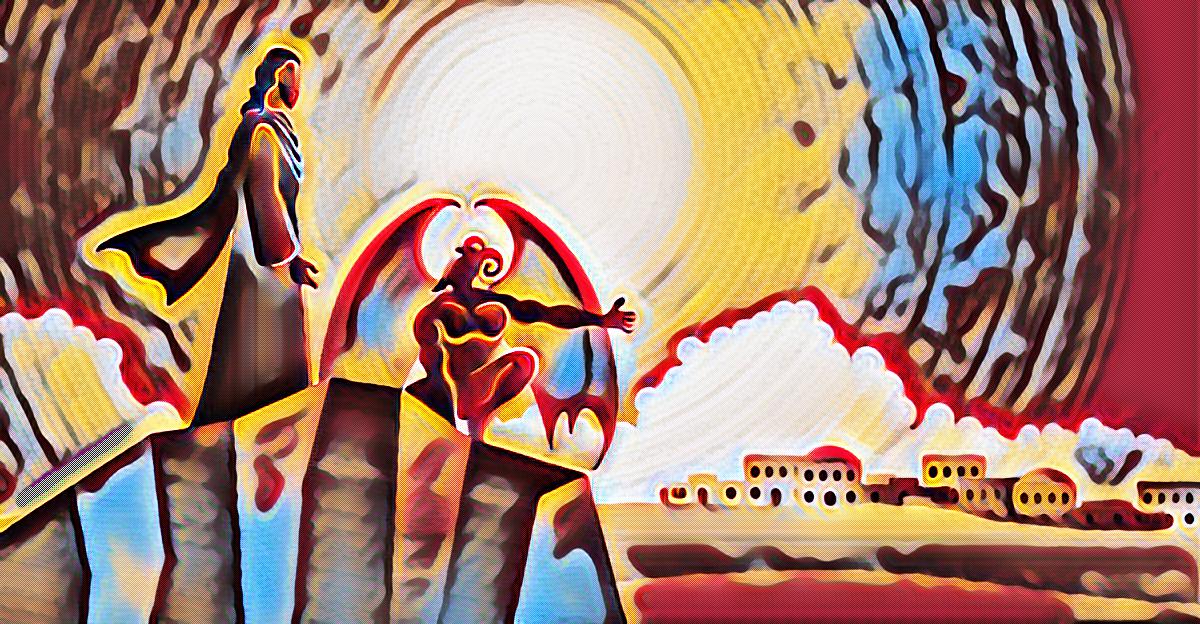
Filled with the holy Spirit, Jesus returned from the Jordan and was led by the Spirit into the desert for forty days, to be tempted by the devil. He ate nothing during those days, and when they were over he was hungry. The devil said to him, “If you are the Son of God, command this stone to become bread.” Jesus answered him, “It is written, ‘One does not live by bread alone.’” Then he took him up and showed him all the kingdoms of the world in a single instant. The devil said to him, “I shall give to you all this power and their glory; for it has been handed over to me, and I may give it to whomever I wish. All this will be yours, if you worship me.” Jesus said to him in reply, “It is written: ‘You shall worship the Lord, your God, and him alone shall you serve.’” Then he led him to Jerusalem, made him stand on the parapet of the temple, and said to him, “If you are the Son of God, throw yourself down from here, for it is written: ‘He will command his angels concerning you, to guard you,’ and: ‘With their hands they will support you, lest you dash your foot against a stone.’” Jesus said to him in reply, “It also says, ‘You shall not put the Lord, your God, to the test.’” When the devil had finished every temptation, he departed from him for a time. (Luke 4:1-13)
There are some critics so desperate to humanize Christ that they will deny the definition of Chalcedon about Jesus as a divine Person with both a human and divine nature. They contend that in his humanity our Lord could sin. Nuts! Let’s be blunt— if Jesus could sin then he is not God. If Jesus is not God, then he cannot save us, and we are still in our sins.
At work here is nonsensical reasoning. It is like the false logic behind the old question, “Given that God is all powerful, can he make a rock too heavy for him to pick up?” There is an inner contradiction. If God can fashion such a rock, then he is not omnipotent in failing to lift it. If God cannot make this rock, then again, he cannot be all-powerful either. But it is a silly and flawed syllogism. Similarly, critics will argue, “If Jesus were truly tempted by the devil, then he must be liable to falling into temptation and sinning. But they are wrong. While one might be tempted by hunger and thirst, power, or worldly acceptance and glory; we do not necessarily have to succumb to such allurements. Indeed, for Jesus while the temptations are real, he is incapable of sin. How is this? Sin is a violation against God. There is no way that God can wrong himself. The humanity of Jesus can never be severed through sin from his divinity. Such would be a twisted version of the heresy of Nestorianism. There can be no fracturing of the holy Trinity. There is one deity, not two or three. God is perfect holiness. There is no defect in God that would permit a wrongful act. He is all good and there is no space in him for evil. He is the LIGHT that cannot be dimmed by the darkness.
Hebrews 4:15 leaves no room for doubt. “For we do not have a high priest who is unable to sympathize with our weaknesses, but one who has similarly been tested in every way, yet without sin.” The moral test was real, but the test was fixed. The new Adam was not liable to fall as was the old Adam.
While not God, the angels of heaven can no longer sin either as they share the beatific vision. This is another reason why sin for Jesus is impossible. We must accept that while our Lord entered the human family, he is not entirely like us. After the incarnation of the eternal Word, his hypostatic union ensures the unity of his two natures. Jesus has a complete human nature (body and soul) and a divine nature. But he is not a human person but the divine Second Person of the Blessed Trinity. Our Lord’s human soul, including its mind and will, were sanctified by the divine presence and heavenly vision. The beatific vision means that he both saw the Father and also all those joined with him in his mystical body. That is why he conquers our sin on the Cross and does not falter as we often do. He lovingly sacrifices himself, intimately knowing by name all those for whom he surrenders his mortal life.
This is the home of the AWALT PAPERS, the posting of various pieces of wisdom salvaged from the writings, teachings and sermons of the late Msgr. William J. Awalt.


























 Blogger Priest