• Our Blogger

    Fr. Joseph Jenkins

  • The blog header depicts an important and yet mis-understood New Testament scene, Jesus flogging the money-changers out of the temple. I selected it because the faith that gives us consolation can also make us very uncomfortable. Both Divine Mercy and Divine Justice meet in Jesus. Priests are ministers of reconciliation, but never at the cost of truth. In or out of season, we must be courageous in preaching and living out the Gospel of Life. The title of my blog is a play on words, not Flogger Priest but Blogger Priest.

  • Archives

  • Categories

  • Recent Posts

  • Recent Comments

    Barbara King's avatarBarbara King on Ask a Priest
    Ben Kirk's avatarBen Kirk on Ask a Priest
    Jeremy Kok's avatarJeremy Kok on Ask a Priest
    Barbara's avatarBarbara on Ask a Priest
    forsamuraimarket's avatarforsamuraimarket on Ask a Priest

The Ranks of Angels

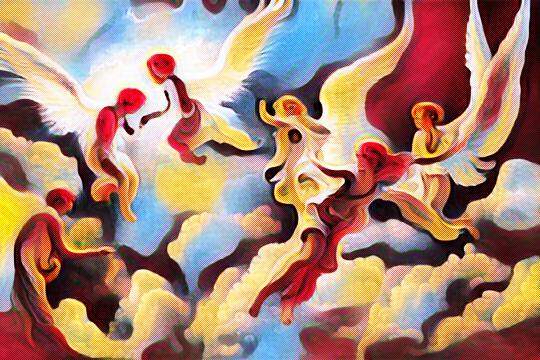
The fact that there are ranks of angels is a truth that I would concede. However, I must honestly admit that all efforts to denote them strike me as contrived and speculative. Focusing on the Scriptures, the Jews tend to speak of ten ranks while Catholics detail nine broken down into sets of three. The source for Christians is Pseudo-Dionysius the Areopagite from the fifth or sixth century and his work entitled, On the Celestial Hierarchy. It is all remarkably interesting but is it credible?

  • Highest Rank – Seraphim (Is. 6:2), Cherubim (Ez. 10:15,20), Thrones (Col. 1:16)
  • Middle Rank – Dominions, Virtues, Powers (all mentioned in Eph. 1:21)
  • Lowest Rank – Principalities (Eph. 1:21), Archangels (Jude 1:9), Angels (throughout Bible)

How are they distinguished? The highest or first rank of angels focus immediately upon the godhead. They bask in the presence of God. They praise him as holy Wisdom. They clearly acknowledge God as the Judge of all. Those of the middle or second rank possess governing authority over the universe and have power over natural creation. The lowest or third rank is where we find the guardians or messengers of God. These are the angels we most invoke for intercessory prayer.

What are my thoughts about this? The substantial form in human beings is the immortal soul. It is what separates us from animals. If the soul leaves the body, it survives as a ghost. The body, however, would become a corpse. It cannot live without the soul. The soul is the principle of life. By contrast, an angel is pure form without matter. That is why angels cannot die. An angel is a spiritual creature that can know, will and act. The primary activity of an angel is to see, know, and love God as the greatest good. Beginning with its creation, every angel is its own form or species. There is no matter to be determined (formed) as in the race of men. While matter is our principle for individuation, such is not the case for angelic beings. Given the lack of informed matter, there can be no membership in any angelic species. Every angel has its own unique form. While they share a common spiritual essence, each angel is a species of one. I have heard it argued that there is a radical self-determination by the angel’s act of will at creation. The angels of God would sort themselves by their species and office. While all adore, some are drawn to proclamation or governance or revelation or blessing or whatever. This is apart from the orientation that separates the good from the bad angels.

The rebellion among the angelic hosts constitutes the most important distinction between the good and the bad angels. There must have been some kind of veil at the beginning so that there might be freedom regarding the acceptance (or rejection) of God as the greatest good. Otherwise, the compelling attraction of the greatest good would strip away any choice.

Great and small, not all angels are the same. Cherubim are imaged as with four wings and many eyes or faces. They are understood as all seeing. Isaiah 6:1-3 describes those of the highest rank— the Seraphim. They are as sentinels before the throne of God. “Seraphim were stationed above; each of them had six wings: with two they covered their faces, with two they covered their feet, and with two they hovered. One cried out to the other: ‘Holy, holy, holy is the LORD of hosts! All the earth is filled with his glory!’” Imaged with six wings, the Seraphim are associated with fiery purification. St. John of the Cross writes that the seraphim covering its face with its wings symbolize “the darkness of the intellect in God’s presence.” He continues that the covering of the feet symbolizes “the blinding and quenching of the affections of the will because of God.” It thus constitutes humility of the creature before the Creator. “With the two remaining wings they flew, indicating both the flight of hope toward things that are not possessed and the elevation above all earthly or heavenly possessions that are not God” (The Ascent of Mount Carmel, II, 6.5).

As a closing aside, various authorities regard Lucifer or Satan as either a Seraphim or Cherubim (Ezekiel 28:11–17). Such a lofty standing among the angelic hierarchy, would denote two things: (1) he would possess tremendous angelic powers (even without grace) and (2) his was a most terrible fall and loss. Satan brings upon himself an alienation from God that portends to a frustration of his very purpose. What are we to make of a corrupted creature called to resound the thrice Holy name of God? Instead of a hymn or prayer, is he a living curse? Akin to Dante’s frozen Satan, is he eternally silent— locked in a moment of hesitation— unable to adore the one who is Holy, Holy, Holy?

The Truth about Angels

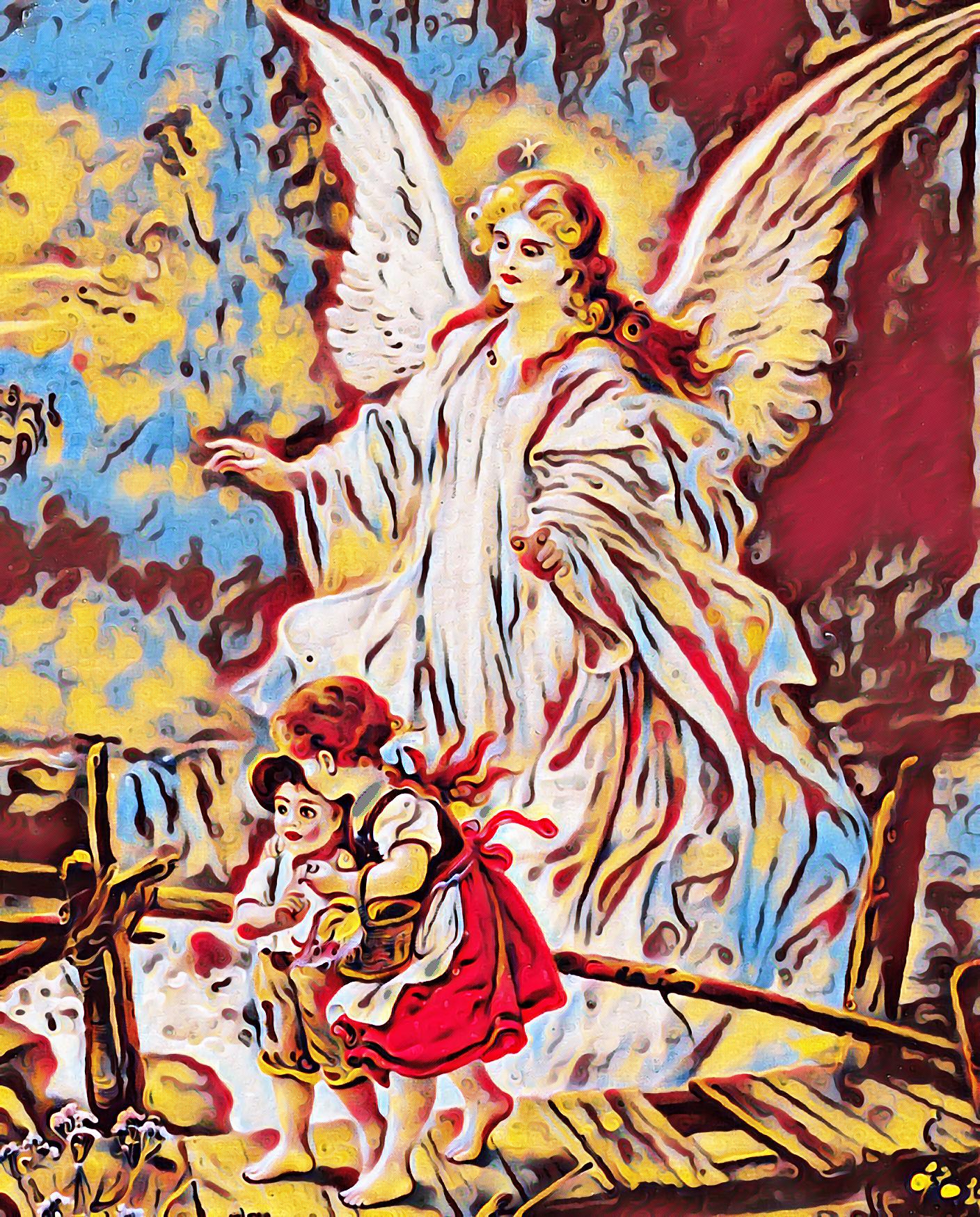
There are so many misconceptions about angels. Many imagine they are simply human souls that have been rewarded with wings in the afterlife.  This is not the case.  Many have their religious formation from Hollywood and not from the source that is truly holy. Angels like us are “persons” with will and intellect.  They are both good and bad. However, other than that, they are utterly alien to humanity.  They are purely spiritual entities without bodies and thus they do not reproduce, do not age and cannot die. We often fantasize about them with flowing robes, wings, and halos. But in truth they look like nothing at all. If God should allow them, they can appear before men, but only as phantasms or caricatures of human beings.  Beneath the appearances, they are something utterly beyond our comprehension. The good angels obey and will never tarry to answer God’s summons.  They adore the Lord as a host or angelic choir.  They love God and they love us.  While they are not human, they are counted among the saints of heaven.  They intercede and pray for us. The bad angels turned from God. Unlike mortal men this rebellion has permanently misaligned their orientation. The West, unlike certain Eastern churches, does not believe that angels can repent and return to God’s good favor.  Demons will always be demons.  They may know an intellectual life with the other damned of hell, but they have forever forfeited grace. Where there should be love there is hatred or indifference.  At death the souls of the departed are also fixed, either orientated toward God or away from him.  It is said that as many as a third of the angels rebelled against God.  Many of the ancient Church fathers thought that their fall was due to a repudiation of the providential incarnation. Unlike the angels of the nativity, they had refused to bend the knee to the Christ Child.  The good angels always adore the Lord and praise the godhead as Holy, Holy, Holy. 

As spiritual and not material beings, the angels know duration but not time as we do.  They have no gender. They do not have our five physical senses. They do possess angelic powers.  However, as “persons” they are aware, can know and love and choose. All the angels that would ever exist were created in the same moment.  This is contrasted to human beings who are created throughout time.  However, at the end of the world, our numbers will also be fixed.             

The word “angel” means messenger and they are periodically sent by God in the history of salvation. Note what is said in the universal catechism.

CCC 332Angels have been present since creation and throughout the history of salvation, announcing this salvation from afar or near and serving the accomplishment of the divine plan: they closed the earthly paradise; protected Lot; saved Hagar and her child; stayed Abraham’s hand; communicated the law by their ministry; led the People of God; announced births and callings; and assisted the prophets, just to cite a few examples. Finally, the angel Gabriel announced the birth of the Precursor and that of Jesus himself.

CCC 333From the Incarnation to the Ascension, the life of the Word incarnate is surrounded by the adoration and service of angels. When God “brings the firstborn into the world, he says: ‘Let all God’s angels worship him.’” Their song of praise at the birth of Christ has not ceased resounding in the Church’s praise: “Glory to God in the highest!” They protect Jesus in his infancy, serve him in the desert, strengthen him in his agony in the garden, when he could have been saved by them from the hands of his enemies as Israel had been. Again, it is the angels who “evangelize” by proclaiming the Good News of Christ’s Incarnation and Resurrection. They will be present at Christ’s return, which they will announce, to serve at his judgment.

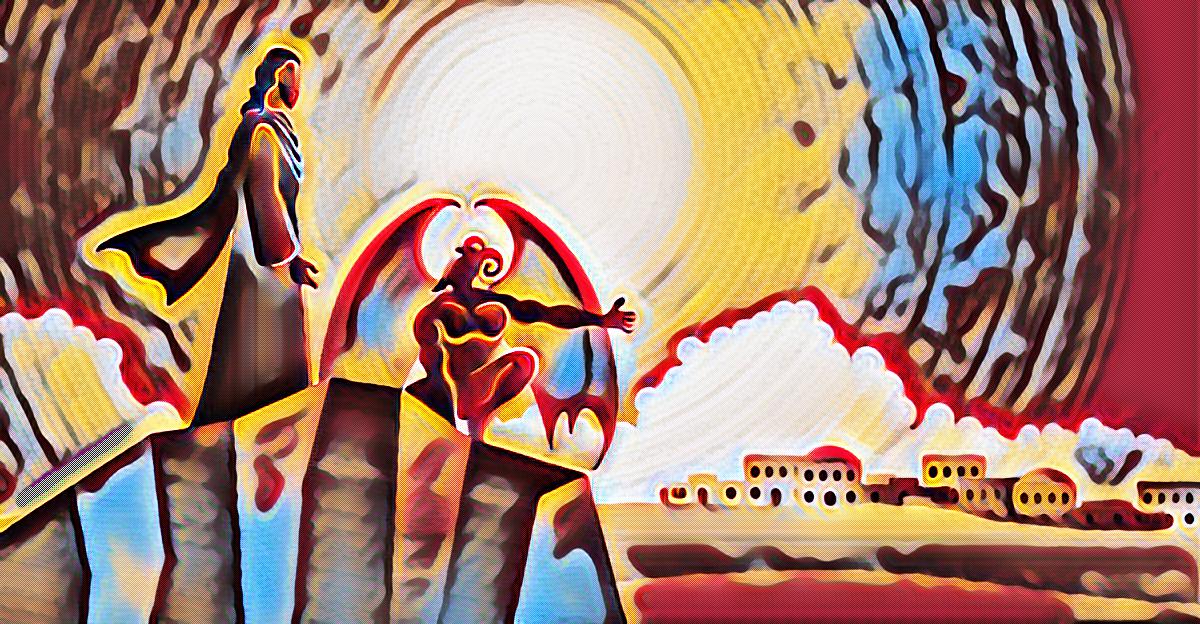
Given the identity of Jesus as God’s only Son and the Second Person of the Blessed Trinity, the angels are preoccupied with Christ— announcing his birth with the hymn of heaven, ministering to him after his temptation scene with the devil, and giving him consolation in Gethsemane before the ordeal of his betrayal and passion. Angels are also heralded to accompany the risen Christ on the day of judgment.  They are imaged as harvesters of souls.  Similarly, we are informed that angels can minister to us (Hebrews 1:14) and function as special guardians (Matthew 18:10).  The Roman Canon of the Mass even speaks of an angel that takes the oblation of the Eucharist to the heavenly Father. 

While angels belong to the supernatural realm, they are limited by their nature to angelic power and to whatever divine grace allows for them.  Just as we can make things, only God can create from nothing.  Similarly, neither angels nor demons (fallen angels) can truly create, as this requires infinite power. New Age religion erroneously corrupts this understanding by having its adherents praying to angels as if they were deities.  Such an angelology is an utterly offensive idolatry as it seeks through superstition to usurp divine sovereignty.

The Wonderful Absurdity of the New Eve

Granting that the role of Mary is a manifestation of truth, it still stands out to many as a theological absurdity.  Her place in the history of salvation becomes a point of contention in the early Church.  She plays a singular part in cooperating with the redemptive work of her Son.  And yet, we affirm that Jesus is the one Redeemer— the Way, the Truth, and the Life.  There is no other WAY to the Father except through him. Concurrently, Mary is acclaimed as the Theotokos (Bearer of God) or Mother of God. Indeed, given that Jesus is a divine Person (God), the genuine adversary of Satan (an angelic creature) is the Virgin Mary (a human person and creature of flesh and spirit). It astounds us that almighty God would make himself dependent and entrust himself to a creature.  How can the first principle for all things proceed from that which is secondary?

Something of this mystery is spoken about in the primordial garden.  Satan as the serpent tempts the first Eve with fruit from the forbidden tree, saying, “God knows well that when you eat of it your eyes will be opened and you will be like gods, who know good and evil.” The irony here is that there is a twisted truth hidden behind the deception.  Our first parents would know good and evil because they would literally “know sin” and stand before God as guilty of a disobedience that would bring disharmony to all creation. Whenever humanity usurps the sovereignty of the deity, the very first of the commandments is violated— it is the highest in the hierarchy of sins. But how does this speak to the person and role of Christ’s Mother?  The words of the serpent are fully realized in a manner that mocks the devil.  While Adam and Eve will not themselves be “as gods,” over the expanse of time a Savior would be born to humanity, a new Adam who literally is the incarnate Second Person of the Blessed Trinity.  Jesus as a son of Adam is also the eternal Son of God. Christ comes to restore what was lost.  While Eve is the vehicle for Adam’s transgression by giving him the forbidden fruit to eat; Mary is the handmaid of the Lord who gives us all the saving “fruit” of her womb, Jesus. The devil despises the woman as she is beneath him in the hierarchy of being. He is a pure spirit, albeit fallen, while the sons and daughters of Adam and Eve are akin to animals, sacks of skin filled with blood.  Of course, Mary has that which the devil has forever forfeited, sanctifying grace.  Those who are children of God in faith and baptism, and thus sons and daughters to Mary, also share this divine favor that allows us to be spiritually born again.  Satan hates the Blessed Mother and all who take refuge under her mantle.   

Her YES to God at the annunciation is made not just for herself but for all humanity.  She has been preserved from sin so that she might serve as the immaculate vehicle or conduit through which God would enter the world of men. The sacramental value of the cross reaches backward into human history and touches her at the first moment of her existence in the womb of St. Ann. Unlike the first Eve, she will treasure her righteous standing before God, remaining sinless and now interceding for us as the Queen of Heaven.

Although only a blessed creature and not divine, she is called upon as “Mother” throughout the world and the many passing centuries.  She is the first disciple of her Son. She is at the creche, at the Cross and in the Upper Room.  She holds out her newborn child at Bethlehem and extends her arms again to receive him on Calvary. The Mother of the Redeemer becomes the Mother of all the redeemed.         

Awaiting the Messiah, any woman could have been the vehicle through which the ancient promise would be fulfilled. Despite the lies of our times, this signifies that gender does matter and is never irrelevant.  There is a profound miracle to the feminine potency for motherhood. It is a hallmark of God’s plan that clashes with human capriciousness and fanciful denial. A similar discordance arises between a secular world and the meaning of Mary’s Son as the incarnate Christ. We view something of the Christ Child in the countenance of every child.  Any child could have been the Christ Child. That is why the Good News will always be a Gospel of Life. Mary becomes a guidepost, not only to Christ, but to the dignity of motherhood and the person. If the first Eve ushers forth death, Mary as the new Eve is the cradle of life. Of course, this is through her cooperation with her Son.  “For just as in Adam all die, so too in Christ shall all be brought to life . . .” (1 Corinthians 15:22). The apostle repeats this message in Romans 5:19: “For just as through the disobedience of one person the many were made sinners, so through the obedience of one the many will be made righteous.”

After condemning the serpent to crawl on its belly, the divine judgment against the devil plays a part in our understanding of Mary as “the woman” or new Eve: “I will put enmity between you and the woman, and between your offspring and hers; They will strike at your head, while you strike at their heel” (Genesis 3;15). That last line is sometimes translated as “her heal” making the connection with Mary even more striking.  While we often posit the image of Mary as meek and humble, as the new Eve she is not only a sovereign of the kingdom but a warrior queen. The first Eve rebels within the safe and peaceful confines of the garden; Mary’s fidelity comes to realization on the battlefield of a dangerous world. The first woman forfeited grace while the immaculate Virgin Mary is hailed as full of grace. The first Eve fostered division between God and man as well as within the human family. The new Eve would know an intimate unity with the Lord which she would share with all her children.        

Dealing with the Mystery of Death

There is something about our nature that instinctively resists death and finds the notion repugnant.  Many are fearful of death. Others forestall it through positive eating and drinking habits, exercise and medical intervention. Despite all the talk about quality of life and growing advocacy for euthanasia, we all know of heroic souls who cling at great physical and mental cost to every breath and heartbeat remaining to them. Indeed, although finding ourselves in a culture of death that excuses the termination of millions of unborn children, we are self-seeking and defiant in defending our own lives.  Celebrities are infamous for plastic surgeries, hair dyes, and body augmentation— all to at least feign youthfulness and vigor.  We appreciate all-to-well that we are on a trajectory with the Grim Reaper. Aging, ailment, and accident are the “Three A’s” about which we are wary.  Advancing years bring us ever closer to our time of departure from this world.  However, if a passage of the years offers a period of preparation for the inevitable; disease and accident are a lot less forgiving. Disease is the handmaid to aging.  Accident is the worst as even the most robust and healthy can be quickly taken out— here one moment and suddenly gone the next.  Modern people are very uncomfortable with death. Notice that we dress up and paint the dead in caskets as if they were alive.  The preference for cremation removes the body entirely from the funeral scenario.  The so-called ashes are a token of a life, remembered in photos, but increasingly even without a formal grave. Traditional Christian sensibilities insist upon a grave or place of internment for ashes— why? It is because we are a people of faith who employ sacraments and sacramentals. When we remember those who have passed, it is always with the accompanying hope that the beloved dead are alive in the Lord. The “sacramental” gives us something visible or tangible to grasp for that, which is in truth, unseen and beyond our senses.  It is no denial of reality or an escape into the fanciful. But we prefer to believe that we exist for a reason and that we do not live and die in vain. Those who deny the existence of God and life after death can only find comfort in a nostalgic remembrance.  It is sad because the person recalled is no more.  When the few remaining who know the deceased should die or suffer from Alzheimer’s, then the remnants of the dead become no more than tattered photographs of ghosts without names or stories.  The Gospel looks to Jesus and how he transforms the mystery of death. Indeed, at Mass we remember Christ in an “anamnesis” that makes present the one remembered. We are to similarly ponder the dead but remembering them as alive and as still loving and praying for us. The gravity moves from “us remembering” to the fact that “God remembers” and never forgets us.         

We often weep when friends and families die.  We are touched by death while still living in this world because the deceased remain a part of us.  Our stories are interwoven and there are ties that remain unbroken, even by death. Often, we hear mourners cry things like, “Why O Lord, why did he have to die? Lord, could you not have taken me, instead? How could you have let this happen?” The question, “Why do human beings die?” is an important one.  We want to live. We might not want to be vampires, but the prospect of eternal life is appealing. Those who study history often wish they could have lived in the past. Those who delight in science fiction want to see the future.  Many in their preoccupation with collecting things and advancing their wealth live as if they will be around forever. But such is a lie.

Then he told them a parable. “There was a rich man whose land produced a bountiful harvest. He asked himself, ‘What shall I do, for I do not have space to store my harvest?’ And he said, ‘This is what I shall do: I shall tear down my barns and build larger ones. There I shall store all my grain and other goods and I shall say to myself, “Now as for you, you have so many good things stored up for many years, rest, eat, drink, be merry!”’ But God said to him, ‘You fool, this night your life will be demanded of you; and the things you have prepared, to whom will they belong?’ Thus will it be for the one who stores up treasure for himself but is not rich in what matters to God.” (Luke 12:16-21)

As in the parable, when death comes, to whom will their piled-up bounty go?

Despite the harsh reality of death as the great equalizer, coming to the rich and poor alike, we have an intuition that dying has been interjected into the human equation.  It is not the way things are supposed to be. The serpent in Genesis 2:17 urges disobedience to God, discounting the consequence of death for forbidden knowledge.  This so-called knowledge is “to know sin” and such changes the agent, clipping the relationship with God and a vital connection with the one who is the source of life. Why do all men die? The answer is simple and terrible— despite our abhorrence of death, we have chosen it. Not long after the fall, one brother would kill another. Rebellion against God brings about death, indeed, more than this, it invites murder.  The sin of Adam and Even was the signing of warrants against them. A bounty was placed upon their heads and those of their children.  We are all murderers. This truth is fully realized in the passion and death of Christ. We all have blood on our hands. And yet, the bounty is paid not by our deaths but by the sacrifice of our Lord.

Sin and death enter the world through Adam. The new Adam or Christ brings forth grace and life.

For since death came through a human being, the resurrection of the dead came also through a human being. For just as in Adam all die, so too in Christ shall all be brought to life . . . (1 Corinthians 15: 21-22).

What We Have Lost

Death enters the world due to sin. Regardless of whether there was spontaneous creation or development of species as through evolution, the Church teaches that death enters the world because of sin. Had Adam and Eve remained faithful, our first parents would either have never known death or it would have been as merely opening a door and walking from one room to another.  Human rebellion would cost us preternatural gifts and usher forth suffering, sickness and dying.  It is a crucial hallmark of Christian anthropology, that these dark mysteries are not the result of the divine active will, but rather of his passive will— God makes space for the misuse of human freedom.  While he does not preserve us from the consequences of sin, he does not forget us and makes a promise of redemption. 

After the fall, our first parents hide themselves in shame of their nakedness.  They forfeit their profound union with God.  An awareness that raised them ahead of all other creatures of material creation was accompanied by a duty or responsibility to honor the Almighty.  However, their love and fidelity fall short. Eve falls to the serpent and Adam is emasculated in complying with the demand of Eve.  They would remain stewards of creation but as deeply flawed sentinels in a now broken world. The sin of our first parents brings about a woundedness to all creation. The bridge collapses between heaven and earth. It would only be in Christ our “pontifex” that the bridge would be restored, albeit in the form of a cross.  While hope remains, our pilgrimage would henceforth include struggle and suffering. The actions of Adam and Eve do not mean merely death to a few but death to many. As in any mortal sin, they are stripped of sanctifying grace.  This is still how we enter the world and why faith and baptism are so essential. Another lesson learned is that just as the cost of original sin is passed down to every child of humanity save Mary; all sin, even the most personal and hidden, touches others because we then cannot witness as the saints we should be. Indeed, one of the imperatives for the sacrament of penance is that we might be healed as members of the mystical body, the Church.  The sin of any one of us is a cause of diminishment for all.  We are called not simply as individuals but as a new People of God or New Israel.    

Compounding the gravity of Adam and Eve’s rebellion is that within their intense intimacy with God comes a heightened awareness of intellect, sometimes referred to as infused science. Not only have we lost this supernatural gift, but today many seem to possess only a vague appreciation of human nature and our true place in the world. Consciences are numbed to the truth about the sanctity of human life and the dignity of persons— divine light is displaced by a satanic darkness. Every school kid is aware of this loss because learning often does not come quickly and requires constant study and repetition to store information in memory.  What should be easy becomes difficult or arduous.

Original sin also strips away our sense of integrity, making us capricious and prone to the urging of concupiscence.  It is hard to do the good and easy to do the bad. The symphony of harmony in us and in creation is disrupted. The fruitful blessings of the garden would be traded for the struggle of the arid wastes— men would toil for their food and women would know the pains of childbirth.