























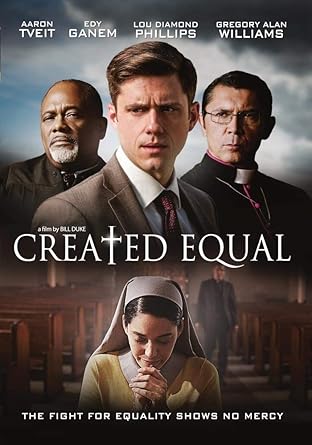
The film seems oblivious to the fact that the conflict is one-and-the-same as that of the Roman empire against the early Church. It is the question as to whether we follow Caesar or the Lord. The courts and the world of politics have no jurisdiction over the faith of the Church. That is where the story should have ended. However, the premise of the film is that the Catholic Church might be compelled to open the priesthood to women by intimidation of the civil legal system. This is not the case. Whatever the state might decide, the Church would refuse to comply, even if it meant persecution and martyrdom. One is reminded of the Church of England that sought to manipulate the Church when a king demanded a divorce. But the Church was willing to allow an entire country to evade its grasp to preserve the meaning of marital fidelity. Like holy orders, marriage is a sacrament of the Church. The Church has the right to administer her sacraments as she feels fit. The jury in the film judges a male-only priesthood as discrimination; but this is not true because priesthood is not a job or an entitlement. Yes, as a vocation it is a calling, but just like the nature of our saving faith, it is both personal and corporate. Any calling from the candidate must be affirmed by the Church, notably the bishop and those placed in charge of formation. Priesthood is a gratuity and no one can demand that gift.
The film would intimate that our religious liberty comes entirely from the state, but our founding documents merely acknowledge that such freedom comes from God, himself. No judge and jury, particularly made up of non-Catholics and/or those unsympathetic to Catholicism have any say about the Church. Indeed, even the laity that constitute the “sensus fidelium” must live and share the tenets of our holy religion. Pope John Paul II definitively answered the question about women’s ordination, explaining that the Church has no power to change the practice of ordaining only males. Short of any new miraculous revelation, the Church is bound to keep the tradition. Responding to the challenge of stereotypes, the pagan world had many priestesses and yet the new dispensation of Christ that fulfilled the promises of Judaism maintained male leadership among the apostles. Our Lord was shown to break convention as when he spoke to the Samaritan woman at the well. She would become a prophetess to her people, but not a priest. The Blessed Virgin Mary was the holiest woman to ever walk the earth and yet while she takes a priestly stance at the foot of the Cross, she is entrusted to the apostle John who was a sharer in Christ’s ministerial priesthood. While all of us participate in a baptismal priesthood (given that sacrifice defines our faith and charity), the ordained priesthood is reserved to men, and not all men, but a select few. If the state were to assume authority over our ministers, then it could just as likely demand married and divorced men and women or even overt homosexuals. But our sacraments are not subject to the fads of changing times or the capricious desires of men and women. Indeed, even if we should want to ordain women, we cannot do so.
The reasoning of the Church is clear and sound. While the Church can mitigate disciplines like celibacy in specific cases, the matter of gender is no accidental that can be brushed aside. The theology of the body focuses upon gender as being constitutive of our deepest identity and personhood. Just as only a man can be a father and only a woman can be a mother, only a man can be a priest. If we should attempt to ordain females and it should prove against the will of Christ, then we would forfeit both the sacrament of holy orders and the Mass. There would be no more Eucharistic real presence of the risen Christ. There would be no more unbloody re-presentation of the sacrifice of Calvary. The oblation and banquet that renews our covenant with Christ would disappear with the loss of apostolic succession.
A male-only priesthood is no injustice and not chauvinism. The house of the Church is that of a family with a given structure. Would you allow strangers to come into your house and tell you how to run your home? Children obey parents, not the other way around. The objective of this film would introduce dysfunction into the home of faith, the Church. Where there was a faint promise of teaching on this subject, the film gives a simplistic and one-sided view. Even the churchmen are so terribly caricatured that they are hard for knowing believers to watch. The nun in the movie might believe but she is also a rebellious daughter. Her journey will likely take her into Anglicanism where they have priestesses that go through the motions but a faith that compromises to secular modernity at every turn.
Filed under: Uncategorized | Tagged: apostolic-succession, Bible, christianity, Faith, God, holy-orders, Jesus, Priestesses, priesthood, Religious Liberty, Women Priests | Leave a comment »




















 Blogger Priest