• Our Blogger

    Fr. Joseph Jenkins

  • The blog header depicts an important and yet mis-understood New Testament scene, Jesus flogging the money-changers out of the temple. I selected it because the faith that gives us consolation can also make us very uncomfortable. Both Divine Mercy and Divine Justice meet in Jesus. Priests are ministers of reconciliation, but never at the cost of truth. In or out of season, we must be courageous in preaching and living out the Gospel of Life. The title of my blog is a play on words, not Flogger Priest but Blogger Priest.

  • Archives

  • Categories

  • Recent Posts

  • Recent Comments

    Barbara King's avatarBarbara King on Ask a Priest
    Ben Kirk's avatarBen Kirk on Ask a Priest
    Jeremy Kok's avatarJeremy Kok on Ask a Priest
    Barbara's avatarBarbara on Ask a Priest
    forsamuraimarket's avatarforsamuraimarket on Ask a Priest

Argument Over Jesus & Intercession

Georgios argues:

The primary role and purpose of the devil is to take the believer’s attention as far away as possible from the truth and the blue-prints or foundations of Christians, which is the Bible.

He would have us compromise them with unbiblical diatribes so that the believer loses focus upon JESUS.

He would have the Christian weakened by diminution from 100% fidelity to the doctrine of JESUS.

JESUS is the Way and the Truth and the Life— the only way toward the Father-God.

JESUS taught with parables and he is our answer to all intentions in the spiritual process.

The parable of the sinful rich man and poor Lazarus is sufficient to verify that the saints who died are in a place where intercession for people on earth is impossible! What this means is that only the living saints have the right to do so.

God does not give exemptions to the prohibition of acting outside his Word, which is JESUS.

If Mary can intercede for us, then God is lacks constancy with his Word and that is something that God will not do. He will not oppose his Word. If God made such exceptions then he would not be God at all.

Receive this revelation of the Spirit of God— what he is saying to you Now in the mighty NAME OF JESUS!

Father Joe responds:

The devil’s primary aim is one of eternal spite. He would have us corrupted so as to offend God. He would have us embrace selfishness and a disordered love.

The devil knows well the Bible. The trouble is that what he knows, he utterly rejects. While the devil is certainly involved with error, this in itself is not his primary purpose. Good men and women might be confused or ignorant about many matters of faith. They may yet be saved. The devil places an emphasis upon the will. HE especially delights in one who comes close to the truth and then rejects it. The more you know the more that you will be held accountable.

Much of the confusion and fracturing of the Church after the Reformation has to do with men and a rejection of the shepherds appointed by Christ. You seem to infer that the Bible is self-sustaining and interpreting. This is simply not the case— historically or theologically. I suspect that the “diatribes” you condemn are efforts within the Church to prayerfully reflect upon the saving kerygma.

If you have rejected the sacraments and the teachings of the Catholic faith then you have quite literally separated yourself from elements of the revelation received from Jesus Christ. The Church follows the Lord and his two sources for Christian revelation: Sacred Scripture and Sacred Tradition. Only the reformation churches, and not all of them, would utterly reject the second tier established by Christ.

Jesus is also one with the Mystical Body or the Church. That is why the early Church spoke about Christ and our life in the Church as the WAY.

Jesus taught in many ways. Yes, his parables give us insight into the kingdom of God. But he also prophesied, made commands, and witnessed the message of the Gospel.

The parable of the rich man and Lazarus does indeed speak to life after death, although there is some question as to whether Lazarus was in heaven or the limbo of the fathers. Similarly, was the rich man in hell or in purgatory? The gates of heaven are only opened by Christ, and at the telling of this parable, Jesus had yet to undergo his saving trial. Further, the parable does not offer us an instance of attempted intercession as understood by the Church. He requests that Abraham send a message to the living or make an appearance to warn them. The intercession of the saints is directed, not to another saint, but to almighty God. We pray that they will add their prayers to ours in asking God for his mercy and favor.

Actually, the trouble here is you have a very narrow notion of how the Word operates. The Word is written upon human flesh in the incarnation. The Word is breathed into the Scriptures. The Word becomes one with his Holy Church. The Word is given perpetual efficacy through the sacraments. The Word takes to himself a human mother, sanctifies her and gives her to us as a model of the Church. The Word conquers death and all who are alive in Christ can pray for themselves and others, including the saints of heaven.

Who are you to tell God his business? Who are you to make yourself the interpreter for all Christianity, including attacking a Church that was instituted by Christ, gave us the Bible and is the Mother of all the breakaway Protestant denominations? Mary can do as she did at Cana… intercede when the wine runs out.

I would caution you again hubris. You are not God’s special messenger or prophet. You are just one poor confused soul putting on airs to others.

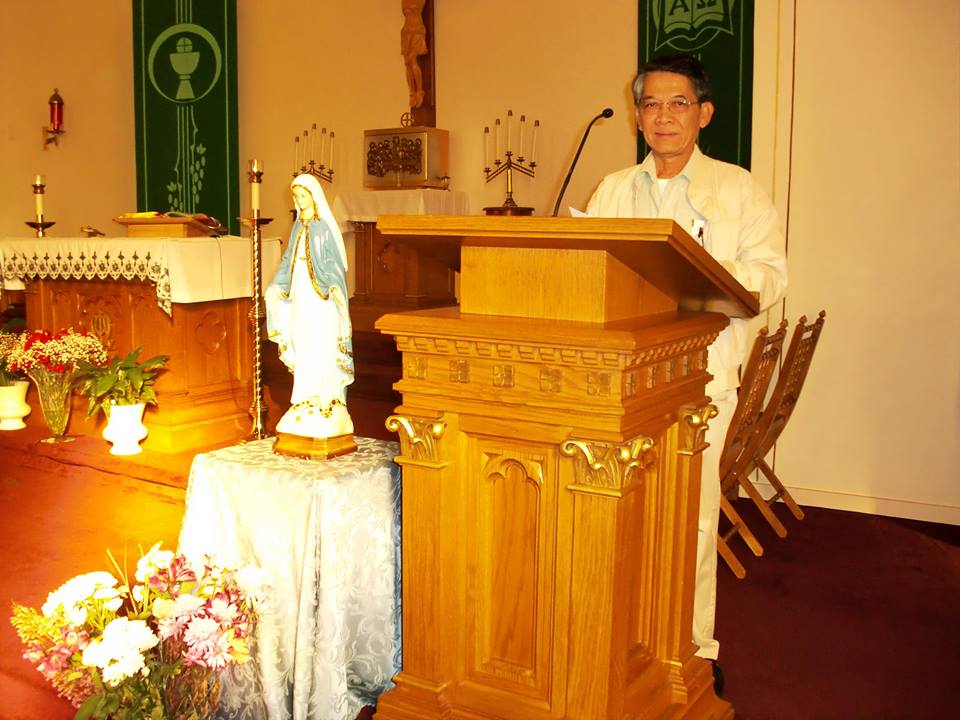
Rosary Decade for Peace After 9:30 AM Mass at Holy Family

1939510_10152459676648435_4373835780492390952_n

Perry Concepcion, FS for Father Kidd Council does the Scripture reading in our weekly Rosary decade for peace and especially for suffering Christians.

A Response to Grace on Faith, Jesus & Salvation

GRACE:

Allow me to make reference to the Old Testament and sin offering. A sinner would go to the Jewish priest with a lamb without blemish. He MUST lay his hand on the lamb. This signified a transferring of sin to the lamb and acquiring the lamb’s innocence. The lamb had to die. Sin must DIE. Under the New Covenant, Jesus is the Lamb of God. The Messiah is our offering. HOWEVER, one cannot physically lay hands on the lamb of God. This is how one lays hands on Jesus and acquires His righteousness: whoever BELIEVES/FAITH that He is the son of God becomes righteous. This is unmistakably the most fundamental building block of Christianity!

When a believer in faith bows down in prayer they have instant access to God, justified by Jesus. When I ask someone else to intercede, I have downplayed the biggest sacrifice; the very reason God became man. It was so that whoever believed should not perish. Otherwise, I have put my FAITH in something other than His dying for my sins. In effect, I have said that even though Christ did die for my sins and I am justified before God. It is still not good enough. So stop going to saint Mary! Worthless are cries of please intercede! JESUS said “I AM THE WAY THE TRUTH AND LIFE NO ONE COMES TO THE FATHER EXCEPT BY ME.” That truth was absolute. There is no negotiating it. When He said on the Cross “IT IS FINISHED,” He meant just that.

FATHER JOE:

You call into question the following:

1.  The manner in which Jesus offers a sacrifice of propitiation as the Lamb of God.

2.  The extension of the paschal mystery into the life of the Church and the sacraments.

3.  The participation in the one-time suffering and death of Jesus.

4.  The definition of saving faith as combined with obedience (works) and accessed first through baptism.

5.  The inner unity of Jesus as a divine Person but made fully human.

6.  The significance of the Church, communion of the saints and intercessory prayer.

What you initially discuss is an appreciation of substitution. The blood of the lamb is sacrificed so that the believer might be spared, as with the Jews when the first born of Egypt suffered the angel of death.

You assert that with Jesus as “the Lamb of God,” no one could physically lay hands upon him. This is false and calls into question the graphic truth of the incarnation. It is a variation upon the heresy of the Nestorians.  The Second Person of the Trinity takes to himself human flesh, he becomes Man. Thus he is able to lay down his life, enduring the indignity of the scourging and crucifixion. Jesus really did die on the Cross. The Mass is an unbloody but real re-presentation of this saving mystery. We are born again by water and the spirit. As God’s people, we come back again and again to the Lord so that our sins might be washed away and that we might be filled with grace. There is a spiritual operation here connected to Calvary, the last Supper and the sacraments.

Faith and baptism allows us to be engaged by the Paschal Mystery of Christ, his suffering, dying, rising and ascension. Our belief or faith is equivalent to obedience. God’s response is the gift of salvation for the redeemed. Christ is obedient to the Father even unto the Cross. He calls us to imitate his fidelity by taking up our crosses and following him.

Intercession to saints or to the Church is an acknowledgement that ours is both a personal and a corporate Lord and Savior. We gather to pray as the Church and our Lord tells us that he is present. There is no competition or downplaying the oblation of the Cross. Far from it, our unity with each other is expressive of the reality of the Church that Jesus instituted. You deny this truth from God’s Word and embrace a Baptist tradition that denies the ongoing nature of faith, obedience and the need for communion with the Church. You short-change revelation and deprive yourself of the full benefits of Christ oblation. You say you are justified before the Lord and yet this too may be a sinful presumption. You cannot save yourself. Only God can save you. Many will cry, “Lord, Lord,” and Jesus will respond, “I tell you, I do not know you.” The Church is the Body of Christ. If you attack the Church, you assault Jesus.

Mary intercedes, but by always beseeching us to follow her Son. She beckons that we might know and love him. All prayer, even intercessory, finds God as its proper object. The saints pray with and for us. We are not alone.

The saving work of Jesus is accomplished in that Jesus will never suffer and die again. But the saving power and effects of his work are still being realized in the lives of believers. It is in this sense that it will not be finished or over until the consummation of the world to Christ. The story of salvation is still being told in our lives.

5. Charged with Consorting with Demons

The Fifth Scurrilous Mystery

Again and again, Jesus is accused of performing his miracles through demonic agencies. It is never explained why the devil would want to give sight to the blind or make the cripple able to walk. The Pharisees commit blasphemy against the Holy Spirit by charging that Jesus drove out demons by the power of the prince of demons. It makes no sense. Jesus takes the opportunity to explain why it is important to be in unity with him. Our Lord would also give us a genuine warming about how the devil loves a vacuum. It is not enough to be cleansed or liberated. The space within us must be filled with God’s presence and grace. If God fills us then there is no corner where the devil can hide. The Pharisees would insist they are clean; however, their lack of charity and refusal to see the goodness in Christ and his works would demonstrate that the demonic had invaded their house. If demons are genuinely exorcised, no matter if it is by Jesus or other Jewish exorcists, the real agency is always Almighty God. There are false prophets, even today, who condemn Marian piety and the sacraments as the devil’s work. The devil always exploits spiritual blindness, hypocrisy and malice. These three vices parallel their antidote: genuine truth, sincere fidelity and charity.

4. Commending the Unclean Woman Who Touched Him

The Fourth Scurrilous Mystery

Ritually unclean because of her bleeding, a woman touches the tassel of his cloak for a healing. She is desperate in that the doctors could not cure her, even after they took all her money. Given that she has suffered so for twelve years, it was a crime under Jewish law for her to approach the Lord. It represented a type of spiritual pollution. When Jesus asked who touched him, she was prepared for public condemnation. Women have been put to death for similar offenses. The crowd was pressing upon Jesus but he knew that power had gone out from him. She falls to his feet trembling. She witnesses to her healing and Jesus says to her, “Daughter, your faith has saved you; go in peace.” He changes her life. Now she can have normal associations with others, not always afraid about being “cursed” by God. Her healing happens very casually. There are no longer prayers and elaborate gestures. She believes, touches him and is healed. It is enough sometimes just to be in the presence of God. Faith the size of a mustard seed can move mountains.

3. Forbidding Divorce & Adultery

The Third Scurrilous Mystery

When it came to marriage, Jesus raised the bar and angered many. Indeed, there are still people upset with what he had to say about marriage, divorce, remarriage, adultery and the celibate life. He tells his listeners that Moses allowed a writ of divorce because of the hardness of their hearts. However, this was not the way it was supposed to be. The pattern of Genesis was one man and woman, becoming one flesh, never to be torn asunder. Multiple wives and/or marriages were thus condemned. Divorce was absolutely prohibited. Women suffered under the law of divorce, often making a woman destitute in her abandonment. This would often force these women into adulterous relationships so that they could survive. Jesus saw the great injustice in this. Promises were made to be kept. Just as Christ would keep his covenant with his bride the Church, so too were other husbands and wives called to constant fidelity. When the disciples react to his words as hard to hear, saying it might be better not to marry at all, he says that celibate love is not given to all. But he does elevate a celibacy that renounces “marriage for the sake of the kingdom of heaven.” Given that Jews associated divine blessing with wife, children and wealth; he was turning their accepted understanding on its head.

2. Condemned for Forgiving Sins

The Second Scurrilous Mystery

The real scandal was on the part of the crowd. While there was no charity to allow the paralytic to be carried into the house, they are moved by fear to allow the healed man to walk out. Jesus was moved by the faith of the men who lowered the poor man from the roof. What Jesus does is in response to their intercession for their friend. Instead of an outright physical healing, Jesus says to him, “Child, your sins are forgiven.” This angers the scribes and they condemn Jesus for blaspheming. After all, only God can forgive sins. It may be that the man’s soul was more afflicted than his body. Illustrating he had the authority to absolve from sin, he ordered the paralytic to get up and walk. The crowd is astounded and gives glory to God. And yet, do they perceive the full truth that in Jesus God had come to save his people?

1. Demanding We Eat His Flesh & Drink His Blood

The First Scurrilous Mystery

Jesus goes to great length emphasizing that we must eat his flesh and drink his blood if we would have his life within us. His listeners murmur and quarrel about it. How can he say this? A good number abandon him, complaining that this teaching is too hard. Jesus then turns to his apostles and asks, are you going to leave me too? Peter responds, “Master, to whom shall we go? You have the words of eternal life.” Like us, Peter is saying the he does not understand it either; but if Jesus says it, he accepts it. Jesus was preparing them for the sacrament of the Eucharist that he would institute at his Last Supper. Some believers insist that Jesus only meant a figurative or symbolic presence. They refuse to accept a literal interpretation. However, the Jews understood the use of representational language. They abandoned Jesus precisely because Jesus was graphic and insisted on a REAL presence. Similarly, at the Last Supper, our Lord takes the bread and says it is his body. He takes the cup of wine and says this is the chalice of his blood. A new covenant is made. Covenants cannot be established with fake blood. There has to be a real sacrifice. Here too the emphasis is upon a substantial change. This caused great scandal among the Jews who were forbidden to taste blood. This is still a point of contention between Catholics and many Protestant believers. We continue to take Jesus for his word.

5. Allowing the Sinner Woman to Anoint Him

The Fifth Scandalous Mystery

Jesus has been invited into a Pharisee’s home. But immediately we are told a sinner woman came to Jesus weeping and next bathed his feet with her tears, wiped them with her hair, kissed and anointed them. Simon the Pharisee is secretly scandalized. He thinks to himself, “If this man were a prophet, he would know who and what sort of woman this is who is touching him, that she is a sinner.” Our Lord knows what is going through his mind and tells him a quick parable about two debtors, one owing more than the other. He asks, if are both forgiven “Which of them would love him more?” Simon answers it is probably the one with the larger debt. Jesus agrees and connects the parable and question to the woman. By comparison with Simon, she has demonstrated the greater love. He shocks everyone by saying that her sins are forgiven. Only God can forgive sins. There is a certain recrimination against Simon when Jesus says, “But the one to whom little is forgiven, loves little.” He is challenging Simon to reflect upon his own spiritual state. Notice that this sinner woman had no trouble entering Simon’s house. How is that? I suspect it was because the servants recognized her and that she was regularly a visitor, not so much as a guest but for Simon’s secret pleasure. There is a story here that has been left unsaid.

4. Dismissing the Woman Caught in Adultery

The Fourth Scandalous Mystery

There is a popular expression, “People who live in glass houses shouldn’t throw stones.” While we might think that we can hide the truth about ourselves, and our sins, the truth is that we are largely transparent and God sees everything. Before charging others we should all admit that we are guilty and vulnerable. The scribes and Pharisees bring to Jesus a woman caught in adultery. The Mosaic Law required stoning to death, crushing and suffocating the person. Will Jesus insist upon the law or excuse sin? Jesus writes upon the ground. It has been speculated that Jesus was listing the secret sins of her accusers. He says let the one without sin cast the first stone. One by one they walk away. Finally, he is alone with her. Note that her accomplice in sin is nowhere to be found. Our Lord is aware of the double-standard and the hypocrisy of her accusers. As the innocent all holy one, he could rightfully condemn her. But instead he shows her mercy and tells her to go and “from now on do not sin anymore.” He did not say that what she did was right. Along with her absolution comes the admonishment to repent.