












• Our Blogger

    Fr. Joseph Jenkins

  • The blog header depicts an important and yet mis-understood New Testament scene, Jesus flogging the money-changers out of the temple. I selected it because the faith that gives us consolation can also make us very uncomfortable. Both Divine Mercy and Divine Justice meet in Jesus. Priests are ministers of reconciliation, but never at the cost of truth. In or out of season, we must be courageous in preaching and living out the Gospel of Life. The title of my blog is a play on words, not Flogger Priest but Blogger Priest.

  • Archives

  • Categories

  • Recent Posts

  • Recent Comments

    Barbara King's avatarBarbara King on Ask a Priest
    Ben Kirk's avatarBen Kirk on Ask a Priest
    Jeremy Kok's avatarJeremy Kok on Ask a Priest
    Barbara's avatarBarbara on Ask a Priest
    forsamuraimarket's avatarforsamuraimarket on Ask a Priest

Divorce & Remarriage, a Witness from the Other Side

I want to share a response to my remarks about Catholic teaching from a man hurt and angry about his wife’s divorce and subsequent remarriage. While we only know his side of the case, I found myself very sympathetic toward his concerns. No annulment was granted and yet it appears that her pastor permitted her to return to the sacraments. This is problematical and, not privy to the situation, I am at a loss as to what the extenuating circumstances might be.  The reader should be warned that while I censored a couple of words, the language is sometimes harsh and crude.  Further, we have many good people who have suffered divorce, received proper annulments and have started to rebuild a life wounded by  an earlier bad and invalid marriage.  I praise the Lord for how the Church and divine grace has brought healing and hope to their lives.  But this post is about someone who is still hurting and who feels left out or abandoned.  We do not know the grounds for the divorce or why the annulment was denied.  What we see is a man angry that his wife divorced him; angry that she has married again and will not be coming home; and angry that a seemingly passive Church will not excommunicate and punish her.        

Here is what Karl wrote, please note that my response immediately follows:

As a victim of a destroyed marriage due to the Catholic Church’s acceptance and encouragement of divorce, adultery and remarriage without an annulment (which is exactly the situation I faced), your question of divorce is invalid and shows that you really do not know what is going on in the Catholic Church.

I speak from experience.

I have seen tremendous evil and have begged for intervention at every level in the Catholic Church and only am ignored in spite of the FACTS!

Father Joe, the Church is a whore and the clergy are her pimps and none of them care to really understand the evil they are about.

With a broken heart, I say this is absolutely true and if the Pope had the COURAGE to give me a private audience, along with my adulterous wife, her lover and all of our children, he would be heartbroken if he opened his mind, which I think is beyond him. He would see what I have seen and see how my pleas for justice and for healing a Sacramental marriage have been ridiculed and ignored, while the adultery of my wife and her lover, in the face of two Roman Rotal decisions in favor of OUR SACRAMENT have been encouraged and supported for now over sixteen years!

Show some guts and get me a Papal audience, at the Church’s expense and the Pope will never be the same about these issues if he could but open his mind and LISTEN.

For the record, such as this commentary, it is a scandal and should not be said, unless it IS true; before Jesus Christ I have stated herein what is the TRUTH and am very willing to be held accountable for it, but only by those capable of objective, truthful analysis and free from assailing by any legal entity or ecclesial entity. I know their blood thirst for vengeance.

You may be a nobody among priests, Father Joe, but what you have read here is the TRUTH. Ignore it or say it is the rant of a madman and your Savior will know what is in your heart.

You can also be assured that there are many others who have experienced what I have and know this but who are ignored by the Catholic Church.

We DO NOT NEED OR WANT kind words. We DO NOT WANT spiritual direction.

We want accountability among the priests and bishops for what has been done to us. And we want it done publicly since publicly our marriage has been violated.

We want JUSTICE, not VENGEANCE.

We want our SACRAMENTS RESPECTED AND SUPPORTED BY ACTIONS NOT WORDS AND FALSELY PIOUS WORDS!

We want our marriages healed, which in cases like this can only be accomplished with Canonical sanctions – EXCOMMUNICATION.

Excommunication is supposed to be used to restore a person to the state of grace but instead nothing is done while our spouses are completely accepted by the Church as a couple, albeit not married in the Church, but nevertheless functioning as a married couple, while usually deceiving all by saying the arrangements are “brother and sister.” All this is with Rotal decisions stating just the opposite.

When was the last time brothers and sisters dated or took a romantic vacation together?

I dare you to have the [deleted] to preach about this scandal from your pulpit. I would come to hear you and answer questions if you had the guts and were willing to openly challenge the Bishops and the Pope.

I would like to hear what you think, but do not waste my time with piety if you are moved to believe that there is some truth in what I have told you. (I have heard so much [deleted] empty words from priests!) But I am passed being patient/understanding unless the person is willing to go to the wall with me on this issue.

You have no idea of the rage that this injustice breeds or the guilt we feel for our rage and our desperate desire to get rid of all the anger, to heal our marriages to forgive and to be forgiven. But not a single Bishop, at least in the US, cares enough to make this a prominent issue for the press, since the rest of the Church will do NOTHING.

Karl

RESPONSE FROM FATHER JOE

Dear Karl,

I am sorry about what happened to you in your marriage. Even the Holy See has offered subtle warnings and guidance about the large number of annulments in the United States. The response is usually that we have the largest number of canon lawyers in the world or that Americans are generally immature and have difficulty making true commitments. Along with you, I think there is rampant abuse in the system. However, just because divorce and remarriage seems easy in this nation, and I have only had two annulment cases out of countless ones submitted that were turned down, still the truth remains that Jesus hates divorce and it is labeled “sin.” Admittedly, there are priests who would disagree with me, at least as to how this teaching is expressed. Certainly the Separated and Divorced Catholics groups might find such a verdict painful; however, I find disturbing that a number of sanctioned support groups often function as dating services for men and women who are not free to marry or even to have romantic relationships (adultery) . I must quickly add that this is NOT the case with all groups which focus on healing after these losses.

I know it is anger and frustration speaking when you label the Church “a whore” and all her clergy “pimps.” But remember, that no matter how sinful the membership (including the clergy), the Church is holy because Christ is holy. The Church is the Mystical Body of Christ. As for clergy, yes we have more than our share of rascals; but I would contend, from my own associations, that most of them are good men who love the Lord and sacrifice much in the service of his people. Good priests keep their promises, just as we want married couples to keep theirs.

It would seem that if the Roman Rota ruled in favor of the sacrament of marriage between you and your wife, then the Pope is actually already on your side. Unfortunately, it is a big Church and even papal universal jurisdiction has a hard time breeching the mechanizations of the local churches and the various bishops. One of the reasons that Rome insists that a second tribunal affirm or cancel the decision of the primary tribunal is to help insure justice.

I know a good man, and a devout Catholic, who suffers daily because his wife left him for another man. He fought the divorce and later he tried to stop the annulment. However, he failed. He still goes to Mass and often he weeps at prayer in loss for her and in distress about the Church. He is absolutely convinced, despite the verdict of the marriage tribunal, that she is still his wife. He spurns suggestions that he should date and marry again. That would be adultery, he tells everyone, and knowing him I would be inclined to agree with him. I never met his wife and cannot say what kind of person she is, but knowing her husband (or ex-husband) my impression of her is not good. I am not blind that such things are going on. But neither can I water down what has always been the official teaching of the Church, and a prohibition (against divorce) that comes from the very mouth of Jesus.

The difficulty is that there are some invalid and unlawful marriages.

If the groom sleeps with the maid of honor the night before the wedding, I would say there is something seriously wrong already with the necessary intention.

If the man is partially paralyzed and impotent, he cannot lawfully consummate the marriage.

If there is an absolute opposition to children and intercourse is always contraceptive, the marriage is negated by the rejection of its principal object or good.

If the girl’s “pappy” forced the boy to marry his daughter at the end of a shotgun, then coercion negates the authenticity of the bond.

I have even turned down weddings that other priests eventually witnessed, as when one or both of the parties is mentally deranged. I recall one lady who was a heavily medicated paranoid schizophrenic. The drugs that drowned out the invisible voices would deform any child conceived. I recommended that she keep a platonic friendship, but that God was not calling her to marriage. They went to another priest and he did the deed. She got pregnant and had to go off medication. As a screaming insane person, necessity required that she be tied to a bed for months. Her husband walked off, like I suspected he would. The child had all sorts of defects and was eventually taken away from her. It was a real mess. She was incapable of the responsibilities of marriage. And her spouse was a lazy bum.

Prenuptial agreements are the big topic these days. They imply a level of doubt that invalidates the vows. Such contracts are forbidden to Catholics, but couples sometimes lie to priests.

These are real if extreme cases, but they represent some of the genuine areas where tribunals are “supposed” to judicate.

I have even had guys who were married before who tried to hide their previous bonds! One girl had gotten married by a bogus priest!

Another fellow had a vasectomy and failed to tell the bride. She wanted a big family and found out afterwards that all he wanted was to violate her virginity.

I have seen it all. I am not the proverbial ostrich with its head buried in the sand. And yet, I sympathize with you and share your concern about laxity in the annulment system.

I have never met the current Pope myself and so I am the last one to ask in getting you an audience with him. However, he is no fool, and I think he is aware of the abuses that are happening. Much is going on behind the scenes to improve things, but I suspect it will move too slowly to assist you. I am sorry for the pain you feel. I do not know about any “blood thirst for vengeance” and do not know the particulars in the case your wife brought against you. However, I can promise you my prayers and personal good will.

Yes, I suppose you could say that I am a “nobody among priests,” but every priest can forgive sins and confect the Eucharist, and so in this light I always feel especially privileged and blessed.

I beg you not to reject the compassion, spiritual direction and formation that the Church and good priests have to offer. You may not want kind words, but I suspect that Jesus would want me to extend them to you, all the same. As for direction, I must encourage you to stay close to the Church and to Jesus. Our Lord’s sacred heart knew what it meant to be betrayed and abandoned. Find solidarity with him in prayer and hope to enrich and live your life. We really have little or no control over what other people do. We do have some say about what we, individually, do. We all have crosses of some sort or another. Join yours to Christ’s. Life is not fair. People we want to respect disappoint us. The “happy ever after” ending of fairytales often does not materialize…at least not in this world.

It is right to want “accountability” among our priests and bishops, but as the Scriptures tell us, “vengeance” belongs to the Lord. God the Father, the Son and the Holy Spirit is that great Tribunal before which we will all one day stand.

People argue for the censure of excommunication these days as if its imposition would cure everything. It does not restore a person to a state of grace. Indeed, it often hardens hearts and people walk away from the faith entirely. It does the opposite from what we might expect. The person is cut off from the Church, the sacrament of salvation. What we should not forget is that which is most basic in regard to rebellion, and that is plain old mortal sin. It does not have to be imposed; the person incurs it immediately and directly by enmity with God and the violation of his commandments. Clergy and other Church officials who do not take their responsibilities seriously, or who are hypocritical, will be punished by God. People who “knowingly” commit adultery will be punished as well. St. Paul says that adulterers, fornicators, and homosexuals will have no part in the kingdom of God. It does not get more serious than that. Please do not forget, that while righteous indignation is permissible, violent anger and seeking revenge are also serious sins. Jesus gave us a response pattern; he forgave his murderers from the Cross.

Catholics not married in the Church are not truly married. You write, Karl, that your wife and her “new husband” are “…functioning as a married couple, while usually deceiving all by saying the arrangements are ‘brother and sister.’” There is a peculiar arrangement permitted by the Church where pastors can allow a couple not married in the Church to feign such a situation in the attempt to avoid scandal. It is called INTERNAL FORUM. However, the couple has to be elderly and the annulment has to be impossible to receive. They are forbidden to publicize the true nature of their relationship and they are forbidden to have any sexual congress. They must live as brother and sister. Is this what happened? [Rome and certain canonists, I learned recently, have become much more strict and hesitant to tolerate internal forum situations.]

The trouble here is that the companionship and affection owed to the lawful spouse is still withheld (or given the wrong party).

Almost everyone in my last parish was elderly. It was a small place. Over the years, however, I have spoken about the sacrament of marriage and the evil of divorce. A number of my priest friends have done the same. I am not sure this necessarily brings one into opposition with the Pope and every bishop, either. Archbishop Wuerl has said wonderful things about the indissolubility of marriage in his catechism and television program.

Let us avoid vulgarity. Dialogue must be respectful. I am a priest and I belong to the Church. The question is not whether I will stand with you, Karl, but whether or not we will both stand with Jesus.

You do not want to hear pious talk, but honestly, there are some wounds that cannot be healed in this world. Life is messy and we struggle in a society of sinners with too few saints. All God is asking of you and me is that we be faithful. We may never know success, but that is okay, as long as there is fidelity.

“Forgive us our trespasses as we forgive those who trespass against us.”

Peace,
Father Joe

Questions & Answers About Liturgical Matters

Why does the Catholic Church have so many ceremonies?
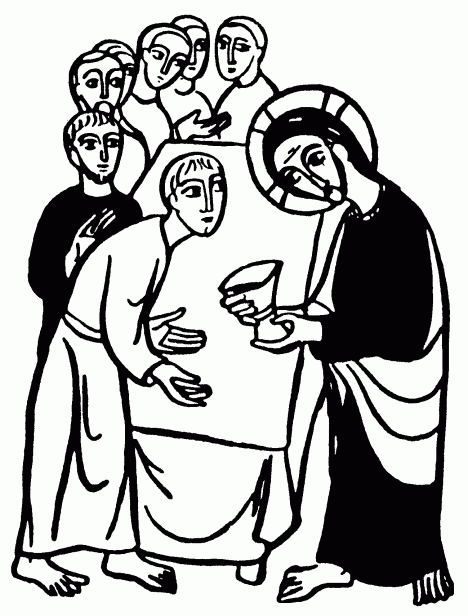
The ceremonies and rituals assist in our lifting up of our hearts to God. The instrumentation of visible symbols helps us to grasp the invisible mysteries of faith.

Does the Bible approve of such things?

The Old Law prescribed many Jewish ceremonials. Christ made use of numerous such rituals and introduced his own ceremonies.

What is the altar?

The altar stands for the table upon which Jesus instituted the sacrament of the Eucharist.

Why is the altar often so imposing and made of marble or stone?

While other materials may also make up the altar, the traditional altar was fashioned in the likeness of the martyrs’ tombs upon which the Mass was often said in the early Church.

Why is the altar covered with linen cloths?

It serves as a decorative cover giving reverence to the holy sacrifice, to help insure that if spilt no precious blood shall fall to the ground, and as a vestment for Christ symbolized there.

Why is there a cross (usually a crucifix) near the altar?

It is a visible reminder that the sacrifice of the Mass is an unbloody re-presentation of the sacrifice of the cross.

What is the chalice?

This is the cup into which the priest pours wine that is to be transformed into the blood of Christ.

Why do priests wear particular vestments at the altar?

The vestments remind us that the priest is a living representative of Christ at the altar. He acts in the very “person of Christ,” head of the Church. God himself prescribed vesture to be worn in the divine services of the Old Covenant.

What is the amice and what is its meaning?

This is a shoulder cloth that serves the practical purposes of covering the priest’s ordinary clerical attire and keeping the neck of certain albs (the white gown) clean. At one time it was even worn over the head as a cover against the cold. It signifies “the helmet of salvation” (Ephesians 6:17), with which the priest arms himself against devilish assaults.

What is the significance of the alb (a long white garment)?

It signifies the purity of body and soul with which a priest should possess before approaching the altar.

What does the cincture (rope worn around his waist) symbolize?

It calls to mind his priestly chastity and continence.

What does the stole (looks like a scarf) signify?

It is a vesture of dignity, as with the ancient Roman senators, symbolizing his honor and power.

What is the purpose of the chasuble (garment worn over all the rest)?

Just like the altar, as a symbol for Christ, is dressed; so too is the priest. The chasuble reminds us that he puts on Christ in a singular fashion. He is Christ, the one high priest, at the altar. It signifies the yoke of the Lord and reminds us all that to follow Christ means to take up the cross.

Suppressed today, although still implemented in the traditional liturgy is the maniple (a band hanging from the left arm); what is it about?

It is a symbol of penance, as well as of the various cares and responsibilities of the priestly vocation.

What do the different colors of vestments mean?

WHITE implies innocence and is particularly festive; it is used on feasts of the Lord and of saints who were not martyrs.

RED signifies martyrdom and is used at commemorations of the Passion, Pentecost and on the feasts of martyrs.

GREEN is used during Ordinary Time and represents the hope of eternal life.

VIOLET signifies penance and to some degree royalty (Advent and Lent).

BLACK is rarely used these days; however, it can replace white or violet at funerals and may still be used on All Souls Day. It expresses sorrow and morning.

SILVER and GOLD are variations upon white and point to even greater festivity.

What do the candles beside the altar signify?

They are another symbol for Jesus who is the Light of the World. We are reminded that his charity should always burn in our hearts. They also call to mind the first Christians who offered up the sacrifice in the dark and cold catacombs.

What is the meaning of incense?

It is a symbol of prayer that rises up to heaven as a sweet odor before God (Psalm 141:2).

Why do the priest and people make the sign of the cross at Mass?

It reminds us of the suffering and death of Christ on the cross. It also dedicates that activity to the Lord and sanctifies it. Associated with grace and blessings, it is often made over people and things.

What is the bow, bending the knee (genuflection), the bent head, and the kissing of holy objects about?

They are signs of veneration, and when directed to God, of adoration, respect, and homage to the presence of Christ upon the altar and/or in the tabernacle.

What are the principal parts of Mass?

Traditionally they were catalogued as the Offertory, Consecration, and Communion. The revised liturgy has much reduced the Offertory and simply calls it the Preparation of the Gifts. In light of renewed interest in the Scriptures, post-Vatican II directives speak of the two main parts of the Mass: the Liturgy of the Word and the Liturgy of the Eucharist. Having said this, the center of gravity will always be upon the Eucharist. At the words of consecration the priest changes the bread and wine into the living body and blood of Christ. God makes himself present upon our altars. Holy Communion is our reception of the bread of life and the cup of salvation.

What ingredients compose the host that is to be consecrated?

It is unleavened bread made from pure wheaten flour and water.

What is the tabernacle?

This is the container, either upon its own altar table or in a wall, where the Blessed Sacrament is reserved.

What is the Introit?

Usually replaced by a musical piece on Sundays, it is the Entrance Antiphon of the Mass.

What is the Confiteor?

It is a confession of fault and sin; in other words, of our unworthiness as we begin the Mass.

What is the Gloria?

It is a solemn song of praise to the goodness and majesty of God.

What is the Liturgy of the Word?

It is composed of various readings and their application is a homily. The pattern on Sundays is as follows: Old Testament Reading, Responsorial Psalm, New Testament Reading, Alleluia and/or Verse, Gospel, Homily, Creed and Prayer of the Faithful (General Intercessions).

What do we understand by the Profession of Faith at Mass?

This is the Creed given to the universal Church at Nicea in 325 AD and again at the council of Constantinople in 381 AD. It is a formal confession of the Catholic faith.

What is the meaning of the priest pouring a drop of water into the wine?

It signifies the union of the divine and human natures in Christ, and it represents the water that flowed from the side of Christ.

What is the purpose of the Lavabo?

It is to clean the priest’s hands and prepare them to touch the Sacred Host. It signifies an inward purity of soul with which we should offer this holy sacrifice to God.

What is the Preface?

It is a solemn hymn of praise and thanksgiving just before the canon of the Mass proper.

What is the Sanctus?

It is the thrice-repeated salutation of the angels in heaven: Holy, Holy, Holy.

What does the word “Canon” mean?

It refers to the anaphora or Eucharistic prayer used at Mass. The oldest in the West is the first Eucharistic prayer, the Roman Canon. The word “canon” means rule and here points to the unchangeable rule or manner in which the holy sacrifice is daily commemorated. The Roman canon had remained unchanged for almost 1,300 years prior to the Second Vatican Council. The most essential part of the canon, as with those in the newer ones, finds its source in the words of our Lord, himself. Of course, the traditions of the apostles and church fathers, as well as the reverent regulations of popes, have played a part in the development of liturgy, too.

Why does the priest extend his hands over the gifts?

This action parallels a similar gesture in the old law where the priest was required to lay his hands upon the sacrificial offerings as a sign that the animal now bore their sins and had to expiate them by death. At Mass, the extension of the hands signifies that Christ is the Lamb of God who took upon himself all the sins of the world. It is also associated with the invocation of the Holy Spirit (epliclesis). The power of the Holy Spirit makes possible the sacrifice of the Mass and the transformation of the gifts.

What does the priest do at the consecration?

The priest says what Christ said at the Last Supper: “Take this, all of you, and eat it: this is my body which will be given up for you. . . . Take this all of you, and drink from it: This is the cup of my blood, the blood of the new and everlasting covenant. It will be shed for you and for all so that sins may be forgiven. Do this in memory of me.”

What is the effect of these words?

When they are spoken, the bread and wine are changed into the true and living body and blood of Christ.

Why does the priest raise up the bread and chalice?

Not only does it better allow the people to see, he lifts up the host (not simply bread) and then the chalice with the precious blood, as an invitation to adore our Lord and Savior now present under the forms of bread and wine.

What are the two prayers, which immediately follow the consecration?

The first is a Vatican II interpolation of the words associated with the consecration, “Mysterium fidei,” or THE MYSTERY OF FAITH. The congregation offers one of several memorial acclamations, which affirm that our Eucharistic Lord and the historical Christ are one-and-the-same: “Dying [you] destroyed our death, rising [you] restored our life. Lord Jesus, come in glory.” The anamnesis or memorial prayer is next. By recalling Christ, we make present in the Eucharist both his person and saving activity. We affirm that this is a “holy and perfect sacrifice, the bread of life and the cup of eternal salvation.”

How does the priest pray for the dead?

He prays that the faithful departed may also receive from the fruits of the Mass and be granted “Light, happiness, and peace” in God’s presence. Sometimes the priest will even mention the dead by name. This is called the “memento” of the dead. The congregation should pray also for their deceased relatives and friends at this stage of the liturgy.

Why do we offer the Lord’s Prayer after the Eucharistic prayer?

It is because as children of God we are entitled to call upon God as “Our Father.” The mediation of Christ brings our prayer to God in heaven. We are confident that God will hear our prayer and give us what we need for body and soul.

Why does the priest break the host?

The fracturing of the priest’s host reminds us of the passion and death of Christ when his soul parted from his body. A fragment of the consecrated host is mingled with the precious blood as a sign that Christ is here present as our Redeemer, risen from the dead.

What is the Agnus Dei?

This is the “Lamb of God” prayer that echoes Scripture in repeating three times that he is the lamb of sacrifice “who takes away the sins of the world.” It is a prayer for mercy and one which acknowledges what Christ has accomplished.

What is with the sign of peace?

It is a ritual gesture, not simply a handshake, where we extend Christ’s peace to one another. We are admonished not to come to the altar unless we are reconciled with one another. St. Paul tells us: “Greet one another with a holy kiss” (Romans 16:16). That is why it is sometimes called the kiss of peace.

What does the response “Amen” mean at communion?

It is a faith profession and means “Truly” or “Surely.” It is an affirmation of the priest’s words, “The body of Christ,” or “The blood of Christ.” More than that, it also expresses acceptance and unity with the Church that offers the sacrament. In other words, a person is saying that I accept all that the Church holds as true, the Holy Father and all the bishops in union with him, etc. Not wanting to make hypocrites of people, we do not invite non-Catholics to receive. However, we do ask them to hunger with us for a more full unity and, if possible, to make a spiritual communion.

How is Mass concluded?

The priest does a post communion prayer, renders a Trinitarian blessing and then either the priest or deacon says the words of dismissal: “The Mass is ended, go in peace.”

How is the blessing offered?

Using his right hand he makes an outward sign of the cross, saying, “May almighty God bless you, the Father, and the Son, + and the Holy Spirit.” The people answer, “Amen.”

For more such material, contact me about getting my book, CATHOLIC QUESTIONS & ANSWERS.

Questions & Answers About the Sacrifice of the Mass

What do Catholics mean by the sacrifice of the Mass?

A sacrifice is the oblation of a sensible thing made by God through a lawful minister by a real change in the thing offered, testifying to God’s absolute authority over us and our complete dependence upon him.

Does God really want us to render sacrifice?

Yes, indeed, so much is this need ingrained in us that we find various forms of sacrifice in many world religions and in those of antiquity. It was because of a jealousy over the acceptance of a sacrifice that Cain killed Abel. Beginning with the Jews, sacrifice was properly directed toward the true God who had revealed himself. Noah, Abraham, and the Old Law enacted sacrifice to God. The sacrifices of the first people called by God would typify and foreshadow the sacrifice of the cross upon which Christ offered his body and blood to the Father for our redemption from sin and the devil. This same sacrifice is commemorated or made sacramentally present in the Mass. It is offered to God upon our altars for the living and the dead.

Does the Bible say anything about New Testament sacrifices?

The prophecy of Malachi states that the sacrifices of the old law would be abolished and supplanted by a new one offered for the entire world: “I have no pleasure in you, says the LORD of hosts, and I will not accept an offering from your hand. For from the rising of the sun to its setting my name is great among the nations, and in every place incense is offered to my name, and a pure offering; for my name is great among the nations, says the LORD of hosts” (Malachi 1:10-11).

Was this prophecy fulfilled?

Yes, the Jewish sacrifices have utterly ceased. The new sacrifice is the saving death of Jesus Christ, which is renewed and made present in each Mass offered every day. Around the world and in countless places it is celebrated, from the rising of the sun to its setting.

Does this mean that, according to Catholics, Jesus must suffer and die over and over again?

No, Jesus does not suffer and die all over again. Christ has risen from the dead and can never more die. As if it were a time machine, the Mass connects us with his onetime passion and death– extended to us sacramentally so as to give us the opportunity to participate and to offer ourselves along with him. It is repeatedly offered to God the Father for the forgiveness of sins.

Does not this notion of repeated sacrifices clash with the warrant of New Testament testimony? After all, St. Paul states: “But when Christ appeared as a high priest of the good things that have come, then through the greater and more perfect tent (not made with hands, that is, not of this creation) he entered once for all into the Holy Place, taking not the blood of goats and calves but his own blood, thus securing an eternal redemption” (Hebrews 9:11-12) and later: “And just as it is appointed for men to die once, and after that comes judgment, so Christ, having been offered once to bear the sins of many, will appear a second time, not to deal with sin but to save those who are eagerly waiting for him.” (9:27-28). In 10:14, we read: “For by a single offering he has perfected for all time those who are sanctified.” It seems to be saying that the one sacrifice on the cross was enough and no other ones are needed.

The one sacrifice of the cross is enough for our redemption. However, it must be commemorated and applied to souls, just as Jesus commanded: “Do this in remembrance of me” (Luke 22:19). This is done daily in the Mass.

But if Christ has already died for our sins, and we are thus saved, why is the Mass necessary?

If all we had to do were to believe that Jesus had died for us and that we were then automatically saved, then there would be no need for the Mass. Of course, such a presumption would make preaching and the Church herself unnecessary. There would be no impetus to live a holy life. While proponents of such a view often speak a great deal about hell, it would largely make it inconsequential as well. Those who have committed the most grievous wrongs would be on the same footing as saints. However, our Lord, besides his death on the cross, has commanded other things of us if we are to be saved.

How can Catholics make such a claim contrary to St. Paul’s words? He writes: “For it was fitting that we should have such a high priest, holy, blameless, unstained, separated from sinners, exalted above the heavens. He has no need, like those high priests, to offer sacrifices daily, first for his own sins and then for those of the people; he did this once for all when he offered up himself” (Hebrews 7:26-27).

The context is being confused here. He is not talking about the Mass but about Jewish sacrifices and their high priests. Because of their imperfections, their sacrifices were no longer needed. Catholic priests do not offer a new sacrifice, but the same oblation of Jesus on the cross. The words of Jesus make it a command performance.

Does St. Paul say that ministers should do more than preach; they should also render sacrifices to God for their peoples’ sins?

Certainly, he says in Hebrews 5:1: “For every high priest chosen from among men is appointed to act on behalf of men in relation to God, to offer gifts and sacrifices for sins.”

If the sacrifice of the Mass were required, it would seem to imply that the sacrifice of the cross was insufficient to reconcile us with God; is this true?

No, it is not. The sacrifice of the cross was sufficient to reconcile us with almighty God, but Christ desired that his oblation of the cross should be commemorated in “living” memory of him. As with the memorial acclamation in the revised liturgy, St. Paul says: “For as often as you eat this bread and drink the cup, you proclaim the Lord’s death until he comes” (1 Cor. 11:26). As faithful adopted sons and daughters of God, our Father, we celebrate our redemption with an unbloody sacrifice (of the cross) to God for ourselves and for the good of the world.

For more such material, contact me about getting my book, CATHOLIC QUESTIONS & ANSWERS.

Questions & Answers About the Real Presence in the Eucharist

What is the main difference between the Holy Communion received by Catholics and that, which is implemented by non-Catholics?

While some may contend that there is some sort of weak “spiritual” presence, most non-Catholics reduce Communion to an “empty” sign, in other words, something that signifies a presence, which is absent, namely the historical Jesus. This reduces the communion elements simply to ordinary bread and wine. Of course, without a legitimate priesthood and Eucharistic liturgy, their communion is precisely such. On the other hand, Catholics believe that their Holy Communion conveys a sacramental and real presence of the risen Christ. The Eucharistic species have literally been transformed into our Lord. Possessing a valid priesthood, which celebrates a lawful Mass, the communicants eat the REAL body of Christ and drink the REAL blood of Christ.

Did Jesus really promise that he would give us his body to eat and his blood to drink?

Yes, most assuredly so. Jesus says in John 6:51: “I am the living bread which came down from heaven; if any one eats of this bread, he will live forever; and the bread which I shall give for the life of the world is my flesh.” His fellow Jews murmured in disagreement, seriously doubting that Jesus could do such a thing. He could not be serious, they thought. Maybe, he only meant it in a figurative fashion? Of course, even that was somewhat offensive to Jews, given their strict dietary laws. Jesus reiterates it to insure that there is no confusion: “Truly, truly, I say to you, unless you eat the flesh of the Son of man and drink his blood, you have no life in you; he who eats my flesh and drinks my blood has eternal life, and I will raise him up at the last day. For my flesh is food indeed, and my blood is drink indeed” (John 6:53-55).

Later, did Jesus fulfill his promise and give his apostles his body to eat and his blood to drink?

Again, the answer is yes. We read in Matthew 26:26-28: “Now as they were eating, Jesus took bread, and blessed, and broke it, and gave it to the disciples and said, ‘Take, eat; this is my body.’ And he took a cup, and when he had given thanks he gave it to them, saying, ‘Drink of it, all of you; for this is my blood of the covenant, which is poured out for many for the forgiveness of sins.’”

Is not the fact that many denominations stress the eating and drinking a sufficient indication of their belief in the body and blood of Jesus?

No, it is not. Indeed, many deny the Catholic understanding of “real presence” while making a big deal over the fact that often Holy Communion in the Catholic Church is reduced to the host. (Each particle of the host and every drop of the precious blood, not wine, is the complete Jesus, body and soul, humanity and divinity.) Certain Protestants get caught up in the mechanics and deny the very essence of the sacrament. Jesus himself was concerned that his followers might go through the motions of eating and drinking the sacred meal and lose sight of the underlining reality. He says: “For my flesh is food indeed, and my blood is drink indeed” (John 6:55). Further, he tells his people: “Truly, truly, I say to you, unless you eat the flesh of the Son of man and drink his blood, you have no life in you” (John 6:53). Acknowledging this truth, the apostles raised the “breaking of the bread” or Eucharist to the center of their lives and that of their faith communities.

But Christ seems to reverse himself when he says: “It is the spirit that gives life, the flesh is of no avail” (John 6:63). How is this explained?

If it were not tragic, it would be amusing how numbers of Protestants often point to this sentence to refute the Catholic understanding of real presence. After all, it intimates that Jesus was in error or that he hastily revises his teaching when most of his followers abandon him over it. Such is far from the truth. Jesus does not suddenly suffer from amnesia regarding his earlier words; rather, he is talking about the spirit of God which makes faith possible, even in those things difficult to accept, like the graphic truth of his Eucharistic presence. Eating the flesh of Jesus without faith would profit nothing; eating it with faith gives life.

It has been offered that what Jesus meant to say at the Last Supper was, “This represents my body, this represents my blood.” Is this not more correct?

It is a lie. If Jesus meant to say that the bread and wine only represented his body and blood, then he would have said so. However, he purposely said: “This is my body, this is my blood.” Lacking a “to be” verb, his expression is even more stark: “This–my body, this–my blood.” Some time prior to the Last Supper, our Lord promised his followers that he would give them his body and blood as food and drink. Jesus spoke plainly and made no attempt to mislead his listeners with ambiguous rhetoric. Christ’s Church has believed Jesus’ words in their literal sense for two thousand years. The apostles believed that the Eucharist was the real body of Christ. It is not ordinary bread. St. Paul goes so far as to emphasize that unworthy reception of this bread of life causes damnation.

How can God possibly give us his own body to eat and his blood to drink?

This question suffers from the intrusion of modern atheism, even when it emerges from fundamentalist Christians. How could God possibly take flesh at all? And yet, he did precisely this in the incarnation. How could he feed five thousand people with a mere five loaves of bread and two fishes? Nevertheless, he did.

If God could change rivers into blood, as he did in Egypt, could he not transform bread and wine as a sacrament for his followers? Sure he could! God is almighty and can do all things. Would we be so egotistical as to hold that just because we cannot envision something as possible that it is impossible for God?

When Jesus, and today the priest, breaks the consecrated bread, is he breaking the body of Christ?

No, only the outward form of bread is broken, not Christ’s body.

How can the complete and living Christ be present in each and every Holy Communion around the world and often at the same time?

He is God. This mystery of the real presence of Christ cannot be explained in a way sufficient for human understanding. Nevertheless, we know with God that all things are possible. The sun in the sky can shed its light and warmth upon many places at the same time, but there is still only one sun. This is a poor analogy, and yet it might help.

How can Catholics argue such a transformation when St. Paul merely called it BREAD, saying, “Whoever, therefore, eats the bread” (1 Corinthians 11:27)?

The apostle emphasizes “the bread” as something more than ordinary bread. Recall that in the same chapter he complains about those who fail to discern between this bread and the ordinary variety. He warns them that to eat this bread unworthily brings down judgment, making one guilty of the body and blood of Christ. Ordinary bread could not mandate such a punishment.

While it might be granted that Jesus gave his body and blood to his apostles, is it not too great a leap to suppose that priests can give this body and blood to others?

It is no stretch of credulity at all. The apostles were commanded by Jesus to repeat what he did. He gave them his body and blood so that they might have a share in his eternal life. If this power was not handed down to the priests, how could we eat the body of Christ and drink his blood? Jesus said to them, “All authority in heaven and on earth has been given to me” (Matthew 28:18); “As the Father has sent me, even so I send you” (John 20:21). The authority given the apostles is necessarily passed down to the bishops and priests.

Might the communion bread and wine be seen as a remembrance of Christ only?

No, this view is too narrow. The consecrated elements are indeed a remembrance of Christ, but they are also his body and blood. The stark words of institution make any other interpretation impossible. Further, the Hebrew view of memory is much different from our own. We tend to use remembrance in a nostalgic way, recalling something that is past and absent. The ancients saw the past coming alive again in the telling. Remembrance makes something present; it allows one to enter into the story. Regarding the Eucharist, this is not only figuratively true, but really so. The Mass allows us to visit and participate in the sacrifice of Christ on Calvary. Holy Communion is our encounter with our risen Lord, now made our saving food.

Can it be proven that the first Christians held such views about the Eucharist?

Yes, it can. St. Justin (150 AD) says, “The faithful receive communion not as an ordinary bread, or an ordinary drink, but we were instructed that it is the flesh and blood of Christ” (First Apology). St. Irenaeus (200 AD) writes regarding the Gnostic heretics, “They refuse to acknowledge that the bread in Communion is the body of their Lord and the chalice his blood” (Against Heresies). Other early authorities write similar testimonies, saying that Christ is joined with us in communion, not only through faith, but really and truly. It is said that just as water was changed into wine, so is the bread changed into the body of Christ. Others speak of adoration, an operation proper to God alone, as proper before the Blessed Sacrament. Extending back to apostolic times, this 16th century epiclesis illustrates this abiding belief: “Come, Holy Spirit, consecrate, change, transform by thy almighty power the bread and wine into the body of Jesus, born of the Virgin Mary, and in the blood which was shed for our salvation.” Even many of the early breakaway groups from the Catholic Church retained this central teaching in the real presence.

How could Jesus reasonably be present under the appearance of so many wafers and in so many churches at the same time?

Spatial and temporal limitations do not apply to God. We may not understand it, but Jesus, being God, is not locked exclusively into any one time or place. Such is the mystery of Christ after his resurrection and ascension.

What proof can be put forward in favor of the claim that Jesus remains in the hosts reserved in the Church tabernacle?

We have Jesus’ own words for this sacred trust. He says: “This is my body,” and he makes no move to turn the sacred elements back into bread. Therefore, as long as the appearances of bread are present, so is Jesus. In addition, we know that the first Christian believers carried the consecrated bread to the sick, to prisoners, and maintained it in valuable vases for later administration to those near death. This faith of the early Church is formative to what we have always maintained.

Does the body of Christ in Holy Communion suffer from human digestion?

No, only the outward appearances are subject to change. The body of Jesus is not touched.

Does the Bible say that Jesus will live in our hearts after communion?

Yes, we find the passage in St. John 6:56: “He who eats my flesh and drinks my blood abides in me, and I in him.”

Is it permissible only to believe that Jesus is somehow present in the bread, but not that it is actually transformed into his body?

No, it is not, if one wants to remain a true Catholic. Again, Jesus said: “This is my body.” We either believe in Jesus’ words or we do not. If it is not really changed into his body, then Jesus was lying to us. This would be absurd.

Is it idolatry to adore the communion bread?

If it were ordinary bread, adoration would indeed be idolatrous. However, since it is the body of Jesus, it is expected and proper.

Why do so many churches offer only the host and not the cup?

The pattern followed by the early Church is significant in that many received only the consecrated bread or only the precious blood. Further, the totality of Christ– body and blood, soul and divinity– is received whole and entire under either form. The practical consideration aside, which could be serious regarding excess consecrated wine, the priest’s communion of both species illustrates the unity of the host and the cup.

But, are not Catholics denying a direct command of Jesus in not drinking from the cup?

It should be said that many Catholic parishes do offer the precious blood to the congregation. However, large parishes often find it difficult. After all, unlike some of the Protestant parishes, our sensibilities about the real presence would cause a just anxiety about the use of hundreds of small thimble-sized cups. While Jesus did say “unless you eat my body . . . and unless you drink my blood”; he also said in the same chapter: “I am the living bread which came down from heaven; if any one eats of this bread, he will live forever; and the bread which I shall give for the life of the world is my flesh” (John 6:51). Clearly, this means that eating this bread will give us a share in eternal life. This is elaborated by St. Paul: “Whoever, therefore, eats the bread or drinks the cup of the Lord in an unworthy manner will be guilty of profaning the body and blood of the Lord” (1 Cor. 11:27).

Is not every baptized believer a priest who can celebrate the Lord’s Supper?

No, baptismal priesthood and ministerial priesthood are quite different. The laity cannot consecrate the bread and wine. Only the apostles were commanded to do this by Jesus. Consequently, only their successors, the bishops and priests at Mass, are able to consecrate the bread and wine in the name of the people. As St. Paul tells us, the ministers are chosen by God to offer sacrifices for the people (Hebrews 5:1).

What are some of the practical reasons why the cup might not be offered?

  • The apostles themselves could not always administer it to the sick or imprisoned.
  • The danger of spillage is a real concern.
  • There is a great aversion to drinking from the same cup, especially with the sick.
  • Some places have difficulty procuring and preserving wine.
  • Alcoholics and certain others cannot drink it.
  • Because Jesus gave the Church authority to regulate such matters.

Questions & Answers About the Reception of Communion

Where do we receive Holy Communion?

Communion is usually distributed in church; however, the sick may receive it in the hospital or in their homes.

How is it administered in church?

There are two ways that the host is given at present in the Roman Rite: upon the tongue and in the hand. Various Eastern rites also have their own manner of distribution, including the spoon or a sacred tube. The priest holds up the host before the communicant and says, “The Body of Christ.” The communicant responds, “Amen,” thus acknowledging the real presence of Christ and the full authority and authenticity of the Catholic faith that makes this holy encounter possible. The unity here between the communicant, Christ and the Church is intensely intimate. It is for this reason that one who is not of our faith or who is in mortal sin should not receive the sacrament. It would turn the “Amen,” no less than a faith profession, into a lie. The person opens his mouth and puts out his tongue slightly. The minister places the host upon the tongue. The communicant immediately closes his mouth, signs himself with the cross and moves back to his place in the church. Those receiving in the hand make a throne of their left hand in their right for Christ the King. They do not put their hands side by side in the image of a bird. Nor should they pick at the host as an insect would with its pinchers. Fingers should be together and nothing should be carried. If a communicant has a rosary in the hand, a purse under the arm, or a baby held close — he or she should not receive in the hand but upon the tongue. Having received in the hand, we step aside but still facing the altar, pick up the host with the right hand and put it into the mouth. We make the sign of the cross, and then, and only then, we turn and walk back to our place. We do not walk away with the host in our hand. We do not make a hasty sign of the cross as we rush to our pew. The minister of the sacrament must be able to see the communicant put the host into the mouth.

Why is Holy Communion sometimes designated as Viaticum?

It applies to Holy Communion given to the sick as spiritual sustenance and as saving food. It helps to prepare them for the final leg of their pilgrimage into eternity.

Why are people sometimes blessed with the sacrament?

Benediction is offered with the Blessed Sacrament because it is really and truly Jesus. Thus, blessing people with the sacrament is quite literally Jesus blessing the people just as he did when he walked the earth.

How is such a benediction usually conducted?

While a hymn in honor of the Blessed Sacrament is sung, the priest, dressed in a cope and humeral veil, incenses the monstrance (a display container placed upon the altar). After this sign of adoration, he blesses the people with the Blessed Sacrament by making a sign of the cross with it over them.

Why have there been processions with the Blessed Sacrament?

It is a touching and solemn profession of our faith, giving adoration to our Savior in the consecrated host.

What is the meaning of the Vigil Light perpetually burning next to the tabernacle containing the consecrated hosts?

It is a visual reminder of the abiding presence of Jesus in the church and of our worship that is everywhere and always due him. The Lord has not abandoned us. One faithful critic claimed that it is not unlike one’s mother leaving a light burning in the window. Jesus is always there for us, ready to receive us back.

For more such material, contact me about getting my book, CATHOLIC QUESTIONS & ANSWERS.










