
Who can forgive sins?
Only God can forgive sins, and those to whom he has given the power to do so.
To whom did God give such a power?
The Scriptures reveal that Jesus gave this power to his apostles. We read in John 20:22-23: “And when he had said this, he breathed on them, and said to them, ‘Receive the Holy Spirit. If you forgive the sins of any, they are forgiven; if you retain the sins of any, they are retained.’” Our Lord says that all power in heaven and on earth has been given to him, “Peace be with you. As the Father has sent me, even so I send you” (John 20:21). Jesus was sent into the world to forgive sins, and so he similarly sent the apostles.
Instead of confession, maybe this meant that priests could forgive sins in baptism?
The Bible makes a clear distinction between the sins forgiven by baptism and those remitted afterwards. Regarding the former, we are told, “Repent, and be baptized every one of you in the name of Jesus Christ for the forgiveness [remission] of sins” (Acts 2:38); as for the latter, there is the charge, “If you forgive the sins of any, they are forgiven; if you retain the sins of any, they are retained” (John 20:23).
Maybe Christ forgives sins, but not priests?
Jesus Christ does forgive our sins, provided that we confess them to a priest (particularly if we have the opportunity to do so).
The Scriptures assert that the forgiveness of sins shall be preached to all nations; if mercy is granted in preaching, why is confession necessary?
The proclamation of forgiveness points to the remission of sins through baptism, confession, or any other means instituted by the Lord.
Does not the biblical notion of forgiving sins apply to the excommunication of sinners or their restoration?
The apostles are given a two-fold power. First, they can forgive sins as our Lord makes clear. Second, they are given the authority to excommunicate. Jesus says, “Truly, I say to you, whatever you bind on earth shall be bound in heaven, and whatever you loose on earth shall be loosed in heaven” (Matthew 18:18).
If Mary Magdalene can have her sins forgiven because she “loved much” then perhaps all sins are similarly forgiven (see Luke 7:47)?
Mary Magdalene’s outward display of great sorrow in her confession of Jesus brings about the forgiveness of her sins by Christ (who knew her sins). It is not the sentiment of love that is sufficient, but a practical love which results in sorrow, confession if possible, satisfaction and a firm resolve not to sin again. Few priests are given the supernatural power to read souls; thus, unlike Jesus, the priest cannot know what your sins are unless you tell him. This allows the priest to apply an appropriate penance and to give adequate counsel.
If confession is legitimate, why does the Bible remain silent about it?
It is not silent. We have already read Christ’s stipulation in its favor. The historical fact that the early Christians, indeed Catholics during the last two thousand years, have confessed their sins is proof that Christ taught the apostles that sins should be confessed.
But St. Paul said as proof of ourselves, “Let a man examine himself, and so eat of the bread and drink the cup” (1 Corinthians 11:28). He did not say “Go to confession.” Is there not a real clash?
St. Paul meant that we should be proved according to the teaching of Christ. In other words, we are to prove and to examine our conscience. If we discover any sins, then we should confess them before “eating of this bread.” Certainly, St. Paul would not contradict Jesus who commanded the apostles to forgive sins.
As we say in the Lord’s Prayer, “Forgive us our trespasses as we forgive those who trespass against us,” are we not forgiven by forgiving others?
It means that if we want our heavenly Father to forgive our sins, then we must forgive our neighbor. This is more than a precondition connected to human activity. God is not crudely bargaining with us. This line has everything to do with conversion or transformation into a new Christ. We are to imitate and to manifest the loving mercy of God in our very selves. By forgiving others, we become precisely the types of persons who are open to the graces of mercy. God can use us in ushering in his kingdom. We grow in holiness because we become revelatory to the face and presence of God. Ultimately, the Father will look upon us and see his Son living in us. He will give us a share in the eternal life that Christ merits on our behalf.
If sins can readily be forgiven, will it not entice people to easily relapse into sin?
No, because a good confession demands true sorrow for sin and a firm intention to avoid sin in the future. The more a sinner experiences and expresses his sorrow in confession, the less likely will he return to his sin. This sorrow is more than just “feeling” sorry. It reflects a real remorse over what our sins have accomplished. Our sins inhibit our transformation in Christ, deprive us of grace, and threaten us with the loss of heaven and the pains of hell. While fear of punishment illustrates imperfect contrition; we are all to strive for perfect contrition. This requires that we be conscious of the dishonor our sins bring upon God for whom we are created. They strike down our Savior upon Calvary (often imaged in the Sacred Heart devotion).
Can it be said that the apostles went to confession?
We certainly know that our Lord told his apostles to forgive sins; no doubt, if they committed any, they forgave each other’s sins.
Can a priest charge money for forgiving sins?
No, this would be a great crime called simony. Severe punishments would be inflicted upon any priest who would dare do something so offensive.
Can a priest forgive a thief who has no intention to return stolen goods?
No, the stolen property, if possible, must be restored to the lawful owner or at least a promise must be given that restoration will be made. Only then is the priest at liberty to absolve the sin.
Does the Bible distinguish any sins as mortal?
It most certainly does. The Bible tells us that some sins deserve death and that they exclude sinners from the kingdom of heaven. St. Paul states in Galatians 5:19-21: “Now the works of the flesh are plain: immorality, impurity, licentiousness, idolatry, sorcery, enmity, strife, jealousy, anger, selfishness, dissension, party spirit, envy, drunkenness, carousing, and the like. I warn you, as I warned you before, that those who do such things shall not inherit the kingdom of God.” St. Paul enumerates a number of serious or mortal sins in 1 Corinthians. Exclusion from the kingdom of God literally means damnation.
Does the Bible mention any sins as venial (more easily forgiven)?
Again, the answer is yes. “For a righteous man falls seven times, and rises again” (Proverbs 24:16). Evidently it is possible for a righteous or just man to commit certain sins and not forfeit his good status. However, if a person commits a mortal sin, he can no longer be considered righteous or just. [Also see James 3:2.]
Is there a clear biblical teaching that God punishes mortal sins with temporal and eternal punishments?
This is the case. David was guilty of murder, which merited the pains of hell (2 Samuel 12:9). Nathan warned him of his mortal peril. David repents: “I have sinned against the Lord” (2 Samuel 12:13). Nathan responds as the voice of God: “The Lord has put away your sin,” (2 Samuel 12:13) that is, the eternal punishment of hell. Nathan continues: “You shall not die. Nevertheless, because by this deed you have utterly scorned the Lord, the child that is born to you shall die” (2 Samuel 12:13-14). This was clearly temporal punishment.
How is the Sacrament of Penance administered?
It is very simple. The ritual usually begins with the sign of the cross. The penitent will often ask for a blessing from the priest at the beginning. Next, he confesses his sins. The priest might offer some fatherly advice, a penance is imposed, and absolution is given.
What are the essential words of absolution?
“God, the Father of mercies, through the death and resurrection of his Son has reconciled the world to himself and sent the Holy Spirit among us for the forgiveness of sins; through the ministry of the Church, may God give you pardon and peace, and I ABSOLVE YOU FROM YOUR SINS IN THE NAME OF THE FATHER, AND OF THE SON, + AND OF THE HOLY SPIRIT. Amen.”
For more such material, contact me about getting my book, CATHOLIC QUESTIONS & ANSWERS.
Filed under: Confession, Questions, Sacraments | 10 Comments »
























 A central theme of Christianity is reconciliation with our neighbor and with God. In Matthew 5:20-26, Christ exhorts us to nurture a holiness which goes beyond external appearances and which emanates essentially from within. Our hearts need to be forgiving and willing to accept forgiveness. Our minds need to elevate good thoughts about our brothers and sisters, and not be centered upon how we might get even with those who hurt us. This is what Christ would do for us who murdered him by our sins. Instead of utterly destroying us with thunderbolt and fire, he offers us a share in his victory over death. He died, loving and forgiving his murderers. When we come together to celebrate this great gift offered by Christ, the Lord desires us to respond in kind. He says, “If you bring your gift to the altar and there recall that your brother has anything against you, leave your gift at the altar, go first to be reconciled with your brother, and then come and offer your gift” (Matthew 5:23-24). With the bread and wine which comes up to the altar, we have to offer ourselves for transformation, so that Christ may live more fully in us. This is the essential meaning behind the sign of peace. This becomes even more essential when we recognize that Christ identifies himself with the persons in our lives whom we least love. Here is the kind of love which grants blessings upon another and not curses, even when we find it difficult to like someone. It is this kind of love which is quick to forgive and which makes one willing to admit his or her sinfulness, and need for forgiveness. The Old Testament was not silent about such a disposition. Ezekiel 18:21-28 challenges us to forgive as God forgives. Ezekiel said, “None of the crimes he committed shall be remembered against him; he shall live because of the virtue he has practiced.” When God forgives, it is as if he forgets. We are made as white as snow. For this reason, let us forgive as God forgives, without resentment and backstabbing. Let us forgive ourselves, recognizing that we have no right to hold bound what Christ in the Church has loosed.
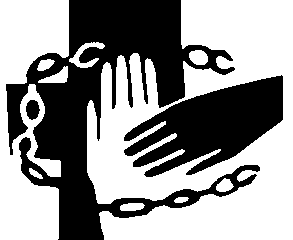 Sometimes the Church is falsely charged with the wrongful coercion of people into guilt-trips and/or with brain-washing the young through religious indoctrination. This allegation is unfair. What the Church wants people to know is that while we are guilty as sinners, we can know the forgiveness of sins in Christ. Religious formation in the truths of faith respects human freedom and conscience; but, objective truth remains what it is. Others skip condemnation of the Church and directly charge the Judeo-Christian God with intimidation and harshness, especially in regard to hell and judgment. Believers would argue that the critics have it backwards; intimidation and/or manipulation are precisely the tools of sin and the relationship of devils. If there is no genuine love, what other cohesive force is there for control? C. S. Lewis paints an image in his writings of big devils that literally eat the lesser ones– in other words, they use them to their own advantage without regard to their personhood and rights. Sometimes we might paint a picture of God’s justice that falsely falls into such a category. Hellfire images that threaten damnation from a wrathful God are a case in point. Do not get me wrong. Fearing the loss of heaven and suffering the fires of hell have their place. These are real tragedies. But people choose this fate for themselves, more so than by divine imposition. The prophets and our Lord were willing to endure any hardship for the saving message they delivered. Did they do this out of fear of almighty God or out of love? The answer is love. A true parent does not abuse or lie or callously manipulate children. Rather, he or she speaks the truth, even when it is unpopular, and makes every sacrifice to insure the well being of the family. May we all be imitators of God and speak with his voice.



















 Blogger Priest