This is a reflection upon a two page document sent to me from Bai Macfarlane entitled INCONSISTENT INFORMATION ABOUT DIVORCE, VARIETY OF TEACHINGS:
Father Christopher J. Rossman
Divorce in itself is not a grave (mortal) sin, however. Jesus says, “… whoever divorces his wife (unless the marriage is unlawful) and marries another commits adultery” – Matthew 19:9. It’s not the divorce that is a grave sin rather someone engaging in another relationship after the civil divorce. … If one civilly divorces and remains unmarried and chaste no grave sin is committed and the person is not prevented from receiving the sacraments.
I suspect that what Father Rossman means is that while we are dealing with grave matter, the subjective element depends upon a number of factors. While it might be misunderstood and painful to hear, divorce as such is a sin. Yes, I know there are some who would argue otherwise, including clergy; but we cannot allow pastoral considerations and human sentiment to cloud the truth about the matter. I would take exception to redirecting the focus from divorce to adultery; while the offenses are often related (as in the Gospel of Matthew), they are also substantially different. It is not enough to say that as long as the divorced person does not have sexual relations with a person other than the spouse, that the divorce is an insignificant or neutral matter. Pastors may make an accommodation for divorced people to receive the sacraments; but to be quite frank, they often do not even ask the priest if it is okay. It is possible that some divorced people need both Confession and efforts at restitution before the regularization of their status in the Church. Often the fault for the failure of marriages rests with both parties; but it can also be the case that one is innocent of wrongdoing. A person who loves his or her spouse and is faithful to marital obligations would certainly not be culpable of sin if there should be spousal abandonment. The person who selfishly walks away from marriage is guilty of sin and I would argue that the gravity is probably mortal. Those persons who through temptation and/or bad counsel lead others to divorce would also acquire guilt. What makes separation and divorce so very problematic is that spouses have a pledged duty to fulfill the obligations of procreation and fidelity. Spouses have a right to the emotional, physical and spiritual satisfactions of marital love. Those who use sex as a weapon of manipulation in marriages are sinning in a way akin to divorce. Divorce here is understood as more than a legal status; but as the separation of spouses and as their estrangement from the supports proper to this state. A person might divorce his or her spouse and remain both chaste and celibate; however, a sin is committed because the spouse still has needs and a right to a shared life and sexual intimacy. The sin of divorce is precisely this depravation. Arising from this, our Lord intimates about how a man who divorces his wife can be guilty for his own and for the spouse’s adultery, both in actuality and potentially.
There are cases where marriages are defective and for that reason we have an annulment process. But I would urge couples not to date or to pursue romantic entangles until or unless they are free to do so. It may be that some divorced people can never remarry because the first bond is genuine. Are there reasons why a divorce should be pursued? The various grounds for annulments represent a partial list. It might also be the case that a spouse is abusive, violent and dangerous. I knew a case where a woman had to separate from her spouse because he was a bad drunk. He regularly beat her and threatened to kill her and the children. She wanted to preserve the marriage but the value of life and the safety of her children came first. She did not remarry.
Tribunal of the Archdiocese of Atlanta
Please remember that a divorce alone would not affect, or hinder in any way, your participation in the Catholic Church. A divorced Catholic is free to receive the sacraments. … However, if you are divorced and remarried without a Decree of Invalidity (and your former spouse is still living) a problem does arise.
Here too the issue of divorce seems confused with adultery, however, I suspect it is simply the bottom line regarding the law of the Church. Legal norms in the Church have always tended to be minimalistic. A divorced spouse may be the innocent party or he or she might be the source or agent of the breakup. Beyond civil divorce there are some who remain together but live as if they are divorced. These spouses tolerate living together but are both emotionally and physically living distinct lives remote from each other. This is wrong for many of the same reasons why separation and civil divorce are offensive. Those working in a tribunal would hope that people from failed marriages would first seek out their priestly confessors. Before calling it quits, couples should do all they can to work out their problems and, if possible, save their marriages. They should also invoke divine grace and assistance. Attempting (another) marriage without ecclesial approbation is a decisive civil act that places one in conflict with Church teaching and discipline. Here is an explicit and verifiable act with a written record to which the sanctions of Church law quickly respond. However, this does not mean that the couple’s faith and discipleship was not already in trouble. Spouses are supposed to be the first of helpmates in supporting each other in becoming saints. If a marriage falls apart, it is obvious that this goal and preoccupation for mutual holiness has also collapsed.
In the Know with Fr. Joe. (America’s Catholic Television Network)
If you are divorced and not remarried, you can receive communion.
This says what the others said, and it is frequently the practice. But just as many priests lament that so many come up for communion without recourse to the sacrament of penance, similarly divorced believers should change their lives and seek out a priest prior to receiving communion.
North American Conference of Separated and Divorced
There are no laws preventing a divorced Catholic who has not remarried from active participation within a parish. This includes receiving Eucharist and Reconciliation, or participating as a Lector, Eucharistic Minister, Parish Council member, etc. You do not need absolution prior to fully participating.
Reception of communion is not just a legal issue but a spiritual one. Is the person properly disposed for the sacrament? If not, then he or she desperately needs to seek out the counsel, and if possible, the absolution of a priest.
As an aside, the new guidelines reserve the title Lector to those men formally installed and the term Eucharistic Minister to bishops, priests and deacons. Other ordinary ministers would be installed Acolytes. Those who read at Mass are now called Readers. The laity who assist with communion are called Extraordinary Ministers of Holy Communion. No other terms are currently permitted.
Catholic Answers. Jim Blackburn , Staff Apologist
However, in other cases [for the one in grave fault who destroyed marriage], —as with all serious sin—a divorced person should go to confession immediately, prior to receiving Communion.
Yes, this is exactly the case.
EWTN – Pennsylvania Bishop Pastoral Letter. July 29, 1994
Therefore, it is helpful to keep in mind several distinctions among divorced persons whose previous marriage(s) have not been declared sacramentally invalid by the lawful authority of the church. Such distinctions include first of all those who have not remarried, as well as those who have remarried and seek to live in complete continence. These persons are eligible to receive the Eucharist according to the regular norms of the church.
It might seem that the minimalism of law or norms in this instance is based more upon what one does not do than on what one actually does. Instead of placing a lot of moral weight on divorce, it shifts to the avoidance of adultery. The issue of spousal support and intimacy is not addressed, just the fact that there is no sexual activity. I have to admit that, while the canonists may be correct, such understandings leave me very uncomfortable. The statement here says that remarried couples who “seek to live in complete continence” are eligible to receive the Eucharist. Okay, norms are fulfilled, but serious questions remain. Human laws, even in the Church, may not always satisfy all the prescriptions of divine law. This allowance is probably in reference to those brother-sister internal forum situations known privately to the pastor. I can certainly understand how an older couple might be given such an allowance given mistakes that were made and the approaching proximity of their departure from this veil of tears. But, it could be sorely abused as well. The potential exists for egregious scandal. We only have a couple’s word that they are not sexually involved. Further, what about all the other satisfactions of married love: a shared life, kisses and small embraces, holding hands, bodies resting next to each other on a couch, intimate words and romantic encounters. Continence might not be breeched and yet all these sweet elements still properly belong to someone else, a true spouse forgotten or ignored. I have encountered men who have wept daily at the loss of knowing that the love of their lives is now in another man’s arms. The Church should not forget these poor souls and the lonely pain they feel.
Diocese of Bismark, ND
Can a divorced Catholic receive the sacraments? Yes. There is nothing in the Church’s law that prevents a divorced Catholic from receiving the Eucharist and other sacraments of the Church. A divorced person is fully and completely a member of the Church.
This explanation is much like the ones that have come before. Tribunals are only concerned about the canonical norms. However, in practice many questions must be asked. There is much public debate today about the scandal of sin or complicity in regards to the reception of communion. The American Life League regularly petitions the bishops to tell pro-abortion Catholic politicians not to receive the Eucharist. Similarly, like all believers, divorced Catholics must seriously examine their conscience before partaking of the bread of life. Are they living chastely? If not remarried, are they cohabitating? That is sin or at least the occasion of sin. As far as I know, no one denies that divorced persons are still members of the Church. That does not mean that our relationship with Christ and his Church is everything it should be. Our Lord identifies himself with the beloved in marriage. Marriage is a sacrament which points to Christ’s covenant with his Church. Jesus keeps his promises and will never divorce himself from the Church. Divorce is a fractured sign of this mystery. How can it not touch our relationship with the Church? If Christ will never abandon us then should we not also keep our promises, even when it takes us to the Cross?
EWTN, Colin B. Donovan, STL
By itself civil divorce is not an obstacle to Communion. As a civil action all it does is settle the civil legal effects of marriage (distribution of property, custody of children etc.). … those who are actually responsible for the breakup of the marriage and the failure to be reconciled when possible are indeed guilty of sin and have an obligation to repent and confess their sin before receiving Communion, as would any grave sinner.
Yes, this is precisely the true Catholic answer to the question!
Diocese of Lacross, WI.
Divorce does not mean one can no longer receive Holy Communion. A Catholic is barred from receiving Communion only if he or she goes on to remarry after a divorce, while their previous spouse is still living, and no annulment has been granted in regards to a prior marriage.
This is consistent with the other answers given. However, a number of things are presumed: that there is no attempted marriage and/or ongoing cohabitation and adultery. It is peculiar that no one talks about the wrong of neglecting marital duties. Refusing the sexual advances and the various acts of marital support and intimacy are also sinful. Might such neglect constitute serious sin and inhibit one from receiving communion?
Diocese of Charleston
A divorced Catholic who is neither remarried nor cohabiting is free to receive the sacraments and to be involved in life of the parish. In many cases such individuals can help their fellow parishioners who may be going through or have gone through the pain of marital separation or divorce.
I suspect this response is alluding to organizations of Separated and Divorced Catholics. It is true that they can help people through their pain. However, I often worry that they can inadvertently create other problems. People in these situations are very vulnerable. Acts of kindness can lead to special friendships and intimacy. My suggestion would be that such support should be limited to people of the same sex to avoid the possibility of romantic entanglements. I would also resist efforts to automatically minimize the value and authenticity of failed marriages. Some situations cannot be fixed. This is the hard truth we need to face.
Diocese of Arlington. Catholic Herald. Fr. William P. Saunders
Another question arises concerning the status of a divorced person in the Church. Since divorce involves a civil decree by the state and is not recognized by the Church, a divorced person remains in good standing and may receive the sacraments. However, if a divorced person remarries without a Declaration of Nullity, then strictly speaking, an act of adultery is committed: since the first marriage still is presumed valid, remarriage without an annulment places the person in a state of mortal sin and prevents him from receiving Holy Communion. Therefore, the Church encourages a divorced person who may think he may one day remarry to see his parish priest and pursue the annulment process.
Yes, admittedly this is the practice in the United States. Are we too quick to encourage the annulment process? Tribunals will not even begin the investigation until a divorce decree is acquired. Many couples do not seek marriage counseling or some time has elapsed when they finally contact a priest. Often one spouse wants to salvage a marriage and the other does not. Many annulments are pursued after people have become entangled in new romantic relationships. In other words, many if not most annulments are responses, not to divorce, but to what are externally regarded as adulterous situations. Due to weakness and passion, there is often already a second marriage although conducted civilly or in another religious denomination. I heard a priest once joke that we have to teach our people that Catholic divorce is not annulment but murder. The bond is “unto death do we part.” The six month preparation period is precisely to stress the permanence of the bond. However, even at the initial stage, many couples are already brushing aside Catholic teaching by living together and having sexual relations. It is my contention that the disregard for virginity prior to marriage is a poison leading to infidelity and divorce later on. Annulments cannot be assured. I have had a few denied. There were no grounds. It is quite rare that these adulterous couples would then separate or not seek marriage outside the Church. Tell them to separate and they look at you with shock and bewilderment. All the Church is doing is trying to keep them to their word. They promised fidelity to a spouse and before Almighty God. Promises are meant to be kept.
Archbishop of Cagyan de Oro City, Philppines
Archbishop Antonio J. Ledesma of Cagyan de Oro City has strongly criticized a proposed bill that would legalize divorce in the Philippines and said that the move would destroy the moral fiber of Philippine society. “Legalizing something that is immoral will not make it right, but will instead make it worse,” said Archbishop Ledesma.
Similar arguments were made in Ireland. But secularism seems to be winning. Here we do see a “disconnect” from the practice in other nations. Tribunals in the West require a divorce before permitting annulment applications. Meanwhile, in the Philippines, the Church is arguing against legalized divorce. This is the traditional stance and it best reflects Catholic teaching about the indissolubility of marriage. Divorce is not regarded as an option. For better or worse, marriage is for keeps!
Archbishop of Malta and Bishop of Gozo
[From the Archbishop of Malta] As there are those who promote divorce in a pluralistic society, the Church’s mission is to promote the stability of marriage, insisting on the moment of consent as the focal point of one’s commitment. In divorce there is a shift from this focal point towards each moment which is presented as giving the spouse a potential right to consider his/her consent and commitment thus ending one’s marriage.
The philosophical interpretation of the archbishop is on the mark. Sacraments represent special moments where promises or vows can be renewed but not denounced. A person is baptized and becomes a child of God and member of the Church. A man is ordained and he is forever configured to Christ the high priest. A couple is married and the two become one flesh. There is a new and enduring reality. Christianity believes that there are particular moments when we take a stand and define ourselves. Secular society today runs away from perpetual commitments and consistency. No lines are drawn and change is embraced where people are constantly redefining themselves and their lives. These views are incompatible. One promotes order or structure and obedience; the latter brings about chaos and confusion. Christians are people of the promise in a world of broken promises.
Prefect of Divine Worship and the Discipline of the Sacraments, Roman Curia, Francis Cardinal Arinze
Divorce tears marriage apart. It desolates both husband and wife. It leaves the children not only in tears but also in misery. We do not deny that there can be serious disagreement between husband and wife, but divorce is not the solution. When husband and wife have a disagreement, they should reflect, pray, sit together and discuss. Accept fault where you are wrong, ask for pardon, or consult a priest or other spiritual adviser, but do not divorce.
Cardinal Arinze, as always, is quite right. The problem that pastors face is that the couples we marry, and the many that get divorced, are only superficially Christian. Large numbers are ignorant of their faith and those who are informed lack a basic conviction to live out their Christianity. If there is rebellion and sin at the beginning of a bond, why should we think it would not show its face when the marriage falls apart? They do not see what is wrong with fornication and later explain away culpability for adultery and divorce. We hear things like this: “Our love died. We grew apart. We married too young. God would not want us to stay in a loveless marriage. I have fallen in love with someone else. It was good while it lasted. It is time to move on. We only stayed together for the children. We are not the same people anymore.” None of these reasons is sufficient for divorce. How many have the mentality that divorce should not even be placed upon the table as an option? Unfortunately, very few think this way. Often it is as if they speak an entirely different language from the priest.
[CCC 2385]
Divorce is immoral also because it introduces disorder into the family and into society. This disorder brings grave harm to the deserted spouse, to children traumatized by the separation of their parents and often torn between them, and because of its contagious effect which makes it truly a plague on society.
[CCC 2384]
Divorce is a grave offense against the natural law. It claims to break the contract, to which the spouses freely consented, to live with each other till death.
The universal catechism also condemns divorce. It is wrong in itself and it acts as a poison to marriage and the family throughout society. The bond of marriage is a facet of the natural law. Men and women were created to enter into a lifelong union. Unlawful marriages by people who are not free violate both natural law and divine positive law. Civil law once reinforced this basic truth, but not so any longer. Indeed, no-fault divorce and attempts to redefine marriage for same-sex couples shows how the corruption is escalating.
Filed under: Adultery, Annulment, Catholic, Divorce, Holy Communion, Marriage, Sacraments, Sexuality, Sin | 6 Comments »















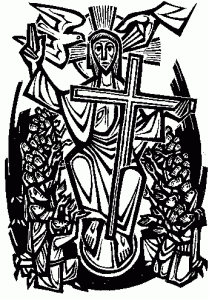
 Peter stands before us in Acts 4:8-12 much transformed from the miserable figure we knew who denied our Lord three times. We are told that he is filled with the Holy Spirit and proclaims the Gospel without qualification or self-aggrandizing. A cripple is healed as a sign that his words ring with the truth. It is all realized in the name of Jesus Christ. He explains that Jesus, the stone rejected, has become the cornerstone: “There is no salvation in anyone else, for there is no other name in the whole world given to men by which we are to be saved” (verse 12).
 Acts 2:1-11 gives us the scene of that first Pentecost. There are some interesting elements. First, the day “found the brethren gathered in one place.” There is an unexpectancy to the movement of the Spirit who FINDS them and acts SUDDENLY. On what would be the birthday of the Church, the Spirit finds the brethren watchful and awake. The believers are gathered, no doubt for fellowship and prayer. Since Christ had already instituted the priesthood and Eucharist, they might have been celebrating the “breaking of the bread.” Second, we read that “Suddenly from up in the sky there came a noise like a strong driving wind . . . .” All hear it in the house. Behind the symbolism of the wind, the Holy Spirit literally breaks from the celestial house of heaven and reverberates in the house of the Church. Third, the Holy Spirit is imaged as “tongues of fire” over the assembled. Fire gives off light. The Holy Spirit would illumine their minds and make them sharers in the Light of the World, Jesus Christ. Fire warms the flesh, and again like Jesus, the Church would bring the healing and forgiveness of the Lord to a cold world. Fire also burns and so does the Holy Spirit in that it destroys the old way of sin and builds new with the firm foundation of Christ Jesus. Fourth, the assembled speak in many tongues, a recognition that the Gospel proclamation is meant for all peoples and nations.
 It is sometimes complained that Christians of the West seem apt to neglect the role of the Holy Spirit in their prayer, worship, and reflection. The Catholic emphasis often centers upon Jesus, his mother Mary, and the saints. However, the Holy Spirit is not utterly forgotten and is implicitly invoked every time we make the sign of the cross. The early Church discerned the power of the Holy Spirit in their midst as a personal encounter with God.
 At this point I would like to say something about the liturgical year; more precisely, I would like to give a quick summary of the first week of Easter. The Gospels relate the resurrection appearances of Jesus. Easter Sunday, we have the discovery of the empty tomb; Monday there is the story of Jesus appearing to the women; Tuesday there is the sending of Mary Magdalene to tell the disciples of his restoration; Wednesday he reveals his identity in the breaking of the bread to the two men on the road to Emmaus; Thursday he reappears to these two while they are recounting the incident to his disciples; Friday he appears upon the shore while his friends are fishing; Saturday there is a brief summary from Mark of his earlier appearances and the narration of his coming to his followers while at table. Finally, John offers us two occasions where Jesus appears to his friends while assembled in the upper room.
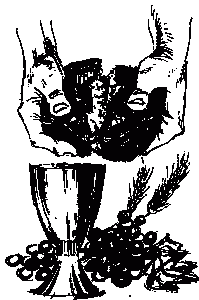 You may have noticed how often the resurrection appearances are linked with meals. I have already mentioned the story of the two men on the road to Emmaus who recognized Jesus in the breaking of the bread. Jesus also took and ate a fish to demonstrate that he had actually risen from the dead.
 The story of Jesus appearing to two men on the road to Emmaus is one of the most famous of our resurrection accounts (see Luke 24:13-35). The last phrase, “. . . they had come to know him in the breaking of the bread,” speaks to us about how we encounter the risen Lord in our Eucharist. The Eucharist is Christ’s living legacy to us. No matter what age it might be, he does not abandon us. After his ascension, the Lord continues to abide in his early disciples as well. He sends them his Spirit and works his ministry through them.
 From the very beginning, there would be those who would doubt the resurrection of Christ. Indeed, even one of his disciples, Thomas, would have to be challenged by Jesus himself to touch his wounds before his skepticism could be swept away. However, the Gospel chronicles another type of rejection as well, one far more resistant to the truth (see Matthew 28:8-15). The chief priest has an inkling that the story of Christ’s coming back from the dead might bear some truth. It is this possibility which he and his cronies seek to hide behind lies. So, they bribe the soldiers to say that Jesus’ disciples had stolen the body at night.
 The cast of characters and events in John 20:1-9 fuel our hope. They include Mary Magdalene, Simon Peter, and John. But notice who is absent in our reading; although it is a Gospel and therefore about Jesus, he is neither seen nor heard. All we have is the empty tomb and some surprised disciples. The story, of course, goes on; but, the Church in its wisdom feels that this passage alone would suffice on Easter morning at Mass. Why is that? Let us look at the story.
 The feast of Christmas is very important in preserving an authentic understanding of the identity of Jesus. It is for this reason that the Knights of Columbus each year promote their loyal “Keep Christ in Christmas” campaign with essay and poster contests. Of course, it has been argued that the abbreviation “X-mas” still preserves something of the truth in that the “X” is an ancient symbol for the Cross and thus, by association, for Christ, himself. Those who malign the celebration of Christmas as a religious holiday, more so than not, minimize the mission and identity of the Lord. There is a minister, nationally televised throughout the nation on Sunday mornings, who annually assaults the meaning of Christmas. He actually claims that the Jesus who walked on earth was a different individual from God’s eternal Son in heaven. Jehovah Witnesses reduce Jesus to an important prophet but sidestep the dilemma that unless he is God then the charges of the Pharisees and the Sanhedrin stick. Only God can forgive sins. Only God could save us. Another evangelist bewails the fact that at Christmas even the most sanitized Protestant worship space looks like a Catholic church with the various “idolatrous” statues of Jesus, Mary and Joseph. This is peculiar in that many of these same churches will return to repudiating such graven images come December 26 and argue that Catholicism has stripped the corresponding commandment from the Decalogue. Our view is not all that complex, although it is perfectly reasonable: the incarnation of Christ alters forever the economy of images. Jesus is the revelation of the Father and God with us. Now, the image of the creature can convey something of the dignity of God and his involvement in salvation history. Representations of Christ, the Virgin Mary and other saints are not worshipped in themselves but constitute a language in pictures that moves the mind and heart to the truth of the Gospel. A crucified figure on the Cross or any baby in a manger is recognized immediately, even by a child, as Jesus. One of the most heated debates on Internet message boards is between hard-line Seventh-Day Adventists and mainline believers over the correct Sabbath and the so-called pagan origins of Christmas. Protestant Christians are ridiculed for following Catholic institutions not mandated by the Bible. The Mormons often have very elaborate and beautiful commemorations for Christmas; however, they deny that Jesus is the unique or only Son of God the Father. This difference is critical because a denial of monotheism separates them from classical Christianity as well as from Islam and Judaism.















 Blogger Priest