























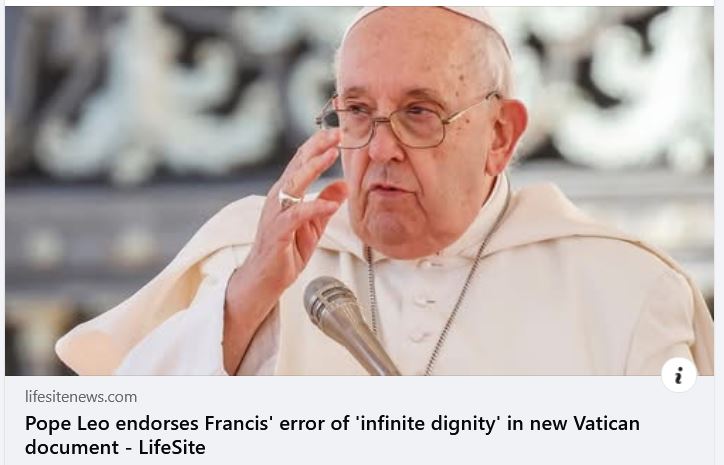
Every time Pope Leo XIV agrees with Pope Francis on something, the critics go crazy! Here there is opposition to the argument from Pope Francis in DIGNITAS INFINITA that human dignity is an “infinite” value. The concern is that it seems to deify the human creature when only almighty God is truly infinite. It is argued that this compromises Catholic teaching on original sin.
I think a grievous misreading has been made. I may be wrong but I discern shades of Pope John Paul II’s thinking in this, too. Yes, we are are finite creatures. We do not self-exist and we cannot save ourselves. However, there is an ancient notion that elements like the good, the true and the beautiful are perfections of God in which we participate or share in some small measure. Whatever we share can be traced back to God the Creator who has infinite value. Human dignity is viewed on two levels, first that of human creatures born of women into the human family, and second, as regenerated sons and daughters of the Father reborn at the womb of the baptismal font. The latter (spiritual dignity) builds upon the first (ontological dignity). Indeed, sanctifying grace divinizes the person with a share in Christ’s life. While all human life is incommensurate as God’s gift to us; the dignity of the human person is further enhanced by the sacraments. While we are finite, that which God shares of himself is not— basic existence and on top of that eternal life in Christ.
The late Pope Francis taught that the human person possessed an immeasurable or incommensurate worth. This was a major contention of the late Dr. Germain Grisez (1929–2018). He contended for the incommensurability of basic human goods.
Reflexive Goods: Self-integration, Practical Reasonableness, Justice and Friendship, and Religion.
Substantive Goods: Life and Health, Knowledge of Truth, Appreciation of Beauty, and Excellence in Work and Play.
(The basic goods delineated by John Finnis were similar.)
Grisez claimed they are equally good in themselves and cannot be rationally compared. He argued that the basic goods are equally ranked and thus there can be no proportionalism in their regard— you cannot act against one to promote another— there is no lesser evil for a greater good. This becomes foundational for his moral theology on behalf of the sanctity of life and the indissolubility of marriage. Contraception, abortion and euthanasia are entirely removed from the drawing board! Everyone is thus viewed as precious and irreplaceable. Every person has immeasurable worth, even the convict on death row.
Pope Francis broke down dignity in terms of anthropology: The first is “ontological.” Every moment God is keeping us in existence. If he were to forget us for an instant we would cease to exist and be annihilated. Such would be against the divine economy. This value is incommensurate. The second is “moral” and here dignity can be lost through evil acts and sin. This is where original sin and concupiscence come into the picture. The third is “social” and dignity can be violated by oppression and poverty. However, worth remains the same. The fourth is “existential” which refers to a person’s subjective experience of life.
Filed under: Uncategorized | Tagged: Bible, christianity, Faith, God, human-dignity, incommensurate, infinite, Jesus, original-sin, sanctity-of-life |




















 Blogger Priest
Leave a comment