• Our Blogger

    Fr. Joseph Jenkins

  • The blog header depicts an important and yet mis-understood New Testament scene, Jesus flogging the money-changers out of the temple. I selected it because the faith that gives us consolation can also make us very uncomfortable. Both Divine Mercy and Divine Justice meet in Jesus. Priests are ministers of reconciliation, but never at the cost of truth. In or out of season, we must be courageous in preaching and living out the Gospel of Life. The title of my blog is a play on words, not Flogger Priest but Blogger Priest.

  • Archives

  • Categories

  • Recent Posts

  • Recent Comments

    Anonymous's avatarAnonymous on Ask a Priest
    Michael J's avatarMichael J on Ask a Priest
    Jeremy Kok's avatarJeremy Kok on Ask a Priest
    Mike Zias's avatarMike Zias on Ask a Priest
    Jeremy Kok's avatarJeremy Kok on Ask a Priest

If Good Dogs Can Go to Heaven, What About Bad Cats?

There are a couple of gentle and devoted dogs I would love to see again.  There is even a horse I miss from long ago.  I am not untouched by the companionship given by animals.  I would be happy to see and to experience their presence again. But I am also confident that God will satisfy every longing and that nothing is lost in God.

Dr. Peter Kreeft asserts that it is irrational to deny the existence of animals in heaven. He cites C.S. Lewis who assumed that tamed animals might be saved as extensions of their masters.  But Kreeft says it is likely that wild animals will also inhabit paradise. I suppose in this reckoning, Eden and its harmony is somehow restored.  Man is once again the steward of a creation made invulnerable to natural violence and extinction.

Really, is this so?  Call me mean-spirited or illogical, but I just do not know— it is hard for me to take a certain view on this matter.  Indeed, if I lean one way over another, it would be toward a kingdom inhabited by God, angels and men, but not by our furry friends.  But, I might be wrong.  I know Franciscans, true to their founder, insist that animals will join us in heaven.  If I should find my old cat there I will be much surprised.  She consumed 20 years of my life and was reckoned by most as an evil creature.  She would pretend to have gentleness and then she would attack.  She delighted in relieving herself where it would cause the most anguish. She would literally bite the hand that fed her. As for scratching, neither flesh, nor paper nor wood was safe.  I have heard hopeful rumors that dogs go to heaven; it would be easier for me to imagine my feline companion at the head of a gang of hellcats, patrolling the boundaries of Hades.

I suppose most Thomists would say that animals do not go to heaven, given that they do not possess immortal souls. This somewhat harsh response is softened with the caviat that while particular animals are gone, their collective animal soul or substantial form continues to exist as an idea in the mind of God.

C.S. Lewis remarked that canine loyalty and affection oftentimes put human fidelity and friendship to shame. Because of this he thought that maybe dogs would be allowed to join their masters in heaven. Critics contend that this is just another instance of over-blown English sentimentality.

Why would a priest waste his time talking to people about the fate of dead animals? Well, to be honest, it immediately leads to their views about life after death in general. That is more properly my concern. Animals are often the first reminders to us, usually as children when we have lost a pet, that everything that lives in this world will eventually die. We are mortal. We share our physicality with the other earthly creatures around us. Some, like dogs (and maybe cats), give us great comfort and companionship. They matter to us and so the question arises, is this all there is? Will we see them again? Can we find solace in knowing that all we cherish as good in creation will be reflected back to us in the beatific vision of the Creator?

I have had a number of inquiries about people’s pet dogs and the question as to whether they would be given entry into heaven.  I would move the gravity to stress human immortality and our hope for heaven. I would tend to agree with Thomists that animal substantial forms would continue to exist as paradigms in the divine mind. Anything more would be up to God’s mysterious providence and I would not presume to give an answer where the Church has not. Others are free to speculate, but we will not know anything more for sure until or if we find ourselves among the saints.

It is possible that my view would make some angry with me but I am not mean-spirited. Others come down on the side of continued existence of animals because these creatures are a part of our affection and shared existence in this world and thus, the argument goes, they would add to our happiness in the next.

Certain animal apologists cite Scripture and argue for a literal new earth. Some ridicule the whole notion of an afterlife, for anyone or anything. Others agree with me that the stress has to be upon the beatific vision and how we (people) are made for God.

I would not worry much about the fate of animals after they die. If we love animals we should do what we can now to protect them from abuse and suffering. We live in a world where many species are rapidly becoming extinct.

Further, some may err by the sin of presumption about their own salvation. “Are you sure that you are going to heaven?” Speaking for myself, I have faith in Christ and try to be a faithful disciple in the Church. I worship God and seek to serve him through my charity and sacrifices for others. However, if people forget God, discount obedience to the commandments, and hate their fellow man… well, they may be in for a terrible surprise!

Art, Poetry & Song in Heaven?

The question about art, music and poetry in heaven is more complicated than we might initially acknowledge.  These three efforts at creativity can either be directed to the common satisfaction of bottom feeders or they can target the enlightened who treasure the heights of inspiration and hope. There is a vast difference between pornography and the human forms that speak of God’s creation and salvation history in the Sistine Chapel.  There is an infinite distance between off-color limericks for dirty old men and such works as Milton’s Paradise Lost, Dante’s The Divine Comedy, Thompson’s The Hound of Heaven or the most elementary rhymes to amuse children. There is no comparison between a vulgar rap song that espouses violence and sexism to a sweet solo of Ave Maria or a full chorus and orchestra giving us Faure’s Requiem or Handel’s Messiah. 

Believe it or not, I have heard arguments for music in hell.  Indeed, certain authorities intimate that the devil or Lucifer had a certain charge over music in heaven.  If so, this explains something of the terrible depth of his fall from grace. It might seem discordant, but the arts can both reveal and conceal.  I suspect that in hell they do the latter. A fumbling king might imagine he has real greatness if only the trumpets blow and the fanfare is exalted enough.  Art can give us a counterfeit beauty, as a mask to cover the ugliness around us. An intricate and moving poem can give a sense of mystery and importance, even to the mundane or hollow.

By contrast, what could an artist in heaven possibly paint that could better express the transcendent than the God and heaven that surrounds him. His picture would be a poor copy.  The only true artist in heaven is God.  He has painted a masterpiece with the blood of the Lamb.  We are all a part of his great work and yet when one steps back from the depiction of all our faces, only one face is seen, the countenance of Jesus, God’s Son.

We speak of the Eucharist as a foretaste from the heavenly banquet.  I suspect that the best and most solemn hymns also grant us a tiny sampling from the heavenly choir.  It is as if something in the soul vaguely remembers music from before the fall. A note here, a piece of melody there, and suddenly we are conveyed to another plateau of existence. The celestial choir eternally sings the praises of God.  While on earth music can raise our hearts and voices to God; in heaven, we are already there— music can only express this abiding presence and the truth that we are made for God and must give him the glory.  Singing God’s praises in heaven might be like breathing on earth.

As for poetry, the greatest works seek to crack open the mysteries of God— to apprehend a fleeting truth.  Poetry and music are kindred threads.  The mystery they target is realized in heaven, but when it comes to the kingdom it has swallowed us up— filled us— transformed us.  God is the poet in heaven and we have become his poem. All poetry in heaven is love poetry. God takes the initiative because he loves us first.  We are called to the marriage banquet of the Lamb.

“My lover speaks and says to me, ‘Arise, my friend, my beautiful one, and come! For see, the winter is past, the rains are over and gone. The flowers appear on the earth, the time of pruning the vines has come, and the song of the turtledove is heard in our land. The fig tree puts forth its figs, and the vines, in bloom, give forth fragrance. Arise, my friend, my beautiful one, and come! My dove in the clefts of the rock, in the secret recesses of the cliff, Let me see your face, let me hear your voice, For your voice is sweet, and your face is lovely’” (Song of Songs 2:10-14).

The Dimensions & Appearance of Heaven

Where is heaven? How big is heaven? What does it look like? Many past believers imagined heaven in the sky, particularly since Jesus ascended and Mary was assumed into heaven. There is also the biblical presumption that hell or Hades is under the earth. Artists have imagined heaven with cathedral like buildings, where the streets are paved with gold and everything is illumined with an interior light. As for how big, we imagine a vastness further than the eye can see. God would certainly insure enough space for all who would call it home. While God and the angels as spirits take up no space or extension; Jesus and the Blessed Mother have glorified bodies, just as the saints will possess. These bodies will have to reside somewhere. We sometimes speak of a new heaven and a new earth. However, I doubt there will ever be a celestial surveyor who could determine the boundaries of heaven or measure the jurisdiction. How big is it?  It is big enough.  I have often pondered the question in reference to our final end.  We will live within the Trinity.  Any way we turn, we will see God.

Physicists speak about the relativity of time and space.  It is my supposition that when it comes to heaven, this relativity is taken to another level entirely with a signification hinted in the sacraments.  When we speak of the Eucharist, we assert that Christ is present in his person and in his saving activity. The entire paschal mystery (our Lord’s betrayal, scourging, crucifixion, resurrection and ascension) is made present in the liturgical action and in the consecrated species.  Just as a taste of heaven can be condensed to the sacrament, we might imagine heaven as a spiritual gravity well, where the providence of God is fully realized and we are offered a share in eternal life.  This new signification or meaning makes the question about size inconsequential. All of creation and salvation history meets in this singularity of the kingdom. One might argue that material creation mimics this situation with its initial singularity, the release of energy with the big bang, and then the unfolding of the universe. God sustains both his material and spiritual creation.

Angels are discussed as spiritual creatures without physical bodies. Stories about full-bodied angels are interpreted as phantasms fashioned so as to relate to men.  Like God, they are perfect spirits that exist outside of time and space.  However, God can give them liberty to become involved with human affairs.  Similarly, God as a perfect spirit can reveal himself to us by entering the human family through the incarnation.  The angels and the souls of the dead know duration but are outside of time.  It has been conjectured that with glorified bodies, the clock might start ticking again as matter and time are partners to each other.  But, having said this we really do not know much about the spiritualized matter or immortality of glorified men and women (where souls and bodies are reconnected).  The risen Christ appears in locked rooms and to men on the road— then just as suddenly he disappears and shows up somewhere else.  What would the space or dimensions of heaven matter if we could all travel at the speed of thought?

Much of this reflection is speculation.  What do we know for sure?  We have the promise of Christ.

“In my Father’s house there are many dwelling places. If there were not, would I have told you that I am going to prepare a place for you? And if I go and prepare a place for you, I will come back again and take you to myself, so that where I am you also may be” (John 14:2-3).

Heaven & the Comedy of God

One definition of humor is this: “Complying with the wishes of someone in order to keep them content or happy with us, no matter how unreasonable such wishes might be.”  It is in this vein that we might understand God and heaven as having a sense of humor.  It may be that in the kingdom that which is serious and that which is comic somehow coalesce or become one. 

There is much about the truth of Christ which consoles and challenges, and yet, simultaneously there is much that seems absurd. Creation itself is not immune from the comic. It should be warned that trying to discern this element in God might inadvertently lead to a kind of cynicism. For instance, focusing on God as the author of creation, I have heard it remarked: “Why did God make the most fertile females in the world, only sixteen years old?” Teens that are least able to deal with the needs of children easily have babies while established and mature women struggle to have offspring.  Those who work with crisis pregnancies often shake their heads in bewilderment.  We can laugh or we can cry about it.  God’s ways often seem unfathomable. It is almost as if intelligent design took a wrong turn.

Turning to salvation history, the ministry of Jesus begins with a humorous oddity.  His mother tells him that they have run out of wine at a wedding banquet.  Our Lord is curt, what has this to do with me— my time has not yet come?  Mary tells the servants to do as he says.  He has water poured into jars. The stewards are already imagining the disappointment of the gathering when they get water instead of wine. But miraculously water becomes wine; indeed it is the best wine so far. Who would have thought such a thing?  Surprise!

If your eye causes you to sin, pluck it out!  If your hand causes you to sin, cut it off! Call no man your father!  You must be born again!  He who loses his life will save it!  He who does not hate mother and father is not worthy of me! Let the dead bury their dead! Hebraic hyperbole gives an emphasis to the demands of Christ, but still it seems crazy to our ears.  If we were to view such matters in a literal way, we would find ourselves set firmly within a Monty Python script.

There are some elements of the Gospel that readily lend themselves to joking.  Even the questions of Jesus can be funny.  A blind man comes up to Jesus and our Lord asks, “What do you want?”  Is it not obvious?  It may be he is hoping that someone would ask for sins to be forgiven, but the given response is more than likely.  The afflicted man says, “I want to see!”  No surprise in the response here, only in the question.

When a woman is caught in adultery, our Lord tells the crowd, let the one without sin cast the first stone.  The text relates that they all walk away and that our Lord, who could condemn her, forgives her instead.  A contemporary joke version has a stone sailing past Jesus and plunking the woman on the head, knocking her down.  Surprised, Jesus looks around and says, “Mother, I told you to stay home!” (This is a Catholic joke as we understand Mary to be the sinless or immaculate Virgin Mary.)

Our Lord tells parables that are familiar to us but which were ridiculous to his first listeners.  Which among you would not leave his ninety-nine sheep to go in search of the one lost lamb?  Later, he speaks about the shepherd rejoicing in having found it.  However, in truth, most shepherds would have written it off.  Why risk all the rest to thieves and wolves? And yet, this good shepherd regards the least of his flock as having a value commensurate with all the rest.  This is crazy but it is part of the irony or humor of God.  Then there is the story of the good housewife. She tears her house apart in search of a lost coin. When she finds it she has a party with her friends that probably amounted to more than the coin’s value.  Again, his listeners, probably frugal women, would have thought the whole business was crazy or nonsensical.

Take the last place at gatherings.  You must become like little children.  Sell all that you have and follow me.  The one who would be the greatest must become the least servant of all.  Our Lord never lets up.  The absurdity is amplified as the topics become more grave or important.  Thousands have followed him to an isolated location.  When asked to dismiss them so that they might find sustenance, he tells his apostles to feed the crowd themselves.  All they have are a few fish and a little bread.  Nevertheless the multitude are fed and there is food left over.

His humor is so severe that one day most of his followers walk away. He says that unless we eat his flesh and drink his blood then we can have no life in us.  Today, the guys in the white suits would be coming to take him away.  And yet, it is precisely this Eucharist that has sustained the Church for two thousand years. Indeed, these are the rations from the promised shore to which we travel as pilgrims of faith.  We must become a parable people.  We must become fools for Christ.

Everyone likes to receive a gift or reward, so Jesus assures us of a litany of favors. Our Lord gives a series of benedictions, assuring us that we will receive the kingdom, will be comforted, inherit the land, have justice satisfied, know mercy, see God, become God’s children, and one more thing—know persecution, including torture and murder.  It sounds pretty good until that last bit.  But such is the humor of God.

“Blessed are you when they insult you and persecute you and utter every kind of evil against you [falsely] because of me. Rejoice and be glad, for your reward will be great in heaven” (Matthew 5:11-12).

“For as I see it, God has exhibited us apostles as the last of all, like people sentenced to death, since we have become a spectacle to the world, to angels and human beings alike. We are fools on Christ’s account, but you are wise in Christ; we are weak, but you are strong; you are held in honor, but we in disrepute. To this very hour we go hungry and thirsty, we are poorly clad and roughly treated, we wander about homeless and we toil, working with our own hands. When ridiculed, we bless; when persecuted, we endure; when slandered, we respond gently. We have become like the world’s rubbish, the scum of all, to this very moment “(” (1 Corinthians 4:9-13).

Our Lord writes his straight lines with our crooked ones.  He shows his greatness, not by calling the best of men but making the least and the weakest into his ministers and messengers.

These are the ones that make up the great saints of heaven.  Yes, the joke is on us, but it is a joke that brings not brief laughter but eternal joy. The infinite and omnipotent God has filled his house with the likes of thieves, prostitutes and traitors.  Just as he could change water to wine and wine and bread into his flesh and blood, he can transform the weakest of sinners into the greatest of saints. I suspect, albeit in a spiritual manner, there erupts a celestial guffaw that the children of heaven appreciate and which leaves the devils of hell scratching their heads.  They do not get it and that is why they have cast themselves outside the gates to paradise.

The greatest humor or ironic sign of contradiction is found in the heart of the incarnation.  It is here that we discover the full scope of infinite power, love and humor.  The perfect Spirit, the Creator of this and all dimensions and universes, the one who is truly omnipotent and omniscient, the one that stands outside and yet sustains all that he has made— makes himself almost infinitely small, weak and subject to all the petty jealousies and enmity of humanity.  The devil is the first to distance himself from God in utter disbelief— something ridiculous and impossible happens— the great Unmoved Mover seems to move… and the Word becomes flesh.

Step Up to Fidelity & the Law of Love

Looking at Deuteronomy 30:10-14, the translation of verse 10, “If only you would heed the voice of the LORD, your God, . . .” implied that future divine blessings and promises were contingent on the obedience of God’s people. The prophetic address  assured the Israelites that the commandments were reasonable for them to know and obey. God knows all things, and despite their brokenness, God had designed a covenant that fit his people. They could do this. The almighty was not far away but close to his people. If they kept faith in him, he would not lead them wrong. Regarding the law and faithfulness, God told his people that their fidelity was not an insurmountable goal, rather he said, “No, it is something very near to you, already in your mouths and in your hearts; you have only to carry it out.”

While many believers suppose they are going to the promised land of heaven, they are quick to say they are not saints, implying that perfect holiness is too hard or impossible. It was this attitude that Moses was facing with his people regarding fidelity to God’s law. Remember that through Moses, God had brought them out of the bondage of Egypt by tremendous displays of divine power. The real work of liberation belonged not to them but to the LORD. Similarly, Christ has redeemed us from Satan by the power of the Cross and Resurrection. Again, we did not save ourselves. We are saved by the LORD. And yet, then and now, many claim fidelity and holiness is too hard.  This is exposed as an empty excuse; indeed, let us call it what it is—a lie. We can do all things in Christ. The gift of grace can make what seems impossible, possible.

Psalm 69:33 echoes this theme of reliance upon God: “Turn to the Lord in your need, and you will live.” Fidelity to the covenant always assures God protecting and nurturing his people. Look at the words or expressions in the rest of Psalm 69 associated with God’s intervention: “your favor, great kindness, constant help, bounteous kindness, great mercy, saving help, hears the poor, spurns not,” etc. The selection ends with an affirmation that “God will save Zion and rebuild the cities of Judah.” True for the first people of God it is even more so realized for Christians since the Church is the new Zion or Jerusalem.

The story of the Good Samaritan in Luke 10:25-37 spells out the essential law that we must obey to merit eternal life. We need to be possessed by a divine love that is so thorough that it spills over into love of neighbor. If we want to reach the promised land of heaven, we must avoid the current name-calling, the polemics of hate and bigotry, and indifference to the oppressed and poor. It we want God to care about us then we must also care for others. Ours is a jealous God and he wants all that we are. The transformation of love must reach the mind and heart of the believer, our core identity. Many are hesitant to love in such a way. It signifies risk and sacrifice.  This radical call demands obedience to God. Saving faith is literally an active fidelity realized in obedient love.  A failure to love is a refusal to obey. A failure to love is to dismiss God and our obligations to one another.  Love brings life in Christ. A failure to love brings death.

We humbly submit to the Lord, we obey.

We ask for contrite and compassionate hearts, we love.

We bend both the knee and our will, we are faithful.

OBEY! LOVE! BE FAITHFUL!

The Great Exile Ends with Christ

God called a people to himself and they became a paradigm or model for the plight of the human family. The Israelites were a “broken people,” defeated, exiled, no longer counted as a nation. They had suffered much, and yet a remnant kept faith alive. They hoped that somehow, they might know restoration— that despite their failings, God might keep his promise to them. After the defeat of the Babylonians by Persia, a few returned to Judah. But what did they find? All they had built was gone. They still knew oppression and suffered hunger and poverty. The prophet Isaiah explained that they had brought their troubles upon themselves. God exacted punishment for their infidelity. But if God’s justice was terrible, they knew from the stories of old, that his mercy was boundless. Jerusalem or Zion would rise again.

Just as we often speak of Mother Church, the prophet Isaiah equated Jerusalem with a maternal image. Hope in restoration would require a rebirth. While the labor pains might be terrible, the new Jerusalem would nurture her children. But they must not forget the hard lessons they have learned. The prophet Isaiah exhorted his people to fidelity. They might rebuild the temple but had to avoid any semblance of idolatry. “Comfort” and “delight” would supplant their mourning. The image is that of a nursing mother. Just as a mother’s milk brings life and contentment to a baby, God’s people would know a great reversal from their discontent. The New Zion is the Church instituted by Christ. Those that hunger and thirst will be satisfied. Those who counted themselves as dead will be alive again.

God hears the prayer of his children. We must trust him. As stewards of creation, men are obliged to join angels in praising God. “Shout joyfully to God, all the earth; sing of his glorious name; give him glorious praise” (Psalm 66:2).

The history of salvation finds a summation in the paschal mystery of Christ. Paul says, “May I never boast except in the cross of our Lord Jesus Christ” (Galatians 6:14). The great exile because of sin has ended. It reaches back not simply to Israel and Judah but to the primordial garden. The crucifixion expiates us from sin as God’s people. Christ’s passion and death bridges the distance between heaven and earth, between the divine and the human heart. By a living and loving faith, we are born again. We become “a new creation” (Galatians 6:15).

At Mass there is the proclamation or “breaking open” of the Word. Next, we have “the Breaking of the Bread.” After Mass, we find ourselves sent out on mission. The kingdom of God finds testimony in the coming of Christ. Now the kingdom of God “breaks” into the world through his holy Church. As God’s messengers and witnesses, we are to rejoice because our “names are written in heaven.” Claimed and not forgotten, the exile or estrangement is over. God’s children are coming home.

The Purpose of Infernal Incarceration

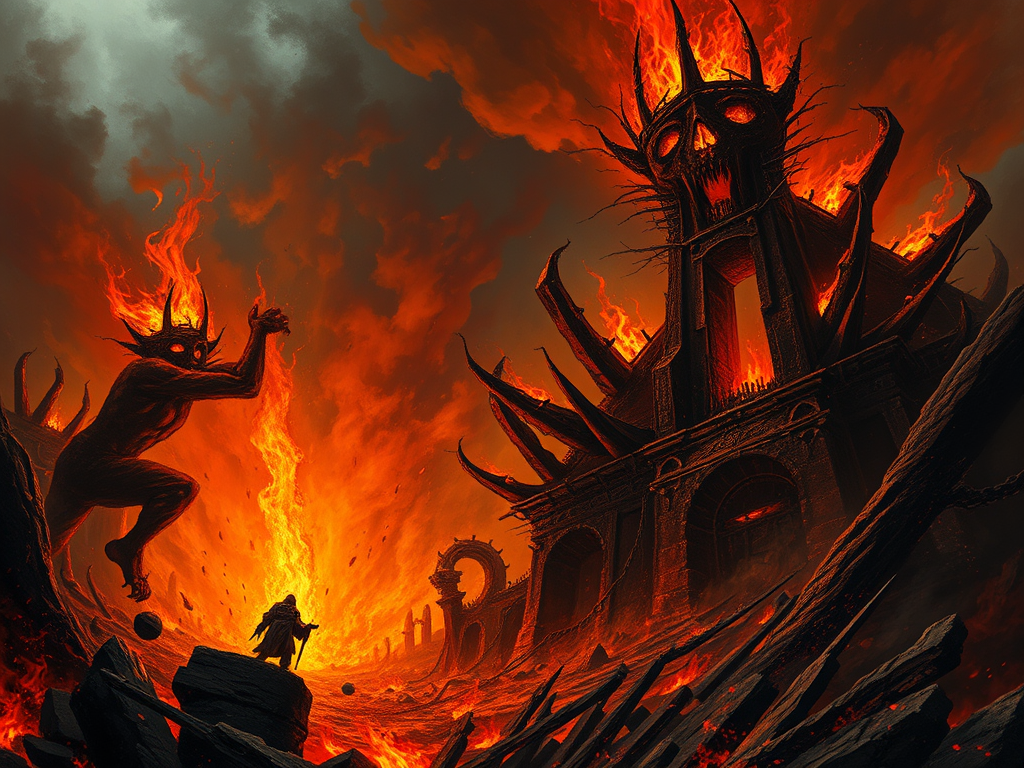
Many lament the large numbers of prisoners, particularly male convicts, who face extended jail time in the United States. Many advocates for judicial reform have sought reduced sentences for convictions and leniency for certain crimes.  Often at the heart of these discussions is a debate about the overall purpose of our prisons. There is a parallel here with the spiritual realm. Either denied or left largely untouched in religious arguments is the fact that an almost unimaginable number of spiritual felons are incarcerated by God in a prison where there is torture or pain and an eternal sentence without reprieve. Is God cruel and sadistic? The Church would say, no. Then what are we to make of all this?

Like earthly prisons, our appreciation of purgatory is for rehabilitation. A better analogy might be that of a hospital. A surgical procedure might hurt but in the long-run we will be better for it. The purgation will perfect and heal the soul. All who pass through purgatory are on their way to heaven.  They are saints in the making. At the end of time, purgatory will cease to exist and there will only remain two realities, heaven and hell.    

Unlike terrestrial jails, there can be no rehabilitation in hell.  This is no longer on the table. Often this seems to be the case on earth, not because hope has vanished, but because hearts have become too hardened to change. Recidivism rates among violent federal offenders in the U.S. is over 60% or 3 out of 5 men. Prison doors swing open and close with repeat offenders. While human justice makes mistakes, divine justice is perfect. God knows our hearts. Those who can be corrected pass through purgatory but the damned must suffer hell. We trust a God who does not err. The sentence fits the crime.  

The purposes of hell seem similar to the traditional purposes for earthly prisons:

  • RETRIBUTION – crime or sin cries out for punishment.

All sin requires the satisfaction of temporal punishment. That is why a priest gives a penance to the penitent. If this punishment is not served on earth then it must be satisfied in purgatory before our release into heaven. However, when it comes to hell, there can be no full satisfaction or propitiation. The redemptive work of Christ has been rejected. Apart from Christ, we cannot be saved. This retribution (not revenge) insures that Divine Justice is not compromised. Dishonoring or offending God is a most terrible sin. It is the direct opposite of our purpose to give glory to God and to serve him.

  • INCAPACITATION – protecting the innocent from their influence.

This topic brings up the serious issue of demonic involvement in the world. Some have even speculated that damned souls or ghosts may be able to extend something of their oppressive manipulation, particularly of those in their family line. Having said this, I have tended to interpret so-called ghosts as either the souls in purgatory beckoning our prayers or demons in disguise.  Note that in cases of demonic possessions, exorcists will order the devils to return to hell. The peculiar case of Christ driving demons into the suicidal swine is reflective of a Jewish ritual where demons might be dispatched into animals. The demons so dreaded hell that they begged to be consigned into the unclean animals, instead. A strange case with some similarity was explained to me where a Jewish exorcist drove a demon into a chicken and then he killed the bird. Unlike living human beings, demons have no localized bodies. Given that fallen angels and “disembodied” souls lack matter, they are technically only where they operate or are active. As finite, they are not like God who sees all and is in all or everywhere.

But how is it that these demons are escaping to earth anyway? This happenstance goes all the way back to the book of Genesis where we find Satan as a serpent causing trouble for our first parents. How was it that he was not caged in hell?  Some of the church fathers theorized a close proximity where hell was understood as below or under the earth.  Light is thrown upon this in the last book of the Bible:

Then war broke out in heaven; Michael and his angels battled against the dragon. The dragon and its angels fought back, but they did not prevail and there was no longer any place for them in heaven. The huge dragon, the ancient serpent, who is called the Devil and Satan, who deceived the whole world, was thrown down to earth, and its angels were thrown down with it. (Revelation 12:7-9)

We battle with cosmic powers and principalities. The hell spirits may be invisible but they are among us exerting their dark influence. Fallen angels have no corporeal bodies and thus do not “physically” break out of hell. Their condemnation and the suffering accompanied with it is their hell. While hell is a place it remains true that the devils carry hell with them wherever they go. God’s permissive will allows them a certain influence, as we see in the testing of Job and in the temptations of Christ. However, the war is won in Jesus Christ. Satan and his devils are spiteful but they are losers. God’s permissive will allows for the correct and incorrect use of freedom. He equips his children in faith with the gift of sanctifying grace, our great weapon against the powers of hell.

Some would speak of the demons as extending themselves or their spiritual stuff in such a way as to be both in hell and on earth. When it comes to certain saints this is referred to as bi-location. In any case, with the last judgment and final consummation, whatever liberty the damned spirits possess will be rescinded. Indeed, the redemptive work of Christ has broken the devil’s hold on the earth. But each of us still has to want to be saved.

  • DETERRENCE – urging those on earth to do good and to obey God.

The prospect of the loss of heaven and the pains of hell is meant to deter the living from leading ungodly lives.  Some preachers take this to the extreme of seeking to scare people into being good. The ideal is that people would be good because they love the Lord and want to honor God through their praise and obedience. But some with meager love might still be saved through the intimidation of punishment. Of course, this would not work if there were nothing of love in their hearts. In such a case, the damned of hell might know regret, not toward the Godhead, but rather because of the pain associated with hell he has brought upon himself.

Our Understanding of Hell

The traditional view of hell in Scripture and in Church teaching reluctantly admits that most people will suffer perdition. There is a universal call to salvation but that does not mean that everyone will be saved. Heaven is the ultimate sign of God’s love which we must share and return. Purgatory is an expression of God’s mercy for those who love the Lord but not as they should. Hell is proof of God’s justice where goodness is rewarded and evil is punished. There is a particular judgment at the end of life and a final judgment at the consummation of all things.   The damned in hell are alive and conscious. They are not asleep and they have not passed out of existence. The soul is immortal. It has no parts to break down. The suffering of hell is due to their awareness. Primarily, they are alienated from the God for whom they were made. Secondarily, hell is a place where there is punishment or pain to the senses. This torment is defined as fire, both literally and spiritually. It is a fire that torments but is incapable of consuming us. Hell is forever. There is no respite or escape. The literary reflection of Dante would suggest that there are circles or variations of hell based upon one’s spiritual state at death. While God’s providence cannot be thwarted and he saves whom he wills, this is understood as an election to glory. Catholicism does not teach that any are stamped as damned from the very beginning of their life-story. Rather, we get what we want. It comes down to our cooperation or lack of it with divine grace. Our emphasis is upon human freedom or choice. Not to be confused with hell is purgatory, a temporary abode (where those in venial sin or suffering from temporal punishment due to sin) can be purified or perfected by the fire of God’s love prior to entry into heaven.         

Who is the God that Saves?

Despite clashes in how we envision God, authorities in the Church insist that the Islamic God and the Father God of Jews and Christians is the same. But militants are not convinced. Neither are many Christians. If he were the same God would we not treat each other as brothers and sisters? Unable to directly assault the Christian deity, militants destroy the things and persons connected to him. Churches are bombed and believers who refuse to convert are beheaded. The God of Islamic militants is one of vengeance. The deity of Christians is weighted toward mercy and love. Note the discrepancy in the definition of one who sacrifices his life for the faith. The Muslim would count as a martyr the suicide bomber who dies taking others with him. The Christian martyr is one who has his life taken away from him and dies forgiving his murderers.  This radically different posture points to a divergent understanding of the Lord God. The definition for hell held by the two religions is largely similar although certain Muslims confuse it with purgatory.  

Ten Points About Divine Wrath & Damnation

Today we face not one heresy but a revamped modernism of all heresies. What is our posture toward God and judgment? Here are some important points:

First, one of the gifts given to terrestrial man is that we live in time and not in eternity like the angels.  When the angels rebelled, that was the end of their story.  That moment of decision was forever. As creatures that live within time, God has given us the opportunity to reconsider and to repent so as to believe.  However, this gratuity of being temporal creatures can and will be exhausted.  Starting with our conception in the womb, our days are numbered and no one knows exactly how much time will be given. That is why our Lord preached urgency in embracing and spreading the Gospel. Now is always the appointed time. Some waste the time given them or suppose that they can wait for tomorrow to repent and believe. But tomorrow often never comes. The wicked regularly discover to their dismay that they waited too long and find themselves cast by God into hell.   

Second, we should neither be presumptuous of our own salvation nor think that Divine Justice is harsh or cruel for others. Unlike human courts, God’s judgment is always true— no mistakes. The damned deserve hell.  They have earned this state for themselves. It is along these lines that we often hear silly questions and arguments. A false sentimentality is wasted on the wicked who consort with demons. They get what they want and deserve. One question that regularly comes up is whether pets like cats and dogs will join us in heaven. In truth I do not know, and often urge questioners to focus upon what “they” must do to get there. Our preoccupation in heaven will not be Spot or Kitty but in honoring and giving glory to almighty God. If it gives some consolation, nothing is lost in God. Those creatures lacking immortal souls will certainly exist as substantial forms or paradigms in the divine mind. Annihilation is against the divine economy. What God has created, he will not uncreate. God sustains his creation from moment to moment.  If he were to forget us, even for an instant, we would cease to be— indeed, we would be entirely subtracted from our time-line. But God never forgets, sustaining saints, angels, the damned and devils.

Third, the deceased are not asleep— some know God’s bounty and others know the curse of hell. The souls of all the dead separate from their corpses and await reconstitution (body and soul). There is some question as to whether this is realized immediately after death or at the consummation and final judgment. Most would argue the latter. The saints of heaven know joy and see God. They dance in the fire of divine love. The souls in purgation are being perfected by this very same flame. The damned are alienated from God and burn from the spark of God’s love that keeps them in existence. It both distracts them from their terrible loss and brings pain to the senses. The dead are aware. They suffer no amnesia. The saints pray for the living and the Church. The damned remain self-preoccupied. The punishment of hell is real. Everything is now fixed with death.  While we might imagine the worst of dictators, murderers and sex fiends in hell, I suspect there are also many average people in hell who were indifferent to the needs of neighbors, neglected divine worship and rejected friendship with Christ.   

Fourth, just as we have living saints among us, we also have the walking dead or those who abide in mortal sin. The prospective damned must struggle against divine grace or help. This is the start of divine wrath or suffering for sin. They have made themselves into nests for demons. They carry hell around with them everywhere they go. They stand convicted by God. They sap the life out of those around them. They use and abuse others, even those who would be friends and family. They might yet be saved through repentance and conversion, but it becomes increasingly unlikely. They make themselves ill-disposed to grace and they reject the Good News. I recall one such abusive man who flippantly said that religion (meaning prayer and Mass attendance) was merely for women and children. There was always a heaviness to being in his presence. One could almost feel the weight of perdition around him. His wife later confirmed it with tales of abuse and how he left her for another woman.   

Fifth, as difficult as the world is, it could be far worse. God restrains the wicked and prevents the full intrusion of hell on earth. Spiritual obsession and possession are real and God permits Satan to exploit his landfall. However, he has given his priests the authority to combat him in the sacraments and in the rites of the Church (like exorcism). If this world shares a “taste” of hell, it is all so that men and women will take the prospect of hell seriously.   

Sixth, proximate happiness and particular pleasures here on earth should not lure us into a false sense of safety or security from damnation. Everything is passing. Universalism is a lie and not everyone will be saved. Failure to keep the commandments and precepts of the Church will have a terrible cost. By contrast, remembering the poor and the oppressed will have the most important positive consequences. Many personal failings will be forgiven those who care and love much.   

Seventh, there is no safe haven for sin and evil.  Hell is not a place where the devil reigns but where evil is segregated from good and imprisoned. Despite their consternation and protest in hell, the one king is not the false light of Lucifer but the Christ who sits at the right hand of the Father. The devil truly has lost everything. The one who regarded himself as the lord of the world could not even retain his dominion over hell.  All are subject to Christ— the saints of heaven in love and the damned of hell in fear and trembling. While on earth, many of the “people of the lie” seem to place little concern in their approaching death? Why is this? Evil itself acts as a narcotic, numbing the wicked to the truth. How can one be anxious about death when one is already spiritually dead in mortal sin? Of course, a few still seem to awaken from their moral slumber and repent before their deaths. The miracle in this is entirely in the mysterious movement of providence and grace. God chases down and snatches certain souls from the grips of the evil one. They might even become great saints. Others languish in the squalor of their iniquity and find themselves forever counted among the unrighteous. God saves whom he wills.  

Eighth, there are some who laugh and joke about their spiritual condition. Many of us have been guilty of this and admittedly it betrays an element of anxiety. What are some of the things said? “Only the good die young so I guess I will be here for a long time to come.” “Why did I not die? Well, heaven did not want me and the devil did not want competition.” We live in the hope of our salvation, but for the grace of God any of us might be lost. None deserve to be saved. It is not something we can merit on our own. It may be that we take solace from having religious or holy friends who think well of us. We hope that their intercession will bring leniency upon us when judgment comes.  While there is value in this, we must still be in a state of grace. We cannot expect the merit of another to make up for our own poverty in grace.  We are a holy nation and ours is a corporate faith; nevertheless, each soul will still be judged on the merit of its faith, obedience and charity. None should think they are utterly safe from the wrath or severe judgment of God.    

Ninth, nothing we do, no matter how courageous and good, will save us if we reject Jesus Christ.  We must be re-made into his likeness. The Father must see his Son in us if we expect a share in his reward. Our merit means nothing apart from Christ and his mystical body, the Church. However, everything is to be gained by allowing the Lord to work and to be seen in us.

This is how you can know the Spirit of God: every spirit that acknowledges Jesus Christ come in the flesh belongs to God, and every spirit that does not acknowledge Jesus does not belong to God. This is the spirit of the antichrist that, as you heard, is to come, but in fact is already in the world. You belong to God, children, and you have conquered them, for the one who is in you is greater than the one who is in the world. They belong to the world; accordingly, their teaching belongs to the world, and the world listens to them. We belong to God, and anyone who knows God listens to us, while anyone who does not belong to God refuses to hear us. This is how we know the spirit of truth and the spirit of deceit (1 John 4:2-6).

Tenth, wrath or divine justice does not mean, as some of the Calvinists believe, that almighty God “hates” sinners. God hates sin but he loves even those children who disobey him and fail to return his love. The fact of this love seems to further embitter the damned against God. This is witnessed again and again in how the ire of the wicked targets the prophets of God, notably Christians who minister in charity and promote peace.