















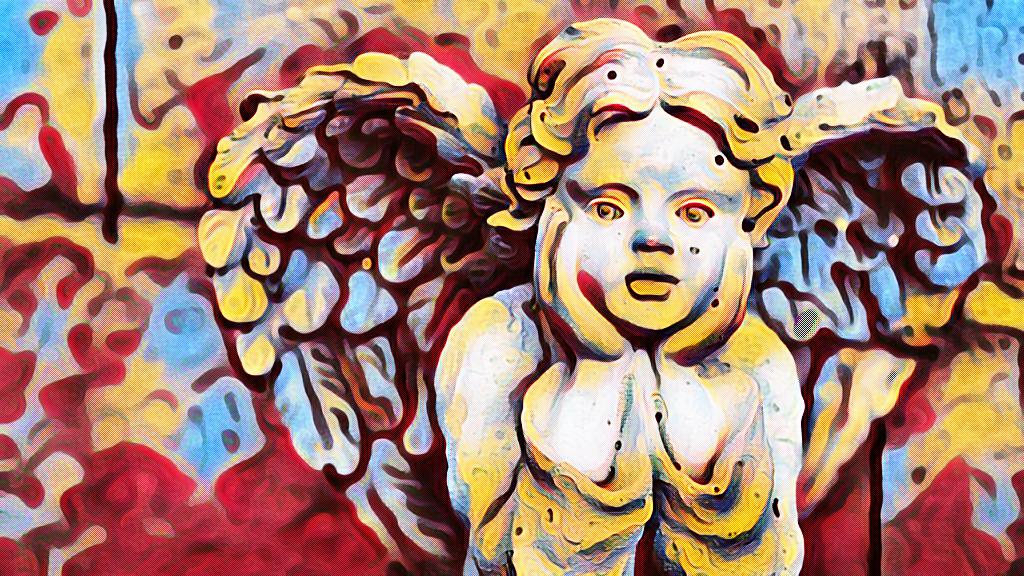
There are so many misconceptions about angels. Many imagine they are simply human souls that have been rewarded with wings in the afterlife. This is not the case. Many have their religious formation from Hollywood and not from the source that is truly holy. Angels like us are “persons” with will and intellect. They are both good and bad. However, other than that, they are utterly alien to humanity. They are purely spiritual entities without bodies and thus they do not reproduce, do not age and cannot die. We often fantasize about them with flowing robes, wings, and halos. But in truth they look like nothing at all. If God should allow them, they can appear before men, but only as phantasms or caricatures of human beings. Beneath the appearances, they are something utterly beyond our comprehension. The good angels obey and will never tarry to answer God’s summons. They adore the Lord as a host or angelic choir. They love God and they love us. While they are not human, they are counted among the saints of heaven. They intercede and pray for us. The bad angels turned from God. Unlike mortal men this rebellion has permanently misaligned their orientation. The West, unlike certain Eastern churches, does not believe that angels can repent and return to God’s good favor. Demons will always be demons. They may know an intellectual life with the other damned of hell, but they have forever forfeited grace. Where there should be love there is hatred or indifference. At death the souls of the departed are also fixed, either orientated toward God or away from him. It is said that as many as a third of the angels rebelled against God. Many of the ancient Church fathers thought that their fall was due to a repudiation of the providential incarnation. Unlike the angels of the nativity, they had refused to bend the knee to the Christ Child. The good angels always adore the Lord and praise the godhead as Holy, Holy, Holy.
As spiritual and not material beings, the angels know duration but not time as we do. They have no gender. They do not have our five physical senses. They do possess angelic powers. However, as “persons” they are aware, can know and love and choose. All the angels that would ever exist were created in the same moment. This is contrasted to human beings who are created throughout time. However, at the end of the world, our numbers will also be fixed.
The word “angel” means messenger and they are periodically sent by God in the history of salvation. Note what is said in the universal catechism.
CCC 332 – Angels have been present since creation and throughout the history of salvation, announcing this salvation from afar or near and serving the accomplishment of the divine plan: they closed the earthly paradise; protected Lot; saved Hagar and her child; stayed Abraham’s hand; communicated the law by their ministry; led the People of God; announced births and callings; and assisted the prophets, just to cite a few examples. Finally, the angel Gabriel announced the birth of the Precursor and that of Jesus himself.
CCC 333 – From the Incarnation to the Ascension, the life of the Word incarnate is surrounded by the adoration and service of angels. When God “brings the firstborn into the world, he says: ‘Let all God’s angels worship him.’” Their song of praise at the birth of Christ has not ceased resounding in the Church’s praise: “Glory to God in the highest!” They protect Jesus in his infancy, serve him in the desert, strengthen him in his agony in the garden, when he could have been saved by them from the hands of his enemies as Israel had been. Again, it is the angels who “evangelize” by proclaiming the Good News of Christ’s Incarnation and Resurrection. They will be present at Christ’s return, which they will announce, to serve at his judgment.
Given the identity of Jesus as God’s only Son and the Second Person of the Blessed Trinity, the angels are preoccupied with Christ— announcing his birth with the hymn of heaven, ministering to him after his temptation scene with the devil, and giving him consolation in Gethsemane before the ordeal of his betrayal and passion. Angels are also heralded to accompany the risen Christ on the day of judgment. They are imaged as harvesters of souls. Similarly, we are informed that angels can minister to us (Hebrews 1:14) and function as special guardians (Matthew 18:10). The Roman Canon of the Mass even speaks of an angel that takes the oblation of the Eucharist to the heavenly Father.
While angels belong to the supernatural realm, they are limited by their nature to angelic power and to whatever divine grace allows for them. Just as we can make things, only God can create from nothing. Similarly, neither angels nor demons (fallen angels) can truly create, as this requires infinite power. New Age religion erroneously corrupts this understanding by having its adherents praying to angels as if they were deities. Such an angelology is an utterly offensive idolatry as it seeks through superstition to usurp divine sovereignty.
Filed under: Uncategorized | Tagged: Bible, Christmas, Faith, God, Jesus | Leave a comment »

















 Blogger Priest