














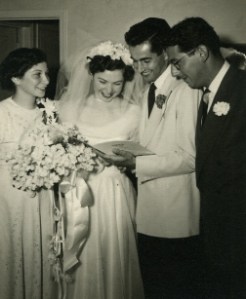
 Marriage is a natural right. However, the Church reasonably asks couples to refrain from this right until they have obtained adequate psychological maturation. This coming-of-age is indicated by comprehending marriage as a life-long, complete commitment between a man and woman. They would also have to understand that this relationship is orientated toward mutual love and help (fidelity) and to the procreation and education of children. The background to this awareness is a realistic appreciation of the various difficulties in marriage and how they might handle them. They must be free from coercion in making this promise of a shared life and possess integrity of intention or will, resolved to endure any hardship.
Despite the shameful statistics, the Church is almost alone in teaching that marriage is an unbreakable bond. Non-Christians may know it as the noblest of natural contracts; Christians can embrace it as a sacrament, a covenant through which Christ gives grace. St. Paul tells us that Christian marriage is a sacred sign that reflects the lasting unity of Christ, the groom, with his bride, the Church.
A married couple extracts life from out of their love. First, in their reciprocal fidelity, they nurture and give life to each other. Second, in their openness to children, they cooperate with God in the act of creation. They summon into existence separate individuals who will endure for all eternity. What other human work could ever compare with this? Rather than a onetime event, they continue to give life to their children by caring for their physical needs. They must also aid in their spiritual development, laying foundations for growth in faith and holiness. This latter responsibility cannot be over-emphasized. Third, growing in holiness themselves, the couple’s love and service is a powerful witness, giving life to all whom they meet. Seeing their faithful commitment, we are reminded that this kind of love has not utterly passed from the world.
Jesus raised marriage to the level of sacrament. Although we do not know the precise occasion of its institution, the Church early on recognized that the reality of this relationship was transformed by the commitment of two baptized Christians in a covenant of love. Indeed, Christ identifies himself with the beloved.
Marriage makes two people helpmates to each other in seeking holiness. Spouses are to assist each other in becoming saints who will share eternal life with Christ in heaven. If all their earthly preoccupations bypass this objective, then there is something defective in their love. It must be an ingredient— even if it is tragically reduced to one spouse praying for the other to return to faith practice or to join the Church. Ultimately, sacramental grace brings confidence to the couple that God will help them to persevere in love, fidelity, and holiness.
The sacrament of marriage has certain effects:
1. An invisible bond that will last until the death of one of the spouses; and
2. The graces of the sacrament.
The graces of the sacrament include all those necessary to maintain their collaboration and mutual love in all aspects of their shared life— graces to confront and conquer all threats, troubles, misunderstandings, illness, or anxiety. If we walk with the Lord, his promise of grace and his presence will remain with a marriage for a lifetime. It must be made clear that one might receive the sacrament of matrimony with its permanent bond, but without the graces to faithfully live it out. Indeed, a root cause for divorce among Christians is in this regard; serious sin would lower the sacrament to a sacrilege. This is no light matter. Mortal sin destroys our relationships, both to God and to one another. However, even in these unfortunate cases, with the restoration of saving grace through the sacrament of reconciliation, the graces of marriage would be made fully available.
There are many duties and responsibilities in marriage. Chief among these are fidelity, cohabitation, and mutual help (especially with offspring). Statistics reveal that the Catholic divorce rate is rapidly approaching the national average wherein half of all marriages fail. Interestingly, a Gallup poll discovered that couples who pray together for a few minutes every day and who regularly attend Sunday Mass have a much lower failure rate. Indeed, 98% of such marriages survive and flourish. This says something wonderful about the intimacy of prayer between spouses and God— it is a visible testimony about the positive influence of grace living in true Christian marriages.
Filed under: Discipleship, Marriage, Sacraments, Sexuality |













 Blogger Priest
Dear Fr Joe,
Thank you for your kind words and immense wisdom, Sometimes my unresolved anger slips out sideways as cynical comment. I remember the old Catechism answer to: “What is prayer?”…….”Prayer is the raising up of the mind and heart to God”. Sometimes my prayers are more like a shopping list with just one of two items constantly written down.
I have many blessings that I can count even if they seem without worth somedays. I have a brilliant foster daughter who I will be taking to the airport tomorow morning for 5 days to Auswitz and Berkenau as part of her philosophy degree. She’s the only Deist in the group of 40 or so, and although not baptised, yet still she sees herself as Catholic and I doubt God would refuse her Heaven for want of a sprinkling. Theologians would take me to task I suspect.
Depression is a desperate place to be, and the affliction takes me over from time to time, but strangely at those moments there is a genuine questioning even though it seems not only an absence of anything good, but also the concept of God. It can be a bit like looking into the desolation of the gates of Hell in a way.
On a plus, I was able to find a dealer, in USA who supplies diesel injector nozzles so (as a retired engineer), I was able to mend my 20 year old car and keep it on the road a little longer. Gas here is about $10 a gallon. The Old age pension is about $190 per week. So you can see life for the 2 of us is very tough, but I genuinely thank God that we manage very well. And I will try to get out to help others now that I’m mobile again.
With loving thanks, Paul
A few points based upon questions asked in RCIA class and marriage preparation:
1. The couple marry themselves; they are the ministers of the sacrament.
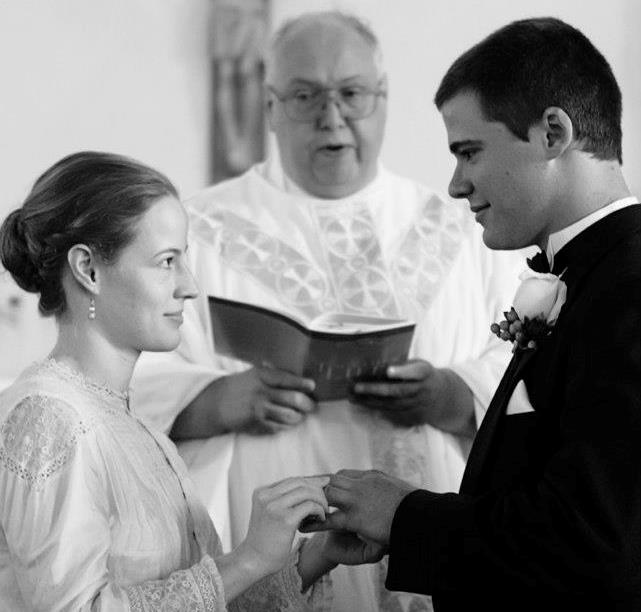
2. Catholics are generally required by the Church to have their marriages (vows) witnessed by a priest (or deacon) and two witnesses.
3. Attempted marriages of Catholics outside the Church are regarded as null-and-void. Marriage before a Protestant minister or civil magistrate is neither licit nor valid. Marriage (without permission) in an Eastern Orthodox church (not in communion with Rome) is considered illicit, but valid. If the law of the Church could not reasonably be fulfilled, as with a couple stranded for years on a desert island, they could make their vows before God and share the sacrament of marriage. Upon their rescue, the Church could provide the missing ceremony, but their marriage would be recognized and their children regarded as legitimate.
4. All sacraments have form and matter. The form consists of the vows (recited before a Catholic minister and two witnesses). When asked, inquirers often suggest that the rings are the “matter” for the sacrament. But this is not true. Rings are not absolutely essential. The matter of the sacrament is the bodies of the couple. The marriage is consummated after the official ceremony by the marital act: consensual non-contraceptive vaginal intercourse. It is the chief way that a couple regularly renews their covenant with each other.
5. The Catholic Church frowns upon divorce. The person or persons who are the primary cause for the failure of a marriage commit sin. Remarriage after a genuine and consummated marriage is forbidden. The Church sometimes tolerates divorce and grants annulments; but an annulment is not the same as divorce. An annulment implies that there was an initial defect which compromised the validity of the marriage. Such a situation is supposed to be proven with documentation and witnesses. Annulments are sometimes turned down. When this happens a person cannot get married again and must live a life of perfect continence.
6. The marriage between two baptized Christians is regarded as a sacrament. If one or both of the spouses is not baptized, the marriage is classified as a natural bond. As long as they are free and responsible, the Catholic Church recognizes the marriages of non-Catholics by their ministers and even by civil magistrates.
7. Elderly and infertile couples can get married; however, couples should not seek to sterilize themselves either through the use of artificial contraceptive or surgical intervention. Indeed, there must be openness to the generation of human life as a chief purpose of marriage. Otherwise, given that they are honest with the priest preparing them, they would not be permitted to marry in the Church.
8. A prenuptial agreement stipulates a level of doubt in the consent of the couple and the conviction of permanence for the marriage union. Such an agreement is forbidden by the Church and can nullify the bond of marriage. If people are not sure and do not trust their potential spouse, then they should not get married.
9. In an attempt to counteract the epidemic divorce rate, couples desiring to get married must give the priest they contact at least six months prior notice. During this time they will take instructions and necessary documents will be gathered: prenuptial investigation forms, baptismal certificates, license application, and possibly an evaluation like FOCCUS.
10. Couples are increasingly spending a great deal for weddings and saving nothing for the marriage afterwards. This is ridiculous and irresponsible. People should not go deep in debt because of one day. They need to invest in each other and their life together.
11. Increasingly couples are fornicating and cohabitating before marriage. Sex outside of marriage is a mortal sin. Once sex is take out of marriage it is hard to put back; in other words, fornication before marriage sets the stage for adultery after marriage. If couples cannot exert self-restraint and discipline before marriage then where will they get the strength of character to make their marriages work when problems arise? Men and women alike should be virgins on their wedding night. When they are not, they have cheated each other of a great gift. Often they have been intimate at some time or another, with a person who was not their intended spouse. That means that they have given to someone else something that belonged to their future spouse. They can know forgiveness but they cannot undo the damage that was done.
Dear Fr Joe,
It may be that the couple who ‘prays together stays together’, or it may well be that those who are that way inclined to think that prayer could possibly bring benefits are just ‘nice’ people and would be able to endure anyway………….it’s cause and effect!
Having done all the praying that could reasonable be expected by a normal person my life has continued to fall apart, my marriage ended in divorce, I was left ‘holding the baby’, but a beautiful baby nevertheless, and I continue to struggle with my faith. Every day I want it to be over, and I’m currently half way through a nine week novena to St Anthony. Will it make any difference? I am convinced to a man that there will be no benefit whatsoever.
Does God answer prayer? In my experience and of those around me…………NO! Is Catholic prayer more efficacious than the exhortations of pagans? Not that I am aware of. Did I get any special grace from God to make my marriage special? Absolutely not. But I can only base my beliefs on my experience and of the experience of those around me.
Because of some really bad childhood experiences, two insane but very Catholic parents, and a whole gamut of indoctrination forced into me by a very abusive education I learned to be self sufficient. There was only one person I could ever rely on and that was …………me. And that became rocky as I sank into alcoholism. I’ve been sober for 26 years now, but every day I make tough choices battling depression, relative poverty and failing health.
The Catholic ideal, the notion that marriage is somehow special and a sacrament was a childhood dream that turned into a nightmare for me and one never to be repeated. Because of my Catholic beliefs I do not get a second chance and in some respects that is a blessing. But the isolation of singleness is somedays overwhelming.
After God created Adam he realised that it was not good for man to be alone, so He made him a helpmate and the two became one flesh. When a helpmate and soulmate dies it can be traumatic and a awful time to go through. When that helpmate actually and deliberately rejects you for another, that wounding can last a lifetime, especially if it was a culmination of a lifetime of experiences of rejection and judgement of ‘not good enough’…………….it’s easy to get caught up in the belief that God also rejects you especially if the continued experience is of an unattainable and unattentive God set upon punishment and retribution.
Perhaps I was never constructed to have a helpmate, but one thing is true: “It is not good that man should be alone”
Best wishes, Paul