






















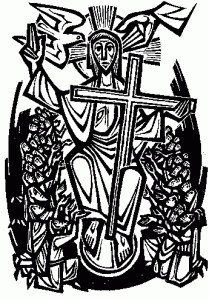
 At this point I would like to say something about the liturgical year; more precisely, I would like to give a quick summary of the first week of Easter. The Gospels relate the resurrection appearances of Jesus. Easter Sunday, we have the discovery of the empty tomb; Monday there is the story of Jesus appearing to the women; Tuesday there is the sending of Mary Magdalene to tell the disciples of his restoration; Wednesday he reveals his identity in the breaking of the bread to the two men on the road to Emmaus; Thursday he reappears to these two while they are recounting the incident to his disciples; Friday he appears upon the shore while his friends are fishing; Saturday there is a brief summary from Mark of his earlier appearances and the narration of his coming to his followers while at table. Finally, John offers us two occasions where Jesus appears to his friends while assembled in the upper room.
Jesus has risen from the dead. Over and over again it is with this message that the Church saturates us. John 20:19-31 has the doors locked in fear of the Jews who plotted Christ’s death. But, doors locked because of fear are no barrier to the risen Christ. The only locks which might prevent him from being present in our lives are the ones we place upon ourselves.
We are surrounded by signs of God’s presence. Every Springtime signals the reawakening of nature, aiding us in appreciating the meaning of Easter. Learning our catechism answers is not enough. If we say that God is everywhere, we run the risk of some skeptic asking us where we saw him last. What answer would we offer?
Astute philosophy teachers would remind us that God is in his creation, but only in the Incarnation can he be identified with it. Who is this God who is vast and infinite — who is all-perfect and knows everything — who is omnipotent and the source of all life — who is three persons in one nature — who can be revealed to us in the flesh of a frail individual called Jesus and be put to death and rise from the grave? Do we see the wonders of God around us and proclaim his glory or do we nurture doubts?
Our faith teaches us that the Scriptures are both the word of God and of man and that they speak infallibly in regards to salvation truth — do we believe this? Do we believe their testimony and that of the Church that Jesus rose from the dead? These are important questions. There are some who seem to believe easily and there are others who find it a most grueling pursuit.
I want to narrow this focus to the abiding presence of Christ in the Church and the ongoing historical fact of the resurrection. I do not pretend to speak the last word on these matters; but, it may be important to speak all the same.
There was an Anglican Bishop of only a few years ago who publicly admitted in his cathedral that he did not believe the resurrection had ever occurred. Even men of faith may lose it. An interesting footnote to that incident was that a bolt of lightning immediately struck the building and destroyed an ancient stained-glass window. One uncharitable critic with a sense of humor remarked that God’s aim was off and he just missed. Like Thomas in our Gospel, it is easy to discount the fantastic or the unusual. Indeed, this is the age of the doubting Thomas. Science has taught us to believe only what we can empirically prove. Because we cannot place the resurrection of Christ under a microscope, it is a matter, if not outrightly rejected, then ignored. Theologians, even in the Catholic camp, have endorsed an assortment of resurrectional theories which I must admit, if I accepted, would seriously dampen my faith. I recall one most famous thinker writing that if the bones of Christ were discovered tomorrow, his faith would remain intact. He would do this by spiritualizing the event into some kind of a-historical sphere beyond the datum of archeology. For me, such a statement already infers a level of doubt. Some of our thinkers would minimize the resurrection to the level of an internal feeling or experience with no physical counterpart or manifestation. There would be no visions of the risen Christ and the stories of the risen Christ a fiction made up to express what they were feeling in their hearts, especially at meal time. I am sorry. I cannot buy any of it. Maybe we all think too much? Maybe we want everything too explainable within very narrow limits? Faith is deeper than knowledge, even if one informs the other. There are plenty of men and women with intellects which could do circles around most of us; but, they might not all be believers. First and foremost, we need to fall upon our knees and admit that the resurrection is a mystery. However, having said this, we must also acknowledge that it is very real. Everything that Jesus was, his entire person — body, soul, and divinity, is transformed or glorified by the resurrection. He is like us even though his humanity is perfected beyond our wildest dreams; he is unlike us in that he appears in locked rooms and to those with eyes of faith. I believe this is the response to which the Scriptures honestly testify. To doubly stress the fact that this resurrection has a deeper substance than that which some moderns would offer it, we have the story of Thomas. Because we could not all be there, he is our representative. He says, “I’ll never believe it without probing the nail-prints in his hands, without putting my finger in the nail-marks and my hand into his side” (John 20:25).
A second time Jesus appears in the locked room. Thomas is there. After wishing them peace, he says to Thomas, “Take your finger and examine my hands. Put your hand into my side. Do not persist in your unbelief, but believe!”
(John 20:27). I cannot imagine this testimony from Scripture if this appearance were simply on the level of hallucination or a dream. No, Jesus said and meant these words. This particular testimony is for us more so than any previous age.
In the sacrament of the Eucharist, the Church provides what is missing so that the risen Christ might be here for us as our food. Jesus again speaks, but this time his words may be more directed to us than to Thomas. “You became a believer because you saw me. Blest are they who have not seen and have believed” (John 20:29). A day should not pass without our thanking God for the gift of faith and beseeching him for an ever greater share of understanding and belief. The sacraments must suffice until we meet Christ face to face. When we look upon the cup of his blood and the bread which is transformed into his body, we need to see with eyes of faith. He is here with us. His real being is present in these gifts, not just as empty symbols, not merely as devices to recall a past event, but actually here. My father had this kind of faith. Every time he saw the host and cup elevated he could not help but respond with those words of Thomas, “My Lord and my God!” (verse 28).Those need to be our words, if not upon our lips, then at least in our hearts.
For more such reflections, contact me about getting my book, CHRISTIAN REFLECTIONS.
Filed under: Catholic, God, Incarnation, Jesus, Liturgical Year, Redemption, Reflection | Leave a comment »
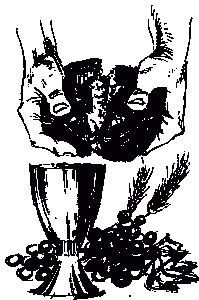 You may have noticed how often the resurrection appearances are linked with meals. I have already mentioned the story of the two men on the road to Emmaus who recognized Jesus in the breaking of the bread. Jesus also took and ate a fish to demonstrate that he had actually risen from the dead.
 Jesus appears to his friends and wishes them peace (Luke 24:35-48). I want to speak briefly about this appearance and a connection we can make with it in our lives. When his friends doubt it is him, or fear that it might be a ghost, he tells them to look, to see, and to touch. He shows them his wounds and says, “…a ghost does not have flesh and bones as I do.” Then he accepts and eats a piece of fish with them. St. Luke is adamant in having us understand that he is really in this scene and no mere ghostly apparition or simply an internal feeling that he is present, as we sometimes sense at prayer. He is much more here.
 The story of Jesus appearing to two men on the road to Emmaus is one of the most famous of our resurrection accounts (see Luke 24:13-35). The last phrase, “. . . they had come to know him in the breaking of the bread,” speaks to us about how we encounter the risen Lord in our Eucharist. The Eucharist is Christ’s living legacy to us. No matter what age it might be, he does not abandon us. After his ascension, the Lord continues to abide in his early disciples as well. He sends them his Spirit and works his ministry through them.
 From the very beginning, there would be those who would doubt the resurrection of Christ. Indeed, even one of his disciples, Thomas, would have to be challenged by Jesus himself to touch his wounds before his skepticism could be swept away. However, the Gospel chronicles another type of rejection as well, one far more resistant to the truth (see Matthew 28:8-15). The chief priest has an inkling that the story of Christ’s coming back from the dead might bear some truth. It is this possibility which he and his cronies seek to hide behind lies. So, they bribe the soldiers to say that Jesus’ disciples had stolen the body at night.
 The cast of characters and events in John 20:1-9 fuel our hope. They include Mary Magdalene, Simon Peter, and John. But notice who is absent in our reading; although it is a Gospel and therefore about Jesus, he is neither seen nor heard. All we have is the empty tomb and some surprised disciples. The story, of course, goes on; but, the Church in its wisdom feels that this passage alone would suffice on Easter morning at Mass. Why is that? Let us look at the story.
 The feast of Christmas is very important in preserving an authentic understanding of the identity of Jesus. It is for this reason that the Knights of Columbus each year promote their loyal “Keep Christ in Christmas” campaign with essay and poster contests. Of course, it has been argued that the abbreviation “X-mas” still preserves something of the truth in that the “X” is an ancient symbol for the Cross and thus, by association, for Christ, himself. Those who malign the celebration of Christmas as a religious holiday, more so than not, minimize the mission and identity of the Lord. There is a minister, nationally televised throughout the nation on Sunday mornings, who annually assaults the meaning of Christmas. He actually claims that the Jesus who walked on earth was a different individual from God’s eternal Son in heaven. Jehovah Witnesses reduce Jesus to an important prophet but sidestep the dilemma that unless he is God then the charges of the Pharisees and the Sanhedrin stick. Only God can forgive sins. Only God could save us. Another evangelist bewails the fact that at Christmas even the most sanitized Protestant worship space looks like a Catholic church with the various “idolatrous” statues of Jesus, Mary and Joseph. This is peculiar in that many of these same churches will return to repudiating such graven images come December 26 and argue that Catholicism has stripped the corresponding commandment from the Decalogue. Our view is not all that complex, although it is perfectly reasonable: the incarnation of Christ alters forever the economy of images. Jesus is the revelation of the Father and God with us. Now, the image of the creature can convey something of the dignity of God and his involvement in salvation history. Representations of Christ, the Virgin Mary and other saints are not worshipped in themselves but constitute a language in pictures that moves the mind and heart to the truth of the Gospel. A crucified figure on the Cross or any baby in a manger is recognized immediately, even by a child, as Jesus. One of the most heated debates on Internet message boards is between hard-line Seventh-Day Adventists and mainline believers over the correct Sabbath and the so-called pagan origins of Christmas. Protestant Christians are ridiculed for following Catholic institutions not mandated by the Bible. The Mormons often have very elaborate and beautiful commemorations for Christmas; however, they deny that Jesus is the unique or only Son of God the Father. This difference is critical because a denial of monotheism separates them from classical Christianity as well as from Islam and Judaism.
 The presence and participation of girls as altar servers has become fairly commonplace since their official introduction in the 1990’s. Just as we would hope that our young men might be inspired to consider a vocation to the priesthood; it is desired that our young ladies might give some thought toward a calling to the religious life as either a sister or a nun. While it is only “private” revelation, I have routinely shared with our altar girls the following citation from Mary of Agreda’s CITY OF GOD about the Virgin Mary’s service in the temple:
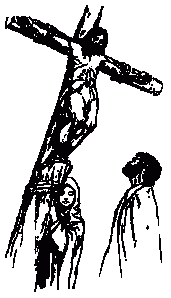 Jesus is our High Priest. Unlike the Jewish priests, he was not given his role by human authority and neither did he have any personal sin for which he needed to make an offering. Jesus took upon himself the punishment that was rightfully ours. Certainly his death on the Cross brings immediately to mind the great offense of our sins. We did not deserve such a Savior who would make himself priest and saving victim. Looking upon the Cross should serve as a remedy for our pride and lust, unless we have desensitized ourselves to human suffering. Jesus repairs the damage inflicted by Adam and Eve. His death will render satisfaction for all the sins of their children.
 The long-awaited Jewish Messiah comes into the world (Matthew 1:1-25). The Genealogy of Jesus is traced to his stepfather, Joseph and the remaining Gospel text affirms the virgin birth. It was customary for people to marry within their tribe. Thus, if Joseph was of the line of David then Mary would be as well. Despite the fact that the conception was made possible through the intervention of the Holy Spirit, it was customary to trace the family line through the father. Again, affirming that Jesus was the promised Messiah of the line of David, Joseph and Mary go to David’s town of Bethlehem for the census (Luke 2:1-14). The story is familiar; there was no room at the inn and so the Christ-child was placed in a manger, a feed box for animals. Today, upon the manger of the altar, we again find Jesus, who makes himself a saving food for men and women. The angel makes the wonderful pronouncement to shepherds and the hosts of heaven rejoice. It is part of Christian folklore that the devil and the other fallen angels were thrown out of heaven precisely because they refused to have any part in this angelic rejoicing. He would not bend the knee or give glory to a God dressed in human flesh and made vulnerable to human caprice. The shepherds visit the nativity (Luke 2:15-20). Mary “treasured all these things and reflected on them in her heart,” an indication from St. Luke that Mary was one of his sources for the nativity narrative. The great theologian of the evangelists, John, speaks of the pre-existent Word that became flesh, the only Son of God come into the world to save us and to bring us to the Father (John 1:1-18). The Jewish Messiah is revealed as the World Savior and God come among us.



















 Blogger Priest