























 The presence and participation of girls as altar servers has become fairly commonplace since their official introduction in the 1990’s. Just as we would hope that our young men might be inspired to consider a vocation to the priesthood; it is desired that our young ladies might give some thought toward a calling to the religious life as either a sister or a nun. While it is only “private” revelation, I have routinely shared with our altar girls the following citation from Mary of Agreda’s CITY OF GOD about the Virgin Mary’s service in the temple:
“The priest also gave Her a rule for her occupations and said: ‘My Daughter thou wilt assist at the exercises of divine praise and song in honor of the Lord with all reverence and devotion, and always pray to the Most High for the necessities of his holy temple and of his people, and for the coming of the Messiah.” . . . The most holy Child remained on her knees, while She listened to the words of the priest and then asked his blessing; . . . In the performance of works not commanded Her our Queen and Lady distinguished Herself from other maidens by asking her teacher to be allowed to serve them all. . . . By means of her infused science She understood all the mysteries and ceremonies of the temple; but She was anxious to learn them also by study and practice, as if She were ignorant of them, nor did She ever fail in any ceremony or duty, no matter how small. She was most eager for humiliation and most submissive in her self-contempt; . . .” (pp. 130-132).
If our girls and women can in some small way imitate this kind of model, then the novelty of their service should prove no problem. Notice the word “maidens” in the text? Although not translated, the Roman Canon mentions God’s servants and handmaids. Considering the political climate, such an appreciation would be a wonderful counter-cultural sign of humility, not to men, but to almighty God.
Filed under: Altarservers, Discipleship, Liturgy, Mary, Mass, Parish | 2 Comments »
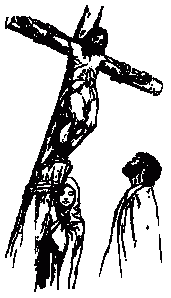 Jesus is our High Priest. Unlike the Jewish priests, he was not given his role by human authority and neither did he have any personal sin for which he needed to make an offering. Jesus took upon himself the punishment that was rightfully ours. Certainly his death on the Cross brings immediately to mind the great offense of our sins. We did not deserve such a Savior who would make himself priest and saving victim. Looking upon the Cross should serve as a remedy for our pride and lust, unless we have desensitized ourselves to human suffering. Jesus repairs the damage inflicted by Adam and Eve. His death will render satisfaction for all the sins of their children.



















 Blogger Priest