• Our Blogger

    Fr. Joseph Jenkins

  • The blog header depicts an important and yet mis-understood New Testament scene, Jesus flogging the money-changers out of the temple. I selected it because the faith that gives us consolation can also make us very uncomfortable. Both Divine Mercy and Divine Justice meet in Jesus. Priests are ministers of reconciliation, but never at the cost of truth. In or out of season, we must be courageous in preaching and living out the Gospel of Life. The title of my blog is a play on words, not Flogger Priest but Blogger Priest.

  • Archives

  • Categories

  • Recent Posts

  • Recent Comments

    Anonymous's avatarAnonymous on Ask a Priest
    Michael J's avatarMichael J on Ask a Priest
    Jeremy Kok's avatarJeremy Kok on Ask a Priest
    Mike Zias's avatarMike Zias on Ask a Priest
    Jeremy Kok's avatarJeremy Kok on Ask a Priest

Mary as an Antidote to Sin & Temptation

There are innumerable temptations and sins which afflict modern men and women. Honor given to Mary may be an antidote to many of these. Mary says YES to God when so many say NO. God was at the center of her existence. We push God off into the periphery of our lives and sometimes with a loss of faith, under the rug. We pretend that we do not need God and that we have a large level of control over our lives. This is a lie, though, and sooner or later mortality fails us.

Mary, on the other hand, humbly submitted herself into the hands of God. She trusted in his providence which called her forth and imbued her with the mystery of mysteries, the incarnate Christ. She was chaste and pure, qualities no longer deemed as having value. She accepted her miraculous motherhood. Today many women run away from this noble vocation and either medicate their fertility away or destroy the child in the womb.

Where do we find ourselves in the story of Jesus and Mary? Are we defenders of decency and champions for the Gospel of Life? It may be that some of us have compromised ourselves. Mary, like Jesus, will always embrace the prodigal who comes home.

We should not dismiss the guilt and shame we feel; rather, there should be acknowledgment of fault, repentance, conversion, renewed faith and healing.

The Receiving & Giving of Mary

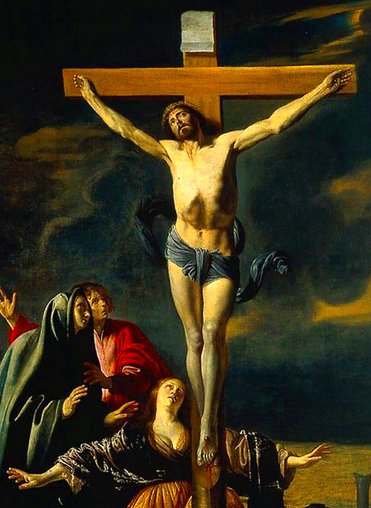
There is something strangely dynamic about Mary in that she receives within her the Christ so that she might give him to the world. It was with this insight that some of the Church fathers spoke about her as a tube or straw. Her personal virginity is not infringed upon and yet the one who is the Way comes into the human family by “way” of this maiden of Israel. She is there at the very beginning and she will be there when his saving work is accomplished. It is on Golgotha that she takes back to herself, into her arms, the Son that she gave to mankind. He is abruptly gone but she remains, given to our emissary John. When others ran away, she sought to be near her Son. She will always be near him.

After the Lord rose and ascended, the early Church cared for her in the desire of believers to be near Christ. They knew that respect and honor given her would be looked upon kindly by Christ. There was confidence that the bond she had with him had not been severed by his passion and death. Motherhood, and I should hasten to add, fatherhood, are not temporary jobs but lifelong vocations. This holy vocation of love lasts as long as there is life; and of course, in Christ, life is eternal.

The apostolic community saw in Mary’s intimacy with Christ something of its own hope for life and desire for union with Jesus.

A Private Litany for Mary

Response: Hear our prayer.

Mary, the maiden of prophecy, R.

Mary, conceived immaculately in the womb, R.

Mary, entrusted by your aged mother to temple service, R.

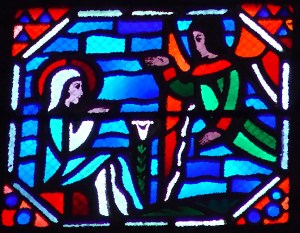
Mary, approached by God’s angel at the Annunciation, R.

Mary, watching over the Christ Child in a manger, R.

Mary, fleeing with Joseph and Jesus into Egypt, R.

Mary, warned of the piercing sword at the temple presentation, R.

Mary, searching for Jesus among the crowds, R.

Mary, weeping at the foot of the Cross, R.

Mary, holding the dead body of your Son, R.

Mary, witnessing the resurrected Christ, R.

Mary, matriarch over the whole Church, R.

Marian Hymns Without Mary & Jesus?

There are beautiful Marian hymns, ancient and modern, everything from Ave Maria and Immaculate Mary to the more modern, Sing of Mary, Pure and Lowly. But some have attempted to censor Mary and Jesus out of Christmas and Marian hymns. Austere Protestants might sanitize beautiful melodies of Marian references. Secularists and non-Christians would subtract Jesus. There are also new melodies and songs which portray Mary in ways that Catholics might find offensive. Desiring a larger audience, critics might mean well and no slight, but informed Catholics are still understandably disturbed.

Ending traditionally, I am reminded of Barry Manilow’s nondescript English “maiden’s prayer” substitution for the Latin, Hail Mary in the AVE MARIA. Subtle but problematic is the popular song, MARY, DID YOU KNOW? It has been claimed that the composer (Mark Lowry) intended a denial of the Catholic teaching about Mary as the Immaculate Conception (already saved). Sadly, Catholic parishes and schools sometimes perform songs without really reflecting upon the doctrinal content. We are so preoccupied with entertainment and performance that we have neglected the appreciation that hymns can teach and function as expressions of prayer.

Let us never forget that we must worship God and honor his saints in truth.

Women Like Mary are Not Ordinary

I read a defender of Mary’s dignity and singular role in the Church, assert that we cannot treat her like ordinary women. I would not dispute this but I would object to the word, “ordinary.” Is there really such a thing as an ordinary woman? The women in our lives prove themselves to be quite extraordinary. Indeed, those who model themselves on Mary and who fulfill the counter-cultural exhortations from St. Paul and other Scriptural authors, illustrate both holiness and an intense capacity for sacrificial love. Married women honor and serve their husbands as they would Christ. Their husbands are to demonstrate a reciprocal love that is modeled on Christ’s acceptance of the Cross for his bride, the Church. There may be nothing in this world more moving and vital than the Christian woman. She is the heart of the home and of the Church. Mary is inseparably connected to these women as the supreme exemplar.

Mary testifies to holiness and unity with Christ. His flesh had been joined and dependent upon hers in the womb; but there was a spiritual connection which could never be severed. As the Immaculate Conception, she responded to the saving works of God like no other human being ever could.

The YES of Mary was not just a personal response but one for the sake of the whole world and all who would come to believe.

Mary & Other Women Will Not Be Discarded

We live in a world where we make people disposable. They are often treated as a means to an ends. Oriental sweat shops keep our prices down and the profits up while costing American workers their jobs. There is a mounting national debt and we seem all too willing to pass it on to the next generation so that we can sustain our standards of living and government bureacracy. Disasters happen every day around the world but we never seem to care as much as when something bad happens here at home or to people we love. While human life is incommensurate we tend to put a price tag upon the value of persons and their dignity.

The Virgin Mary remains important and was not simply a minor character in the history of salvation about whom we can forget. Just as Mary is not discarded or dumped as someone who has served her purpose; all women, indeed all people, must be regarded as having immeasurable dignity and worth. Every day is an opportunity to make a difference and to live out our calling. Our commitment to God and to one another is not simply a onetime act of faith, but a continual surrender and cooperation with God’s will. Mary’s role stretched throughout the life of Jesus, his hidden private life and later his public ministry.

Indeed, Mary continues to have a maternal role to play in the lives of all believers.

We Love Our Mother Mary

Can we love Mary too much? I doubt it. The late Pope John Paul took as his motto, “Totally Yours,” in reference to the Blessed Mother. He had lost his mother when he was a child. The only real mother he ever knew was the Virgin Mary. He would even credit her with saving his life from an assassin’s bullet.

Could Jesus love his Mother too much? If the divine love is infinite then it would seem that whatever measure we can weigh in her regard will always be lacking. Nevertheless, we seek to imitate Jesus.

Some critics act as if they are embarrassed that Jesus ever had a Mother. This is not the Catholic stance. Jesus kept the commandments, including the honoring of his parents. If Jesus could love and honor Mary, who are we not to do likewise? We love Mary and she loves us with a Mother’s heart.

Imitating Mary, women of faith are essential to the life of the Church, but they need the heart of the handmaid and not the feminist terrorist who comes to tear down. Mary loved her Son, the Great High Priest.

Women with a maternal love for priests are at the heart of the Church. Mary’s strength was creative, not destructive.

Mother Will Make It Better

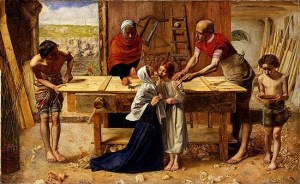
While Mary brings spiritual children to her Son, Jesus; our affiliation with her first rests with our relationship to the Lord. Jesus gives us his Mother as our Mother. Due to his identity and the posture of the Creator to his creatures, Jesus can never be eclipsed. We find this truth in the Rosary. While many Hail Mary prayers are said, as well as the Hail Holy Queen, the meditations are almost exclusively about Jesus and his saving work. The “fruit” of her womb gives importance to the tree that is Mary. The fact that Marian devotion and pilgrimages are often associated with healing inspires a reflection as to the WHY. No doubt when Jesus was a child or even a young man at work with wood and stone, there must have been times when there were injuries. I am reminded of several paintings of Jesus as a boy helping out in his foster father’s carpentry shop. The frozen image shows Jesus holding up a cut hand or a finger with a splinter of wood in it. Blood flows from the wound. The scene prefigures his crucifixion. One of the paintings shows Mary’s response, she immediately assists him. How many times did our mothers kiss our wounds to make them better? They bandaged our hurts and cared for us when we were sick.

As a spiritual Mother, Mary seeks to bring healing to those sons and daughters who are kin with Jesus. She cares for Jesus among the community of believers.

Mary, Beyond Private Revelation

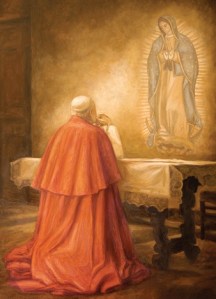
When many Catholics ponder the Virgin Mary, their thoughts do not pass immediately to the Gospel narratives but stray to the many apparitions, approved and dubious. Messages from heaven, albeit purportedly through visionaries and those receiving inner locutions, frequently take center stage. Pilgrims visit the sites of these visitations and there are plenty of peddlers ready to sell them trinkets. I do not mean to sound cynical, and I myself place great value in the stories around Lourdes and Fatima, but we must never forget that all this sensationalism is about private revelation. A Catholic is not obliged in faith to assent to any of it. Even the approval that the Church renders certain apparitions is rather negative in formulation. The authorities simply assert that there is nothing contrary to Catholic faith.

Of course, there are unapproved events, seers and messages which receive various levels of rebuke. The official Church verdict is still out about Medjugorie. While the local bishop insists that there is nothing genuinely supernatural going on and priest-involvement in pilgrimages is discouraged, pilgrims of faith keep coming. Miracles seem to be happening and people are repenting of sin and coming back to the Lord. Might Mary be involved with this?

Is not the movement of faith in itself something supernatural and from God?

Mary’s Titles & Cooperation with Jesus

There are some titles given to Mary which make certain theologians squirm. One of these became controversial during the pontificate of Pope John Paul II due to rumors that he was going to define Mary as the Co-redemptrix. Another title arising from an older popular piety was Mediatrix. Usage of these titles is probably somewhat reserved or rare because of confused definitions and ecumenical concerns.

It is important to clarify that there is only one Mediator and Redeemer, and that is Jesus Christ. Mediatrix says a lot about Mary’s unique and powerful intercessory role. She is of one mind and heart with Christ. Mary submits herself entirely to the divine will and mercy. Co-redemptrix is more problematical for non-Catholics because we admit that Mary has a singular role to play as the “Mother of God.” This latter Christological title protects the divine identity of her Son. Her YES to God resonates and participates with the primary YES of Christ. So that he might die for sinners, he first had to be born. Jesus did not suddenly beam down from Heaven. Mary was there and played her part. No other human being would ever have such intimacy with Christ.

Similarly, at the Cross, although she was never a priest, she could look upon the abused body of her Son and say, “This is my body. This is my blood.”