• Our Blogger

    Fr. Joseph Jenkins

  • The blog header depicts an important and yet mis-understood New Testament scene, Jesus flogging the money-changers out of the temple. I selected it because the faith that gives us consolation can also make us very uncomfortable. Both Divine Mercy and Divine Justice meet in Jesus. Priests are ministers of reconciliation, but never at the cost of truth. In or out of season, we must be courageous in preaching and living out the Gospel of Life. The title of my blog is a play on words, not Flogger Priest but Blogger Priest.

  • Archives

  • Categories

  • Recent Posts

  • Recent Comments

    Jeremy Kok's avatarJeremy Kok on Ask a Priest
    Gary Joseph's avatarGary Joseph on Old Mass or New, Does It …
    Barbara's avatarBarbara on Ask a Priest
    Anonymous's avatarAnonymous on Ask a Priest
    forsamuraimarket's avatarforsamuraimarket on Ask a Priest

Jesus the Way

ANTI-CATHOLIC ASSERTION

We become children of God by accepting Jesus as our Savior; nothing is said about the church. The church is only a fellowship structure to hand down the truth about our need for salvation. Jesus does not say that the church is the way or that no one comes to him except through the church. Jesus alone is the way!

John 14:6: Jesus said to him, “I am the way, and the truth, and the life; no one comes to the Father, but by me.”

CATHOLIC TRUTH

Jesus here speaks of himself as “the way and the truth and the life.” The critic above quoted this text to illustrate that the Church is only a bearer of the proclamation and that Jesus alone is the way to salvation. This viewpoint shows a terrible ignorance of the Scriptures. The “way” would come to refer, not only to Jesus, but to Christianity and to the Church herself (Acts 18:25; 9:2; 19:9,23; 22:4). Christ, indeed, is the way to the Father; his exodus from darkness to light opens the road to salvation for all of us. We are invited to travel that road; such is our participation with Christ. The Church comes to be understood as also the way because she has, in actuality, taken this road.

We find something of this in 1 Peter 2:9:

But you are a chosen race, a royal priesthood, a holy nation, God’s own people, that you may declare the wonderful deeds of him who called you out of darkness into his marvelous light. Once you were no people but now you are God’s people; once you had not received mercy but now you have received mercy. Beloved, I beseech you as aliens and exiles to abstain from the passions of the flesh that wage war against the soul.

Often read at funeral liturgies, we have the text of 2 Corinthians 5:1-7:

For we know that if the earthly tent we live in is destroyed, we have a building from God, a house not made with hands, eternal in the heavens. Here indeed we groan, and long to put on our heavenly dwelling, so that by putting it on we may not be found naked. For while we are still in this tent, we sigh with anxiety; not that we would be unclothed, but that we would be further clothed, so that what is mortal may be swallowed up by life. He who has prepared us for this very thing is God, who has given us the Spirit as a guarantee. So we are always of good courage; we know that while we are at home in the body we are away from the Lord, for we walk by faith, not by sight.

Moving to 1 Corinthians, we read in the context of the roles and gifts in the Church:

But earnestly desire the higher gifts. And I will show you a still more excellent WAY (12:31).

The Church is where we find ourselves in the earthly pilgrimage. It is by means of her divine mysteries as the great sacrament of salvation that we encounter Christ. Imbued with the presence of her Savior, the Church is the new chosen People of God. She is inseparable from her Lord and Redeemer. Christ’s way is illumined by her presence in the world. Christ’s truth is fearlessly proclaimed in a world that still counts the Gospel as foolishness. Christ’s offer of eternal life is realized in her saints and all life is defended from the womb to the tomb. Without the Church, we would be an orphaned people, quick to lose our way.

1 Timothy 2:5: For there is one God, and there is one mediator between God and men, THE MAN CHRIST JESUS, who gave himself as a ransom for all.

Okay, Catholics also believe that Jesus is the Mediator and Redeemer. The role of Mary, the saints, and the believing Church does not diminish this truth. Just a few verses earlier, the words of Paul attest to this much:

First of all, then, I urge that supplications, prayers, INTERCESSIONS, and thanksgivings be made for all men (1 Timothy 2:1).

I am at a lost as to how the anti-Catholic critic could have missed this; no doubt, his agenda of hatred blinded him to the truth. Indeed, given this context, it is understood that this intercessory liturgical prayer can also be made for pagans and it receives its efficacy from the presence of the saving Lord within the community of salvation, the Church. Verse five may have actually been an early creedal statement of faith similar to the Jewish shema (Deuteronomy 6:4-5).

For more such reading, contact me about getting my book, DEFENDING THE CATHOLIC FAITH.

Faith & Works

ANTI-CATHOLIC ASSERTION

The Catholic Church wrongly teaches that we can be saved by works and sacraments. Penance and rosaries are of no avail. We can gain no merits by crying to heaven, lengthy prayers, periods of fasting, required church attendance, pilgrimages, the monastic life, or the sacraments. Works are only the fruit of faith. The believer does not work for salvation; it is precisely because he is already saved that he does good works. If he remains in his sins, then there has been no change, and his faith is a pretense.

Romans 3:28: For we hold that a man is justified by faith apart from works of law.

Galatians 2:16: . . . yet who know that a man is not justified by works of the law but through faith in Jesus Christ, even we have believed in Christ Jesus, in order to be justified by faith in Christ, and not by works of the law, because by the works of the law shall no one be justified.

CATHOLIC TRUTH

Anti-Catholics often purposely quote verses while leaving out adjacent words which might nuance matters more in the favor of Catholicism. Take for example the citation from Romans, we read in Romans 3:31: “Do we then overthrow the law by this faith? By no means! On the contrary, we uphold the law.” It would seem that Hebrew customs and traditions (including the works of the law and the commandments) could very well be an element in their newfound faith in Jesus. The dichotomy is between those who place works over faith, as if the latter is inconsequential. Faith and works are as two sides of a single coin. However, it should be mentioned that the law mentioned here is particularly the Jewish Law; an exact parallel cannot be drawn by works as they emerge under the New Covenant of Christ. Catholics understand works as a participation in Christ’s meritorious or saving activity. Christ lives in the believer through grace and anything the Lord does in us belongs essentially to him. All saving merit belongs to Christ, yes; but “greater is he who lives in me than he who lives in the world.” Our faith in Christ is necessarily realized and actualized, not only manifested, in the life of charity and obedience. It is not simply a stagnant profession of faith in response to the Word.

The core of his contention is that works possess no saving merit. The Catholic would agree, if such works were separated from our faith in Christ. The Scriptures render a view quite different from what the critic of Catholicism contends:

Matthew 6:4: [Giving alms] “. . . so that your alms may be in secret; and your Father who sees in secret will reward you.”

Matthew 6:6: [Prayer] “But when you pray, go into your room and shut the door and pray to your Father who is in secret; and your father who sees in secret will reward you.”

Matthew 6:18: [Fasting] “. . . that your fasting may not be seen by men but by your father who is in secret; and your father who sees in secret will reward you.”

Matthew 16:27: [Deeds] “For the Son of man is to come with his angels in the glory of his Father, and then he will repay every man for what he has done.”

Romans 2:6-10: [Works done] For he will render to every man according to his works: to those who by patience in well-doing seek for glory and honor and immortality, he will give eternal life; but for those who are factious and do not obey the truth, but obey wickedness, there will be wrath and fury. There will be tribulation and distress for every human being who does evil, the Jew first and also the Greek, but glory and honor and peace for everyone who does good, the Jew first and also the Greek.

1 Peter 1:17: [Works done] And if you invoke as Father him who judges each one impartially according to his deeds, conduct yourselves with fear throughout the time of your exile.

2 Timothy 4:8: [Righteous life] “Henceforth there is laid up for me the crown of righteousness, which the Lord, the righteous judge, will award to me on that Day, and not only to me but also to all who have loved his appearing.”

While Catholics follow a contextual approach, we can still quote verses back to those who use Scripture proof texts in a fundamentalist manner. Here are two of my favorites:

All who have sinned without the law will also perish without the law, and all who have sinned under the law will be judged by the law. For it is not the hearers of the law who are righteous before God, but the doers of the law who will be justified (Romans 2:12-13).

You see that a man is justified by works and not by faith alone (James 2:24).

This second citation so troubled Martin Luther that he extracted the entire book of James from his bible! Later Protestants restored it while ignoring its content.

For more such reading, contact me about getting my book, DEFENDING THE CATHOLIC FAITH.

Biblical Terrorism

The misuse of the Scriptures, twisting verses into contrived apologetical schemes for purposes of refutation or to shore up dubious opinions is increasingly common. Catholics are reminded to be careful in their study of the Bible, acknowledging that there is an authentic interpreter (the Church) and that we have a living tradition that includes the writings and homilies of the ancient fathers and the saints. Despite the format employed here, Catholics tend to interpret passages in a contextual manner that does no injustice to the Word of God. Certain fundamentalists will pick-and-choose verses with little consideration about what they are actually addressing or the inherent language and cultural peculiarities attached to them. The Internet itself is full of sites where individuals parrot the anti-Catholic arguments of those of a century or more ago who saw the immigrants from Catholic lands to be the sub-human mongrels castoff by a Europe that was glad to be rid of them. It is ironic that the new “know-nothings” sometimes include the descendants of these poor Catholic refugees, adopting the prejudiced arguments used against their forebears. The fallen-away Catholic betrays all for which they sacrificed and forfeits the fullness of truth as proclaimed by the true Church of Christ. It is unfortunate, but true, that the Bible can be erroneously used to prove all sorts of nonsense. Opponents of Catholicism reject the Pope and yet in the same breath give themselves his authority and infallibility over religious truth. More so than the Pope would ever claim, their conceit drives them into the role of the only competent interpreter of the Scriptures. Such a position is flawed because it is a lie. Depending upon their agenda, the meanings of verses might even vacillate.

Bible study, particularly if it is badly organized, can become a similar sharing in ignorance. If the leader of the group is strong and the other members consist of largely dependent personalities, he will have no trouble dictating to them what passages mean. “I think this passage means this, thus it only means this.” If they are somewhat stronger of character, then there is a tendency to make bible interpretation rather relativistic. “I think that passage means this, you think it admits that, and someone else the other thing.” Of course, if the traditional Catholic interpretation is given then that must be wrong; after all, they will say, Catholics are always wrong and are not true Christians. The anti-Catholic fundamentalist has ruptured himself from the Church and from her living witness during the centuries. Old heresies and false paths are blindly taken again. All our ancestors in faith are reduced to fools who have nothing to contribute to the searcher of truth today. What a terribly impoverished view of faith and of the Scriptures!

Many of the modern Christian denominations and cults claim the Bible as their own and yet disagree about what it teaches. One television evangelist claims every Christmas that Jesus was not God. He does so while quoting verse after verse from the Bible and swinging the book around like a sword. Others stress the divinity of Christ to the point of negating his humanity. Unitarians might fall into this category and indeed, they reject the whole concept of a Trinity. Mormons prize the Bible along with purely human works, and yet they reject strict monotheism and argue for the pre-existence of souls. Some claim priests while others insist that no one participates in the priesthood of Christ. Certain sects will deny the need for baptism entirely while others will argue from Scripture for an improper form. Others will say that it is required, but only for adults. They might even reduce baptism to a hollow rite of initiation with no mention of its orthodox elements: the infusion of sanctifying grace; rebirth as a new creation in the image and likeness of Christ, and becoming a temple of the Holy Spirit— a member of the family of God and the Mystical Body of Christ. Some only accept baptism that is done by full immersion. Others sprinkle with little regard as to whether water touched each candidate. One minister was in the news recently for only putting his wet thumb upon the foreheads of his people and calling it baptism. Some believe in a literal rapture (although such a Protestant teaching was unheard of until recent times). A number believe that there will be a thousand-year reign and a second trial for all. Certain Calvinists use their bibles to prove that most people are predestined for hell, no matter what they do. Others use the Bible to show that there is no hell and that everyone will be saved. This final view is even making headway into the camp of poorly catechized Catholics. Is Jesus really going to invite into his kingdom all the unrepentant murderers and abortionists, adulterers and fornicators, thieves and oppressors of the poor? I would not bank on it. Nevertheless, all these views and practices emerge from churches that claim the Bible as their own.

The Gospel of Matthew, according to Irenaeus, was written while Peter and Paul preached in Rome (61 to 67 AD). Other authorities place it after the Gospel of Mark, around 70 AD when the temple was destroyed. The other gospels, Acts, Revelation, and the assorted letters were complete by 100 AD. Many other books were considered by some to be inspired. Persecution and distance kept the Church from effectively gathering the books and judging their canonical status. The peace of Constantine (313 AD) gave the Church the opportunity to begin doing this. Scrupulous study, prayer, and dialogue (all guided by the Holy Spirit) led the bishops to affirm a canon of approved biblical books by 397 AD. The New Testament, as we know it, had come into existence. Christ gave something of his own authority to the Catholic Church so that people might truly understand the Word of God and not succumb to the empty prattle of men. The living tradition of the Church with all its past testimony of the fathers and the saints, its early art and catacomb inscriptions, its various regulations, etc. would create an umbrella of understanding around the Scriptures. Forsaking the true Church, Protestant reformers and their churches would cast aside centuries of authentic Christian life and teaching to find their own way. What they forgot was that Jesus was the Way and the Truth and the Life. Jesus was still very much with his Catholic Church. Some have lost their way entirely and can no longer be called Christian. Others still look to Jesus with love but only possess partial truth and much that is erroneous. Some of these find their way back home, as with notable converts to Catholicism in recent years.

For more such reading, contact me about getting my book, DEFENDING THE CATHOLIC FAITH.

Sources for Catholic Doctrine

1. Those things taught directly by the Bible, either explicitly or implicitly.

2. Those things transmitted through sacred traditions that develop and complement reveal truths while not contradicting the biblical testimony.

3. The guiding presence of the Holy Spirit promised by Christ to safeguard his Church (John 14:16,26).

4. The abiding presence of Christ in the Church as he had promised (Matthew 28:20).

For more such reading, contact me about getting my book, DEFENDING THE CATHOLIC FAITH.

Angels & Saints

Ephesians 2:19: So then you are no longer strangers and sojourners, but you are fellow citizens with the saints and members of the household of God . . .

Acts 12:7: . . . and behold, an angel of the Lord appeared, and a light shone in the cell; and he struck Peter on the side and woke him, saying, “Get up quickly.” And the chains fell off his hands.

Hebrews 1:14: Are they not all ministering spirits sent forth to serve, for the sake of those who are to obtain salvation?

Luke 15:10: “Just so, I tell you, there is joy before the angels of God over one sinner who repents.”

Those of our family of faith in heaven are actively concern about our well being. Insofar as God allows, they intercede on our behalf. We honor the saints as our friends and even name the angels among our heavenly protectors.

For more such reading, contact me about getting my book, DEFENDING THE CATHOLIC FAITH.

Virgin Mary

Luke 1:26-35: In the sixth month the angel Gabriel was sent from God to a city of Galilee named Nazareth, to a virgin betrothed to a man whose name was Joseph, of the house of David; and the virgin’s name was Mary. And he came to her and said, “Hail, full of grace, the Lord is with you!” But she was greatly troubled at the saying, and considered in her mind what sort of greeting this might be. And the angel said to her, “Do not be afraid, Mary, for you have found favor with God. And behold, you will conceive in your womb and bear a son, and you shall call his name Jesus. He will be great, and will be called the Son of the Most High; and the Lord God will give to him the throne of his father David, and he will reign over the house of Jacob for ever; and of his kingdom there will be no end.” And Mary said to the angel, “How can this be, since I have no husband? And the angel said to her, “The Holy Spirit will come upon you, and the power of the Most High will overshadow you; therefore the child to be born will be called holy, the Son of God.”

Luke 1:48: “. . . for he has regarded the low estate of his handmaiden. For behold, henceforth all generations will call me blessed; for he who is mighty has done great things for me . . .”

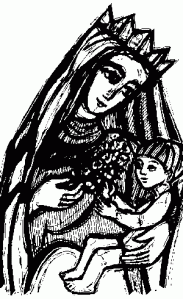
Mary is the mother of Jesus. This truth is attested by the Scriptures and universally held. However, a few verses later in Luke it is written that all generations will honor her. The Catholic Church still venerates her as the blessed Virgin, the mother of the Redeemer who is now the mother of all the redeemed. Fundamentalist churches tend to respond to Mary with silence or with a quick rebuke that she was “only” the mother of Christ. Ours is the Church where the prophecy is fulfilled! Yes, she is a creature like us, although “full of grace” and preserved from sin; but she is the mother of the whole identity of her Son. Her Son is the Second Person of the Blessed Trinity. As with all mothers, her maternal role never ceases. Truly, she is “blessed among women!” Our honor of Mary imitates that of heaven. As for her assumption, there is precedent in the Old Testament. Unlike Jesus, she is not taken up by her own power but by that of her Son.

For more such reading, contact me about getting my book, DEFENDING THE CATHOLIC FAITH.

Good Works

James 2:22-26: You see that faith was active along with his works, and faith was completed by works, and the scripture was fulfilled which says, “Abraham believed God, and it was reckoned to him as righteousness”; and he was called the friend of God. You see that a man is justified by works and not by faith alone. And in the same way was also Rahab the harlot justified by works when she received the messengers and sent them out another way? For as the body apart from the spirit is dead, so faith apart from works is dead.

1 Corinthians 13:1-3: If I speak in the tongues of men and of angels, but have not love, I am a noisy gong or a clanging cymbal. And if I have prophetic powers, and understand all mysteries and all knowledge, and if I have all faith, so as to remove mountains, but have not love, I am nothing. If I give away all I have, and if I deliver my body to be burned, but have not love, I gain nothing.

Matthew 7:21: “Not everyone who says to me, ‘Lord, Lord,’ shall enter the kingdom of heaven, but he who does the will of my father who is in heaven.”

Mark 16:16: “He who believes and is baptized will be saved; but he who does not believe will be condemned.”

Both faith and good works are necessary for salvation. This is the witness of Scripture. Martin Luther was so possessed by his “faith alone” theory that he even forcibly inserted the word “alone” into his version of the Bible. When told about his error, he responded that he would not remove it even if an angel from heaven were to tell him to do so. Catholics rightly contend that faith must be actualized with charity. We profess and make real our faith, not only with an assent of the mind and our words, but with our heart and our actions. Christ is only “our personal Lord and Savior” if we exercise necessary faith and good works. The incarnation of Christ, first into human flesh and now into our souls by grace, allows him to perpetuate his ministry through our lives. Good works have merit precisely because the Lord living in us ultimately performs them. Since faith and good works are required, it becomes an imperative that we reject the view of Luther. It does make a difference what we believe. The growing consensus on this issue between modern day Lutherans and Catholics is evidence of a positive development in mainline Protestantism as well as a reconciliatory stance with Catholicism.

For more such reading, contact me about getting my book, DEFENDING THE CATHOLIC FAITH.

Incense

Rev. 8:3: And another angel came and stood at the altar with a golden censer; and he was given much incense to mingle with the prayers of all the saints upon the golden altar before the throne; and the smoke of the incense rose with the prayers of the saints from the hand of the angel before God.

Psalm 141:2: Let my prayer be counted as incense before thee, and the lifting up of my hands as an evening sacrifice!

Incense is only one of the many ceremonials in Catholic ritual and worship that are validated by the Bible. The fragrant smoke proved quite practical in outside processions against the pungent smells of the city streets. Sanitation not being what it is today, incense was very helpful on this account in old Rome. While there are references to the use of incense in the Bible, some of the early Christians avoided it because of cost and because it was also used by the pagans. After paganism was extinguished, this was no longer a concern. The smoke of the incense is a symbol of our prayer and our offering. It rises into the air just as we hope that our prayers will be taken up to the throne of God for a hearing.

For more such reading, contact me about getting my book, DEFENDING THE CATHOLIC FAITH.

Relics

2 Kings 2:8-14: Elijah’s mantle.

Exodus 7:10: Aaron’s rod.

Matthew 9:20-21; Matthew 14:36: The hem of the garment worn by our Lord.

Acts 19:12: . . . so that handkerchiefs or aprons were carried away from his body to the sick, and diseases left them and the evil spirits came out of them.

Acts 5:15-16: . . . so that they even carried out the sick into the streets, and laid them on beds and pallets, that as Peter came by at least his shadow might fall on some of them. The people also gathered from the towns around Jerusalem, bringing the sick and those afflicted with unclean spirits, and they were all healed.

It was only natural that Christians, from the very earliest days, would hold onto mementos of the saints. Relics remind us that holiness is real and that some of our number have followed Christ in spectacular ways. The veneration of relics of saintly persons or things is recommended by the Bible. However, such regard is not the same as the worship that belongs to God alone. We do not pray to such objects or treat them superstitiously; we honor what they signify and the graces God conveys in them. The secular world does similar things. A person might cherish a lock of hair from his beloved. A nation might treat with respect the great patriotic symbol that is the flag.

For more such reading, contact me about getting my book, DEFENDING THE CATHOLIC FAITH.

Holy Water

Numbers 5:17: . . . and the priest shall take holy water in an earthen vessel, and take some of the dust that is on the floor of the tabernacle and put it into the water.

Here is a case where God actually commanded the use of holy water. If this is the case, how can anyone blame the Church for its use? Used for blessings, water is a powerful symbol of cleansing; it also carries with it the theme of life and death. We need water to live; and yet, too much can drown us and bring death. It always reminds us of our baptism and the promises of faith.

For more such reading, contact me about getting my book, DEFENDING THE CATHOLIC FAITH.