• Our Blogger

    Fr. Joseph Jenkins

  • The blog header depicts an important and yet mis-understood New Testament scene, Jesus flogging the money-changers out of the temple. I selected it because the faith that gives us consolation can also make us very uncomfortable. Both Divine Mercy and Divine Justice meet in Jesus. Priests are ministers of reconciliation, but never at the cost of truth. In or out of season, we must be courageous in preaching and living out the Gospel of Life. The title of my blog is a play on words, not Flogger Priest but Blogger Priest.

  • Archives

  • Categories

  • Recent Posts

  • Recent Comments

    Barbara King's avatarBarbara King on Ask a Priest
    Ben Kirk's avatarBen Kirk on Ask a Priest
    Jeremy Kok's avatarJeremy Kok on Ask a Priest
    Barbara's avatarBarbara on Ask a Priest
    forsamuraimarket's avatarforsamuraimarket on Ask a Priest

Biblical Principles of Marriage

On Saturday, March 24, I gave a talk on the Biblical Foundations of Marriage at the PreCana Classes held at St. Mary of the Assumption in Upper Marlboro, MD. Some of the notes are give in the immediately previous posts. There is a joke that if you get two ministers in a room, you will get three different interpretations of Scripture. Given that biblical interpretation is so volatile these days, I first gave the gathering my five basic presuppositions. Next, I gave the ten basic principles of marriage from Scripture.

Presuppositions As we Begin

1. The Scriptures are inspired by God and teach truth.

2. We must have the mind of the Church in how Scripture is interpreted.

3. The Bible is not a marriage manual.

4. Better understanding of Scriptural truth comes through a contextual approach.

5. The truth about marriage in the Bible is revealed in a progressive way, culminating in the New Testament.

A Few Basic Biblical Principles

While the Bible is not a manual for marriage, there are some basic principles we can derive from God’s inspired Word. Here are a few:

1. Men and women were made for each other. Most men and women are called to marriage.

2. Marriage is a covenant between a man and a woman. They pledge themselves to each other in vows made in the sight of God.

3. The husband is the head of the home and the wife is its heart.

4. While the Bible speaks of the wife’s submission to her husband, there is mutuality in this surrender since the husband is commanded to practice sacrificial love for her, even offering his life as Christ did on the Cross.

5. The husband and wife are dependent co-creators with God.

6. The spouses are called to be helpmates to one another in grace and holiness.

7. Marriage is a vocation that takes precedence over other preoccupations. Your attention and energies must first be focused toward one another.

8. Marriage is a sexually intimate relationship between a man and woman.

9. Christian marriage infers a third in the marriage, Christ. Couples enter into the mystery of Christ and his Church. Our Lord identifies himself with the beloved.

10. Couples should come to the marriage bed undefiled. All sexual activity outside of marriage was regarded by the Jews as a violation of the commandment against adultery.

A Hierarchy of Love in the Home

Given that one sees a hierarchy in marriage; neither spouse should lead the other into sin. Similarly, parents can rightfully demand honor and obedience from children, but they must be worthy of such honor. Many things might be excused to preserve the peace of a home; but once a husband starts ordering his wife and children around as slaves, it will not be a happy home. When there is abuse, cruelty and sin; an offending spouse is stripped of authority by the one who is the source for all authority. The message of the Gospel is to embrace a sacrificial love. Jesus pours himself out on the Cross. If this is to be realized in marriage, then it must be mutual. The husband pours his hopes and dreams and life into his wife. Conversely, she pours all her longings and love into her husband. When there is this mutual self-donation, a couple may always be filled and whole. Indeed, their love may bear the wonderful and mysterious gift of children wherein God makes them co-creators with himself. When one gives and the other only takes, the one finds him or herself empty and the other caged in selfishness. Such a mentality is at the root of cold marriages, adultery and the culture of death.
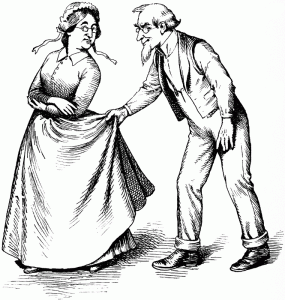
Men and women are both made in the divine image; they have a need for mercy and a capacity for grace. The Scriptures make it very clear that they are called to be helpmates in becoming holy. Marriage comes down from our first parents to the present as an institution to bring fidelity and fruitfulness to the loneliness of the human condition.

Jesus Elevates the Dignity of Women

While always regarded as something more than a man’s land and livestock, the Mosaic writ of divorce and cataloguing women along with property, tended to undermine something of the woman’s personal worth and her role as a companion in marriage. Jesus seeks to correct this by stressing the primordial union and elevating the value of women whom he encountered. The woman caught in adultery was threatened with stoning. His challenge to the crowd saves her. But he tells her to avoid this sin in the future. She was singled out for condemnation by the mob, but where was the man with whom she sinned? A double-standard was at work. The Samaritan woman at the well is told her past by Christ, who knows all her infidelities, and he offers her saving water. She too did not sin alone and who knows what dire circumstances pressed her into many transitory unions? She becomes a prophetess for her people. He forbids divorce as something that was never supposed to be, but tolerated before his coming because of the hardness of their hearts. Women deserve better treatment and should not be cast off.
Then there is the Mother of Christ. At the wedding feast of Cana she tells him that the wine has run out. He says to her, what business is this to me, woman? Joseph is gone and now Jesus is the head of her little household. Nevertheless, she tells the stewards to do as he says and he changes water into wine. The heart of the home will always have a lot of influence and meaning. Jesus preserves the joy of the marriage banquet. Similarly when located in the temple, the boy Jesus challenges her. And yet, we are told that he “immediately” came along with her and the good St. Joseph and was obedient to them. Mary was “the woman,” and according to the fathers of the Church, “the new Eve.” She would be the spiritual Mother of the many adopted sons and daughters of God. Although his physical Mother, she would also prefigure the Church as the spiritual and spotless bride of Christ. Her model for womanhood would always be with Jesus. Our Lord saw in her the great dignity and immeasurable value of all women, and their inherent potential for holiness.

The Complementary Role of Husband and Wife

A major source of discussion these days is the notion of a husband’s headship. Largely because of the sexual revolution, many take serious exception to it. However, I suspect that it is largely misunderstood. While isolated verses would seem to place all the gravity with the husband, the Catholic “contextual” approach would weigh it with references to the role and value of the wife. There is equality between the spouses and yet this should not be interpreted in any egalitarian manner. Each spouse has his or her complementary role to play. Notice in the life of the Holy Family, Joseph is understood as their great defender. And yet, it is Mary who is focused upon as the parent at the Presentation in the Temple. Similarly, when the boy Jesus is found in the Temple, the recorded conversation is between Jesus and Mary. Joseph is the foster father of Christ. He is entrusted with his family’s care. But respecting Mary’s motherhood and her deep faith, he steps back and allows her to do the talking. This does not destroy his headship. Instead, he had a good enough head to appreciate Mary’s strength, gifts and calling.

As a boy my family always respected my father as the head of the home. Daddy would work hard, cash his check and give mother all the money to pay the bills. She would take out two dollars and put it back into his wallet saying, “A man should always have money in his wallet.” She did so many things that he found difficult. They worked together. They lived out a real partnership. At the same time, my mother always gave my father the deepest respect. We were a poor family but my dear father worked from 5:30 AM to 6:00 PM six days a week so that we could have a roof over our heads and food on the table. Mother was a stay-at-home Mom, but she worked just as hard or harder in caring for the home and seven children. She would have been the first to say that Daddy was the head of our family; but by the same token, mother was the heart of our home. Which is more important, the head or the heart? Take away either one, and a body dies.

St. Paul speaks about the headship of the husband and father but also insists that they be subject to one another as to the Lord (Ephesians 5:21). There is a profound unity between the husband and wife going back to Genesis. The two become one flesh (Genesis 2:24). Jesus will also stress this unity (Matthew 19:4-6; Mark 10:7-9). It signifies a definite spiritual bond or connection between the spouses. Given its ecclesial significance, Christ raises this union to the level of a sacrament.

Ephesians 5: 21-33

Colossians 3:18–21

Titus 2:3-8

1 Peter 3:1–7

Marriage and the Eternal Quality of Love

Certain Sadduccees tried to trick Jesus with a question that mocked the resurrection. They asked, without pure intent, whose wife a woman would be in the kingdom who had alternately married seven brothers, each dying in turn?

Luke 20: 34-38: “Jesus said to them, ‘The children of this age marry and are given in marriage; but those who are deemed worthy to attain to the coming age and to the resurrection of the dead neither marry nor are given in marriage. They can no longer die, for they are like angels; and they are the children of God because they are the ones who will rise. That the dead will rise even Moses made known in the passage about the bush, when he called ‘Lord’ the God of Abraham, the God of Isaac, and the God of Jacob; and he is not God of the dead, but of the living, for to him all are alive.”

This teaching fits neatly into the appreciation of marriage as a sacrament. Marriage in this world is a sacred sign which participates in the great marriage banquet of heaven between the Lamb and his Church. When we rise to new life, there will be no more faith, because we will know the truth and see God face to face. Mortal marriage ends at the entry way from this world to the next because we will know a unity with the divine bridegroom. Having said this, death does not bring an end to love. Indeed, in Christ, love conquers the grave. Love is eternal because life is everlasting. The figure or sign of marriage will be replaced by that which is most real and pure. We will abide within God, that perfect union in divine love, forever.

Permanency of Marriage

Jesus raises the bar on marriage, taking sides in the debate about divorce. Jewish men might write a writ of divorce, leaving the women vulnerable and destitute in their society. Our Lord would have none of it. Citing creation itself (Genesis 1:27 and 5:2), he asserts that men and women were made for each other and that God intended their union to last throughout life. This position in favor of permanence reflected the school of Shammai. An opposing view was espoused by the rabbinic school of Hillel, which permitted men to divorce their wives, even capriciously. This would be similar to the idea of no-fault divorce today.


Matthew 19:1-12

Mark 10:1-12

Jesus saw husbands and wives both culpable for failed marriages. The two in one flesh did not permit any wiggle room or escape clause. Both monogamy and marital permanence become traits of Christian marriages. Divorce would generally disappear from Christian circles until the Protestant Reformation.

While St. Paul would speak about celibacy as an eschatological sign of the kingdom, our Lord also associates his kingdom with marriage. His very first miraculous sign in his public ministry will be at the wedding feast of Cana. While some might suppose that Jesus only lightens the burdens placed upon people by the Pharisees, he actually adds to their weight. The reason why he seems more gentle and tolerant is because of his generosity in offering the mercy of heaven and divine grace. Remember that Jesus has taken away the option for divorce and says things like love those who hate you and forgive those who persecute you. He says that just to hate your brother is to violate the commandment against killing. Returning to this topic, at the Sermon on the Mount, he commands that even to look at a woman lustfully is the commission of adultery. The Mosaic Law, often referenced by St. Paul as burdensome, permitted a writ of divorce. Instead, Jesus substitutes an absolute prohibition, except for what is sometimes translated as “sexual immorality” or “adulterous.” These words fail to appreciate the magnitude of what Jesus is saying. The actual word used is PORNEA and in this context the New American renders it politely as “unlawful marriage,” but it probably means INCEST. Such marriages are not true marriages, the reason why the Church grants annulments, such unions are not sanctioned by God. However, if a marriage is genuine, then it will endure until the death of one of the spouses. Given the fact that it was a patriarchal society, divorce forced women to seek a new protector and source of support. In this sense, not only the man, but the woman was forced into adultery.

The Old Testament Witness of Marriage

The Old Testament offered various marriages as symbolic of God’s relationship with his Chosen People (as with Hosea and Gomer). While Israel was constantly unfaithful, he would bring her forgiveness and seek to woo her back to himself. This understanding becomes more serious in the New Testament in that marriage signifies the relationship between Christ and his Church. It is not for man to redefine marriage or its parameters. It is entirely of God’s design (see Genesis). It points to something beyond itself. Catholics would appreciate this mystery as a sacrament.

There are a number of significant marriages detailed in the Old Testament:

  • Adam and Eve;
  • Abraham, Sarah and Hagar;
  • Isaac and Rebekah;
  • Jacob, Rachel and Leah;
  • Boaz and Ruth;
  • David, Michal, Ahinoam, Abigail, Maachah, Haggith, Abital, Eglah and Bathsheba; and
  • Hosea and Gomer the harlot.

Polygamy was sometimes practiced early in the Old Testament but as with the Muslims today it was probably rarely practiced due to the expense. The Jews practiced a two-tiered marriage, as with see with Mary and Joseph. Jesse Jackson got into some trouble years ago for saying at a Democratic Convention that Mary was an unwed mother. According to Jewish law, however, she was married already. The first stage was betrothal and the second was when the woman came to live in the husband’s house. A dowry was paid to a woman’s father making her his property. The problem with this set up was that it might bypass the woman’s consent. When the man brought the woman to his house, there will be a big celebration or feast in the community.

The Song of Songs celebrates the joys of physical love. Following a terrible curse, we have the poignant night prayer of Tobiah and Sarah. From profane to profound, we see the whole gambit of human love. The old marriage prayers stressed the married life was among the greatest joys not forfeited by original sin or washed away by the flood. The joy and fruitfulness of married life was deemed as a sign pointing to God’s favor and the promise of redemption. A good marriage was thus a taste of heaven.

The new dispensation of Christ would build upon God’s plan seen in Genesis and creation. Further, since the Church was the new People of God, the marriage analogy would refer to Christ and his Church.

God the Father & Priestly Fathers

This discussion emerged within a series of comments from what is commonly regarded as an Internet troll or spammer.  Typical of such efforts, the critic here uses the “cut-and-paste” method of extracting text from old anti-Catholic works and then inserting the material (without attestation) into the comment fields or message boards of others. The style change is the usual give-away.  The modern media allows even a silly and ignorant anti-Catholicism a voice to plague Catholic sites and to tear down the faith of weak Catholics.  While many would erase such comments, I try to turn them into teaching moments. 

RONIE:

Mister Joe, I am sorry but I will not call you as others address you. Christ said call no man Father.

FATHER JOE:

I have discussed the issue of priestly fatherhood before, as well, but let me repeat myself:   

“And call no one on earth your Father; for one is your Father, who is in heaven” (Matthew 23:9).

This is an example of a Scriptural literary form known as Hebraic Hyperbole. It is like the passage that admonishes tearing your eye out or cutting off your hand or foot. It is a way of speaking to give heightened emphasis. The fundamentalist reads everything as if the primary language is English and the author contemporary. This is also an example of taking a verse out of context and distorting its meaning. Verse eight says to call no one Rabbi or teacher. However, do we not use this word all the time? Further, if this line is absolute against Catholic priests who possess a spiritual fatherhood, then what about our foster fathers and biological fathers? It would have to apply there as well. Almost no one would agree to this. It is a wonderful sign of respect and relationship. The matter about which the Lord is concerned is that his disciples not imitate the Pharisees in their pride and hypocrisy, lording their positions over others. God is the true and ultimate Father of all. If any fatherhood does not flow from and participate in divine fatherhood, then it is a lie and oppressive. St. Paul speaks of himself as a spiritual father in his first letter to the Corinthians and admits that there are other such fathers, although not many. The shortage of vocations to the priesthood is still a matter with which we must deal.

[In speaking of our priorities] “He who loves FATHER or mother more than me is not worthy of me” (Matthew 10:37).

[About marriage] “For this cause a man shall leave his FATHER and mother, and cleave to his wife, and the two shall become one flesh” (Matthew 19:5).

[Placing discipleship to Jesus first] “And everyone who has left house, or brothers, or sisters, or FATHER, or mother, or wife, or children, or lands, for my name’s sake, shall receive a hundredfold, and shall possess life everlasting” (Matthew 19:29). {see also Mark 10:29}

[Abraham is called father] “For this reason, it depends on faith, so that it may be a gift, and the promise may be guaranteed to all his descendants, not to those who only adhere to the law but to those who follow the faith of Abraham who is the FATHER of all of us, …” (Romans 4:16). {see also Romans 4:11-12,17}

[Treatment of elders] “Do not rebuke an older man, but appeal to him as a FATHER” (1 Timothy 5:1).

[Enduring trials] “For what ’son’ is there whom his FATHER does not discipline?” (Hebrews 12:7). {see also Hebrews 12:9}

[My favorite and very similar to calling the priest, Father] “I am writing you this not to shame you, but to admonish you as my beloved children. Even if you should have countless guides to Christ, yet you do not have many FATHERS, for I became your FATHER in Christ Jesus through the gospel. Therefore, I urge you to be imitators of me” (1 Corinthians 4:14-16).

RONIE:

Dear Mister Joe, this is in regard to your answer to me and the text:

“Matthew 23:9 – And call no man your father upon the earth: for one is your Father, which is in heaven.”

Sorry but I have to say this, you are out of context. The “Father” in the above text refers to “God the Father,” which is Spiritual, and the verses to which you refer, like Matthew 19:29, Mark 10:29, Romans 4:16, refer to our earthly fathers. The fathers of our flesh must be called fathers, and as such we must give them reverence; but God only must be allowed as the Father of our spirits, (Heb. 12:9). Our religion must not be derived from or made dependent upon any man. Our flesh fathers do not have authoritative power over men’s consciences in matters of faith and obedience, in which God and Christ are only to be attended. Christ’s sense is that he would have his disciples not fond of any titles of honor at all. Much less would he have them assume authority over men, as if they were to depend on them— as the founders of the Christian religion— the authors of its doctrines and ordinances— and to take that honor to themselves which did not belong to them. Neither would he have them even choose to be called by such names, as it would lead people to entertain too high an opinion of them. It would take off of their dependence on God the Father.

You know Mister Joe, these titles the scribes and Pharisees love to be called. Kindly check your verse in 1 Corinthians 4:14-16. I notice that there is a text “for I became your father” which is not found in the Greek text. I more agree on this verse found in the KJV below:

1 Corinthians 4:14: “I write not these things to shame you, but as my beloved sons I warn you.”

1 Corinthians 4:15: “For though ye have ten thousand instructors in Christ, yet have ye not many fathers: for in Christ Jesus I have begotten you through the gospel.”

1 Corinthians 4:16: “Wherefore I beseech you, be ye followers of me.”

FATHER JOE:

The proper title for a cleric is Father, Reverend or Pastor. Why should I spend any time with a person who begins with a deliberate act of disrespect? But given that our Lord would want repentance and conversion for both the ignorant and the bigoted who blaspheme against the Holy Spirit, I will try to make a short response. Admittedly, I have little confidence that anything I might say will penetrate the walls fabricated by those who are obstinate against the truth and closed to the movement of divine grace.

You begin by seeking to “clarify” this text: “And call no man your father upon the earth: for one is your Father, which is in heaven” (Matthew 23:9). Actually it is best that we look at the entire section and our Lord’s use of Hebraic hyperbole (verses 1 to 12):

Then said Jesus to the crowds and to his disciples, “The scribes and the Pharisees sit on Moses’ seat; so practice and observe whatever they tell you, but not what they do; for they preach, but do not practice. They bind heavy burdens, hard to bear, and lay them on men’s shoulders; but they themselves will not move them with their finger. They do all their deeds to be seen by men; for they make their phylacteries broad and their fringes long, and they love the place of honor at feasts and the best seats in the synagogues, and salutations in the market places, and being called rabbi by men. But you are not to be called rabbi, for you have one teacher, and you are all brethren. And call no man your father on earth, for you have one Father, who is in heaven. Neither be called masters, for you have one master, the Christ. He who is greatest among you shall be your servant; whoever exalts himself will be humbled, and whoever humbles himself will be exalted.

The authority of the Church instituted by Christ would eventually supersede that of Moses and his successors in leadership, the Pharisees. The bishops of the Catholic Church sit in the seats of the apostles. The popes govern from the Chair of Peter. Jesus establishes both a new People of God and the accompanying authority. Our Lord was critical about the hypocrisy of the Pharisees and pleaded with his apostles that it should not be so with them. He gave them the example of the foot-washing and urged humility in service. The hyperbole stresses that the ministers of the Church should not seek earthly rewards, titles and esteem, but rather that imperishable treasure of being in right relationship with God. The titles rabbi, father and teacher (or master) would continue to be used. Even St. Paul speaks of himself as a spiritual father. Lost in translation is the peculiar Hebrew form of stressing a point by pushing a matter to absurdity: call no man father or teacher or rabbi; if your eye causes you to sin, pluck it out; if your hand causes you to sin, cut it off. These matters were never meant to be understood in a literal fashion. Apart from the truth of Christ, no one is a genuine teacher. In conflict with the fatherhood of God, no fatherhood is genuine.

You say that my reference to “father” is out of context. You must be kidding! You are the one who gives no real context at all. Indeed, you treat Scripture as if it were written originally in English. Instead of respecting the message and historical setting, you offer an illogical and contrived explanation that goes against the practices and writings of the early Christians. They were close to the source and were in a position to know the truth. They did not understand this text as you do.

The text cannot be dissected as you attempt. The meaning is that there is no true fatherhood which usurps or conflicts with the fatherhood of God. This includes both spiritual fathers (as with St. Paul) and with our biological or adopted fathers. Matthew 19:29 and Mark 10:29 speaks about the family of the Church and the communion of the saints. Romans 4:15 makes mention of Abraham as our father in faith. God calls him forth and his family becomes a tribe and later a nation. He is a crucial starting point in the history of salvation.

The texts you cite either contradict or do not support your view. The Church sees herself as a family and addresses God in her prayers as FATHER MOST HOLY. Priests, bishops and popes are spiritual fathers in that they perpetuate the teachings and mission of Jesus Christ. The Church fully subscribes to the understanding of her membership as brothers and sisters to one another. In faith and baptism, Jesus is our elder brother and Mary is the queen mother. We are adopted sons and daughters of our heavenly Father. The reference to earthly fathers means any type of fatherhood here on earth. Our mortal fathers, no matter if biological, adopted or spiritual, must reflect divine fatherhood or else they are false. There is nothing here that says that biological fathers are exempt. Further, your citation of Romans 4:16 is in reference to Abraham, not almighty God. He is called the father of all.

Parents are the primary educators of their children in the faith. They constitute the “little church.” You wrong Christian fathers by reducing them to roosters who service hens. St. Paul tells us that the Christian husband/father is the head of the home just as Christ is the head of the Church.

You next write (uncorrected here as above for grammar): “Christ’s sense is, that he would have his disciples not fond of any titles of honor at all, and much less assume an authority over men, as if they were to depend on them, as the founders of the Christian religion, the authors of its doctrines and ordinances, and to take that honor to themselves, which did not belong to them, nor even choose to be called by such names, as would lead people to entertain too high an opinion of them, and take off of their dependence on God the Father.” What you write is absolute gibberish. Indeed, your run-on sentence even defies linguistic diagramming. And yet it makes more sense than what you usually write. Of course, you did not write it. You stole it. You plagiarized. You borrowed the work and genius of another to foster the pretense of knowing what you are talking about. These are not your words, but those of one who was a polemicist against Catholic claims. As I said before, you prefer parroting the enemies of the Church instead of learning objectively and directly from her own mouth. These words come from an EXPOSITION OF THE ENTIRE BIBLE written (between 1746 to 1763) by John Gill.

The commentary here is not your own and I dislike dialoguing with cut-and-paste intellectual thieves. However, despite this and the convoluted language, I will try my best to parse it out. Our Lord was not so much against titles as he was concerned that “show” not replace “substance.” The title “apostle” itself becomes one of great distinction. Our Lord was often called “master” or “teacher” or “rabbi.” He explicitly gave his authority to his apostles and sent them out to baptize the nations. He explicitly gave Peter the power of the keys and the power to loosen or bind over sin. He tells him, after the resurrection, to feed his sheep and to care for his flock. It is quite evident that Jesus gave them such authority as shepherds to the community. This authority would be passed down to others. Failure to see this demonstrates your blindness to important passages in the Word of God. Jesus, himself, was the founder of the Christian religion, i.e. the Catholic Church. He is the ultimate source of revelation. He would send his Spirit to insure the Church’s fidelity to the truth, the doctrines and ordinances that men should know and follow. As I have mentioned before, the great apostle Paul spoke about himself as a spiritual father. There was no prohibition, either about the title or the function. The spiritual title of FATHER given to a priest in no way detracts from the fatherhood of God. Indeed, he becomes a flesh-and-blood symbol of God’s abiding love and mercy in the faith community.

Just because the Pharisees allowed their titles to go to their heads does not mean that such must always be the case for others. The title “father” is an expression of endearment.

“I write not these things to shame you, but as my beloved sons I warn you” (1 Cor. 4:14).

Paul admonishes the Corinthians as his beloved children. There is definitely a fatherly relationship.

“For though ye have ten thousand instructors in Christ, yet have ye not many fathers: for in Christ Jesus I have begotten you through the gospel” (1 Cor. 4:15).

This is a somewhat archaic Protestant translation. A better translation is the RSV, also Protestant (but acceptable to Catholics):

“For though you have countless guides in Christ, you do not have many fathers. For I became your father in Christ Jesus through the gospel.”

The reference to “father” is in the Greek text as is the term for being begotten of a father:

ἐὰν γὰρ μυρίους παιδαγωγοὺς ἔχητε ἐν Χριστῷ ἀλλ’ οὐ πολλοὺς
πατέρας ἐν γὰρ Χριστῷ Ἰησοῦ
διὰ τοῦ εὐαγγελίου ἐγὼ ὑμᾶς ἐγέννησα

“Wherefore I beseech you, be ye followers of me” (1 Cor. 4:16).

More than followers, he is literally urging them to imitate him. He sends Timothy as his emissary and calls him his “Beloved and faithful son in the Lord.” The spiritual fatherhood of every priest is akin to that of the apostle Paul.

A brief aside:

While I might sound harsh at times (in this and other posts), it is hard not to become emotionally involved about matters that priests take very personally.  Critics would strip priests of their spiritual fatherhood and label them as minions of Satan and/or the anti-Christ.  There have been a few deletions of the more insensitive material in this particular post.  

Is it impolite for a priest to offer correction and to be blunt? 

Is it rude to speak the truth? 

I received criticism to this effect, and apparently from a Catholic.  But the person in this post, and those narrated in others, often do not come for a sincere and simple discussion, but rather, to ridicule the priesthood and the Church.  I try not to be hurtful.  I avoid foul language.  Nevertheless, I stand by my negative assessment of such anti-Catholicism and the poor people who swallow and spout it. Some people are moved by gentleness and others must be shaken up a bit.  We see this in the ministry of Jesus where he was gentle with the outcasts and marginalized but harsh with others like the scribes, lawyers and pharisees. 

The Catholic Church, Salvation & Peter

MARTHA LEE:

The Catholic Church according to its practice and compared to Biblical injunctions is tantamount to a cult.

FATHER JOE:

Actually, it is more likely that your religion is the cult. Catholicism is true religion and the Church directly instituted by Jesus Christ. Catholicism is the most genuine form of Christianity.

RONIE:

Mr. Joe, can you tell me in your own understanding the meaning of Church?

FATHER JOE:

Mister Joe?

  • The Church is the Mystical Body of Christ.
  • The Church is the great Sacrament of Salvation.
  • The Church is the House that Jesus built.
  • The Church is that community of faith which receives its life from the Eucharist.
  • The Church is built on the foundation of Christ (invisible head) and the ROCK of Peter (visible head).

This information is elsewhere on this site. Look it up next time.

DENNIS:

Purgatory is a myth and Peter was Jewish so how could he be the first pope. I am no longer going to the catholic church because it is all symbolism over substance. It will be a pope (HOLY FATHER…WHAT A JOKE) who will be the antichrist or at least be very supportive. I joined the catholic church before getting married 29 years ago and I told my wife who is catholic that many things the church did were wrong. After many years she agrees and my daughter has taken religious courses that prove the evils that exist.

FATHER JOE:

In the course of God’s progressive revelation to his people, the Jews had come to believe in both an afterlife and that atonement could be made for the dead. Jesus speaks about the afterlife drawing from the analogy of a debtor’s prison where none could be released until the last penny was paid. While the passion and death of Christ makes possible our redemption, he desires that we have both a saving personal faith in him and a corporate faith as members of his new People of God, the Church. Purgation is a sign of God’s gracious mercy. We must be transformed by grace and made perfect for heaven. If we belong to God, then he will finish what is started in this world. The saints of purgatory are all destined for heaven. As they approach the fire of God’s love, that eternal flame burns away the last vestiges of sin and vice. Temporal punishment is appeased and we are made truly holy. Such is no more a myth than our abiding faith that our Lord has gone ahead of us and that he prepares a place in heaven for his children.

The first called by Jesus were the Hebrew people. Salvation comes from the Jews. The apostles were all Jewish and yet at the Last Supper our Lord instituted both the priesthood and the Eucharist. Just as there are Semitic Catholics today, Peter was both Jewish and the visible head of Christ’s Church, the Catholic Church. They became the first Catholics.

You probably never really understood your Catholic faith to really know what you were rejecting. Did you ever sit down with a priest and ask your questions? Did you take advantage of adult faith formation in your parish? The odds are that you did not. There is no conflict between sacred signs and a faith of real substance. The problem is that you may never have known where to look for that substance or the meat of faith.

The Pope or Holy Father has even written a personal reflection on the life of Christ, now in two volumes. He preaches and witnesses to our Lord. Be careful of blasphemy against the Holy Spirit. If God does protect Pope Benedict XVI and the faith and morals he teaches, then you slander not men but God. Only ignorant men filled with hatred would call the Pope by the demonic name of “antichrist.” Be careful that the joke is not on you.

You did not have to join the Catholic Church to get married in the Church. The fact that you entered a Church in which you placed no faith is tragic. It says nothing against the Church but volumes about your own lack of integrity and discretion. Why would you lie and say you believed when you did not? You should have shared your reservations then and withheld your prejudiced venom now.

I suspect that you undermined your wife’s weak faith and now delight that your child has also been stolen from the Church. Am I supposed to take these remarks seriously? I challenge you to bring your family to a strong parish-run Catholic instruction program. Bring your questions to the priest. You assume many things and there are plenty of misguided ministers ready to steer you away from Catholicism… not with a positive message of their own, but with a negative message against the Roman Catholic Church. They build themselves up by tearing others down. My Church preaches love, not hate.

RONIE:

It is very clear. By the way, your explanation about church is different and it is more complex. You know church is not a house or a building, Church is called the Bride of Christ, and also is called the Body of Christ (1 Corinthians 12:12-14). Its members all have different functions. It is composed of saved and baptized believers; that’s why Christ love the Church. The word “Church” in Greek is “ekklesia” which means “called out assembly.” Peter is not the rock because the 12 disciples, knowing well the Old Testament, recognized the Rock as a description or name for God.

“He is the Rock, His word is perfect” (Deuteronomy 32:4).

“The Lord is my Rock, and my fortress…” (Psalm 18:2).

“For Who is God save the Lord? Or who is a Rock save our God” (Psalm 18:31).

We see here that there is no other Rock than God, not even Peter. Jesus Christ is the foundation Rock on which the Church is built. Oh, by the way Mr. Joe, Peter did not even reach Rome. The only man who was sent by God to preach to the Gentiles was Paul. Also, if Peter is your first Pope, why until now are priests not allowed to marry, since Peter had a wife? (see Matthew 8:14)

FATHER JOE:

I am not sure what you read, but I have spoken numerous times about the Church as the bride of Christ. Indeed, the Mass is a sacramental participation in the marriage banquet of heaven. This Church is one and the same with the Catholic Church. The members of the Church have different functions and gifts. We make distinctions between the clergy and the laity. Baptized believers with faith in Jesus live in the hope of their salvation. Your reference to the “saved” might be criticized under the sin of presumption. Jesus loves the Church as his own body.

The term “ekklesia” was originally a political term for the calling together of an assembly. It becomes descriptive of the assembly of the Church. Christ calls us both to a personal faith in him and to a CORPORATE faith as his Church. I suspect that you would tend to minimize this latter understanding. No one is saved apart from Christ; no one is saved apart from the Church.

Moving on, I am sorry, but Peter is the ROCK because Jesus said so.

“And I also say to you that you are Peter, and upon this rock I will build My church; and the gates of Hades shall not overpower it,” (Matt. 16:18).

Our Lord is the foundation stone of the Church. He gives something of his own authority to Peter and his successors to shepherd his flock. There is no contradiction in that Jesus is also called our rock of safety and refuge. Peter is literally a chip off the old block.

There is ample historical evidence that Peter reached Rome. The problem you face is that you exclude any information not put forward in the Bible. That would also exclude the works of the Church fathers and the legacy of the saints. Or maybe this is not true? You do seem to esteem the interpretive works of reformation anti-Catholics like Gill even more than the Bible. Excavations have discovered the tomb and the bones of Peter, clearly marked. The Holy See sits upon the twin pillars of Peter and Paul. As for priests getting married, the fact that Peter has a wife says nothing about the discipline of celibacy as practiced by Jesus, Paul and others. Celibacy is not so much a doctrinal matter as it is one of Church discipline. Disciplines can change or even be revoked; doctrines cannot.

Priestesses: Not Ordination but Subordination?

What are we to make of St. Paul’s writings about women? Those who reject the inspiration of Scripture do not really care what he has to say. Others will try to distinguish changeable disciplines from doctrines, but not everyone draws the line in the same places. Many conservative voices might make light of hair coverings or even silencing women in churches, but still resist a more gender neutral partnership in marriage and more leadership roles for women in the Church. Are St. Paul’s teachings simply culturally conditioned or does his viewpoint reflect God’s timeless mind about matters.

St. Paul is the source for the major texts on the “subordination” of women. Nevertheless, critics of the status-quo of a male-only priesthood often quote his words about equality in grace found in Galatians. Paul is not schizophrenic. His words must not be forced to say things that he did not intend.

Regarding ministry and marriage, Paul is clear.

“What I want you to understand is that Christ is the head of every man, man is the head of woman, and God is the head of Christ . . . a man . . . is the image of God and reflects God’s glory; but woman is the reflection of man’s glory . . . and man was not created for the sake of woman, but woman was created for the sake of man. . . . However, though woman cannot do without man, neither can man do without woman, in the Lord; woman may come from man, but man is born of woman — both come from God” (1 Cor. 11:3, 7-8, 11-12).

Speaking of the organization of spiritual gifts, he demands:

“Women are to remain quiet at meetings since they have no permission to speak; they must keep in the background as the Law itself lays it down. . . . Anyone who claims to be a prophet or inspired ought to recognize that what I am writing to you is a command from the Lord” (1 Cor. 14:34, 37).

Illustrating his sincerity, he repeats himself to Timothy:

“During instruction a woman should be quiet and respectful. I am not giving permission for a woman to teach or to tell a man what to do. A woman ought not to speak, because Adam was formed first and Eve afterwards, and it was not Adam who was led astray but the woman who was led astray and fell into sin. . . .” (1 Tm. 2:1-14).

St. Paul is regarded as infamous in certain circles for his view of marriage:

“Wives should regard their husbands as they regard the Lord, since as Christ is head of the Church and saves the whole body, so is a husband the head of his wife; and as the Church submits to Christ, so should wives to their husbands, in everything. Husbands should love their wives as Christ loved the Church and sacrificed himself for her, to make her holy. . . . In the same way husbands must love their wives as they love their own bodies; for a man to love his wife is for him to love himself. A man never hates his own body, but he feeds it and looks after it; and that is how Christ treats the Church, because it is his body — and we are its living parts. . . . This mystery has many implications; but I am saying it applies to Christ and the Church” (Ephesians 5:22-25, 28-32).

Leaving out commentary, I suspect some readers are already angry. These Scripture texts seem to fly in the face of what many know of the contemporary experience. I have known Christian feminists who gave blunt appraisals of St. Paul. They saw him as sexist and utterly patriarchal. I still remember one frustrated woman of WIT (a group at Catholic University called “Women in Theology”) who just admitted angrily, “I hate Paul!” If she could, she would have torn his writings out of her bible. But there is the catch. St. Paul is in the Bible and many of us believe that we must wrestle even with those texts that challenge us and are hard to accept. St. Paul is the great apostle to the Gentiles. The Pauline community and its beliefs will become pivotal to the Church’s understanding of sin and the measure of faith, ministry, the family and the Church.

The analogy of the spousal relationship is directly attached to Christ’s relationship to the Church. It is this analogy that is operative at Mass, wherein the priest signifies Christ, the head of the Church; the congregation is immediately reflective of the rest of the Mystical Body. The priest is one with the divine bridegroom; the assembly, representative of the bride of Christ, is identified with the Church. As I have mentioned before, unless one is going to overlook “sacramental lesbianism,” a woman cannot fulfill the function of priest in such a theological framework.

St. Paul wanted women to know their faith and to hand it on in the domestic setting; however, they were not allowed to offer the official teaching that is associated with the presbyter at liturgy. Paul makes it definitively clear that this prescription is tied up with the God-given order of creation (1 Cor. 11:7; Gn. 2:18-24). He further admits to a specified “command from the Lord” (1 Cor. 14:37). Although this command is not known to us, it should not be dismissed. Paul is not a liar. Christ is perceived as the ultimate author of a corpus of religious teaching that must be handed on in exact detail and preserved by the teachers of faith (1 Cor. 11:23, 15:1-2; 2 Tm. 1:13). Several times Paul encountered serious assaults upon his person and office (1 Cor. 1:12, 4:3; 2 Cor. 10-12); if he had invented this “command from the Lord” to shore up his arguments, he would quickly have been stripped of his authority and unveiled as a deceiver. Such did not happen.

Will we allow the truths of Christ via St. Paul to speak to us today? I pray it will be so. I only hope it is not too late. As an experiment I read these passages to several fine women in my parish and even the most docile took some offense. How deep is the secular infection in the hearts and minds of believers? How can we recover St. Paul so that traditional values about ministry and the home can be preserved while women might still be empowered and given the respect they deserve?

POPE JOHN PAUL II: “I declare that the Church has no authority whatsoever to confer priestly ordination on women and that this judgment is to be definitively held by all the Church’s faithful” (Ordinatio Sacerdotalis).