• Our Blogger

    Fr. Joseph Jenkins

  • The blog header depicts an important and yet mis-understood New Testament scene, Jesus flogging the money-changers out of the temple. I selected it because the faith that gives us consolation can also make us very uncomfortable. Both Divine Mercy and Divine Justice meet in Jesus. Priests are ministers of reconciliation, but never at the cost of truth. In or out of season, we must be courageous in preaching and living out the Gospel of Life. The title of my blog is a play on words, not Flogger Priest but Blogger Priest.

  • Archives

  • Categories

  • Recent Posts

  • Recent Comments

    Barbara King's avatarBarbara King on Ask a Priest
    Ben Kirk's avatarBen Kirk on Ask a Priest
    Jeremy Kok's avatarJeremy Kok on Ask a Priest
    Barbara's avatarBarbara on Ask a Priest
    forsamuraimarket's avatarforsamuraimarket on Ask a Priest

The Bible is Not Self-Interpretive

2 Peter 1:20: First of all you must understand this, that no prophecy of scripture is a matter of one’s own interpretation.

2 Peter 3:16: . . . speaking of this as he does in all his letters. There are some things in them hard to understand, which the ignorant and unstable twist to their own destruction, as they do the other scriptures. (regarding Paul’s letters)

Acts 8:30-31: So Philip ran to him, and heard him reading Isaiah the prophet, and asked, “Do you understand what you are reading?” And he said, “How can I, unless someone guides me?” And he invited Philip to come and sit with him.

These three passages make it evident that the Bible cannot explain itself. It is the inspired book of the Church and the Church is its authorized interpreter. The Holy Spirit inspired the Bible and it is that same Spirit which safeguards the teaching of the Church regarding the truths of faith and morals. Private interpretation is not absolutely dependable and must be supported by the interpretation given by the Church. Peter argued such about the Old Testament as well as Paul’s letters. Philip explains the Christian understanding of the messiah in Isaiah as referring to our Lord. As representatives of the Church, ministers of the Gospel appointed by Christ, they were authorized to fulfill this role.

For more such reading, contact me about getting my book, DEFENDING THE CATHOLIC FAITH.

The Issue of Heresy

Galatians 1:8-9: But even if we, or an angel from heaven, should preach to you a gospel contrary to that which we preached to you, let him be accursed. As we have said before, so now I say again, if anyone is preaching to you a gospel contrary to that which you received, let him be accursed.

These are pretty serious words. Paul is speaking about the early oral tradition of the Church. Paul says that he offers what he himself has received. He speaks as an Apostle of the one true faith, of the one fold of Christ. Sometimes anti-Catholic critics try to use this verse, out of context, against Catholics; however, it will not wash. Like a boomerang it flies back into their faces. They are the ones who discount the role of this oral tradition and the Church that safeguards it. Separated from this living tradition and the true Church, Protestantism has fractured into thousands of sects, each claiming the Bible for their own.

2 Timothy 4:3: For the time is coming when people will not endure sound teaching, but having itching ears they will accumulate for themselves teachers to suit their own likings, and will turn away from listening to the truth and wander into myths.

Titus 3:10: As for a man who is factious, after admonishing him once or twice, have nothing more to do with him, knowing that such a person is perverted and sinful; he is self-condemned.

Romans 16:17: I appeal to you, brethren, to take note of those who create dissensions and difficulties, in opposition to the doctrine which you have been taught; avoid them.

2 John 10:11: If any one comes to you and does not bring this doctrine, do not receive him into the house or give him any greeting; for he who greets him shares his wicked work.

This is precisely what happened. Heresies afflicted the Church, almost from the very beginning. Nevertheless, under the guidance of the Holy Spirit, the Catholic Church has grown stronger in the face of opposition and has defined her beliefs with deeper insights into the Gospel. The breakaway churches have no safeguard to insure their fidelity in the truth. Indeed, people shop around for a church and minister that fits their tastes. Usually, this means a congregation that fails to challenge its people on basic elements of the Good News. Even fundamentalist Protestant churches, so quick to take stands against Catholicism or issues like homosexuality, can be quite liberal on matters like divorce and artificial contraception. As for the topic of abortion, that attacks at the very heart of the mystery we call the incarnation, there is, and more so than not, a deafening silence in most Protestant churches. Some of their teachers go to ridiculous extremes in order to attack the Catholic faith and our practices. One minister maligned priestly celibacy as unnatural and perverted, something that would necessarily lead to all sorts of immorality and abuse of others. Only later did his words return to haunt him when his own child became pregnant and threw his words into his face; after all, she said, “I am just doing what comes natural.” Lost in the debate was the possibility of self-control and the wonderful gift that is celibate love— something praised by St. Paul. It should be said that this same MARRIED minister later got into his own mess of trouble with an adulterous affair. His glass house was shot full of holes! The so-called bible-alone method fails again and again. Without a history and a teaching Church, ministers quickly allow their own pet ideas and ambitions to cloud their proclamation. Some are afraid that the truth will forfeit their congregations; so they change the truth and convince themselves that they are right. Others are as befuddled as those who seek them out for guidance. Liberal Protestantism has taken such a path as far as it can go, straight into agnosticism and a loss of belief altogether. We need to pray for all such lost souls.

For more such reading, contact me about getting my book, DEFENDING THE CATHOLIC FAITH.

Commanded to Keep Traditions

2 Thessalonians 2:15: So then, brethren, stand firm and hold fast to the traditions which you were taught by us, either by word of mouth or by letter.

2 Timothy 2:2: . . . and what you have heard from me before many witnesses entrust to faithful men who will be able to teach others also.

If these statements did not appear in the Bible, I would suspect that “bible alone” believers would immediately pounce upon them as distortions of the truth by Catholics. Most ministers actually avoid such passages, perhaps with the hope that if ignored, they might go away? The Catholic Church is the most literal bible Church of all in that she makes the entirety of Scripture her own. We keep alive the faith and traditions which come down to us from the Apostolic Church.

A number of years passed before the final composition of the New Testament. Some say the Book of Revelation may have been finished as late as 100 AD. And yet, there is a letter from Clement, the bishop of Rome, in other words, a Catholic Pope, written to the Corinthians in 93 AD. The Catholic Church was teaching and preaching even before the Bible was completed. This is a historical fact! The first complete compilation of the New Testament was not officially completed until the Third Council of Carthage in 397 AD. This runs smack in the face of those who claim only private interpretation of the Scriptures. The Bible, from beginning to end, is the Catholic Church’s BOOK. It was only after the persecution of Christians and the peace given by Constantine in 313 AD that the Church could share the inspired documents preserved by various congregations. The bishops would then have to authenticate the writings, deeming which ones were doctrinally sound and also inspired. If this decision were deemed infallible and such is implicit by our acceptance of the New Testament books, then this Church is still infallible. If not, then the New Testament can be disregarded as inconclusive. Non-Catholics are unable to go back to review the work of Catholic scholars and bishops since the source documents have long returned to dust. Catholic monks throughout the centuries copied the original papyruses. Protestants must, on this account, TRUST that the Catholic Church worked under divine inspiration. Given that this is the past case— then why not now? This also casts dispersion on any theory of private bible-alone interpretation.

Before the invention of the printing press (1440 AD), bibles were scarce and the cost was prohibitive. Most people were not literate. The Church made recourse to ritual and art to get across the Scriptural message. Any bible alone notion would have excluded the majority from any real comprehension of the truths of Christ and our stories of faith. This would have been ludicrous! To insure that the Bible was not lost, they were often secured in churches so that the unscrupulous would not steal or destroy them. Faith-filled religious spent their whole lives copying the Scriptures by hand. Such care and self-sacrificing devotion is a sure rebuttal against those bigots who insist that Catholics tried to destroy the Bible.

For more such reading, contact me about getting my book, DEFENDING THE CATHOLIC FAITH.

Tradition Supplements the Scriptures

John 20:30-31: Now Jesus did many other signs in the presence of the disciples, which are not written in this book; but these are written that you may believe that Jesus is the Christ, the Son of God, and that believing you may have life in his name.

John 21:25: But there are also many other things which Jesus did; were every one of them to be written, I suppose that the world itself could not contain the books that would be written.

On one hand the Church is told that the Holy Spirit will teach the Church all things, and yet there is the admission in Scripture itself that it does not include everything. The early Church practices and extends its faith with only a partially written account of Christ’s life and teachings. The living tradition of the Church does not replace the biblical testimony, but supplements and helps to interpret it.

For more such reading, contact me about getting my book, DEFENDING THE CATHOLIC FAITH.

Christianity is Not a Book Religion


Romans 10:17: So faith comes from what is heard, and what is heard comes by the preaching of Christ.

Mark 16:20: And they went forth and preached everywhere, while the Lord worked with them and confirmed the message by the signs that attended it. Amen.

Mark 16:15: And he said to them, “Go into all the world and preach the gospel to the whole creation.”

There is nothing here about a book-religion or any kind of bible-alone church. Rather, we see what the Catholic Church has done for two thousand years. She preaches the Good News.

For more such reading, contact me about getting my book, DEFENDING THE CATHOLIC FAITH.

Holy Spirit & Infallibility of the Church

John 14:26: “But the Counselor, the Holy Spirit, whom the Father will send in my name, he will teach you all things, and bring to your remembrance all that I have said to you.”

The same Holy Spirit that would inspire the writing of the Scriptures came first to the Church and has never abandoned her. Jesus sends this Spirit, not merely upon isolated individuals, but in a nurturing and protective way upon the Church, notably the Apostles and their successors, the bishops. The Spirit of God has preserved our assurance of the truth and our unity in faith. Protestant churches have no ecclesial safeguard and are liable to constant and unforgiving fragmentation.

For more such reading, contact me about getting my book, DEFENDING THE CATHOLIC FAITH.

Mission of the Church Took Precedence over the Scriptures

Matthew 28:18-20: And Jesus came and said to them, “All authority in heaven and on earth has been given to me. Go therefore and make disciples of all nations, baptizing them in the name of the Father and of the Son and of the Holy Spirit, teaching them to observe all that I have commanded you; and lo, I am with you always, to the close of the age.”

This selection from Matthew reveals that Jesus, to whom all authority properly belonged, extended or gave something of his power to his Apostles so that they might teach the truth and baptize in the name of the Trinity. He also tells them that they will not be orphaned; that he will always be with them. Christ will literally continue his saving work through them. Christ will be made present in the proclamation of the Word of God and in the Sacraments. Baptism is the first and the doorway to the sacramental life. Note regarding the apostolic age, that except for the Hebrew Scriptures, there is as yet, no New Testament. The Gospel is entrusted to the Church and only later will this oral tradition be put to writing. Letters will be collected and the Church will determine which books constitute the inspired canon. Except for a few deletions, the Protestant Church only has its bible thanks to the stewardship and faith of the Catholic Church.

For more such reading, contact me about getting my book, DEFENDING THE CATHOLIC FAITH.

Response to an Anti-Catholic on John 6 & More

One anti-Catholic apologist declared as blasphemy the claim that Catholics “eat” Jesus. In the same breath, he contended that popes forbade bible reading as illegal. Both statements are inexact and misleading. Catholics receive in Holy Communion the sacrament of Christ’s real presence and do so by the Lord’s command. As for the Scriptures, the prohibition was not against reading Scripture but against those translations and texts of the reformers which distorted the true Word of God. Remember, even Martin Luther inserted his own theology into the sacred texts and omitted books (from both the Old and New Testaments) which he found disagreeable. Viewing the Church and the civil society as two sides of the same coin, both Catholics and Protestants alike sometimes exerted undue force in maintaining the ranks and orthodoxy. Exaggerations of anti-Catholics regarding such coercion are not to be taken seriously. Further, the Church herself, then as today, was often incapable to stay the hand of civil authority intent upon using religion as an excuse for intolerance and brutality. Incidents of murder and torture by “unholy Romish priests” are rarely documented; in any case, there is something demented in referencing incidents which happened centuries ago as if they happened last Tuesday.
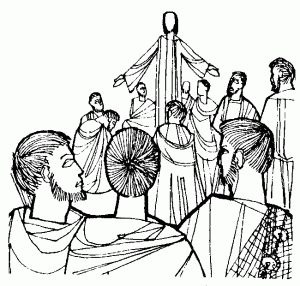
The Catholic Church is the source for the Scriptures: members from her community were inspired in their authorship and by her own authority she determined the canon. The proliferation of bibles throughout the world was not the fruit of Reformation-Protestantism but of the mechanical printing press. Rome has encouraged the reading of the Bible and has long offered a special indulgence to those who do so every day. Unlike the anti-Catholic fundamentalist, the entire Bible (without deletion of books) is offered her people. Further, her use of a lectionary system for liturgies has resulted in a greater variety of biblical passages than what is usual in Protestant services. The Catholic faith is affirmed by an honest and comprehensive understanding of Scripture while the anti-Catholic resorts to biblical fragments, out of context and ignorantly misinterpreted. One anti-Catholic bigot notes that John 6 is frequently used against him by so-called “idolatrous” and “pagan” Catholics. He cites John 6:51,53-58:

“I am the living bread that came down from heaven; whoever eats this bread will live forever; and the bread that I will give is my flesh for the life of the world. Amen, amen, I say to you, unless you eat the flesh of the Son of Man and drink his blood, you do not have life within you. Whoever eats my flesh and drinks my blood has eternal life, and I will raise him on the last day. For my flesh is true food, and my blood is true drink. Whoever eats my flesh and drinks my blood remains in me and I in him. Just as the living Father sent me and I have life because of the Father, so also the one who feeds on me will have life because of me. This is the bread that came down from heaven. Unlike your ancestors who ate and still died, whoever eats this bread will live forever.”

The anti-Catholic bigot argues that Catholics neglect verse 63 which illustrates, so he says, that Jesus did not mean what he said literally: “It is the spirit that gives life, while the flesh is of no avail. The words I have spoken to you are spirit and life.”

In other words, until verse 63, Jesus is lying? Sorry, I do not think so. Our Savior is not fickle in his teachings. He would not deliberately mislead and anger the Jews; he meant what he said about the Eucharist. This verse becomes clearer if we look at the one which follows it: “But there are some of you who do not believe.” This resonates with verse 52, conveniently omitted by the anti-Catholic apologist: “The Jews quarreled among themselves, saying, ‘How can this man give us [his] flesh to eat?’” Did the critic purposely omit this line, knowing that he found himself associated with the disbelieving Jews? It sure seems that way. The Jews are murmuring because they do not like what they hear. Some of their number walk away. They know full well that Jesus means what he says. Their sensibilities, especially regarding blood are offended. They will have none of it. It is a mystery that requires supernatural faith to accept. Verse 63 is not a reference to Christ’s Eucharistic body but is used as it was previously in John 3:6-7. We read: “What is born of flesh is flesh and what is born of spirit is spirit. Do not be amazed that I told you, ‘You must be born from above.’” “Spirit . . . flesh” is a Hebraic form of speech which does the very opposite of what the anti-Catholic bigot claims. It affirms the truth of Christ’s Eucharistic teaching and that to accept it we must be given the gift of faith by his heavenly Father.

We need to pray that the anti-Catholic bigot will be given a greater share in the true faith. He is usually filled with much anger and hate. He can only measure his own religion in reference to that which he opposes. I would fathom to guess that were there no Catholic religion, he would have no faith at all– or perhaps I should call it an anti-faith? He is quick to judge and to damn Catholics even though there is no consideration that if he is wrong then he has blasphemed the work of the Holy Spirit.

The anti-Catholic may also sin by presumption of God’s saving grace. We live in the “sure and certain hope” of our salvation, leaving our eternal destiny to divine providence. The Lord says, “Therefore, by their fruits you will know them.” While the fruits of Christ’s presence and loving ministry are manifested in the life of the Church, the anti-Catholic critic contends that Jesus shall respond to us with the words from Matthew 7:23, “I never knew you. Depart from me, you workers of iniquity!” Many of our Protestant brethren, with whom we would differ on points of doctrine and manners of worship, work alongside us in the promotion of the Gospel of Life. However, the anti-Catholic bigot contends that these groups are contaminated by their association with Catholics and thus are also lost. What can we say to such a critic? If all he understands are isolated bible texts, then let him pay heed to this one: “Beware of false prophets, who come to you in sheep’s clothing, but inwardly are ravenous wolves. By their fruits you will know them” (Matthew 7:15-16).

Every Catholic needs to remember the anti-Catholic and the fallen-away Catholic each time he receives Holy Communion. We need to dedicate our Holy Hours to prayer on their behalf and make reparation for their insults against Jesus, his Mother, and the Church. May our prayer rise like incense to heaven and be found pleasing to Almighty God.

For more such reading, contact me about getting my book, DEFENDING THE CATHOLIC FAITH.

References to Pagan Rome Used Against the Church

Revelation 18:2-8;24 is often misapplied to the Roman Catholic Church. The great harlot Babylon symbolizes the Rome of pagans not of Christians. Despite persecution and martyrdom, Christians of the first century are urged not to surrender their precious faith in Christ.

What is a Christian?

Since anti-Catholics often renounce the Christian nature of Catholicism, we would do well to look at the sober and rich definition of this question in the universal catechism:

[CCC #1694] Incorporated into Christ by Baptism, Christians are “dead to sin and alive to God in Christ Jesus” and so participate in the life of the Risen Lord (Romans 6:11 and cf. 6:5; cf. Col. 2:12). Following Christ and united with him (cf. John 15:5), Christians can strive to be “imitators of God as beloved children, and walk in love” (Ephesians 5:1-2) by conforming their thoughts, words and actions to the “mind . . . which is yours in Christ Jesus” (Phil. 2:5), and by following his example (cf. John 13:12-16).

For more such reading, contact me about getting my book, DEFENDING THE CATHOLIC FAITH.

Isolated Verses Misused Against the Church

A frequent tactic used by critics of Catholicism is to use verses orphaned from their proper context to impugn or undermine the teaching authority of the Church. They both misunderstand and misapply these passages so as to give their personal interpretation credence against the Magisterium. It is symptomatic of the Protestant individualism that often privatizes faith over the corporate understanding of a Church established and sustained by our Lord.

I write you these things about those who would deceive you. As for you, the anointing that you received from him remains in you, so that you do not need anyone to teach you. But his anointing teaches you about everything and is true and not false; just as it taught you, remain in him. (1 John 2:26-27).

The initial difficulty in attacks of this sort is the very origin of the Bible, particularly the New Testament. The Catholic Church gathered and reproduced the canon of the Bible for the believers. As the Mother of the Bible, the Church and her bishops saw no challenge between biblical truth and her authority. The fundamentalist tends to be short-sighted in his historical assessments. This leads to another problem, in that the text he would use as a weapon against Catholicism becomes his own trap. The effort backfires.

His own role as a teacher of faith contradicts a literal reading of these verses. John speaks here with the authority of an apostle, a role which shall find its succession in the bishops. The warning here is not against the Magisterium of the Church, but against those who would lead God’s people astray. There is no Gospel that saves other than that of Jesus Christ. No community possesses any secret knowledge that surpasses that of the public proclamation of the true Church. Keeping faith in Christ Jesus, the believer is baptized and anointed (confirmation), receiving the Spirit of wisdom, the Holy Spirit. We have a responsibility to know the true faith and to spread it. This is the mission of the Church. The Christian has no need to seek another religious truth and we are to remain in solidarity with the chosen community of faith and in union with God. True wisdom and faith comes as a gift from God.

Further, the Holy Spirit leads the humble person to God. Against the Gnostic heretics, John is defending the Catholic truth that Jesus is the anointed Holy One, the Christ. Jesus Christ is indeed the revelation of the Father. In a certain sense, the “sola scriptura” critic of Catholicism is akin to these ancient Gnostics. While they believe that Jesus is both Christ and Savior; like the Gnostics, they minimize the importance of the material in regards to the spiritual. Thus, the Mystical Body and pre-eminence of the Church is denied, the sacramental signs are ridiculed, and the significance of the body in our personhood is often maligned for its wickedness.

Another interesting element about the verses given is their context. At the end of chapter two, something is said about our justification that is sure to make the anti-Catholic reviewer uncomfortable:

If you know that he is righteous, you may be sure that everyone who does right is born of him. (1 John 2:29).

A real sign of our being “born again” is our just behavior; dare I say our good works?
The anti-Catholic critic will sometimes resort to trying to scare Catholics. He argues that time is running out and that Catholics, no matter how well-meaning, are in the wrong camp and facing the prospect of damnation.

So then each of us shall give an account of himself to God. (Romans 14:12).

The detractor of Catholicism would do well to read a few verses earlier,

Why then do you judge your brother? Or you, why do you look down on your brother? For we shall all stand before the judgment seat of God. (Romans 14:10).

Dissimilar from most other institutions, the inherent unity of Church members in Christ means that an attack against one is an assault on all. Similarly, if one targets the Catholic Church, then every Catholic believer is between the cross-hairs. The Church is a family. It is not really possible to hate the Church but to love individual Catholics. Hate the family, and you hate all of us. We are the Church.

While certain critical voices would employ such verses in their apologetics, the citation from Romans points to how one’s faith is actualized by the life of charity and following the commandments. We will each have to give an accounting for what we did in the body, either good or evil. While there is a particular judgment for each of us, there will also be a general judgment at the end of the world. Individual souls as members of God’s holy people or those for whom the Church has interceded will be accorded the reward of the just. The communion of saints is a celebration of the unity of the Church among those glorified by grace and thus worthy of heaven. Having repented, they place their faith in Jesus. They are washed clean in the blood of the Lamb and given the wedding garment of heaven as their vestiture. Those who reject the gift of salvation remain lost in their sins. They are separated from God and breached from their brothers and sisters by their own selfishness and iniquity.

But when he comes, the Spirit of truth, he will guide you to all truth. He will not speak on his own, but he will speak what he hears, and will declare to you the things that are coming. (John 16:13).

These words are not written for various individuals apart from the believing community; these words regarding the Holy Spirit are directed to the Church as a whole. This promise of Christ is fulfilled when the Holy Spirit descended upon the infant Church at Pentecost. Imaged as tongues of flame over the heads of the apostles, the leadership of the Church would always be enlightened and protected in the truth. Individual members can and should invoke the Holy Spirit for wisdom. But, the gift of infallibility and steadfastness in the truth is conferred upon the Church, particularly the Magisterium, and not to every individual believer. The assurance of Christ’s teachings require that members of the faith take seriously the guidance of their lawful shepherds and that they seek to conform their hearts and minds to that of Christ realized in the teaching Church. Our Lord speaks to us through his Church.

As we have said before, and now I say again, if anyone preaches to you a gospel other than the one that you received, let that one be accursed! (Galatians 1:9).

Apart from Christ’s true Church, ministers and the people who follow them fall ever further from the truth. Fundamentalists might love this verse, but it also places them under divine judgment. Originally it applied to those missionaries who insisted that pagans had to become Jews before becoming Christians. Thus, circumcision and other Jewish rituals would be placed on par with the saving Cross of Christ. Paul denounces this activity and insists that his is the correct Gospel proclamation. Catholics place faith in Jesus and consider baptism as the manner in which we join the new People of God and are touched by Christ’s saving activity. The verse can in no way be applied against the Catholic Church. Ours is a faith in continuity with history: to the early Fathers, to the apostles and to Christ.

Now I am reminding you, brothers, of the gospel I preached to you, which you indeed received and in which you also stand. Through it you are also being saved, if you hold fast to the word I preached to you, unless you believed in vain. For I handed on to you as of first importance what I also received: that Christ died for our sins in accordance with the scriptures; … (1 Corinthians 15:1-4).

Paul recalls the living TRADITION which he himself received and transmitted to the Corinthians. Paul stresses their faith in Christ and in his saving actions against the views of those who would deny the bodily resurrection of the Lord. Catholics believe in this very same Gospel and retain the ancient traditions repudiated by many non-Catholics.

Then he brought them out and said, “Sirs, what must I do to be saved?” And they said, “Believe in the Lord Jesus….” (Acts 16:30-31).

Here the anti-Catholic critic is purposely deceptive. As the verse reads, it appears that salvation is an entirely personal matter. Nothing could be further from the case. The complete verse reads as follows,

“And they said, ‘Believe in the Lord Jesus and you and your household will be saved.” (verse 31)

We read further:

So they spoke the word of the Lord to him and to everyone in his house. He took them in at that hour of the night and bathed their wounds; then he and all his family were baptized at once. He brought them up into his house and provided a meal and with his household rejoiced at having come to faith in God. (Acts 16:32-34).

Can we presume that even the babies of the household were baptized? Most probably it is so. The household or family becomes the setting for the “little church.” The gift of faith brings people to Christ, not simply as isolated individuals, but corporately– as a family in faith.

Whoever possesses the Son has life; whoever does not possess the Son of God does not have life. I write these things to you so that you may know that you have eternal life, you who believe in the name of the Son of God. (1 John 5:12-13).

Pope John Paul II stressed this crucial element of the Good News in his encyclical on the Gospel of Life. Christ is the author of life and makes possible our share in eternal life.

For God so loved the world that he gave his only Son, so that everyone who believes in him might not perish but might have eternal life. (John 3:16).

Again, this is a central teaching of the Catholic faith. Those who would use it to stress belief or faith profession over the merits of the Christian life would do well to read verses 20-21:

For everyone who does wicked things hates the light and does not come toward the light, so that his works might not be exposed. But whoever lives the truth comes to the light, so that his works may be clearly seen as done in God.

We believe as Catholics that God will show his face to those who search for him with humility and with sincere hearts.

When you look for me, you will find me. Yes, when you seek me with all your heart… (Jeremiah 29:13).

God is the source of our being. He gives our lives meaning. As St. Augustine would say, “Our hearts are restless O Lord, until they rest in you.”