











Feel free to submit a new question or concern in the comment box below. Various topics and questions are archived here for easy retrieval. Please be courteous. Comments are moderated so please be patient in waiting for them to appear and for any responses. God bless you!
NEW MESSAGES/HOMILIES CHRISTIAN REFLECTIONS DEFENDING THE FAITH










 Blogger Priest
Hello
For a long time I have held my tongue and been kind to my in laws who have repeatedly disrespected me and gossipped about me. I have tried to speak with them about their behavior towards me and I end up being the bad one. How much more should I take. I’m trying to live by my catholic faith and they make it really hard.
I am a Catholic. I have been talking very heavy to this girl. I think I might love her. The only thing is I am a girl as well. I have also been going with someone with whom I have a lot in common— someone who makes me very happy. I know it is a sin; but I really don’t know what to do. Does God want me to live an unhappy life? My question is will I go to hell if I continue dating her? I don’t know what I should do! Please help!
I was thinking about the nature of God, and I came across a question in my head. If God is all powerful, but chose to give man free will, why did he set rules and commandments? If he wanted us to do only what he set as right and moral, why give us the free will to disobey, only to punish us for doing so? Thank you for giving this a look.
Father Joe, I have a question concerning some old documents I’ve come across. I’ve been researching the early church fathers and I read some letters about the Assumption of Mary, and the history of Joseph the carpenter from the Syriac version of the earlier acts of Thaddaeus. They answer a lot of questions concerning these two great people of our faith that’s not covered in the bible, but are they accurate and authentic. Can we trust in what these documents tell us. I hope we can because I would like to reference these when I explain what we believe about the assumption and Joseph having other children and not having any with Mary. Thank you for your time, I hope I haven’t given you to much homework.
If a holy day of obligation falls on a Monday or Saturday is it still mandatory to go to mass?
Hello Father,
I’m not really familiar with this sort of thing so excuse me if you find me rude in any way. Also, before I ask my question I would like to reference a few passages which have lead me wondering about this:
Leviticus 18:22, “You shall not lie with a male as one lies with a female; it is an abomination.”
Romans 1:26-28, “For this reason God gave them over to degrading passions; for their women exchanged the natural function for that which is unnatural, and in the same way also the men abandoned the natural function of the woman and burned in their desire toward one another, men with men committing indecent acts and receiving in their own persons the due penalty of their error. And just as they did not see fit to acknowledge God any longer, God gave them over to a depraved mind, to do those things which are not proper.”
Genesis 1:28, God blessed them; and God said to them, “Be fruitful and multiply, and fill the earth, and subdue it; and rule over the fish of the sea and over the birds of the sky and over every living thing that moves on the earth.”
The lord forebode and ‘cursed’ humanity of homosexuality so that we may multiply and subdue the earth, but don’t you think that we may already have taken over the world? if so, then wouldn’t this mean that God’s word of forbidding homosexuality would be nulled? And if this is true, then shouldn’t the bible be “updated” in order to suit the more present public?
That is all the questions I have for now, Thank You.
Hello, I have been married to my husband for 23 years. We are a Catholic family we go to church every Sunday and try to live by our faith. We have been having an issue with my mother in law. See we live with her in her house. We split the bills and the mortgage between her and us. My brother in law lives there too with his family of 6;however He only pays half of the water bill every two months. My husband and I feel it’s not fair. We too have a family of 6 and my husband works 60 to 70 hours a week. My brother in law only 14. My mother in law enables him and doesn’t want to charge him rent because he doesn’t have a “good” job, and this is really putting a strain on us financially. Since my husband has brought this to her attention she started retaliating against me. She now goes and tells my brother in law and his wife that I have a problem with them. She’s even gone so far as to talk bad about my 18 year old daughter. She’s made false accusations about us and when were alone she doesn’t even speak with us. I’ve spoken with her about her behavior and how this makes us feel but she continues to do it and not respect me or my children. Around my husband she’s a totally different person. My question is I know the bible says we need to honor thy mother and father but what do we do in this circumstance? This woman has spoken so bad of me for 23 years and I’ve let it go, but now she’s starting with my daughter. I dont understand why. She’s had a hard life with my father in law who is a drug addict which I feel primarily a lot of the resentment is coming from that but I dont understand why she has to be that way. My husband is 45 and has always helped her financially since the age of 17. And when my father in law would beat her he was always there to defend her. My husband feels saddened that after all that he’s done for her and the family she would act like this with me and our daughter. I don’t know what else to do. We want to do whats right. How can we help her to understand that she’s hurting the family?
[DELETED]
Hi again, Father!
I have a question regarding my family. My husband and I are both cradle Catholics. Before we were married, we both married Jews outside of the Catholic church. He had 2 children with her, and I did not have children. His children do not practice Judaism, but they are very anti-Christianty and his son (age 13) regularly makes fun of religious kids at his school and laughs when people cite God as an inspiration or a meaningful force in their lives. Their mother seems to take a position of Jewish superiority with regard to religion, and it seems to have indoctrinated the children. His daughter is an adult and does not live with us. His son lives with us half-time.
My husband and I both obviously fell away from practicing our faith for many years, and have now realized that we are being called to practice Catholicism fully and wholeheartedly. We have had many near-miraculous events in our lives during the time in which we have been together, and we can’t deny the hand of God in these unexplained events of serendipity. We are ready to begin ‘getting right’ with our faith and would like some advice on what to do.
We would like to get married in the Church but aren’t sure how to go about it. I have completed my sacraments including Confirmation and Reconciliation, but he has not been Confirmed. He attended Catholic school up until age 16, but did not choose to be Confirmed due to questioning his faith when his parents were divorcing.
What are the steps we need to take with our local parish (we will be joining in September) to straighten everything out? Also, how would you advise dealing with the children and their opinions of Christianity? My stepson seems to desire God in his heart, but I feel like he is uncomfortable with it due to his mother’s influence. He has many Catholic-like opinions of things, and we were thinking of just requiring him to come to Mass, but I don’t want to drive him away, especially if he is curious.
Thank you so much for any guidance you have!
Dear Father Joe,
Thank you so much for praying for my family. We were the ones with the drug dealer who moved in next door and needed to get out of our lease and secure a new home. We have- by the grace of God and prayer – found a lovely rental home and were able to be let out of our lease without penalty! Thanks be to God!
[DELETED]
If a priest gives permission can a family member of a sick person unable to get to Mass bring communion to that sick family member. OR is it ONLY allowed for a priest, deacon or extraordinary Eucharistic Minister to carry Jesus outside the Church?
New Question: Father, what difference does it make if the priest, who is an alcoholic, uses grape juice and not the pre-approved brands of mustum during the consecration? Does it invalidate the Eucharist and the Mass? If so why does that matter?
Dear Father Joe,
I am writing a play that involves a priest. Since I am not a priest and would not know what to say in this kind of circumstance I would like to know what you would say.
In this scene my protagonist is confessing to the witness of a murder that he didn’t do anything about and he feels absolutely horrible he couldn’t do anything. He seeks religious advice and came to his local priest. The line before the priest answers is
“I didn’t try and stop him. All I could do is stand back and watch. I wanted to help but I couldn’t for fear of my own life”
I just want to know what you would say if someone confessed this to you.
Thank you so much for answering my question so hastily and in depth. It is greatly appreciated and helpful. One last question…if we decided to ask a priest to give a blessing at our wedding ceremony in our church, would that be permitted?
Hello!
My fiancé and I are non-denominational Christians who grew up in very devout catholic families. We are getting married at our mom-denominational church that we belong to, but out families are very uneasy with this… My question for you: are non-denominational marriages recognized as valid and/or sacramental in the Catholic Church? Thank you!
Thank you Father, I appreciate the information! It puts mind mind at ease.
What is the church’s position on Medugorje?
Hello Fr Joe! Thank you for your great blog. I have question concerning some rosary beads. We own many of them and recently, while moving, I came across several from a trip that I took to Medugorje in the mid 1990’s. At the time I was unaware of the Church’s position on Medugorje. All of these sets have the word Medugorje stamped on the back of the Crucifix. I often hand out beads to kids in my CCD class, but am hesitant about handing these out this coming fall. I do recall them being blessed (if that makes a difference) but my understanding is the blessing is really for those using them. Is that correct? Can you give me your opinion on what think I should do with them. If they should be destroyed, how would I go about doing so? Thanks!
Father Joe,
I am a Permanent Deacon and at ordination promised to pray the Liturgy of the Hours. We are required to pray only the Morning and Evening prayer. These prayers are beautiful and I always find something in them which pertains to my life. However, on occasion,I am very tired and to be honest,rather lazy and I do skip my LOH.
Am I committing a Mortal sin? I just can’t imagine a loving God cutting me totally from the church for the missed prayers. What are your views on this subject? Thank you and God bless.
THE EUCHARIST AS THE REAL PRESENCE OF CHRIST
MIKE: You want to claim John 6 for transubstantiation?! Really?! Yeshua knew from the beginning the ones who did not trust, as well as which one would betray Him. (John 6:60-64)
FATHER JOE: Are really surprised? Such was the understanding of the Church until the dissent of the Protestant reformation. What our Lord knew in his divine knowledge never stopped him from challenging his listeners or making a universal appeal for salvation. The Lord would have us cooperate with his grace. Those who refuse to do so are known to him, but only after having the opportunity to say YES to God. In reference to the Scriptures you cite, we can only hope that some of his listeners would later return to him. In any case, nothing will circumvent divine providence, not even the misuse of human freedom and the darkness of ignorance. If you would doubt or deny the real presence of Jesus in the Eucharist then you would be counted among the murmuring Jews who walked away from our Lord. No doubt some of them also tried to explain away or rationalize what Jesus said. However, our Lord persisted (as I do) and they abandoned him.
MIKE: Yeshua says “the Spirit gives life; the flesh is of no benefit…” In other words, the words He spoke, though using graphic terminology like gnawing and chewing (in the Greek), were not to be taken literally, but spiritually. He knew who were His, and who did trust in Him, thus He used these words to drive the others away (verse 64).
FATHER JOE:
Our Lord was not talking about ordinary food. It is by the command of Christ and the power of the Spirit that he would give himself to his apostles as a saving food at the Last Supper. Jesus is preparing his listeners for the gift that he would give his apostles at the Last Supper
It was only with the Protestant reformers that some would argue a figurative or spiritualized understanding of the Eucharist. The Church, East and West, well understood the graphic nature of what Jesus explained. He meant for his words to be taken literally. Jesus spoke again and again about how we had to eat his flesh and drink his blood if we wanted his life in us. This is the root cause for the murmuring and those who walked away. His listeners did not like it. It offended their Jewish sensibilities. The reference to Spirit and life is an old Hebrew colloquialism. Jesus did not suddenly develop amnesia about what he had said. Rather, he is telling us that it is only by the movement of the Spirit that one might believe this great mystery.
You misinterpret the words, “The words I have spoken to you are spirit and life.” It is not so much a reference to the Eucharistic species, but rather a distinction between the supernatural and natural. The earthly man cannot understand. It is only by the enlightenment of the Spirit that we can penetrate and accept the truth. God in Jesus Christ makes himself our food. Everything that Jesus uttered about the “bread of life” is revealed by the Spirit of God. A similar connection is made in John 3:6.
MIKE: We read what is said at the Seder, Yeshua says “do this in memory of Me”, which Paul quotes in 1 Cor. 11. When I’m at the Lord’s Table, I truly understand that the matzah and the juice are to point us towards Messiah’s broken body, and shed blood (Paul is clear in 1 Cor. 10, and 11), but I also understand that it’s not physically His body and His blood.
FATHER JOE:
Again, such an interpretation is revisionist and untrue. Jesus institutes his Priesthood and Eucharist as the new ritual by which his covenant would be expressed and renewed. It would make both the person of Jesus present as well as his saving activity, the Paschal Mystery. The Jewish Christians appreciated that a covenant could not be established with fake flesh and blood. A real sacrifice had to be made. This identification of the Eucharist was so identified with the risen Christ that its reception while not disposed could bring down judgment. This would not be the case with a spiritualized or “empty” symbolic association. You might disagree with such a thing, but it is what Jesus meant. That is why some correlate a lack of faith in the Eucharist with the movement of modernity toward overall atheism. The Eucharist is our Lord’s effort to assure his Church that it will never be orphaned or abandoned.
Perhaps as early as 63 AD, Paul is sharing how he says the Mass. The Eucharist allows us to enter into the Passion, Death and Resurrection of Christ. It is a re-presentation, albeit clean or unbloody, into the oblation of our Lord on the Cross at Calvary. The language is stark. “This… my body. This… my blood of the new covenant.” He says nothing about representation. He is literally saying: THIS IS ME!
MIKE: Furthermore if this were the case, why then have there been provisions made for those with gluten issues (low gluten hosts are permissible for people with allergies), and why is mustum acceptable for use of alcoholics? If it were physically the body and blood of Him who bore our sicknesses and diseases, the gluten filled host and alcohol laden wine would be of no effect.
FATHER JOE: You evidently do not understand the Church’s teaching about the Eucharist. While some authorities will use the word “physical” that is not actually what the Church teaches. The Catholic Church teaches that at after the epiclesis and the words of consecration, the elements of bread and wine are “substantially” changed into the body and blood of Christ. This is not a gross physicalism as with the Thanksgiving turkey. The accidents or appearances remain the same. The consecrated species will still have the external traits of bread and wine… taste, touch, and smell. However, the underlying substance is changed. This is called “transubstantiation.” Our Lord is made substantially present: humanity and divinity, raised, whole and complete, in every drop of the precious blood and in every fragment of the host. The multiplication of the food stories in the Gospels foreshadows this sacramental reality. This presence cannot be seen or measured under a microscope. We believe it for one reason… because Jesus said so.
MIKE: I’ve seen the effects of what happens when one who is fasting before receiving communion. They get tipsy from the wine. (Extraordinary Ministers of the Eucharist hold to the tradition of a full 12 hour fasting before reception of communion, thus when they’re finishing off the wine, they sometimes get a little tipsy from drinking on an empty stomach). Furthermore Scripture again bears witness to my words, Paul calls out the Corinthian church for getting drunk at the Lord’s Table! That being said there’s just one solid argument against the VCC (Vatican Catholic Church (I use Vatican instead of Roman because of the fact there is 39 rites within the church).
FATHER JOE:
I am almost embarrassed to discuss this in public with you given your overall misconceptions about Catholicism and erroneous readings of Scripture. We must understand the Bible within the living tradition and witness of the Church Christ instituted. We are bound to the sources of Christian revelation passed down from the apostles in the Church. Once we sever that connection, error builds upon error.
As I explained, the accidents of bread and wine remain (including the effects of alcohol) after the sacramental and/or substantial change that comes with consecration. Our Lord is hidden but present behind these accidents or appearances. However, the presence is affirmed because we are admonished not to get drunk on the LORD.
It should also be noted that the early Church celebrated the Eucharist within the context of an Agape or Love Feast. It included both food for the body and food for the soul (the Lord’s Supper). It was because of abuses in eating, drinking and sharing that the Church later separated the commemoration of the Lord’s Supper (Mass) from the fellowship meal. People could eat at home before coming to the Sunday liturgy.
The laity that assists with distribution is properly called Extraordinary Ministers of Holy Communion. This is another needed correction to your remarks. Further, the Eucharistic fast was not 12 hours. Before Vatican II it was from midnight until after Mass. Later it was reduced to three hours and is currently only one hour before Holy Communion. The fast is to insure that the Eucharist is not wrongly mixed in our mouths with ordinary food. It is a sign of respect and to prepare ourselves for our Eucharistic encounter with Jesus. Further, you need to appreciate proper terminology about the Catholic Church. While there are many rites, we all accept the Pope and teach the same faith and values. The proper name for the largest of the rites is THE LATIN RITE. Even if the Mass is in English or Spanish or German or whatever… we are still members of this rite.
MIKE’S FAITH JOURNEY
MIKE:
I was born to an unwed Jewish teen (she was a rape victim, thankfully her grandmother who survived Auschwitz instilled in her the values of being pro-life), and adopted by a wonderful Roman Catholic couple. They had me sprinkled as a babe, but of course a proxy confession and repentance was made by my godparents (as per what the church teaches).
I always knew I was Jewish (I even went to Jewish day school). When it was time to start preparing for my bar mitzvah I was given the option of staying in the cult of the Vatican, or go back to my roots. I became a baal t’shuvah (which is a term meaning one who has returned to orthodox Judaism).
If I were to die not knowing Yeshua, my baptism would be invalid. At age 23, I came to know the Messiah and was immersed during a Shabbat morning service at the congregation in which I came to faith.
FATHER JOE:
It is indeed fortunate that a pro-life mentality protected you in the womb making possible your birth, even though the circumstances of your conception were violent and tragic.
Your faith history is interesting, albeit with a negative slur against Catholicism. The word “cult” would more technically apply to your current religion than to the institution established by Christ. The Vatican is where the Pope is but it does not describe the Catholic Church or the Latin (Roman) Rite.
If I read correctly, your path was infant baptism, a bar mitzvah into orthodox Judaism and finally re-baptism into a cult or faith community akin to Jews for Jesus. You would have done better to join the Association of Hebrew Catholics.
You may have started out life Catholic, but you were evidently never catechized. Baptism is not magic. Parents and godparents are called to do all in their power to raise a child in the faith so that later in Confirmation they can make the baptismal promises truly their own. Confirmation completes the Baptism and the person is given a fuller share in the Holy Spirit. Along with the Eucharist, these are the three sacraments of initiation. You should have been raised in the Catholic faith and your Jewish background should have been affirmed. Jesus was indeed the Jewish Messiah as well as the Savior of the World. Instead of catechesis, either books or persons fed you anti-Catholic propaganda.
THE MANNER OF BAPTISM
MIKE: I’m well aware of the reasoning for the doctrine and tradition of baby sprinkling/dunking (the eastern rite immerses, which is what the actual greek baptizo means, and the first century form of this was very similar to the Jewish mikveh), however it just doesn’t hold water to (pun intended) to Scripture teaching.
FATHER JOE:
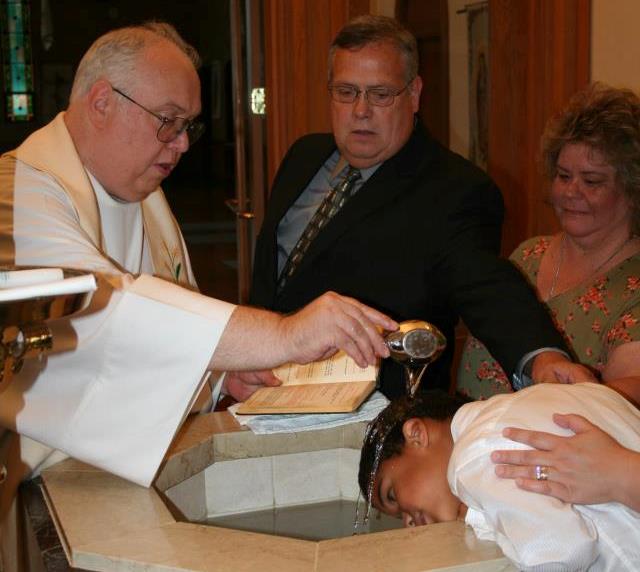
Actually, I do not think you are well aware of much of anything. I do not intend to be hurtful, only truthful. Catholic Latin Rite churches baptize either by infusion (pouring), immersion (dunking). Sprinkling is also permitted but is very rare. The Bible does not describe the process but Church practice goes back to the earliest days. It is true that immersion would immediately parallel the experience of dying with Christ (under the water) so that we can rise with him (emerging from the water). But there is no indication that this was always the practice. Indeed, just as with Hebrew ceremonial baths, one might stand in the water and have it poured over the head. The word for baptize may mean immersion but it may also just mean “washing.” Any general definition of “baptizo” would not exclude pouring. Our Lord told his apostles that they would be “baptized with the Holy Spirit” (see Acts 1:4-5). When Pentecost came, the Scriptures relate that “the Holy Spirit was poured out on them” (Acts 2: 17, 18, 33).
Today immersion is often practiced for both adults and infants. However, one must be cautious. I recall a news story of a baby that died because of immersion. The child had a respiratory disorder. If immersion immediately signifies death and resurrection, infusion or pouring is more symbolic of the Holy Spirit.
Historically, pouring became more common given the great numbers of converts, climate conditions and the lack of availability large pools of water. The permissibility of pouring is testified to by the Didache (70 AD) and the Apostolic Tradition (215 AD).
INFANT BAPTISM
MIKE: Nowhere in Scripture do we see infants being baptized. We always see the Apostles declaring the Gospel, calling for people to repent, and after they’ve repented and made a confession of faith then they were dunked (Matthew 3, Acts 2, 8, and 1 Peter 3).
FATHER JOE:
Initially baptized Gentiles were both circumcised and baptized. The Council of Jerusalem would relieve the Gentile men of this burden. As “whole households” were converted, even small children and infants were baptized. The Jews circumcised small children into the people of Israel; baptism became the Christian manner of incorporating people into the New Israel, the new People of God or the Church. Infant baptism expresses corporate or communal faith. New cults often emphasize personal faith but regard the churches as just a place of fellowship and support.
The Roman Catholic Church teaches that “The practice of infant Baptism is an immemorial tradition of the Church. There is explicit testimony to this practice from the second century on, and it is quite possible that, from the beginning of the apostolic preaching, when whole ‘households’ received baptism; infants may also have been baptized” [CCC 1252]. Records from the 2nd century AD make it clear that infant baptism was routine. Most Christian churches follow this lead and baptize babies.
Just as with Marian doctrines, the New Testament does not directly focus on the question of infant baptism. Rather it emphasizes first the Gospels of Christ and then Acts and the Epistles. We are given a picture of Christ and a very young Church seeking to survive and to spread the Word. It is no wonder that the gravity is upon adults coming to the Christian faith. However, as an aside there are Scriptures that seem to point to the practice of child baptisms: references to whole families “…and [her] household” being baptized (Acts 16:15, Acts 16:31-33, 1 Corinthians 1:16) and “…the promise to you and your children” (Acts 2:39).
THE EFFICACY OF BAPTISM & HUMAN FREEDOM
MIKE: I know of a Nun who fell in love with a Muslim man, she left the church and embraced Islam, she died a Muslim. Her baptism did nothing for her, and she’s now in hell.
FATHER JOE: If this woman were a nun, then she was baptized, instructed in the faith, received the sacrament of penance, professed the faith and renounced Satan for her confirmation, and later became a consecrated religious. She may have left the faith but I suspect you are telling a tall tale. What was her religious community? Where did this happen? Sorry, given your poor appreciation of facts, this story just cannot be trusted. As for her being in hell… that is God’s call, not yours. It may not look good, but we should be wary of presumption regarding souls. As I said, baptism is not magic. I know people who enter the Church from other traditions. Some were already baptized as adults. They became Catholic. They continued their journey by cooperating with divine grace. But there is no absolute assurance. Faith can sour. God respects human freedom, even when misused. The Catholic position is that we live in the sure and certain HOPE of our salvation. But such requires that we keep faith and walk with the Lord.
MIKE: Baptism is for believers who make a confession on their own free will! Scripture makes this point quite clearly.
FATHER JOE:
Adults, who go through the RCIA process will profess their faith and be baptized, confirmed and receive first Holy Communion. Those already baptized will make a verbal act of reception and receive the other sacraments. You cannot be baptized twice. Baptism in the Church requires water and the Trinitarian formula from the end of Matthew’s Gospel. Baptism does the following: (1) we become temples of the Holy Spirit; (2) we are given sanctifying grace; (3) we are reborn as a new creation, made into the likeness of Christ; (4) original and all sin is mitigated; (5) we are made adopted sons and daughters of the heavenly Father; and (6) we are incorporated into the Church.
The Hebrews circumcised their infants. The Christians baptized theirs. Both practices allowed for adult converts, although circumcision was a stumbling block to the Greeks. The Judaizers insisted that they had to first become Jews before becoming Christian. The Council of Jerusalem would put an end to this and St. Paul’s argument would carry the day, convincing St. Peter and others. You have an impoverished notion of the Church as a faith community. You have virtually no understanding of the communion of the saints. No one comes to God alone. It was only with those who hated the Catholic Church and any association with the canonized saints that such a wrongly personalized faith emerges. It is a contradiction, both to the Jewish and the Catholic mindset. The Church is the New Israel. The kingdom of God breaks into the world, first through the person of Christ and now through his body, the Church.
CANON OF THE BIBLE
MIKE: (In reference to Purgatory) The book of Maccabees is not Scripture. When the KJV publishers took it out in the 1800’s, they did a good thing.
FATHER JOE: What is your criterion for the biblical canon? The earliest versions of the New Testament (written in Greek) all use the Old Testament (46 books) canon that was used by the diaspora Jews (Greek speaking). This canon included the disputed books that are included in Catholic bibles: Tobit, Judith, 1 & 2 Maccabees, Wisdom, Ecclesiasticus, and Baruch. At the time of the Reformation, Protestants deleted these seven books. They opted instead for a first century AD rabbinical redaction or edited Hebrew canon. However, the Gospel texts cited the larger Greek canon as did St. Paul. Most Jews used the Greek Old Testament or Septuagint. The early Christians did the same. The Catholic bishops affirmed the canon of the Bible at Hippo (393 AD) and at Carthage III (397 AD). The Catholic Church collected the New Testament writings and joined them to those of the Old. The Catholic Church is the Mother of the Bible.
THE MEANING OF PURGATORY
MIKE:
Purgatory, which your church claims can be based on one passage of Scripture (1 Cor. 3:15) and a passage from a non-Scriptural historical book known as Maccabees, is bad teaching! If one looks at the full context of 1 Cor. 3:15, one can quickly see that this chapter is talking about ministry and not a purgatorial state.
Yes I’m well aware of the fact that Purgatory was a very real piece of theology in the Jewish world at the time.
Furthermore we see those in purgatory rising from the dead at the same time Yeshua died on the cross (the Gospels testify to this). That being said we have no such doctrine of purgatory found in the early church.
FATHER JOE: Actually, the limbo of the fathers no longer exists. The righteous dead awaited the coming of the Savior that they might be released. Remember that Jesus the pontifex or bridge. He is the only WAY to the Father. Jesus descends to the dead and takes then with him into heaven. Prior to coming, the gates of heaven were closed.
You get so much wrong or twisted; I have to wonder if you really even understand the Catholic notion of purgatory or purgation. The souls of purgatory are happy because they still possess a saving relationship with God. Venial sins do not sever our friendship with the Lord. Sanctifying grace which brings the saints to heaven is at work in the souls enduring purgation. They are being transformed and healed. They are being perfected. Temporal punishment is satisfied. All that does not belong to God is extracted. They are purified like gold in the fire. They are made ready to enter into the heavenly presence of God. Venial sins and habits leading to sin are burned away by the fire of God’s love. Such is what happens to souls as they approach God.
This brings to mind an important distinction between Catholics and certain Protestants on the question of justification. Purgatory is linked to our necessary transformation or change, ever more and more into the likeness of Christ. We must be holy to be in the presence of the Great Holy-Holy-Holy. Certain reformers argued that we were saved entirely by Christ, not because of any change or infusion, but because he stands before us as we approach the Father. This appreciation of justification makes Jesus an external shield or disguise, but not a presence within us. This would not only make heaven undeserved but theoretically unbearable. We would never be able to look at God. The light would be too bright. The Catholic notion of heaven is beatific vision. We will see him face-to face. The fire and light of heaven does not blind or burn the souls of the just. Purgatory allows our spiritual eyes to get used to the light. We are remade so that unlike the damned of hell, the fire of God warms us but we are not tortured in flames. Purgatory is temporary. When it has done its work, it will cease to exist. There will be two realities: heaven and hell.
Certain saints may go straight to heaven. Others undergo the purification of purgatory so as to achieve the necessary holiness for heaven and all its joy. Often envisioned like a temporary hell, purgatory is quite different. Purgatory is not so much about punishment as it is about cleansing. Often envisioned as a prison, hell might be better equated with a hospital.
The book of Maccabees is not only Scriptural but reveals that the Jews prayed for the dead. Such prayer was not in vain. The practice was assumed by the early Christians into the new dispensation of Christ.
Praying for the dead is an important distinction between Catholics and many Protestant faith communities. If there is no purgatory then such prayer would be nonsensical. The saints of heaven may intercede for us (something else you probably deny) but they have made it and do not need our prayers. The damned of hell have made their sad choice and it is too late. Prayers cannot help them. If one must be perfect to enter heaven, the purgatory is God’s last gift to his friends. Otherwise, even the smallest sin or spiritual blemish would damn us for eternity.
“If Job’s sons were purified by their father’s sacrifice, why would we doubt that our offerings for the dead bring them some consolation?” (St. John Chrysostom):
Forgiveness is implied in the age to come:
THE REDEMPTIVE VALUE OF CHRIST’S CROSS
MIKE: The sacrifice of Messiah was not only for original sin, BUT FOR ALL OUR SIN (and yes this goes against the Catechism, but I could care less, as the Catechism goes against Scripture).
FATHER JOE: Your ignorance is so severe that it is difficult to read your comments. You might disagree with Catholic teaching but please, at least get it right.
The universal catechism teaches:
All sin is forgiven through the Cross. This is precisely what the universal catechism teaches. But you do not understand. Christ died once and for all. But the Mass is a participation in his one-time sacrifice. The merits of the Cross are applied through faith and the sacraments that Jesus instituted. The priest in the sacrament of penance does not affirm the forgiveness of the Cross in the past but actually applies it as an act of mercy in the present. The priest is configured to Christ to offer absolution and healing. We are healed as members of the Catholic Church, God’s holy people.
YOU ATTACK WHAT YOU DO NOT UNDERSTAND
MIKE: Last rites, penance, indulgences, requiem masses, and so forth are vain practices. How can you justify your claims of being a part of the true church, when the evidence is stacked against you because of some of your doctrines?
FATHER JOE: My faith is justified by Scripture (instituted by Christ), by history (legacy of the saints), and by the continued movement of the Holy Spirit giving efficacy to her teachings and sacraments. The Lord gave us the Eucharist as our spiritual food. That is why his presence is REAL. No one can be fed with fake food. We are not orphaned. The Mass is our participation in the oblation of the Cross. It was instituted along with the priesthood at the Last Supper. The Epistle of James tells the community to send for a priest to anoint the sick. We perpetuate the healing ministry of Jesus. St. Paul speaks of himself and the other apostles as ministers of reconciliation. Our Lord gave the power of the keys to St. Peter and the Church. Just as Jesus forgave sins, he wanted his shepherds to do the same for people burdened by sin. All these mysteries are substantiated by Scripture and by the experience of both the apostolic and patristic Church. The break comes with you and your sorts. You may know Christ but you really do not know his Church. The Catholic Church is the house that Jesus built.
Hello Father,
I was wondering, what are the consequences of marrying outside of the catholic church for the catholic who marries the non-catholic? What of the children born in this marriage, if the marriage is not considered valid?
Thanks,
Josie
Hello!
This question may sound a little strange! I have three cats and when I give them their individual little treats I sometimes say to them “The body of Christ” just to be silly and it’s kind a dawned on me that I might actually be doing something wrong. Should only priest be saying that? I’m only teasing when saying it but I don’t want to offensive to the church! Thank you in advance.
I woke up and saw a woman next to my bed. She was calm and looked at me. I sat up and said the name Marrisa twice. I was not scared but I felt nervous. I didn’t say the name on my own. I don’t know any Marrisas. She pointed at me slowly and was gone in a blink of my eyes. I couldn’t move or breathe but felt like I was supprised to do something for this Marrisa woman. She needed something. Now I’m worried about what happened. Friends say it was the Virgin Mary but why did i call her Marrisa. What did she want from me. I’m not very religious but I am Catholic I was not asleep when this happened but some say I dreamed it. I can still hear myself saying Marrisa twice but it wasn’t me? Ugh. Am I crazy?
Can I complete adult catechism class online? As well as my confirmation? I’m looking for a legit website to do it on.