












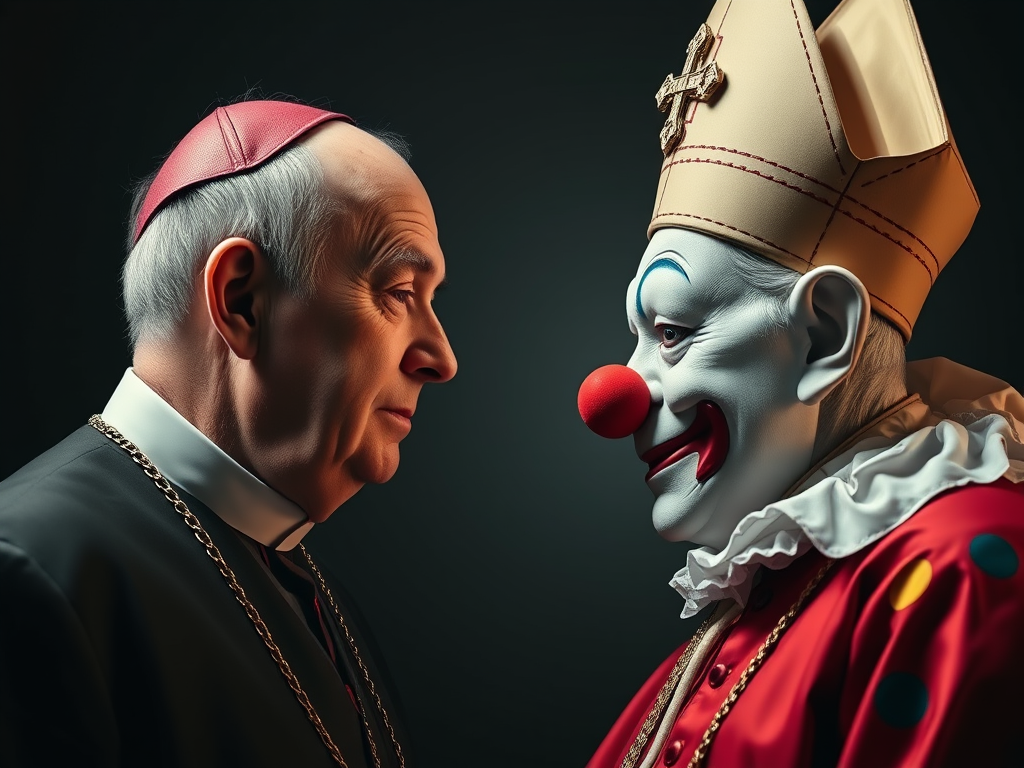
The SSPX postures a “gravitas” and dignity, not against the best that the rest of the Catholic Church has to offer, but the worse. It defines itself through criticism of the aberrational, not the normative. The Masses it deplores are not well conducted Novus Ordo liturgies but clown Masses, liturgies with puppets, dancers and priests making fools of themselves. Every fumble a bishop and even the Pope makes is paraded for all to scorn and laugh.
The liturgies advertised by the SSPX are high Masses, celebrated according to strict rubrics with Latin masterfully articulated from the altar for all to hear. Chant and schola choirs sing with solemn beauty and professionalism. However, this is not how I remembered the old Mass from when I was a boy. The Masses were largely inaudible for congregations as microphones were forbidden on the altar. Altar boys mumbled half-remembered words, and the music was either absent or poorly done. Pope Benedict XVI said that the Latin high Mass was one of the most beautiful forms of worship ever fashioned; but he also lamented that low Mass (which was what most people experienced) was stylistically as bad as it gets. Yes, the supernatural reality was all present— sacrament and the risen Jesus— but artistically it was poor and not very moving. My old pastor had an early working man’s Latin Mass that was rattled off in about 13 minutes each workday morning. The words came out at machine gun speed. Sunday Mass might be 40 minutes. But without the choir, it was not much better. We came to church, said the rosary, took communion at the rail, and went home. Those with missal books followed the Mass as best as they could, essentially reading the Mass while the priest performed his deep mystery. Many who exalt the old Mass and criticize the new, do not remember or were not born when it was the only liturgy of the Roman Catholic Church. (By the way, in truth there is no new Mass, just a Mass with reformed elements.)
Fidelity to the Pope is Essential
There seems to be no breaking of the deadlock between the SSPX and the Vatican over the pending illicit episcopal consecrations. The Society and its defenders are quick to shift blame from themselves to the Vatican. Indeed, faithful Catholics who urge practical fidelity to the Holy See are accused of ultramontane excesses. No one is saying that popes can do no wrong, only that we should not sever juridical ties with the Vicar of Christ. However, those who regularly charge the Pope and other bishops with the heresy of modernism will likely delight in severing any residual ties with Rome. The SSPX says that it acknowledges Pope Leo XIV as the visible head of the Church, but their dissent and autonomy speak of a gravitation toward the sedevacantist stance.
Just as under Pope John Paul II, it is likely that Pope Leo XIV would allow the consecration of a bishop during the time of dialogue. However, such would demand a proper profession of faith and an end to derision against Vatican II. Disobedience to the Holy See and the repudiation of an ecumenical council strips the groundwork to any such concession. The SSPX already acknowledges the validity of the reformed liturgy, although they must be wary of questioning its spiritual effects or labeling it as evil.
While the Pope functions as an absolute monarch regarding temporal matters in the Vatican and many practical elements of Church governance, he is always the servant of the Word and not its master. He is the chief ecclesial lawgiver on earth. Regarding what constitutes the Roman rite, historically it was regarded as how the Pope celebrated the Mass and other sacraments. Lesser churchmen imitated him. It is in this sense that he is the Roman rite.
While foolishness and ambiguities in the Church, even from Rome, have been inflicted upon believers in recent years; we must not lose confidence in Christ’s Church. True reform must take place within and not outside the Church. It is not enough for a representative of the SSPX to talk with Cardinal Víctor Manuel Fernández. The two remaining bishops and the Superior General of the SSPX should request an audience with Pope Leo XIV. He is the one they need to trust if we are to move forward as a unified Church.
An Ecclesial Hermeneutic of Continuity
Both sides protest too much about one form of liturgical worship over another instead of fostering a mutual respect that would grant freedom for rituals old and new. Technically there is no “new” Mass, only a Mass with various liturgical forms. Liturgy contains elements both essential and immutable as well as accidentals open to revision. When it comes to doctrinal issues, Vatican II must always be viewed through the prism of tradition. The dogmatic teachings derived from Trent remain true. The teachings of Vatican II are meant to advance and not to renounce what came before. There remains one Church throughout, not one with loyalties to Trent that is usurped by a post-Vatican II Church. I am at odds to understand why a consensus on this truth, despite dissenters, would not suffice to heal a schism with traditionalists.
The charge given the Pope is both to preserve and transmit the deposit of faith as well as to sustain the legacy and identity of the Church from age to age. Development is necessary as faith is a living thing, but never at the cost of continuity. It is this avoidance of doctrinal rupture that distinguishes Catholicism from confessions like Anglicanism where the fads and fashions of the times sever the lifelines to perennial truths. The Pope points the way to the future while sustaining the Church in the present and always grounded upon a historical magisterium and the legacy of the saints.
Popes generally speak the mind of the Church and are careful about their personal ideas or speculation. The former is infallible and while the latter is not, there is a measure of religious assent given that it arises from the Successor of Peter. The latter is open to review as was Peter’s stance at the Council of Jerusalem about the reception of Gentiles. However, after the apostle Paul made his challenge, Peter as the one with the “keys” from Jesus ultimately agreed and the matter was resolved. It should be noted that no shepherd, not even the Holy Father, can force compliance to error or to sin. Fortunately, the Holy Spirit has largely protected the Church’s teaching office, ensuring the indefectibility of the Church promised by Christ.
Wayward traditionalists often make much about nothing. They are quick to enumerate on papal scandal or ambiguity and slow to acknowledge orthodox wisdom. What are some of these malicious gossip points that take us afield?
The Kissing of the Koran – Critics harp about this event as if this made Pope John Paul II an Islamist. Nonsense! The gesture took place in 1999 when a delegation from Iraq visited the Vatican. It included the Chaldean Catholic Patriarch, the Shi’ite leader of the Khadum Mosque, and the Sunni president of the Iraqi Islamic Bank. Gifted with the ornate book, the Pope bowed and kissed it as a sign of respect to his guests. Given that war was looming, the act was a symbolic gesture for peace and a sign of respect for the suffering people of Iraq. The act signified human respect and in no sense was a profession of faith. Nevertheless, pope bashers labeled it as syncretism and a denial of Christ’s divinity. It was an effort to show respect to “a people,” not to a religion. Admittedly, it was a gesture that backfired and should have been avoided because of possible scandal. But it should remain obvious that the Holy Father placed no faith in the Islamic book.
Conferences in Assisi – Despite traditionalist accusations, the various gatherings in Assisi with world religious leaders signified no syncretistic compromise of the faith but rather constituted efforts at fostering peace. There was no merging or blending of religion but rather, a coming together for dialogue and petitions for peace and harmony. The rejection of ecumenism is manifested by rigid traditionalists on every front. They still speak the language of indictment and curse. Instead of dialogue, there is anathema. Protestants are labeled as heretics, non-Christians as pagans, the oriental believers as demonic idol worshipers, and Jews as the murderers of Christ.
Natural religions may point to the Creator God, much as did the philosophy of the ancients, but Catholic Christianity is the true faith and the supernatural religion that reveals and worships the Almighty. All religions are not paths to God, especially those that disavow a deity or that worship demons. But elements of truth can be found mingled with the errors of other religions. Past statements must always be properly understood and clarified. A failure to do so is symptomatic of deliberate bias and absurdity.
The Pachamama at the Amazonian Synod – This was a definite misstep and debacle that came largely from ignorance of symbolism and a loss of control over events. But note that there was no effort to codify idolatry. Indeed, many voices within the Church rendered proper rebuke and commentary as it was happening.
Status of Those in Irregular Unions – While there has been much discussion about accompaniment and outreach to those in irregular unions, particularly the divorced and remarried, nothing about Catholic moral teaching has changed. Believers are still urged to receive Holy Communion in a state of grace and without mortal sin. Leadership should not be faulted for compassion regarding the alienated. This should especially be the case of the SSPX given their tenuous situation in the Church.
The Death Penalty – Too much is made about capital punishment, almost as if traditionalists suffer a bloodlust for revenge if not for justice. Pope John Paul II argued that leaders within a culture of death forfeit any right to take human life, even for those that are guilty of high crimes. Given the effectiveness of penal reform, what stake do we have in this fight? Compared to the numbers of lives lost through abortion and wars, we are talking about a very small number. Why should it grieve Christians that a few might live to repent? Can it not become a witness to God’s sovereignty over life as the Creator? Would the SSPX really refuse to rejoin the ranks of juridically approved movements in the Church over this issue?
Blessing Those with Same-Sex Attraction – While there are efforts within Western culture to welcome and walk with those suffering from same-sex attraction, it is true that we cannot bless immorality; however, we can pray that God’s healing and mercy will embrace these brothers and sisters. The African bishops forced clarification about this from the Holy See. Here again we find the power of correction within the Church as opposed to those who seek to do so from outside.
Need for Mutual Goodwill & Respect
While the motives of the Society might demand scrutiny, no one should doubt that most SSPX priests are acting from conviction and good faith. They are intensely concerned about the care of souls. Hopefully they appreciate that priests on the other side of the liturgical divide are also dedicated to their flocks. This is often a cause of great pain when SSPX chapels are set up near parishes and Catholics are told that they should never attend a Novus Ordo Mass for fear of spiritual detriment. Not only is this blasphemy against the Holy Spirit, but the juridical alienation of flocks from their appointed shepherds. Where there should be collaboration, there is rivalry. Pastors should function as shepherds, not as wolves or thieves of the sheep. This was a problem in the past, even with priestly societies recognized by the Church, like the Legionaries of Christ. They would frequently offer home Masses and spiritual programs for groups like homeschoolers without the permission of dioceses or even the okay of local pastors. While their enthusiasm was to be applauded, they overstepped their bounds by acting autonomously.
The true issue here is a lack of trust in the Pope and the universal Church. Admittedly draconian efforts to eradicate the traditional Latin Mass and to supplant it with the reformed liturgy have understandably strained confidence. Further, while the SSPX has faced various censures, often the worst of liberal dissenters were not only tolerated but pampered. I suspect this situation reflects no apostasy from Rome but rather an appreciation that most traditionalists will obey and take sanctions seriously while liberal dissenters will not. Tactics with the right are different than those used with the left, to forestall further fracturing by the Church. However, it may be high time to acknowledge what has and has not worked.
The minimal expectations of the SSPX by the Holy See, the continued ministry and expansion of the Fraternity of St. Peter (as a similar organization), and the availability of bishops in good standing to ordain priests according to the old form— all this undermines the argument of the SSPX that the episcopal consecrations reflect an emergency arising from pastoral necessity. Is there any reticence about apostolic succession and holy orders among the clergy outside the SSPX? They say, no, but one must wonder.
Arguably, the overture of the SSPX to the Holy See is less a “respectful request” for consent to the episcopal consecrations as it is an “arrogant demand” about their intent. The situation is one of intimidation or coercion, not benevolent or suppliant discretion. The SSPX is angry that the universal Church with her Pope and 5,430 bishops in union with him will not acquiesce to the demands of the Society’s two remaining bishops, who were themselves, ordained illicitly.
Is there an Emergency Situation from Necessity?
The perpetuation of Latin Masses by the Priestly Fraternity of Saint Peter (FSSP) and the Institute of Christ the King Sovereign Priest (ICKSP), as well as by various monastic communities and diocesan priests, is evidence that the SSPX need not fear the extinction of the old liturgy. Indeed, there are several bishops authorized to ordain clergy who celebrate exclusively the traditional Latin Mass. Further, there is no danger that those affiliated with the SSPX would spiritually starve should the pending episcopal consecrations not take place. As a preference, the traditional Latin Mass will not disappear, and the Novus Ordo is available most everywhere to make present the oblation of Calvary and Christ’s precious body and blood. I suspect the issue is less of a concern about the flock, which has been largely purloined from other shepherds, as it is to retain what they have built. There is a reluctance to trust the Holy See. They desire to keep authority and power for themselves. This places them on a course like that of the reformational Protestant churches. No good will come from this mentality.
Filed under: Uncategorized | Tagged: Catholic, christianity, excommunication, Faith, Jesus, latin-mass, Religion, schism, sspx, traditionalists |









 Blogger Priest
Leave a comment