












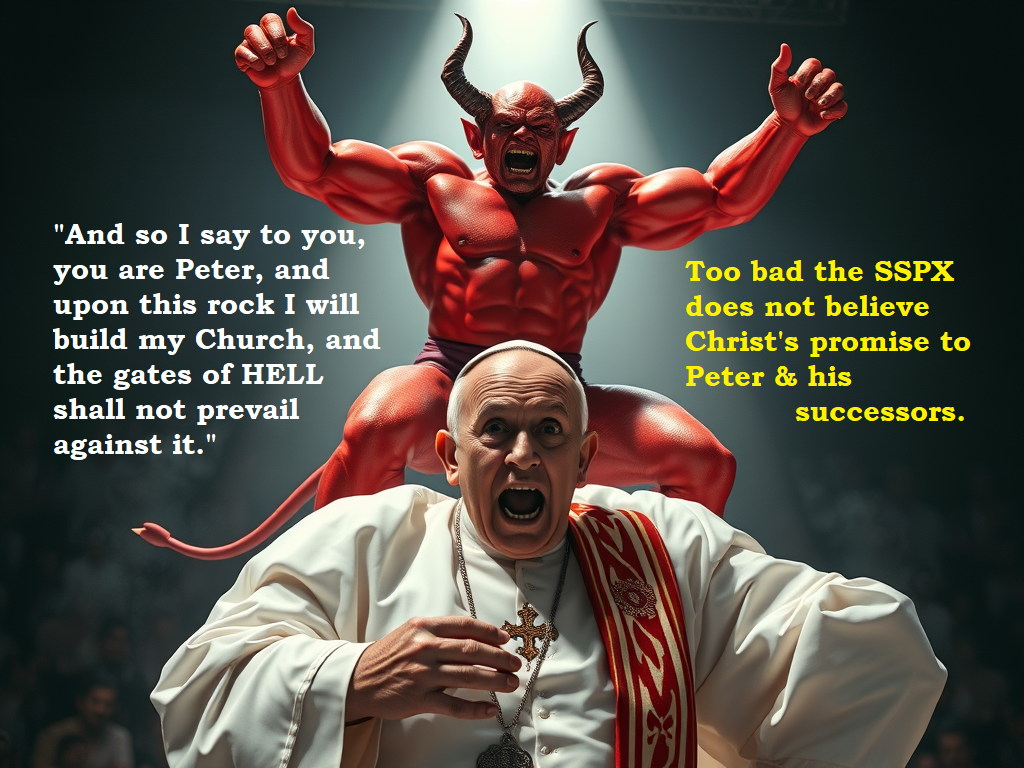
While I think the Pope in the image is Francis and not Leo, the question raised is even more pressing today.
While Cardinals Robert Sarah and Gerhard Ludwig Müller have made strong moral appeals to the SSPX to acquiesce to the rightful authority of the Holy See, Bishop Athanasius Schneider is urging Pope Leo XIV to approve the upcoming consecrations, without further dialogue and concessions. This should not surprise us as he has shown himself in his recent catechism and interviews, to side with the Society of Saint Pius X. Indeed, he claimed delegation by the Holy See to visit the SSPX seminaries in 2015 and gave a ringing assessment that they were a “sound theological, spiritual, and human reality” for which there should be granted full reconciliation and canonical recognition. This alleged deputation was never verified by the Vatican. He also denied they were in schism. But he is on the wrong side of this debate, and it would be demeaning to the authority of the Holy See to grovel to spiritual blackmail. Efforts to manipulate the Pope are a sinful offense to the office and to the Lord who empowers him as his vicar on earth. As an aside, one must wonder how many days a year Bishop Athanasius Schneider stays to manage his diocesan duties as the Auxiliary Bishop of Astana, Kazakhstan. It seems that he is always traveling for speaking engagements around the globe instead of assisting Archbishop Tomasz Peta with the care of his 53,000 Catholics.
His determination for or against schism is not merely with other church monitors like himself but with the Holy See. He questions the verdict of popes going back to John Paul II. The Pope is the chief legal head of the Church, and his assessment cannot be nonchalantly dismissed. He references the patristic period and yet the laws of the Church that govern her have been formulated over time. Church laws, particularly about sacraments and leadership, often reflect dogmatic teachings but many of the practical elements are mutable. In other words, the Church is not obliged to retain past laxity or rigorism. Just as bishops determine what men to ordain as priests, the Pope approves worthy candidates for the episcopacy. Note that at this writing the names of the men the SSPX intends to ordain have not been revealed. It is acting more as a secret society that distrusts the Holy See than as a group seeking full ecclesial unity. Further, the factors leading to episcopal consecrations are necessarily weighted toward unity and obedience over any prospect of rebellion or schism. The desperation of churchmen who consecrated bishops under the communists behind the Iron Curtain cannot be compared to the status of the SSPX. The traditional Latin Mass and the deposit of faith revealed by Christ will survive even should the SSPX disappear from the face of the earth. The true good of souls would not benefit by feigning a unity with the Holy See that does not in fact exist.
The 1917 Code of Canon Law strictly forbade as an illicit grave act, the consecration of a bishop without a papal mandate. Superseded by the 1983 code, unauthorized acts of this sort could trigger excommunication and lead to charges of schism. The Holy See has warned the SSPX that it will face such penalties if it goes forward. This “warning” is itself an element that must be considered. There can be no ambiguity or counter-rationalization as to what is at stake. We are not dealing with quasi-new dogmas, but with the God-given power that belongs to the Pope and certainly not to a non-juridical lay society of seminarians and a self-appointed congregation of priests.
The reference he makes to St. Athanasius in 357 AD is inexact as he did not disobey Pope Liberius but rather resisted pressure to associate with Arian bishops. What is missing from Bishop Schneider’s assessment is that the Pope, himself, was being coerced or manipulated by the emperor, Constantius II, who sided with the heretics. That is where we find the real analogy, as today efforts are underway by the SSPX to manipulate Pope Leo XIV.
The good bishop would seek to remain in good standing by arguing, as he did in his catechism, that everything he regards as heretical in Vatican II and post-conciliar popes is “ambiguous.” However, the failure of past dialogue and clarification to bring about reconciliation is demonstrative that the problem is deeper. Bishop Schneider and the SSPX detect doctrinal rupture, not just from the nebulous “spirit” of Vatican II but more importantly from the conciliar texts themselves. He even claims that the Holy See should thank the SSPX for rejecting Vatican II and the Novus Ordo Mass. He says the bishops and priests of the SSPX love the Church, and this may hold some truth, at least for a few; however, is this a love for the Church instituted by Christ and today governed by Pope Leo XIV, or for the house that Archbishop Lefebvre built?
No matter what they say, a true schismatic is one who still separates himself and disobeys after he has been forewarned. Protestations of fidelity or a desire for union ring hollow. He writes that “True schismatics would never humbly implore the Pope to recognize their bishops.” This is not strictly true. There is likely the fear that many good and informed Catholics will forsake the SSPX should the Holy See judge them outside the saving Church of Christ. If they can feign orthodoxy, they can keep what they have and grow. He writes: “The Holy See has shown remarkable generosity toward the Communist Party of China, allowing them to select candidates for bishops—yet her own children, the thousands upon thousands of faithful of the SSPX, are treated as second-class citizens.” The practice of allowing monarchs and governments “a say” in episcopal consecrations has a long history. The current praxis with China is questionable and a desperate measure to preserve the faith in a difficult situation. Does he really want to make an analogy where the SSPX are likened to the godless Maoists? I pray not, as no such emergency can be claimed with the SSPX because the traditional Latin Mass is otherwise available and the Novus Ordo properly celebrated is salutary for souls and is genuine worship of God. The move to consecrate its own bishops without papal permission would not make members of the SSPX into second-class citizens but threaten to make them a new nation with attributes that harken to the past. They might continue alone or join a communion with the Orthodox, but their Catholic unity would be severed. The demand that the Profession of Faith be accepted is no word game. While Cardinal Victor Fernández may have a somewhat checkered reputation, he is right in saying that this is among the minimum requirements for reconciliation.
Pope Leo XIV has shared his desire for full juridical union with the Orthodox churches, a move that the SSPX would resist. Has the SSPX not been given a greater concession with the papal extension of faculties? While their current standing with the Church of Rome is superior to the orthodox oriental churches, like them, neither has yet been regularized with the Holy See.
Filed under: Uncategorized |









 Blogger Priest
Leave a comment