












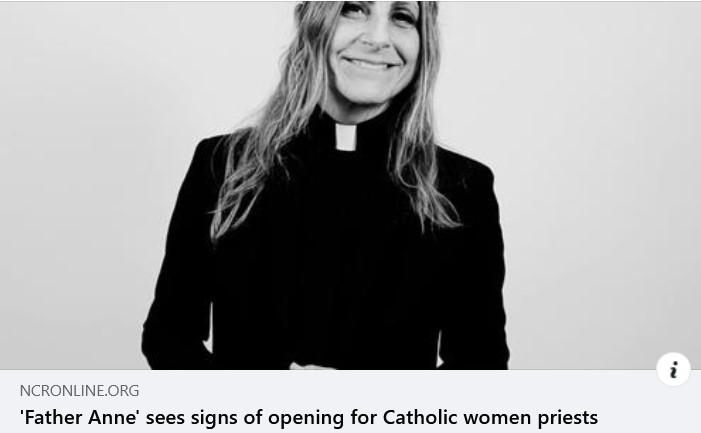
Anne Tropeano claims that she is Father Anne and that she was ordained a Catholic priest in 2021. But this is not true. Her act of defiance was a formal disassociation from the Catholic Church. Not only was she excommunicated, but she also became a Protestant minister. The fact remains, that while such was true for paganism, there is no such thing as a woman priest or priestess in the Church directly established by Jesus Christ. The Vatican synodality may discuss such matters as women clergy but nothing will change. The ordination of women would fracture the Church and create a parallel false Catholicism.
Influenced by the liberal Jesuits, she decided that she could not wait for the Church to change its position on this issue. She procured her so-called ordination, not through valid channels, because none were open to her. Instead, she went to a group that calls itself the Association of Catholic Women Priests. Of course, a cat can call itself a dog and yet it is still a cat. She places her own personal presumption over the judgment of the magisterium of the Church. That is what the Protestant reformers did. Again, it is clear she is a Protestant. Indeed, her attempted ordination in October of 2021 took place in the Cathedral of St. John in Albuquerque, NM, an Episcopal and not a Catholic place of worship. She appealed to an organization that dissents from Catholic teaching and had herself “ordained,” not for genuine priestly ministry but “to bring the church into alignment with God’s desire for women’s full participation.” What she really means to say is that she wanted to coerce Church leadership and even force the hand of God to accept her (and others like her) as priests. It is never going to happen. Further, attesting to her new Protestant and not Catholic affiliation, her first effort to offer Mass, only sacramental simulation, was on the next day in St. Paul Lutheran Church in Albuquerque, NM. While Episcopal orders are compromised, Lutheran churches make no claim to valid and apostolic orders.
Her fraudulent ordination was conducted by so-called Bishop Bridget Mary Meehan. Bridget was ordained a fake priest in Pittsburgh on July 31, 2006 by three fake bishops: Patricia Fresen, Gisela Forster, and Ida Raming. Her attempted consecration as a bishop was in Santa Barbara, California on April 19, 2009, at the hands of three women who were themselves playing “bishop.” They again included Fresen and Raming, with the addition of Christine Mayr-Lumetzberger. The ridiculous situation had bogus women bishops making more bogus bishops and priests.
Is God calling women to the priesthood? This question cannot be answered through dissent to the Holy See. The distinction between many Protestant churches and Catholicism is precisely the communitarian or corporate element of faith. Ours is not a solely personal or interior faith. We are part of something larger. It is the movement of the Holy Spirit in the worldwide or Catholic faith community where the faith is protected, and the sacraments are given their efficacy. What the Church might give as a gift cannot be taken from her hand as an entitlement. The Church has definitively judged herself as incapable of extending Holy Orders to women. We are locked into a male-only priesthood by the pattern given us by Christ and the apostles. Any action otherwise would threaten both the validity of the priesthood and the Eucharist. This is too great a price to pay for the appeasement of women who dissent, not only on the matter of priestly ordination, but upon the disciplines attached to it and other questions of the moral life.
We are told that Anne Tropeano is leading a campaign to influence the Synod of Bishops (and other invitees), as they discuss the role of women in the Church. But the backdrop to any discussion is the absolute prohibition of women’s ordination from Pope St. John Paul II and the recent absolute exclusion of women as deacons from Pope Francis. How is she to have any influence, given her status as one excommunicated and without a formal invite?
She claims that while they want a claim to all three tiers of Holy Orders, there is a lack of openness or transparency on the question of female deacons. However, this is not true. There is absolute clarity, and the answer is NO. What she objects to is the answer given by the Church. It is understandable because it invalidates what she imagined to be a personal calling from God. Granted that mixed signals were sent by the Vatican when an invitation to Anglican bishops included women as with Jo Bailey Wells. However, we must remember that the Church even questions the apostolic nature and reality of orders given to men in the Anglican communion.
Anne Tropeano says she will never abandon the Catholic Church and the Mass. When she attends Mass “in the institutional church,” she says that she receives a blessing instead of communion. This shows some small semblance of respect to the true faith; however, we are judged not simply for where we in conscience stand but by our posture before almighty God and his Church. We can seek a blessing at Mass but are we disposed to the graces that it would ordinarily extend? Even validly ordained men can damn themselves. What should be the status of one who beguiles the ignorant into thinking she is a real priest? What about those who take communion from her table, expecting the body and blood of the risen Jesus, only to receive a cheap wine and a morsel of stale bread? How will God treat a person who has led his little ones astray?
Any effort to re-frame the question is simply trying to get around the set answer. A few men and no women are called to be deacons, priests, and bishops. Word games will not prevail on this matter. No one is questioning the value of female genius and the value of their service to the Church or their capacity for holiness. But all this stands apart from what has been revealed to us about the priesthood. It is not a matter of many in the Church “wanting” to ordain women; rather, the point is that we are not given any certain warrant to do so. We have not been reliably enabled to ordain women. Indeed, the tradition of faith is weighed heavily against such a change.
The argument raised by certain theologians that women should be ordained, since they are already involved in pastoral ministry, albeit without sacramental recognition, is utterly fallacious. Indeed, it signifies two things. On one extreme, there has been a wrongful effort to clericalize the laity. On the other, the clerical vocation should not be elevated by demeaning the lay state. The apostolate of the laity, especially regarding social justice and charity, should not be undermined or minimized.
Tropeano asks a loaded question; she wonders why women cannot be ordained deacons given that they served a sacramental role in the past. But it is clear, that while women may have been called deacons, they were not ordained. The Council of Nicaea strictly forbade the “laying on of hands” upon women. The nomenclature in the early Church lacked sufficient specificity and proved fluid. Deaconesses were either women married to deacons or simply holy women who cared for female neophytes preparing for baptism. Their successors today are women in Altar Guilds and consecrated female religious.
Apologists for women clergy wrongly collapse the meaning of being remade “into the likeness of Christ” by saving grace and the significance of a priest acting “in the person of Christ” at our altars by the new signification of ordination. Just as there are different modes of real presence between the Word and the sacrament, a distinction must be made between our union with Christ in the Church or mystical body and his identification with the priest in the Mass. The Word is associated with the proclamation of the Gospel or the Scriptures. The Eucharist is the bread and wine consecrated into the body and blood of the risen Christ. The Church signifies our membership with each other and our union in Christ’s body. Applying another familiar analogy, Jesus is the vine, we are the branches. The caricature impressed upon us at baptism, makes us Christians. The caricature impressed upon a man at ordination, makes him an “Alter Christus” or another Christ. Just as the Eucharist requires bread and wine, Holy Orders requires a man (not a woman) disposed for the sacrament. Gender is not accidental or something interchangeable, despite the widespread dysphoria of our times.
She insists that the Church must take a prophetic stance. What she fails to understand is that is precisely what the Church has done. Just like the prophets of old, the Church’s message is counter-cultural, it is a message that is opposed. Tropeano is speaking, not for the Lord and the Church, but for a secular modernity that distorts gender and applauds same-sex deviancy. The so-called growing awareness of humanity is merely a growing resistance and supplanting of the things of God for the whims of humanity. Indeed, one might argue that the new awareness is really the discovery of something very old, the re-emergence of pre-Christian paganism with its priestesses, oracles and libertine values.
She writes: “The Roman Catholic Church has grown. It’s one of the largest nongovernmental providers of education and health care in the world. It has a seat at the U.N. When the church comes into alignment with God’s will for women’s participation in the world, it will be a massive force of renewal.” It should be reiterated that the Church has always given opportunities to brilliant and talented women, as shown by their inclusion in the canonized saints and doctors of the Church (particularly as women religious). The rapid loss of sisters and nuns is a negative sign in the modern Church, a retreat from their formative role as teachers to the young and as the chief handmaids of the Lord. The Church is all for women taking their rightful place in the secular world alongside men, but this no more means they should be deacons, priests or bishops than that fathers and mothers should exchange or utterly confuse their roles. Some matters are fixed by God and by the nature of creation. The alignment that she demands would not signify the conversion of the world but rather the final surrender and defeat of the Church.
Filed under: Uncategorized |










 Blogger Priest
Gender insanity yes but the Church has not solved the problem of the large cabal of Homosexual clergy that run the Church
Just another example of this gender insanity. So sad.