












• Our Blogger

    Fr. Joseph Jenkins

  • The blog header depicts an important and yet mis-understood New Testament scene, Jesus flogging the money-changers out of the temple. I selected it because the faith that gives us consolation can also make us very uncomfortable. Both Divine Mercy and Divine Justice meet in Jesus. Priests are ministers of reconciliation, but never at the cost of truth. In or out of season, we must be courageous in preaching and living out the Gospel of Life. The title of my blog is a play on words, not Flogger Priest but Blogger Priest.

  • Archives

  • Categories

  • Recent Posts

  • Recent Comments

    Jeremy Kok's avatarJeremy Kok on Ask a Priest
    Gary Joseph's avatarGary Joseph on Old Mass or New, Does It …
    Barbara's avatarBarbara on Ask a Priest
    Anonymous's avatarAnonymous on Ask a Priest
    forsamuraimarket's avatarforsamuraimarket on Ask a Priest

Hypocritical or Faithful?

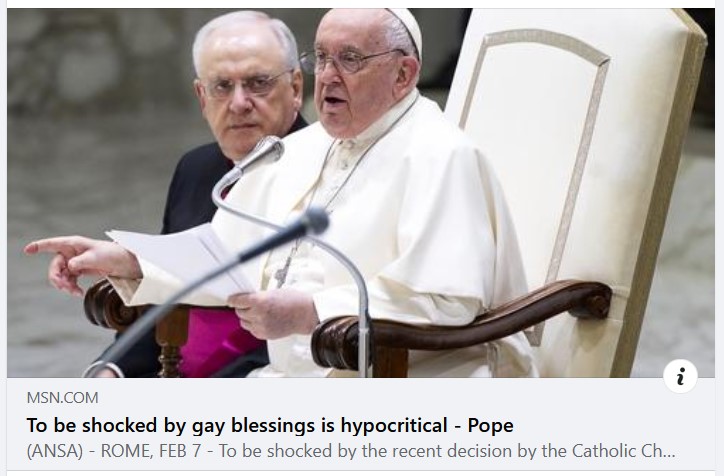
It was reported by ANSA on February 7, 2024, that Pope Francis judged it “hypocritical” to be shocked that the Catholic Church would authorize the blessing of gay couples. He offered the rebuttal in Credere, “No one is scandalized if I give a blessing to a businessman who perhaps exploits people – and this is a very serious sin.” I am tempted to give the retort that the comparison is between apples and oranges. But in truth many of us would anticipate that no cleric would give approbation through a blessing to anyone in grievous sin.  The proper parallel would be with pro-abortion politicians. Many of us would very much hope that the Holy Father would refrain from either blessing or giving Holy Communion to those who scandalously parade their vices as virtues— and both sexual depravity and the murder of children constitute mortal sin and testify to an anti-gospel.   

He says that the heart of the controversial declaration is “welcome.” But many learned authorities interpret it as going further and seeking the regularization of that which cannot be normalized for believers. No one contests that the Pope has a soft heart for homosexual persons.  However, he sometimes seems to demonstrate a hardness to his priests and to those who place the truth prior to any pastoral accommodation. He states: “People suffer so much, we clerics sometimes live in comfort. . . it is necessary to see the work, the suffering of the people.” It may not be his intent, but this is a slight against caring priests. Clergy who uphold the teachings and values of the Church are not ogres who delight in the pain of others.  Often these pastors suffer alongside their people and count themselves as the first among sinners. The promises made by men consecrated to the Lord’s service bring both delight and pain.  We have the privilege to be Christ’s instruments in feeding and healing God’s people; but we also suffer the personal loss of a wife and family given our celibate love. We are also not our own men but stand under lawful authority— to our bishops and yes, certainly to the Pope.  But ultimately all of us, clergy of every station and the laity, must be subject to God and his laws.  Here is the crucible between sin and fidelity. 

The interview leaves orthodox readers with further distress or anxiety because the Holy Father makes the aside, that “opening work in the Curia to women is important.  In the Roman Curia there are now several women because they perform better than men in certain positions.” Where is this going?  No one in his or her right mind would suggest that the Church should deny the benefits of female genius; but the hierarchical authority of the Church is appointed by Christ as exclusive to his apostolic men.  That factor is beyond our control or power to revise. In any case, as with the men, the women chosen for various commissions or roles of participatory leadership should be exclusively selected from those who are faithful and not from the dissenters.  This is an important qualification that is sometimes left unsaid and maybe unfulfilled.

When it comes to his health and mobility issues, Pope Francis remarked, “The Church is governed using the head, not the legs.”  This is a good answer, although lately it seems that the Church is being increasingly governed by the heart than either by the head or the legs. This might appeal to some critics, but it can have disastrous consequences. Without the compass of truth, love is quickly misdirected and loses its way.  We have seen many instances where without the guidance of the Gospel, an intended compassion becomes oppressive and tyrannical.   

It is Wrong & I Will Not Do It!

Individual priests should not have to say what the Magisterium and the entire Church should insist upon, and yet we have entered a strange new land where absurdity rings true, and sin is excused in private if not in public. Therefore, echoing the Scriptures, the catechism, and the legacy of the saints, let me affirm that the Church cannot directly bless or affirm sin. There should be no confusion about the covenant of marriage as strictly between one man and one woman in a bond to be maintained until “death do they part.”  While the clergy can bless congregations and individual sinners; they give scandal should they specially bless couples who come before them in either adulterous or same-sex unions outside the sacrament.  Despite the recent declaration Fiducia supplicans from the Dicastery for the Doctrine of the Faith, as a priest of the Church, I cannot extend blessings over such couples.  It is my conviction, with a fully informed conscience, that any such requests for these novel blessings must be denied for the good of souls. Given just opposition around the world, it is my hope and prayer that the declaration will be retracted, and that Cardinal Fernández will be removed as the prefect who authored the egregious document. He has quickly and utterly lost any semblance of credibility among orthodox believers. I fully concur with Cardinal Müller who has characterized the possibility of these errant blessings as both “impossible” and as “blasphemy.” Not only has ambiguity and scandal been fermented for the faithful; the deviation from biblical truth has caused incalculable damage within legitimate ecumenical outreach with non-Catholic Bible Christians.

It is true that the declaration reaffirms Church teaching about marriage and sexual-relations as exclusive to male-female couples.  But what the text states in principle it then undermines or takes back in terms of praxis. An explication for conditions to allow what cannot be permitted quickly strays into rhetorical incoherence— we are told the blessings must be private, unscheduled, not in sacred space or chapels, and not in fancy-dress clothes.  What moral difference does any of this make? None! Even informal or pastoral blessings are liturgical because the agents are clergy! We are told that these are individual blessings and not benedictions over same-sex unions; however, those coming forward are specifically seeking these types of blessings and validations over their bonds and lifestyles.  The given rationale trespasses from the dubious to the deceptive.

While I take exception to the statement that “an informal blessing” could be extended to those cohabiting in a homosexual relationship, the document does give an escape clause that I would enact in that these blessings “should only be given if there is no risk of causing confusion about the Church’s doctrine on sexual morality, including the nature of marriage.” It is my estimation, as a pastor of souls, that such blessings would not only risk but always CAUSE such confusion.  Thus, they cannot in practice be conducted by me or anyone. Note that those excited about such blessings are on the record saying that they are an important “first step.” These dissenters, for that is what they are, routinely schedule these blessings, photograph them, and then publicize the whole mess for the media. Proscriptions for the blessings are violated with impunity. What are we to make of the fact that there is little in the way of rebuke from lawful authority for doing all this? Indeed, those who criticize are judged as harsh and ideological.  I would simply use the word, “faithful.”










