• Our Blogger

    Fr. Joseph Jenkins

  • The blog header depicts an important and yet mis-understood New Testament scene, Jesus flogging the money-changers out of the temple. I selected it because the faith that gives us consolation can also make us very uncomfortable. Both Divine Mercy and Divine Justice meet in Jesus. Priests are ministers of reconciliation, but never at the cost of truth. In or out of season, we must be courageous in preaching and living out the Gospel of Life. The title of my blog is a play on words, not Flogger Priest but Blogger Priest.

  • Archives

  • Categories

  • Recent Posts

  • Recent Comments

    Jeremy Kok's avatarJeremy Kok on Ask a Priest
    Gary Joseph's avatarGary Joseph on Old Mass or New, Does It …
    Barbara's avatarBarbara on Ask a Priest
    Anonymous's avatarAnonymous on Ask a Priest
    forsamuraimarket's avatarforsamuraimarket on Ask a Priest

Bishop Schneider’s CREDO #209

Again, note that Bishop Athanasius Schneider presumes to correct recent popes, Vatican II and the universal catechism.
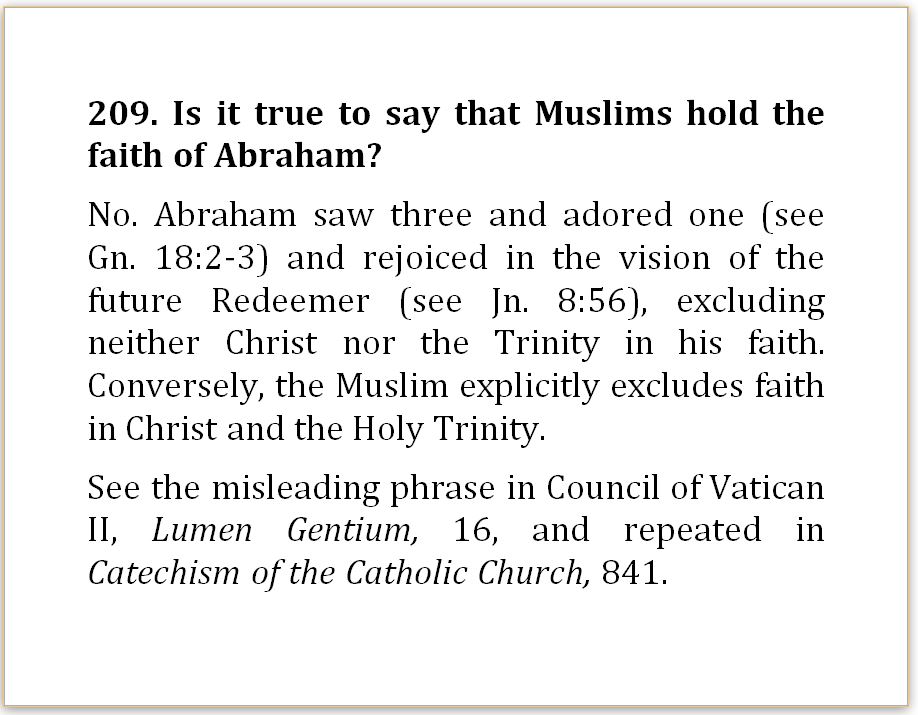
His arguments are not new, as they have often been mouthed, not simply by the SSPX but by sedevacantists who argue the chair of Peter as vacant since Pope John XXIII. Bishop Schneider will not come out and deny papal authority; however, he does make various insinuations, especially later in the text when he speaks about the lack of certainty regarding canonizations. Is he sowing doubt about the newest saints, Pope John XXIII, Pope Paul VI and Pope John Paul II?

He renders a rather peculiar interpretation of Genesis in light of John 8:56 as a revelation of the Trinity given to Abraham long before the New Testament. Biblical exegetes suggest it is merely a reference to the birth of Isaac (the child of promise) and the start of salvation history— it all begins with the pledge about Abraham’s seed coming to pass.

Here is the passage in the universal catechism that he calls misleading, i.e. wrong:

CCC 847 – “This affirmation is not aimed at those who, through no fault of their own, do not know Christ and his Church: ‘Those who, through no fault of their own, do not know the Gospel of Christ or his Church, but who nevertheless seek God with a sincere heart, and, moved by grace, try in their actions to do his will as they know it through the dictates of their conscience – those too may achieve eternal salvation.”

Pope John Paul II quoted the Council, saying:

“The Church also views with esteem the Muslims, who worship the one and only God, living and subsistent, merciful and omnipotent, the Creator of heaven and earth” (Declaration on the Relation of the Church to Non-Christian Religions 2).

Bishop Schneider’s CREDO #208

I am surprised we are hearing so little upset about Bishop Schneider’s CREDO catechism. He mixes truths with his opinion in ways that can be quite seductive. I want to like his work, but it troubles me.

The truth be said, the Koran does misunderstand the Trinity, substituting the Virgin Mary for the Holy Spirit. Its adherents reject what they do not understand. The cause for the confusion is because the deity and religion of Islam is the result of an incomplete syncretism or amalgamation of beliefs extracted from Judaism, Christianity and the local tribal cults prevalent during Mohammad’s lifetime.

Bishop Schneider answers “no” to his question although it is posed as a negative or “not” query. Remember, English is not his first language. What he really means to say is, “Yes,” we do not share the Trinitarian God in common with Muslims. But, it still seems that he might over-make his case. Our differences are real but must one perfectly understand God in order to honor him?

Again, Bishop Schneider does not hesitate to contradict Pope John Paul II or the Vatican II teaching which he labels “ambiguous.” What he means to say behind tepid language is that the Council is wrong.

Lumen Gentium 16 – “Finally, those who have not yet received the Gospel are related in various ways to the people of God. In the first place we must recall the people to whom the testament and the promises were given and from whom Christ was born according to the flesh. On account of their fathers this people remains most dear to God, for God does not repent of the gifts He makes nor of the calls He issues. But the plan of salvation also includes those who acknowledge the Creator. In the first place amongst these there are the Muslims, who, professing to hold the faith of Abraham, along with us adore the one and merciful God, who on the last day will judge mankind. Nor is God far distant from those who in shadows and images seek the unknown God, for it is He who gives to all men life and breath and all things, and as Savior wills that all men be saved. Those also can attain to salvation who through no fault of their own do not know the Gospel of Christ or His Church, yet sincerely seek God and moved by grace strive by their deeds to do His will as it is known to them through the dictates of conscience. Nor does Divine Providence deny the helps necessary for salvation to those who, without blame on their part, have not yet arrived at an explicit knowledge of God and with His grace strive to live a good life. Whatever good or truth is found amongst them is looked upon by the Church as a preparation for the Gospel. She knows that it is given by Him who enlightens all men so that they may finally have life. But often men, deceived by the Evil One, have become vain in their reasonings and have exchanged the truth of God for a lie, serving the creature rather than the Creator. Or some there are who, living and dying in this world without God, are exposed to final despair. Wherefore to promote the glory of God and procure the salvation of all of these, and mindful of the command of the Lord, ‘Preach the Gospel to every creature,’ the Church fosters the missions with care and attention.”

Bishop Schneider’s CREDO #207

We can certainly make the distinction that both Judaism and Islam signify “natural” religions because of the espousal of one true God. Christianity signifies a “supernatural” religion due to the revelation of this one God as “Trinity.” However, Bishop Schneider grants Islam as a religion no credit on this point. He only admits that an individual Muslim might incidentally or let me interject “accidentally” worship the true God with a natural faith.

While left unsaid at this point, such an assessment would also include the modern Jews. By contrast, many of us were taught that what the Scriptures condemned were those Jewish religious leaders (the Pharisees) who rejected the truth out of malice. However, for many of the Muslims and Jews today the issue is one of ignorance. Despite the apologetics of St. Paul, he never condemned his fellow Jews as idolaters. They worshipped the true God. Bishop Schneider might concede this but then contends that Judaism after the destruction of the temple in 70 AD becomes a distinct religion from what came before. Even though Islam cannot genuinely claim the Hebrew trajectory of faith; he would deny it for Jews as well.

While Jews and Muslims alike call upon Abraham as their father in faith, Bishop Schneider would have us believe that God is deaf to their entreaties. His focus is entirely upon Christians as spiritual children of Abraham.

Bishop Schneider directly contradicts Pope John Paul II who taught in 1999 the following:

“We Christians joyfully recognize the religious values we have in common with Islam. Today I would like to repeat what I said to young Muslims some years ago in Casablanca: ‘We believe in the same God, the one God, the living God, the God who created the world and brings his creatures to their perfection’ (Insegnamenti, VIII/2, [1985], p. 497). The patrimony of revealed texts in the Bible speaks unanimously of the oneness of God. Jesus himself reaffirms it, making Israel’s profession his own: ‘The Lord our God, the Lord is one’ (Mk. 12:29; cf. Dt. 6:4-5). This oneness is also affirmed in the words of praise that spring from the heart of the Apostle Paul: ‘To the king of ages, immortal, invisible, the only God, be honor and glory for ever and ever. Amen'(1 Tm. 1:17).”

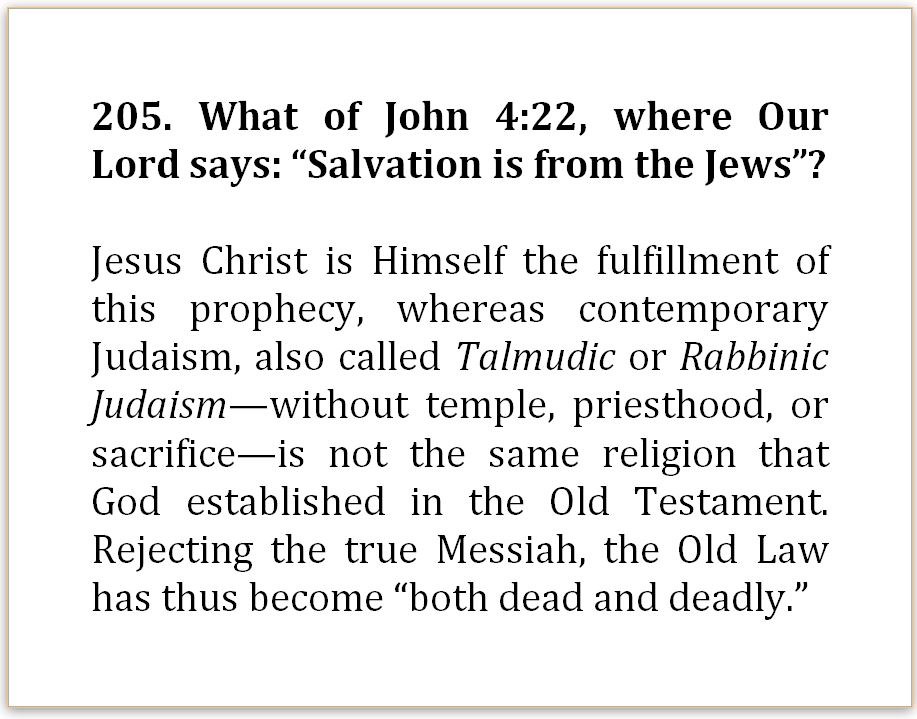
Bishop Schneider’s CREDO #205

I suspect that Bishop Schneider would never go out of his way to placate the sensibilities of Jews. Here is another quote from his book, CREDO.

I may be wrong, but his take on the subject seems to depart from the revision in the universal catechism:

“To the Jewish people, whom God first chose to hear his Word, ‘belong the sonship, the glory, the covenants, the giving of the law, the worship and the promises; to them belong the patriarchs, and of their race, according to the flesh, is the Christ.’”

The USCCB added:

“The clarification reflects the teaching of the Church that all previous covenants that God made with the Jewish people are fulfilled in Jesus Christ through the new covenant established through his sacrificial death on the cross. Catholics believe that the Jewish people continue to live within the truth of the covenant God made with Abraham, and that God continues to be faithful to them.”

Back in 1986, Pope John Paul II visited a Roman synagogue and stated:

“The Church of Christ discovers her ‘bond’ with Judaism by ‘searching into her own mystery’, (cf. Nostra Aetate, ibid.). The Jewish religion is not ‘extrinsic’ to us, but in a certain way is ‘intrinsic’ to our own religion. With Judaism therefore we have a relationship which we do not have with any other religion. You are our dearly beloved brothers and, in a certain way, it could be said that you are our elder brothers.”

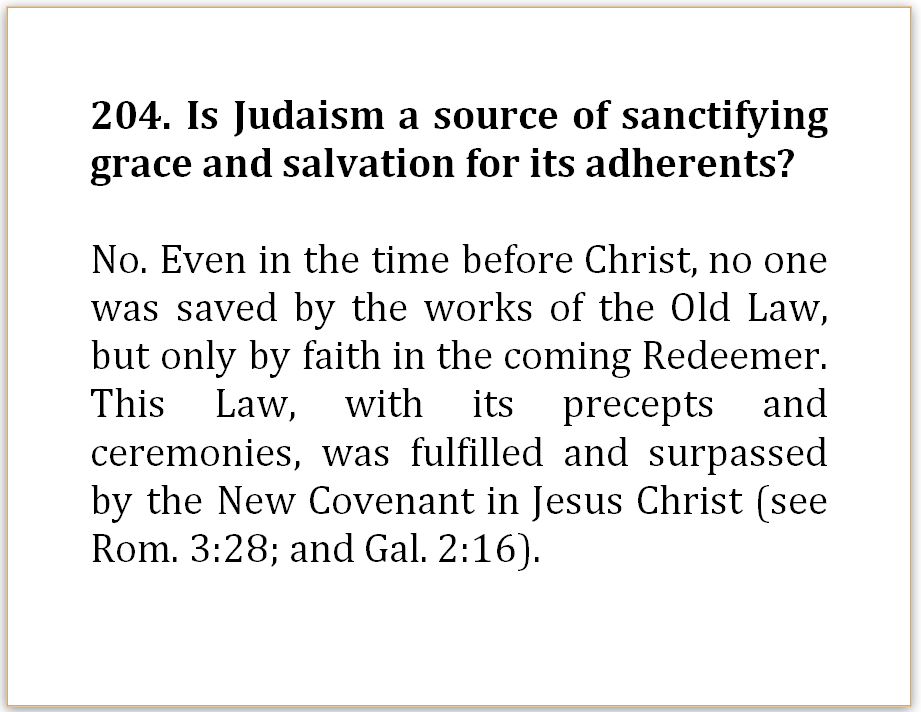
Bishop Schneider’s CREDO #204

I am rereading the sections of CREDO by Bishop Schneider that should probably become a matter of serious dialogue.

According to Christian faith, it is true that there is one covenant, not two. It is true that we are saved by faith in Jesus Christ and not through the works of the Old Law. Our Lord and the sacraments make possible saving grace. But it is also true that God does not forget his promises or his first people. There is a trajectory of faith that would compel me to question the proposition that Judaism as a religion established by God was utterly terminated with the coming of the Messiah.

Bishop Schneider’s CREDO #156

Despite the quotation made by Bishop Schneider, the assessment of evolution made by the late Pope some seventy-three years ago in 1950 is not reflective of the current evidence that substantiates the development of species. The main points for Catholic teaching remain that God is the Creator, there is intelligent order or design and that while the body my evolve, the soul is immediately infused by God at conception.

Pope John Paul II in 1996 stated at the Pontifical Academy of Sciences that new research revealed that physical evolution was “more than just a theory.” Pope Francis stated in 2014 to this same academy that “God is not… a magician, but the Creator who brought everything to life. Evolution in nature is not inconsistent with the notion of creation, because evolution requires the creation of beings that evolve.”