








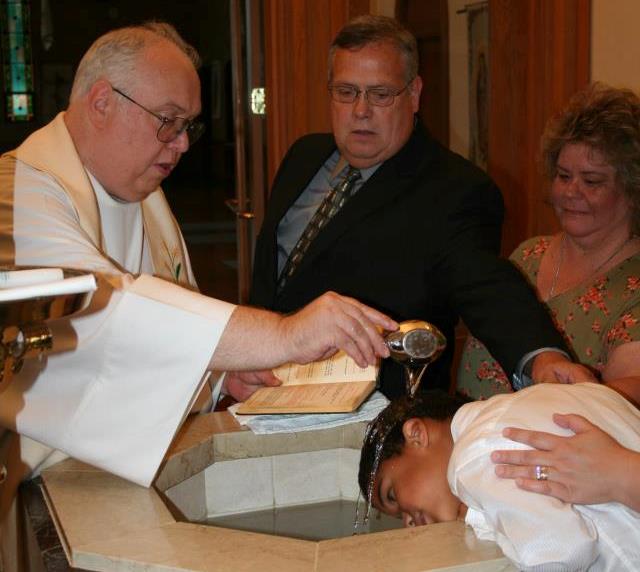





 The Body of Christ has yet another meaning and here we are indebted to St. Paul. The union that exists between Christ and his people (since their baptism into Christ by the waters of the sacrament) is identified as the Body of Christ by St. Paul. Looking at 1 Corinthians 12:27, we read: “Now you are Christ’s body, and individually parts of it.” St. Paul refers to the Church as the Body of Christ. He likens all of us, united to Christ and to each other, as in an intimate union. At Baptism, each of us, if you will, becomes a cell in that body and at the same time participating in the life of the whole body with its head, Christ. That union is not a physical union as in nailing two boards together, nor is it a moral union as when people are united as members of the same club or organization. This union of Christ and his members is unique; so much so, that we have to make up a new phrase to help us understand it. We call it the Mystical Body of Christ. All of us are united to Christ and to one another. Christ tried to inform us of this union with the parable of the vine and the branches. As the branch must adhere to the vine to live; we must adhere to Christ. Life must flow through Christ, the vine, to the branches, bringing about the fruit of our lives. St. Paul, back when he was Saul, persecuted the early Christians. Our Lord called out to him, “Saul, Saul, why do you persecute me?” He asked, “Who are you, Lord?” The Lord responded, “I am Jesus the one you are persecuting” (see Acts 9: 4-5 and Acts 22: 7-8). Again, our attention is called to the union between Christ and his people. Christ also said, “Whatever you do to the least of my brethren, you do unto me” (Matthew 25: 40). Modern social concerns tell us to see Christ in the poor, underprivileged and handicapped persons. We see in these references a reality telling us of the union that is likened to the human body. Christ is the head. We are the members. All of us are important. St. Paul says, “Does the hand say to the foot, I have no need of you?” (see 1 Corinthians 12: 15). All of us have our mission in the Church, the gathered-together people with Christ. Each of us has a mission. It may be very different from another’s mission; but, each of us is important. When we say in the Nicene Creed, “I believe in one, holy, catholic and apostolic Church” or in the Apostles’ Creed, “I believe in … the holy catholic Church,” this does not refer only to the hierarchy but to the whole Christ. At Mass, we beseech God, not to look on our sinfulness, but on the faith of the Church. When I hear this, I think of the known and unknown sacrifices being made by missionaries and martyrs, the unseen raising of children, care for the poor and the sick, and the elderly praying with gnarled hands. This Mystical Body has a structure like the human body with its skeleton; otherwise, it would collapse. Our structure is the Pope, bishops, priests and lay people. The union of people is composed of the saints in heaven, the ones who are striving to get to heaven (pilgrim people) and those waiting for perfection so as to be entirely one with Christ. While Jesus has a human body, a resurrected body; now, he also has the Church as his Mystical Body, where we are united spiritually in its members to Christ and to one another. At baptism we became children of God, members of the divine household and family. We are in union with Christ, both when we pray alone and when we worship together.
Filed under: Awalt Papers |











 Blogger Priest
Leave a comment