












 At the risk of being repetitious, I would like to say a few more words about the Paschal Candle. We greet it in song as it is brought into the darkness of the church on Holy Saturday night, the vigil of Easter. A new fire is blessed first, and from that fire we ignite the Paschal Candle. Carried in procession and raised high in the church, it is a sign to us of the resurrected Christ who dispels the darkness of sin and ignorance. The deacon (or celebrant) sings the beautiful Exultet after it is placed in the sanctuary for the vigil service. It is immersed in the Easter water as a sign that Christ gives his life to us through the waters of Baptism. It is on this night that those who are coming into the Church are baptized at the ceremony. During the year, perhaps we miss sight of it since it is kept by the Baptismal font and not by the altar (as during the fifty days of the Easter season)? Each person baptized has his or her individual candle lit from the Pascal Candle. The candle is also placed at the head of the coffin in funeral Masses, as an expression of our belief in the resurrection of Christ who said, “I am the resurrection and the life.” It is the silent witness to our belief that those who die with Christ will rise with Christ. In the Pascal Candle are imbedded grains of incense in five places, reminding us of the five wounds that our Lord bore for our salvation— pierced hands, feet and side. At his death, blood and water flowed from the side of Christ. The doctors of the Church saw in this— symbols of Baptism and the Eucharist. This candle is also incensed at Easter and at funerals; in so doing we honor the resurrected Christ. As the candle is consumed by burning, so our lives should give off the light of Christ in our conduct; indeed, we should also be consumed in our service to the Lord.
Filed under: Awalt Papers |









 Blogger Priest
Dear Fr Joe,
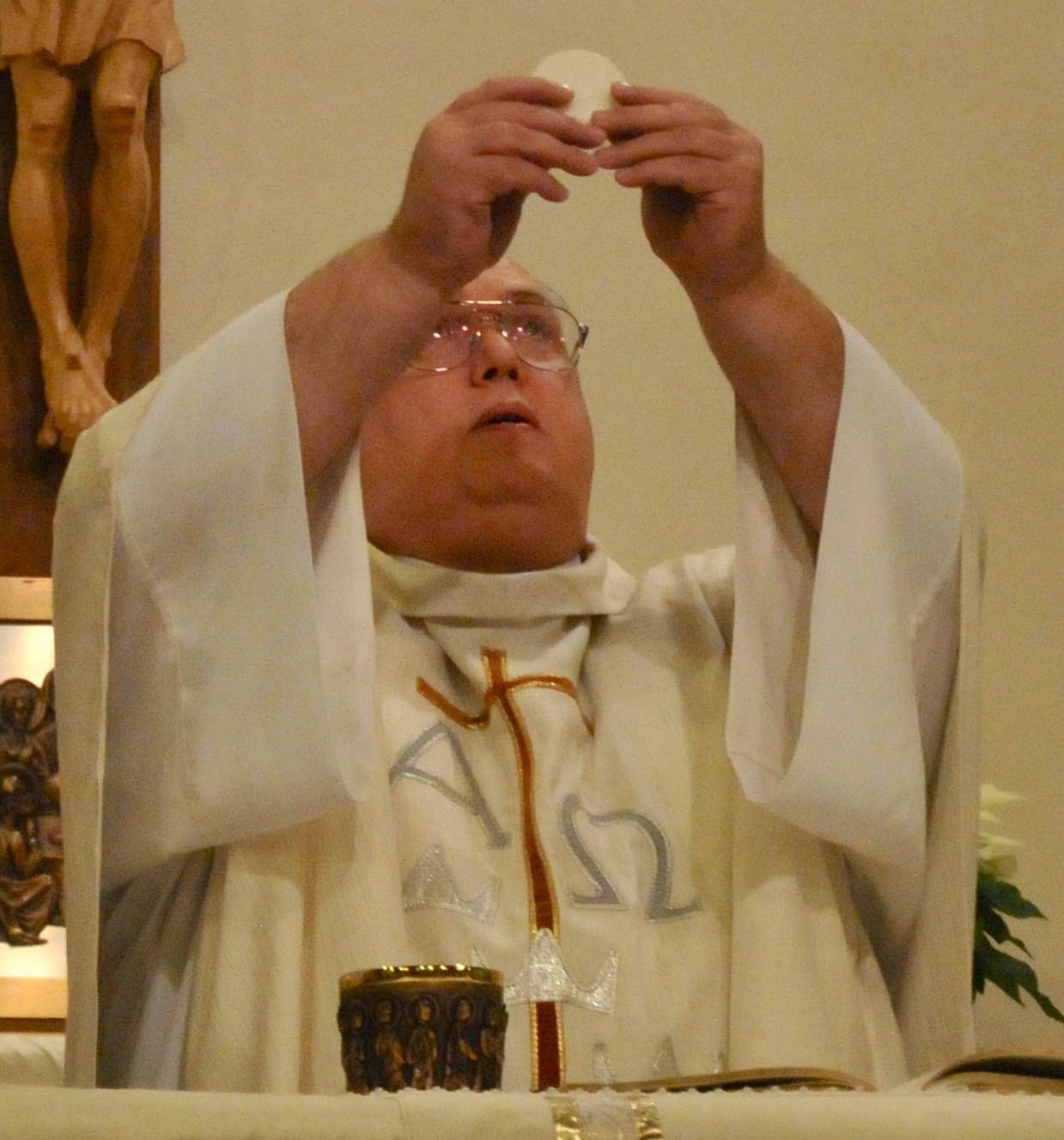
As we had already endured what passes for Exposition and Benediction these days and it was about 10pm, it was of course the ciborium that was removed from the Tabernacle.
I am sorry for the confusion, and indeed for my cynicism. I fear that we are going in the wrong direction with much of what is done ‘In God’s Name’. But He is an all forgiving God if we can only be sorry for our offences. It’s the balance between innocence and culpable ignorance. The Holy Father and some of His Cardinals are also very concerned. Sadly, some of them are also way off beam.
Although I have had to change towns for my place of worship because the new priest to my parish has scrapped the 6pm Sunday Mass (Traditional), and by this and several other actions and attitudes has upset many of us, the other Parish Priest seems to attract large numbers of children and converts. There must be at least a dozen or more going up for a Blessing at Communion who are not yet received but my fear is that if one were to remove all the noise and performance of these well intentioned yet disharmonious squawkers, would the numbers drop off? The bottom line is, I suppose, are they there simply to be able to sing on a stage and be seen doing so; are they thwarted and failed ‘pop stars’?
Do they even know what a Paschal Candle is and what it signifies. (I seem to remember it had to be lighted by the striking of a flint – a canny old Irish Christian Brother always used his Ronson!) I doubt it, but give them a badly tuned guitar and too many cups of coffee and they are away with the fairies. I fear they are under the impression that God is deaf.
Mea culpa, I truly am sorry for my hardened anger that taints my living and is fuelled by my judgements of a flawed world everywhere I look. May the light of The Paschal Candle enlighten my understanding and give me a love of all that is new and pleasing to God.
With love as always,
Paul
Dear Fr Joe,
For hundreds of years we, The Catholic Church, have used ceremonials and ceremonies, steeped in reverent history and full of symbolism and meaning, and man has desperately needed all of those and much more, not only to try to understand and get closer to the spiritual but also for comfort and security,
Sadly, Vatican ll allowed for the removal of much of this, and without authoritative direction from above, many priests misguidedly scrapped much of this tremendous heritage in favour of fervent yet violent guitar strumming, banjos and flutes, and even drums and electric guitars.
The vestments were toned down to appeal to the liberals, and the exposure to these sacramentals and their explanation has faded into a distant memory. Processions, venerations of relics, incense and blessings with holy water have all been marginalised, and in their place we have bouffont haired women and young girls doing the performance. Years ago not even nuns with veiled heads were allowed to serve Mass from within the sanctuary, but had to remain outside the altar rails, now political correctness has infected the Church. I should be allowed to receive Holy Communion, keeling and on the tongue, administered by the Celebrant, instead I am expected to submit to being handed a wafer from a middle aged and unctuous woman. I concede out of deference but know that it is wrong. When I used to serve Mass, not even I as a server was allowed to touch the Chalice, today anyone can finger the precious body of Jesus.
I went to a rather intense and very vernacular Maundy Thursday service and, sitting at the back, was invaded by 2 eucharistic ministers, one with the cup, the other with the bread bin, and during the distribution, which was more like a soup run than anything else, when a transaction was taking place like a crack dealer doing sleight of hand, the woman doing the giving and the woman doing the receiving failed to match their timing and actions and a Precious Host was dropped to the floor and kicked about for a bit. Undeterred the recipient finally bent down, calmly picked it up and ate it, and the whole awful business continued unabated.
Then when the Blessed Sacrament was removed to the side altar in preparation for Good Friday we were required (as always) to genuflect on both knees before turning our back on The Sacrament now contained not only in a metal pot but shrouded behind a veil
Don’t you think that’s a bit odd?
With love, Paul