












 “The worst disease in the world today,” says Mother Teresa, “is not cancer, not leprosy, but loneliness.” The longing to give one’s self in love and to know that one is loved in return, is as universal as life itself. This longing is behind the familiar sentence in the Genesis creation tale: “Then the Lord God said, ‘It is not good for the man to be alone. I will provide a partner for him’” (Genesis 2:18).
We seek the fulfillment for which our hearts long in friendship and marriage. Beyond these human relationships people from the beginning of time have sought a remedy for their inner emptiness through fellowship with God. Often this takes the form of offering God sacrifice. Sometimes the sacrifice is to atone or make up for sin; sometimes it is offered in gratitude for blessings received or to reinforce the worshipper’s prayer for future favors. Sometimes sacrifice may take the form of a religious meal through which the worshippers seek to enter into communion with God.
Jewish religion permitted such sacrifice only in the temple at Jerusalem, which was thought to be the dwelling place of God on earth. Increasingly, however, Jesus’ people came to realize that there was a fundamental flaw in the sacrifices they offered to God. Israel’s prophets continually pointed out that God did not need or want material things, since he was the creator of everything anyway and hence their true owner. God was interested not so much in gifts as in the giver.
This was the one thing people could not offer to God in sacrifice. And, to the extent that they tried to do so, their offerings were tainted by sin, and hence, unworthy of God, who deserved a perfect offering.
The realization that the sacrifices offered in the Jerusalem temple never really made up for human sin is why Paul writes, “Every priest” (and the author is referring to Jewish priests in the Jerusalem temple) “stands ministering day by day, and offering again and again those same sacrifices which can never take away sins” (Hebrews 10:11).
It is part of the Good News which Jesus came to proclaim that this failure at the heart of his people’s religion has been ended. A perfect sacrifice has been offered to God once; one truly worthy of him; one which does make up for and take away the burden of all sins for all time and which actually achieves what all sacrifices tried to achieve without success— end human loneliness and bring people into loving fellowship with the one who alone can satisfy the deepest longings of our hearts: God himself.
This perfect sacrifice was offered by Jesus Christ. It began with his birth in obscurity in a remote village on the edge of the then known world. It continued through the whole of Jesus’ life, which he lived always in perfect obedience to his Father’s will. Jesus consummated this offering of his sinless life to his Father on Calvary, uttering as he did so the words: It is consummated” (John 19:30).
Hebrews 10:12-18 refers to this when it contrasts the repeated offering of material sacrifices in the Jerusalem temple, “Which can never take away sins,” with the perfect sacrifice of Jesus Christ. “But Jesus, on the other hand, offered one sacrifice for sins and took his seat forever at the right hand of God… By one offering he has forever perfected those who are being sanctified. Once sins have been forgiven, there is no further offering for sin.”
The last phrase arrests our attention at once. It seems to contradict the Church’s teaching that there is a daily repeated offering for sin: the Mass. We seem to be confronted with a dilemma. Either Jesus’ self-offering, consummated on Calvary was truly all-sufficient, unique and unrepeatable – in which case it is difficult to see how we can say that the Mass, too, is a sacrifice, or the Mass is a sacrifice – in which case Jesus’ sacrifice on Calvary was not all-sufficient.
This seeming dilemma makes us ask: What is the relationship between the Mass and Calvary?
To answer that question we must go behind Calvary to the Last Supper. There Jesus used the familiar symbolism of the Jewish Passover meal to interpret for his friends what he was about to do the next day. Giving thanks to God over bread and wine, which is the Jewish way of blessing them, Jesus said: “This is my body… This is my blood.” But he said more. He called the bread, “My body given for you,” and the wine, “My blood poured out for you.” That is Jewish sacrificial language. Jesus was referring to the sacrifice of his body and blood on Calvary where his body would be broken and his blood poured out.
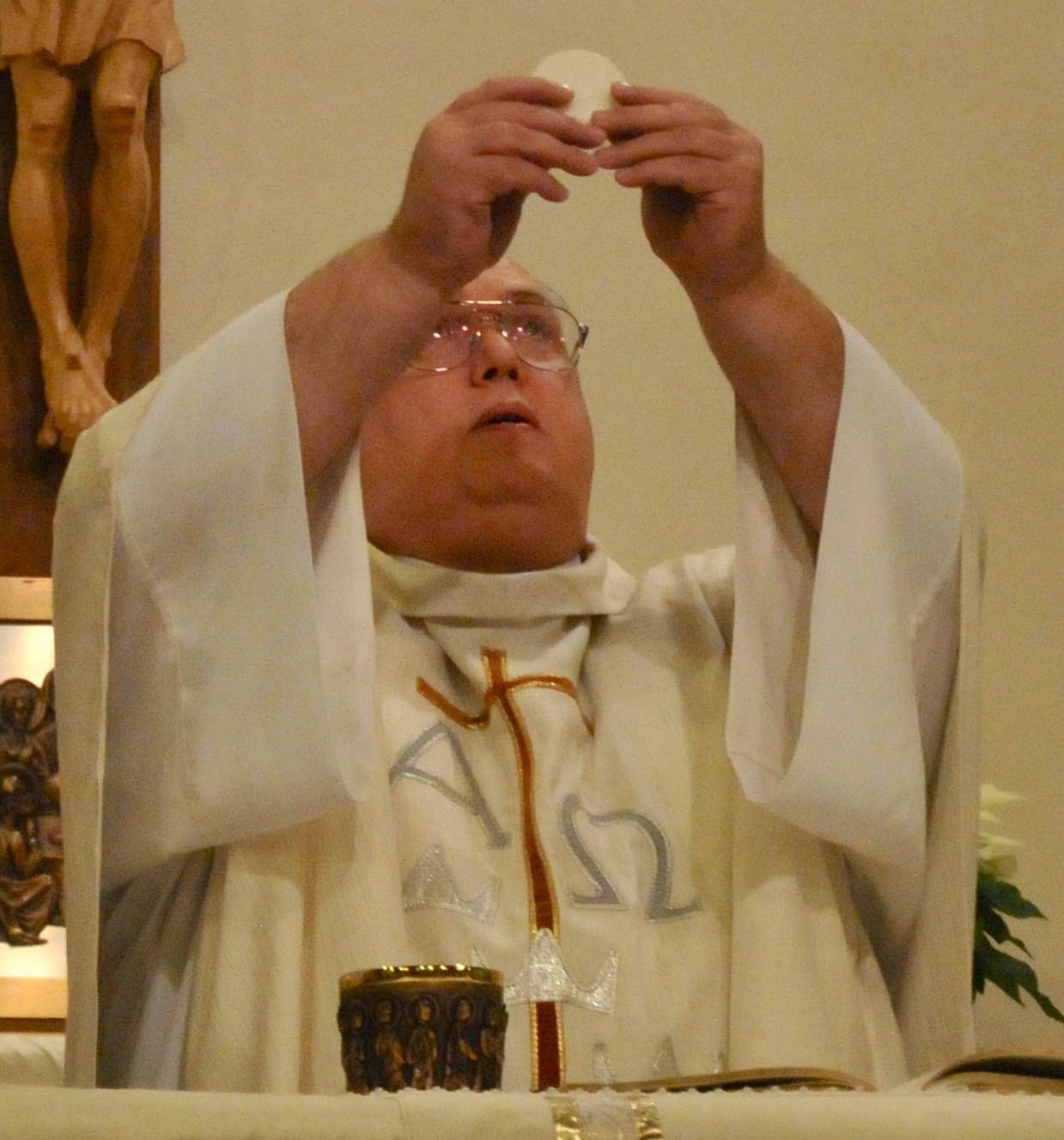
Finally, Jesus gave his friends a command: “Do this in my memory.” When, in obedience to that command, we “do this,” Jesus is truly present with us. Here in the Eucharist we have not merely his body and blood, under the outward forms of bread and wine. Here we have Jesus’ broken body and his poured out blood. Jesus’ sacrifice is not repeated. Rather, it is made present. As Jesus presented his sacrifice “ahead of time,” as it were, at the sacrifice offered once for all on Calvary is again presented and made present as we celebrate that event in sacred symbols.
These symbols, bread and wine, make present both him whom they symbolize and what he has done for us. Here time and space fall away. Here we are able to stand with Mary and John at the Cross, with but one exception: we cannot see Jesus with our bodily eyes, only with the eyes of faith.
There is yet another dimension to the Mass. Because Jesus has offered the one, perfect sacrifice, acceptable to God, the offerings we make to him are no longer unacceptable, despite our sins. Offered together with Jesus’ sacrifice (which is here commemorated and made present, though not repeated) our offering of ourselves, our souls and bodies is acceptable to God. Our offering is imperfect. Yet, offered together with Christ’s perfect sacrifice, our littleness is swallowed up in his greatness; our imperfection is covered over by his perfection.
The priest says at Mass, “Pray, brothers and sisters, that my sacrifice and yours may be acceptable to God, the almighty Father.” Let us always respond to the offertory invitation at Mass with faith, understanding and conviction: “May the Lord accept the sacrifice at your hands for the praise and glory of his name, for our good and the good of all his holy Church.”
Msgr. William J. Awalt
Answers to Yesterday’s Quiz: I. 1) F / 2) F / 3) F (The substance of the bread and wine are completely annihilated; the appearance of bread and wine remain.) / 4) T / 5) F / 6) F / II. 1) Correct way to receive. / 2) Correct way to receive. / 3) Incorrect. / III. 1) water & medicine; one hour (Those of advanced age or severe infirmity can receive Holy Communion even if they have taken food within the hour.) / 2) Amen. / 3) Amen.
Filed under: Awalt Papers |











 Blogger Priest
Leave a comment