























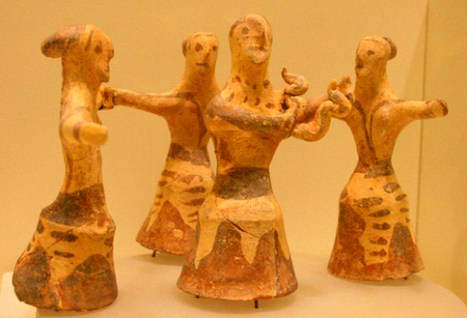
Maybe we should stop using the phrase, “woman priest”? It seems to me that the modern abhorrence of the word “priestess” is a telling fact. Even our unconscious psyches are uncomfortable with the possibility and this Orwellian word game is somehow an attempt to bypass our revulsion and the theological absurdity. Fr. George Rutler remarked in his Episcopalian days: “. . . and to say ‘woman priest’ is semantically as androit as saying ‘female rooster.'” Perhaps we avoid the word priestess because it tears to shreds any conception of this notion as fresh and modern? The word may even be older than “priest.” (See the book Priest and Priestess by Fr. George W. Rutler.)
The new Episcopalian priestesses are not so much one with true Catholic priests as they are with their western European and Mesopotamian forebears who rendered sybilline declamations over animal entrails.
Critics of the Catholic exclusion often quote the universality of baptism and faith in Christ, “There is neither Jew nor Greek, there is neither slave nor free, there is neither male nor female; for you are all one in Christ Jesus” (Galatians 3:28). They confuse Catholic soteriology (that salvation is available to all) with the tradition of a male-only priesthood instituted by Christ and maintained by the apostles. A favorite verse of mine is this one: “But I want you to know that Christ is the head of every man, and a husband the head of his wife, and God the head of Christ” (1 Corinthians 11:3). Paul addresses himself in the subsequent text to some of the lesser and changeable traditions (like Mass veils), but his theological underpinnings are what constitutes the revealed truth. More exactly, he is talking about Christian anthropology and the sacrament of marriage. A woman cannot signify the groom, Christ the head. An even greater scandal erupts if such a priestess were literally married. She who is subject to her husband would then seek the submissiveness of the Church, including her husband, to her. A contradiction would emerge. Those who do not like this analogy have an argument, not with me, but with St. Paul and the Holy Spirit which inspired him.
If critics can cast aside the teachings of popes and apostles, how can they be so sure that they have the mind of Christ regarding women’s ordination?
ALSO READ:
Bishop Kenneth Untener on Women Priests
Filed under: Bible, Catholic, Marriage, Priestesses, Priests, Sacraments, Sexuality, Women Priests |




















 Blogger Priest
Hello,
I’m sorry but as a woman I disagree. You say Paul addresses, after speaking about the husband as head of the wife, some changeable traditions; how do you know that the subjection of a woman to a man was not also one of those changeable traditions? Maybe tradition got in the way of what was right because men ruled women so much that women could not even vote! How can you decide and dispose of what was tradition (according to how you weigh its importance)? If tradition crept into scripture then it is possible it crept in by subjecting women to men as that was the norm in that society back then. It is possible. I’m sorry but I was married to a “Christian” man who used this to the form of extreme emotional abuse making somewhat of a “slave” of me until I saw the truth after years of brainwashing. This is why I adhere to the Episcopal Church, which believes in equality between man and woman.
Thanks for your time!!! May God bless us all with our differences because we are still united in Christ.
Carr
Dear Fr Joe,
Thank you very much for putting in a nutshell so clearly that which has been troubling me in a non-defined sort of way. I had not quite been able to put my finger on it but now I see it much more clearly.
For a number of years now, in my retirement, I have worked part time as a pall bearer and have attended several hundred funeral services of all denominations and indeed none. The Church of England is using an increasing number of women to fill the priestly role and I’ve met dozens and dozens, some of them even practicing lesbians.
I don’t believe it’s simply a matter of semantics either. If there was ever a need for me to address them personally I would always call them ‘father’ which they rather disliked but never challenged me on. There are various Biblical passages that could apply where women are told to keep quiet in church and refrain from tarting up their hair and adorning themselves with jewelery, and most of these ‘Lady Vicars’ would always arrive to ‘lead’ the service with freshly permed hair and garb designed to outdo any competition. I always felt uneasy.
And you have summed it up in this address in the nutshell…… ‘female rooster’. Very few have the courage to voice their condemnation of this trend of the Protestant Churches to appoint, not only women as priests but as bishops also, and the enthronement of active sodomites, in my view, can only be the work of Satan; unless it’s permissable to rewrite the Holy Scriptures to comform to ‘human rights’ and moving with the times.
Thank you for your courage and forthrightness, and I expect that your comments and mine will attract all sorts of reaction, just as Jesus’ comments did when He told them that His flesh was real food to eat and His blood was real drink……..many walked away as that was too hard to swallow.
With love, Paul